"Prepare people for the future and empower them [for they can change the outcome]."
—Richard Clive Neville, futurist
THE FUTURE BEGINS TODAY
The passage of hundreds of millions of years has seen the emergence of highly complex creatures with a large brain capable of developing a sophisticated technology and so put into place virtually every predator on this planet, but also to ask the more fundamental, deeper and difficult questions of:
- Why are we here?
- What is the purpose of death?
- Why does the Universe exist?
- Why is it that life follows this general law of increasing order and greater complexity as far as we can tell (or is life providing a balance in complexity and simplicity depending on the nature of the environment in which organisms are made to live in)?
- Where are we heading?
Indeed, why is there evolution? What does it all mean? What are we reaching for? Are we meant to be heading somewhere? And what will we find in the end when we reach the ultimate goal?
For example, is the ultimate goal to become immortal where stability is finally reached and makes us immune to all these evolutionary changes? In other words, are we reaching a point where we can adapt to any condition the Universe throws at us including all its radiation on our bodies while our biological repair mechanisms can fix our DNA so efficiently that we can potentially live an extremely long life, or possibly even become immortal and hence become God in some way? And will this ultimate goal give us the ultimate truth about the purpose of this mysterious Universe and why we are here?
Or maybe there is not meant to be any specific goal to reach for other than to adapt to the current environmental conditions, and the Universe is a heaven (or a hell) for us to learn to be happy to live in and be loved while we live out our existence with other living things. For example, if we moved to another planet in the Universe that could be described as mostly a watery world, would our bodies merely adapt to those conditions, such as the development of webbed feet and hands? Well, at least we will survive better and continue to experience love where we can in those conditions, and help others to experience that love through our actions and the goals we achieve for ourselves of benefit to others. This is a popular view of most scientists, including Andrew Forrest, Chief Engineer at Solstad Offshore (2005–present), when he said:
"A common misconception about evolution is that there is some sort of goal that things are aiming for. The only goal is survival of the line, and that’s the driving force behind natural selection."
But for those who look for hidden patterns in the Universe, the answer is not as clear-cut as the scientists would like everyone to believe. There is something else going on in this Universe. A kind of paradox that we have yet to clarify and resolve.
Whatever the truth, evolution for all living things on this planet will not stop into the future. The Universe with its ubiquitous radiation has a unrelenting way of forcing change on our bodies at the genetic level whether we like it or not. Nothing will stop its incessant need to change who we are and what we will become as part of the natural evolutionary work of pushing us to become something different, and hopefully better than we are today. Of course, the only thing that is naturally complicating this is our knowledge of genetic engineering, which has the potential one day to keep us the way we are. For example, Forrest stated:
"Another misconception is that some animals stop evolving whilst others continue. ALL animals are evolving at all times, seemingly primitive cockroaches are just as highly evolved as we are, but just down a different path."
However, a species with the technical means to manipulate the genes can choose to maintain its existence without evolving for as long as it wants, thereby defying the natural processes.
On the other hand, we could use our technology to accelerate the evolutionary process for us to become something far greater than natural evolution could ever achieve.
But even if we try to become God and there is a way to live as immortals, why should there be death at all? Is it something to encourage us to find the answers and perhaps prolong and eventually stop death from taking place? Or is death inevitable and we cannot become God because of some fundamental restriction or principle of the Universe that forbids this from happening? And when we do die, where will we go? Or are we forever bounded to this Universe in an endless cycle of life and death as we achieve some unseen and ultimate goal (or continue our existence in this mysterious Universe)?
These are certainly difficult questions to answer even for the most scholarly minds in the business. If there is an answer to be found, then the ones who are most likely to find it are those involved in religion and the Arts. Knowing these people have exceptionally bright and well-trained R-brain skills to help them use their imagination, to visualise, and ultimately to extrapolate and/or see hidden patterns that scientists cannot or has not yet seen with their eyes, more progress might be achieved with the help of these talented individuals. As we know today, science is focused on the visible reproducible patterns. A task generally well suited to the L-brain scientist. Whereas the R-brain is more focussed on the invisible reproducible patterns uncovered from the observable world through our minds using strong visualisation skills. The chances of seeing new and hidden patterns is generally greater among the R-brain types than any L-brain and highly rational scientist among our species can achieve.
Assuming these changes do have to continue and will follow certain current trends based on our environmental conditions and the choices we make for ourselves, let us begin this controversial next epoch by presenting below some of the things scientists are fairly confident will happen in the future assuming our neck of the woods in the Milky Way continues to remain relatively stable and predictable. It will be based on current trends and behaviours observed today among humans as well as cutting-edge scientific knowledge and technologies emerging as we speak. And we will apply a realistic extrapolation of this trend and behaviour to help explain where we are likely to be going into the future.
It is clear our greatest journey has only just begun.(1)
5 YEARS FROM NOW
Just as in the Cambrian period has seen much of life reach up to the surface of the oceans for a better future, in the 21st century, humans will be reaching up in their own way. This time to the final frontier known as the Universe. Such a move will have important implications for humanity. Of greatest interest in this regard is answering the age old question of whether we are alone in the Universe.
As you read this, more and more scientists are coming around to the view that our planet cannot be the only life-bearing planet in the Universe. The indirect scientific evidence supporting the existence of alien life is already strong, such as:
- the vast numbers of long-lived and stable Sun-like stars (literally millions in our Milky Way);
- the great abundance of planets orbiting other suns;
- the considerable time we already have had in the formation of stars, galaxies, planets, and ultimately our own form of life (and by implications alien life as well); and
- the common conditions and materials needed to create life and knowing the materials needed for its creation are available in great abundance everywhere.
All this is telling scientists one thing: there has to be alien life out there. Therefore, the only remaining questions to answer at this stage are:
- Where can we find these aliens?
- How do we contact them?
Of course, we can always be overly rational about this and become fully trusting of our eyes (but not our imagination) just like the highly rational L-brain scientist by saying that there is no alien life because we cannot observe them (and hence no direct evidence). Our existence is just a one-off fluke event and it will probably never happen again. However, science is not all about what we can see all the time. As Dr Carl Sagan made it known to all when he said, "Absence of evidence is not evidence of absence". Because not everything can be directly seen, broadminded scientists will gather indirect evidence to determine the probability that something could exist. Thus, scientists may be able to see the aliens, but it does not mean they do not exist. For all we know, and based on the more genuine UFO reports of strange occupants in their symmetrical glowing electromagnetic flying vehicles, aliens are probably doing all they can to avoid us and prevent us from relying on our eyes to get to the scientific answer. Perhaps they are more concerned about our direction in life and how we do not use enough imagination to solve world problems. By keeping away from us, we have to look at ourselves in the mirror to better understand why we are not considered approachable as a species. At the same time, the lack of direct contact with everyone probably forces enough people to use more imagination and visualise things when finding solutions to problems. Whether it is to find out whether alien life exists, or ensure there is no conflict between our fellow human beings here on Earth, imagination has the potential to find radical and original solutions that can permanently end every problem set before us.
Fortunately, there are some scientists who are not fixated on the eyes for gathering all the data. There are sensible and more balanced-thinking scientists who can observe the hidden trends in the data or in the environment and can visualise where those trends are pointing too. They can gather indirect evidence in support of these trends and state on the basis of probabilities how likely something will occur or exist in the Universe. Science is not always providing a black and white, or 0 and 1, answer to practically everything we see based on what our eyes can see, or not see. This is too simplistic. There are enough scientists who know we cannot have definitive answers to absolutely everything. Just like in quantum mechanics, we cannot be expected to observe an electron with absolute precision in position and speed/direction. We have to make concessions in the answers we give. And that means, providing a probability on how likely something will occur (e.g., at what speed and direction, and/or position a particle will end up when the system has been disturbed) based on certain indirect evidence we are given.
Even the age and size of the Universe is not set in stone based on a single answer. The current view for one group of scientists is that the Universe is finite and expanding. But nothing is ever this clear and perfect. The further we look into space, the more dualistic the answer can get. Indeed, the paradoxical nature of the Universe means we should face two possible answers, and neither one answer can be confirmed to be one hundred per cent correct. Therefore, we should expect the Universe to be either finite and expanding, or infinite and in a stead-state or not expanding. We cannot observe enough of the Universe to help us get a complete and final answer. We need to see evidence for two opposing answers based on how we interpret the evidence. And that requires scientists to use more of their imagination and not just observe with their eyes and instruments.
With this in mind, and based on the available indirect evidence at hand for the existence of ETs, there are enough scientists who are willing to go out on a limb to state that, on the basis of probability, alien life should exist, and probably in great numbers. In other words, it is highly unlikely that we are alone in the Universe. To think otherwise would essentially make us a kind of pariah in the scientific scene. Basically a kind of oddity who probably needs to be relegated to human history and sent out to the pastures to grow old and die because we don't have the imagination and means of observing the universe and gathering evidence in an indirect form to make us realise the probability of another answer being potentially real and likely to be the truth. It would be like thinking our world is flat and is the center of the Universe as the feeble-minded religious people in the Dark Ages once promulgated to its people with an expectation that we should accept it based on what our eyes tell us. Yes, the world may look flat, until you look far enough and realise ships near the horizon are partially disappearing below the ocean, and yet those sailors are not drowning. Something is causing the Earth to curve. And why consider our Sun to be the only one to support a life-bearing world where humans exist? Plenty of sun-like stars out there. We have many millions of sun-like stars in our Milky Way alone. As we all should know, truly curious and open-minded scientists hate the idea of us being special by being the only lifeforms in the Universe. There should be nothing unusual about us, our planet, and our Sun. There has to be other lifeforms in the universe. Why argue against ETs other than the fact that the direct evidence using our eyes is still eluding us (but perhaps not for long)? There are very good reasons why the direct evidence is eluding us. We just need to use our imagination and find indirect evidence to support those reasons, to help us see an alternative answer that is just as valid and rational as any other scientist who relies on his eyes for an answer.
From the way things are heading at the moment, the available indirect and growing evidence is that it is highly unlikely we are alone. Aliens will, almost certainly, exist. Not quite one hundred percent since every scientist loves to see direct evidence for this. But sometimes the probability at the moment is so high that it does not matter. For it seems at this stage that no longer is it a question of if, but when. The evidence to fully confirm the existence of alien life is expected to be found, and it will not be long before we will discover exactly what is out there beyond our solar system.
Now, in the 21st century, scientists are growing in confidence that there is something out there. Already some scientists are seeing a hidden pattern in the UFO reports. A new electromagnetic technology based on the solution of the Abraham-Lorentz formula has been identified. We can now explain the common UFO observations. There is an understanding of why the objects are symmetrical, and why they glow over large region(s). Scientists can already see how UFO occupants can reach us based on the "exponential acceleration" solution of the formula. The kind of solution that occurs commonly for charged particles accelerating inside particle accelerators. However, it seems that the UFO occupants have found a way to set up the same conditions outside of their symmetrical flying objects and adjust their vehicle's shape slightly to achieve a recoil action leading to the kind of phenomenal speed that many witnesses have reported for a long time. Whoever has built these UFOs has discovered a means by which electromagnetic energy can be recycled and amplified to enable this type of acceleration, and at the same time figured out ways to control inertial forces inside their symmetrical metal boxes. Soon testing will take place to confirm this evidence indirectly obtained from the observations made by witnesses. If proven, scientists will have the closest indirect evidence yet for the existence of technically advanced alien life reaching our planet, and an intelligent one at that given the nature of this technology. Not some alien bacteria or tiny slug slithering around somewhere in our solar system, but more sophisticated two legged intelligent humanoid creatures capable of driving one of these vehicles and reaching for the stars, including our Sun and planet Earth. Enough scientists are confident life on other planets has probably evolved sufficiently to allow people to exist on other planets (with the humanoid shape being the most successful and energy efficient design — that is, two limbs to walk, with two more to manipulate the environment and build/use tools, and a head to carry a large brain for solving problems and create amazing things).
Even if this is too controversial to contemplate, there are enough scientists observing the universe and acknowledging the existence of exoplanets, of sun-like stars sauntering about the Milky Way, and the elements and molecules needed to build carbon-based life are out there in abundance. Not even an argument of insufficient time for alien life to establish themselves on some Earth-like world can be used. There is too much time available to allow for it. It is not a question of if, but when we will prove this situation beyond any reasonable doubt. That glorious new dawn in the history of humanity when we meet up with other civilisations is fast approaching us, whether we are ready or not.
However, there is another burning question we need to ask ourselves before we can meet up with these intelligent "people of the stars" and become part of the cosmic community. Have we learned enough about ourselves and our time on this planet to know how to meet and treat aliens in the right way? We say this because there is something else we are going to need to carry with us to the stars to give us the guarantee that we will survive the encounter with other technically-advanced aliens (assuming no asteroid or supernova explosion comes along to affect us in our neck of the cosmic neighbourhood). Imagination is one thing. Having a strong rational mind is another. But neither of these skills are enough to solve all problems to the deepest and most compassionate level. The third and final thing we will need must become an essential and normal part of who we are and be seen as crucial in our ability to properly interact and behave appropriately with intelligent life.
It has to do with the principle of love. That positive emotion for reach all life in the universe strives for because of the long-term benefits it can bring to them and others.
Love is something we should know about by now given our long evolutionary history. We have seen how life has struggled to survive and be happy, not to mention why advanced aliens capable of travelling to our planet are choosing to hide from us at the present time. They too understand the principle of love and are practising it through various means, such as taking on a non-interference approach with all living things on Earth. There is something in the actions of these people of the stars when they arrive here that is not enticing them to say "hello" to us, and certainly not on a grand scale or even to invade and take over our planet. If this were to be untrue, why are we still here? Surely the aliens would have done the dirty deed on us millions of years ago when things were a lot easier. The fact that these aliens have not done so must speak volumes about what these aliens have learned in their encounters with other lifeforms, especially the intelligent and technological kind. Aliens that can travel the stars must have learned that not only can they influence and affect other forms of alien life, but their encounter can cause potential harm if it is not done right. To understand this properly, you have to know something about the principle of love. Therefore, what we are seeing in UFO reports and based on sound sociological principles is that aliens are probably more concerned about the way we behave on this planet and what we do in the presence of any living things trying to carve an existence here. That is likely the reason why aliens are choosing to stay away from us and let us solve our problems, until we finally "get it" in our heads of how we should behave and treat one another.
Not sure about this?
Just look at the UFO reports. If you need more convincing of the way aliens behave, we recommend that you read our research book. As you will discover, the length of time people have observed unusual-looking metallic or glowing UFOs—going back to Biblical times— and yet here we are still existing and surviving is telling us that the aliens are not interested in taking over the planet, let alone want to chat to us at the present time (which is probably more a reflection of their concern about what we are doing today and whether we are using enough imagination and love and not just rational skills to make things a reality). That fact that we are here and we are not being interfered with by other civilisations probably tells us a lot about ourselves as well as what is actually happening out there. Maybe it is time we all grow up, stop fearing everything all the time, learn to apply our skills, and do it with a heart that is positive and beneficial to all. But if we don't know how to do the right thing and continue to take our obnoxious and selfish behaviours out there among the stars when we develop our own version of the electromagnetic spacecraft to achieve the same exponential acceleration as the aliens can do, then we will experience what it is like to be alone. No one will want to talk to us. And if we interfere without consideration of how other lifeforms prefer to live, the time for our extinction is probably near. Because technically advanced alien life can also affect us in ways we may not like.
It would not take much to affect us. In fact, aliens do not need to show their faces directly to us to cause untold damage to our species. All it would take is introduce at a genetic level a virus, bacteria or fungus in our water supplies or food chain to effectively target our bodies through some artificial alien contagion made in the laboratory. By the time we figure out what has happened and how many of us have been infected and are dying, it may well be too late for us to stop the contagion, let alone stop the aliens. One cannot emphasise more the importance of humans showing love and accepting the great diversity of life throughout the universe, especially when we venture out there beyond our solar system.
Still haven't worked out the EM technology to reach the stars? No problems. Certainly it won't bother the aliens what happens to us while we remain stuck on Earth and unable to reach their homes. Each civilisation must experience and learn from its experience on how best to apply the principle of love. If humans make a mistake or choose the wrong decision, we must pay the price. So long as we don't affect the aliens, the aliens won't, and can't care, what we do, given the great distances between the stars. It would take them too long to reach us in time to stop something we are doing. So it is up to us to figure it out and make the right decisions based on the principle of love.
You see, the last thing we want to do is be a threat to other civilisations through our actions and thinking. Any indications of our willingness to disregard the survival of other intelligent lifeforms because we wish to fulfil our selfish needs by colonising everything and grabbing what we want is going to face a rude awakening as soon as these aliens find out. Carry this attitude with us everywhere and we can be certain a time will fast approach us when our proverbial backsides will be kicked so hard, we may never be able to sit down on Earth for all eternity — mainly because we will have no butt to sit on as we will become extinct. The Universe is not big enough to hold an egotistical, non-loving, and conquering attitude of a civilisation with a tenacity to use up the available and natural resources wherever it goes and not recycle them. However, there is plenty of room for more loving creatures and an understanding of how to recycle things to exist side-by-side for all eternity.
It is as simple as that.
However, before we see these people of the stars in all their varied physical attributes and appearances, humanity needs to be prepared with the right attitude and behaviours as needed to show our respect to other civilisations. By preparation, we mean a thorough understanding of the principle of love.
Let's not kid ourselves. There will be untold numbers of intelligent and highly communicative (and even more introverted thinking) aliens out there. A lot of them will look sufficiently different from ourselves, others may be not so much. Guess what? Don't think we are the pretty ones. For all we know, we could be one of the ugliest creatures in the Milky Way. Yet how we look won't change the way aliens treat us. They understand why it is necessary to show respect and be compassionate. Likewise, we need to be prepared to do the same with them. And it will have to be done in accordance with the principle of love. There will be no choice, as humans will discover. Sure, you can choose to love or not love. But each choice has consequences. The kind of consequences that we must experience for ourselves. If we want to experience the positive consequences of our actions, there is only one road guaranteed to help you survive in the Universe in the presence of other intelligent lifeforms. If you need a clue about the kind of creatures we should be treating very well when we encounter them, make sure those humanoid beings are given the respect and kindness they deserve. You know, the ones who already have two arms, two legs and a large head, just like us. They are the ones to have a technology. They can reach our planet and see what we do, and what our attitude is to life on Earth. They are the ones we need to show the greatest respect and kindness for they have learned far more than we have about the principle of love. (2)
"Be good to your mother," as you father might say was just the beginning. Being good to all intelligent beings in the universe, especially of the humanoid kind, will be essential for your survival in the Universe.
If we have learned anything about our long evolutionary past, then it is the fact that these smart people of the stars know a thing or two about why we have evolved and how we should treat living things of any kind of diversity. There is a reason why we change over time. And part of the pressure has been from predators that also need to survive in their own way. We force ourselves to adapt to new environments and try different things with our bodies to hopefully develop mechanisms, behaviours, and tools to help maximise our chances of survival. It is a dog eat dog world because love is lacking at times which requires brutal solutions in order for one or the other to survive, but neverrarely both at the same time unless there is some kind of symbiotic relationship that can be formed. But the reality is, all living things search for a solution that they think is best for them and they implement it without total regard to the principle of love. They don't always seek solutions on a Win-Win basis. Often the simplest solution is simply to see the demise of one living thing in order to provide the sustenance to another living thing.
However, now, we are meant to be showing how intelligent we are. We do not need to kill for food. There are alternative solutions. We can work together to find solutions that can benefit all animals and plants if we so choose. This more co-operative approach becomes even more pertinent by the time we meet up with intelligent and technically-advanced aliens. We have to be thinking differently and see each other as solutions to any problem.
Really, no one would know this better than the aliens, especially the ones who have travelled around and visited other alien civilisations. They know how to behave and interact appropriately, and solve problems with good imagination and rational skills while ensuring everyone is happy. They know how to work together and do the right thing. If you want a good lesson in the principle of love, we should be listening to these great teachers if, for any reason, we are still grappling with implementing this principle of love in our daily lives.
It does not matter whether life is still evolving on this planet or elsewhere, or a technically-advanced alien civilisation decides to come down to Earth to knock on your door and ask for some water. No one deserves any less love than the next living thing. We all need love. You need to provide that love no matter what. Help them as best you can. And make it free and accessible, and of the highest quality. Give that alien a glass of the cleanest water you can provide. It deserves it, just as much as you need it too. The same is true of living things on Earth. We cannot go ahead and cut down trees and cause a desertification of the environment, thereby preventing other life forms from having the water, shelter, and natural foods they need. Who are we to cause this level of harm and eventual extinction to other life forms? We are not God. And we should stop acting as if we can do anything we like. Sure, we understand the need for humans to feel happy and survive by making money. But how much money is enough? Is it worth making so much money that our planet has to go downhill due to our desire to make so much profit? As for all other living things, they merely want to survive and feel loved. Furthermore, you cannot deny the love all living things deserve, from the moment we are born to the day we die. We need love, and that means looking after each other's survival needs and showing the feeling of love and inclusiveness for all times. The same is true when it is our turn to visit other life-bearing worlds around other suns. We have to apply our love to those living creatures, no matter how unusual they may look, by at least letting them live on their planet and not interfere, as they will in return when they have the technology to reach our planet. What we look like, how we do things, and what our hopes and ambitions are for the future, must all be cherished and welcomed, especially when we meet up with these lifeforms. Such diversity, no matter how they look to us, should never change the way we treat all living things. They, as do all of us, deserve the same kind of love as anyone else. The kind of positive and helpful action that allows others to grow and develop in their own unique way. There is no discrimination. Love is the summation of all that we know and will ever know and should already have figured out by now from our long and arduous evolutionary past.
In summary, there should be no holding back in terms of the love we must show to all living things, even with the aliens.
With all this in mind, the next question we need to ask is, Are we showing our understanding of the principle of love to all living things, at least here on Earth?
The evidence is not exactly overwhelming to say the least. We only need to look at the past few thousand years to realise quite a few humans look more preoccupied with plundering and using up the available natural resources, and throwing the waste back at nature without adequate recycling. There is also a remarkable desire to interfere with other people and the natural world in order to get what we want (i.e., acquire the wealth and other extra resources, or deal with people we don't like or look different), often at the expense of reducing the quality and diversity of life. It seems humans on the whole are happy to destroy other lifeforms if they do not provide something of value when they are alive, which today usually involves making huge profits while enjoying our extravagant lifestyles. Or else we somehow cannot be creative enough to come up with alternative, long-term, and sustainable solutions to all our problems, especially the ones designed to ensure the survival of everyone and all living things on this planet. So we choose to stick to what we think is cheapest and easiest to help us stay alive (e.g., our reliance on oil from the middle-east and soon the Arctic regions and in the South China Seas, and the fish in the oceans as food not to mention the freshwater on land etc.). On top of this, all our interference is intricately linked to the size of our population and how rich we all want to become when acquiring and selling these remaining resources (and soon how well we can survive as life gets more complicated and difficult) even if it means increasing one's insecurity with other humans who don't have the same resources (hence the origin of a military force and the danger this can bring to the future of humanity as the population grows and the resources dwindle over time).
Why do humans pursue this agenda?
One possible explanation is that we are still incredibly insecure in ourselves, our future, and what we think we need to survive on this planet. Once thing evolution has taught us is how to feel insecure and fearful. Our predators have helped immensely to form this thinking in many people's minds.
Is this feeling of insecurity warranted? Maybe in the past, but not today. Nowadays we are far more intelligent. We are capable of generating and implementing far more long-term solutions to the point where we do not have to feel insecure anymore. If we are focused on helping one another and we see the value of others in providing their own solutions, there is nothing to be afraid of. We are all on the same journey of surviving and being happy. So why fight or be competitive with each other all the time? There is no need for it. The more solutions we can create and implement to solve all problems relating to our insecurities, the more open and friendly we become. Not enough food to go around? Well, surely one solution would be for all of us to learn to stay within our means, and have an intimate knowledge of recycling. A simple solution that doesn't have to cost the earth.
As for other solutions, we need to go beyond what our eyes can see all the time. We must visualise the grander "unchanging" invisible patterns of the Universe to help make us feel more secure and happy in the Universe for all times, even at the moment of our death and what is to come afterwards for all of us. We are hopelessly short-sighted, highly reliant on our eyes, and in need of instant gratification and living in the present moment that we just don't notice how unbalanced we are in our thinking skills despite all the rational knowledge and technology we have acquired. With our limited knowledge about love and the purpose of our existence in the Universe, we tend to focus our efforts in acquiring as much as we can from our materialistic world. Such acquisition to the extreme is suppose to make us think it will give us greater security and happiness. But, in fact, it is doing the opposite. The same is true of money. Here, money is seen as the be all and end all for our very existence, and our happiness is intricately linked to how much money we have. Soon people think money is all that matters in lifeand there is nothing wrong in being rich. And, because we are afraid of the future, we live in the here-and-now moment of enjoying what we have acquired, materialistically speaking, including having a large family and a large house. We think this is security and stability. To some extent, it can be. But go overboard with it and it can become the opposite. Little do we know, as the population increases and more people compete ever more intensely for their share of the remaining and finite resources on this planet, the feeling of security and stability starts to wane. News of people fighting for their share of the remaining resources or against people who have more than others becomes a regular event.
Then our greed and interfering in the natural world sees global warming takes hold of the planet. This is followed by extinctions of various animals and plants. Less food in supermarkets, or food that seems to be getting more expensive. Either it is greed or there is something that is making it harder for farmers to grow the food and provide clean water.
Over time, what we think is making us more secure and stable is slowly revealing the opposite in pockets of society and in the environment. And as these places grow and becomes a bigger problem, it won't be long before it affects everyone. Even the ones who are rich and have everything they want. Soon everyone will feel insecure and sense a radical change is just around the corner ready to shake up society into a new world order. We can only hope it is better than before, and promotes genuine peace, stability and true security for all living things.
Only problem is, we don't know what can happen what change is inevitable and must be implemented for the benefit of all. Will it be good, and will it bring the worse our of humanity?
But as intelligent beings we don't seem to have enough imagination to come up with long-term and permanent solutions. And we can't seem to apply our emotions when selecting the best solution that will make as many people as we can happy or can at least see a better future for everyone.
Due to a lack of imagination and trusting of what we see and think is the only solution we are familiar with and seems to work, we somehow end up maintaining the same flawed way of doing things and solving problems using existing methods and approaches. We don't try something different. As a result, people tend to solve problems by acquiring more tools and surround ourselves in more materialistic things. We think this will protect us and avoid (or make us forget) the things we fear, such as the issue of death and/or other people or what's happening in the environment. We do everything in our powers through money and the materialistic world to ignore the thing we fear the most by any means, thinking this is the right thing to do and presumably will make us more secure and safer even if deep down we know or hear from others that perhaps what we are doing could be making this world more insecure and will actually burden the planet with more waste and making it harder for all living things to survive in the long term.
Because of our short-sightedness and reliance on the eyes, excessive use of our highly rational L-brain without much imagination when making decisions, we do everything we can to change only those few things around us to help make it suit how we think things should be just to get that sense of security and stability again. We buy security alarms for the home and car while staying in the same large house and family car, we purchase bigger cars and houses on the assumption we will feel more secure and possibly make more money when we sell them again as a way to further insulate ourselves from the rest of the world and think this will make us safer. Heaven forbid, if anyone tries to interfere in this approach to greater security and stability, we may have to hire people to protect us, such as the creation of a military force as well as security guards and all the rest once people make themselves richer. Otherwise, we just enjoy life to the fullest in an attempt to forget the things we don't like to see or hear about.
Yet such actions show that we have failed to see the implications over the long-term in what we have been doing in making those changes. We don't look far enough into the future and use our imagination to see what's coming. The consequences will come back to haunt us through a less loving environment (i.e., not providing the food we need or is much harder to produce what we need to survive). People soon can't afford or find it difficult to afford the basic things of life. Then the return to more insecurity and instability slowly creeps into people's lives as time passes if we don't do something different. Things like global warming is an example of the consequences we will face. We think we are safer now in our homes filled with gadgets and everything we need to stay cool and feel protected, when in reality we are making the planet and those living on it less safe and secure with more greenhouse gases emitted and higher costs, which in term will eventually make us feel more insecure if we can't afford these things or we see other people fighting for their share of what's available. Push this scenario to the extreme and before we know it, certain unexpected things start to emerge. A large population of people can potentially decide to revolt or start a revolution. Old systems and government are ousted and something new begins, hopefully for the better. Or else new viruses kept at manageable levels in the rainforests may suddenly emerge and adapt to the human hosts and cause all kinds of health problems to everyone, not to mention the economies of nations.
Whether by greed and limited resources, prices for food go up as the freshwater supplies dwindle and more technology has to be employed to desalinate the ocean water or build new dams as well as massive greenhouses to help keep the moisture inside and grow the food. Continue the expansion of the human population and at some point the natural ecology collapses. Not enough natural shelter for animals, trees struggle to grow in limited fresh water in the ground after much of it has evaporated into the hot and dry air. We see the insect population some together and target what remaining natural resources exist and soon there is a plague of insects vying for an opportunity to find enough food and survive. Then the insects die from hunger and the population suddenly drops dramatically. Plants struggle to survive as there are insufficient pollinators. There are fewer birds to eat the insects and keep the harmful bugs under control. Fewer birds to pollinate the flowers. Plant-based animals soon die without enough access to green pastures and plants in the natural environment. Predators that rely on plant-based animals disappear too (or certainly the largest one), except for humans who must become the dominant predator to control the harmful bugs (and probably have to eat them for protein as a last resort) not to mention the last remaining fast procreating small animals such as rats trying to survive in human society (already China makes a great delicacy out of rats these days). And humans must also do the work of fertilising the plants by transferring the pollen in order to grow the food, all because the bee populations, birds and other animals have disappeared.
Yet all of this is really making our lives more insecure and unstable (and far more busier than it needs to be, rather than letting nature do much of the work for us).
So what do we do to fix the problems? For L-brain people who know of no other way, it is mainly to continue with the way things have been done in the past. It is difficult to change. So why bother? Instead, the things we accumulate helps us to hide and protect ourselves from the insecurity of the world. We do it because what else is there to do? Lack of imagination to try something different and for the rich to not worry about how much something will cost is holding us back. Our economic system is unprepared for the disaster that awaits all of us if we don't change for the better.
All the things we acquire — our homes, our families, our children, the fancy cars we buy and so on — are there to give people a sense of stability and security, but it really is not the true stability and security that we think we are getting. It is a false form of stability and security. We see glimpses of this falsehood the moment we observe something that affects what we have or changes our understanding of what's familiar or stable. Whether it is a crime from a person missing something in their lives (i.e., love, such as food), or a natural disaster. We try to do everything possible to go back to those feelings of greater security and stability, to relive our past and rely on our memories, and so become hopefully less fearful for the future again. Thus, for older people, it is reminiscing too much about the good old days. For middle aged people, it is about acquiring more of the resources and protecting what we have through the establishment of a military and police force, not to mention fortifying our homes with alarm systems and security guards, and to establish borders around homes with a fence as well as geopolitical borders around countries just to protect this unbalanced way of life. Only a handful of the young people may se a problem here. But at the end of the day, they need money to survive. They need a job to pay for things. How can we change everything if we can't afford to pay for the food on the table?
Thus, in the end, this is the only way L-brain people have learned in life because of the here-and-now focus on survival and being familiar with all the hardships we had to endure and/or solve during our time on this planet. There is no other reality they can see except for the one they trust the most based on what they see, their experiences, and their preferred approach to solving problems.
This odd human behaviour is exactly how the Egyptian pharaohs had thought, except that they had the additional belief (with the help to visualise and see other more hidden patterns in the universe based on the R-side of the brain) that an afterlife might exist. Slightly more advanced in their thinking than many L-brain people living in modern times one might think. Or else L-brain people might consider them foolhardy individuals with not enough sense of reality based on what they should be seeing in a direct sense through the eyes. However, without a thorough understanding of what kind of afterlife is coming for all of us and how our actions today might affect this new life, they are not much better than most humans today. We are all short-sighted and limited in our ability to think long-term and prepare ourselves for a broader number of possibilities of what the future might be, and to see those hidden patterns. We do not hedge our bets, so to speak, so ensure that should we return to this planet, we can benefit from the positive long-term consequences of our actions from the previous life.
So why do we behave like this?
Looking at this more closely, it appears that fear (as well as not being able to see with our eyes the answer to everything we fear) is what's driving L-brain humans to think and take on a short-sighted view of life and the Universe. It is the reason why we have developed the kind of society and artificial environment we see in many developed nations to avoid this fear. These humans don't know of another way, only what they know works right now and can see. And we have our long evolutionary past to thank for this. The difficulties we have had to endure when surviving has required us to stand up on our two feet, to use our eyes to observe the world around us, and to apply our L-brain to solving the observable problems in a quick and efficient way. As our memories, earliest writings, and the study of fossils has revealed, our time on Earth was filled with countless episodes of observing and experiencing fear as we tried to tackle or run away from the numerous predators and various geological cataclysmic events. We know all about fear. We are literally experts in this field and ingrained in the primitive parts of our brain. It is an inherent part of who we are when we look back at our past. Evolution has taught us to instinctively fear things, especially things that are different and unfamiliar, and we know it so well.
Even today, there are enough people still living in fear because we do not know what the future will bring. We somehow continue to fear for the future, when in reality we shouldn't be.
Is there a solution to all this fear?
For the L-brain person, it is generally to do more of the same but in a more highly ruthless and efficient way, and to acquire more wealth and materialistic things. Being efficient may involve using less of something, but in reality as more people appear on this planet, the efficiency gains are lost. So efficiency turns to ruthlessness in getting what we want at a faster rate as it helps the person to acquire more things.
For the R-brain person, it is to think and do the opposite of what L-brain people are doing until balance is restored.
First, it is the aim of the R-brain person to tackle the fears head on. Next, he/she must look beyond what we see and look for unseen patterns, some of which could bring new solutions, while others can help to change the way we think at a deeper level and so help us to view reality and life as a whole in a totally different way. Of course, for this to work, the person must be willing to learn and make the right kind of changes in order to achieve and see this new reality. For example, when it comes to world problems, R-brain people can see the value of recycling as a long-term solution to many world problems (whether it is the food we throw out and new food need to be grown, to the type of energy we must use for transportation etc.), as well as recognising the cyclic nature of life and the universe rather than the short-term linear approach. Another example is how R-brain people are able to see people as part of the solution, and all the while can continue to show compassion and empathy.
As well as seeing the hidden patterns in life and the universe, such as the cyclic nature of life and the universe, R-brain people can observe in their minds certain other hidden and positive patterns among people when the principle of love is applied, and not just what's in the environment. When it comes to people, they stop looking for different things and instead look at what's in common with people and even all living things on this planet. They start to realise we are all searching for and struggling for the same things. With a little sharing and helping one another, we don't have to be at each others throats. We don't need to focus on the differences with people. Yet, on the same token R-brain types look for differences in the environment as these can be a source of new insights and solutions. By applying this approach in a balanced way, R-brain people have the power to view, and teach others, a different reality. We can see an alternative solution.
With people, R-brain types learn to take the hate away from our hearts when they get to the essence of people. They can understand why people do what they do. They start to forgive them for the things they have not done right. But to really see why you must forgive one another, it requires that you bring out the creative side of your brain (also known as the right side of the brain, or R-brain) to see the hidden and common patterns and what we will all go through, as well as how to solve the fears and problems people have through different solutions.
Once you have these new insights and solutions, you can implement them in a balanced way through just the right amount of rational thinking to make the solutions practical and achievable. We start to see new solutions that at first may seem too simple, but, in fact, are the best solutions. Showing love to others, for instance, by providing what they need and finding creative new solutions to problems is a natural thing for R-brain people to do.
It is usually when the solutions are implemented and the effect of change of a positive nature is seen will enough L-brain people see the benefit to everyone including themselves. Then there is hope that they can begin to change themselves once they make the decision to accept the solution.
Remember, within this new world set by the R-brain types, there is a chance for everyone to work together to survive and be comfortable, happy and more fulfilled in a simpler way. Everyone can be focused on the important things we need and ensuring those needs are met for people and everything we do is recycled for a plentiful supply to return and so keep us alive and happy (i.e., love) for all eternity (barring any natural catastrophe which we must keep an eye out for and use our technology to help protect and prepare us). So the fear of not surviving among L-brain types can be avoided. There is no need to fight for the things we need. We don't need to feel insecure with other people all the time. Once people settle down and understand why and realise their needs will be met, so many problems are alleviated. As for the thing we want when achieving other goals, we must ask what is important to achieve. Do we need everything? Of course not. Nor is it reasonable to expect that we can. We must choose our life's work and reach that goal with the tools we are given or available for us to borrow. Perhaps we can keep one item that we use all the time to achieve our life's work until we move on to the next life, but never any more. Beyond that, a roof over our heads, a productive and healthy natural environment, and people having what they need should be more than we ever need. And whatever we make or produce of great positive value to us and potentially to others should be shared, preferably for free. When we do produce the things we want, things will be built to last for much longer, to serve many more people for a longer period of time, and can be recycled easily when we need to build better and more durable solutions. There is more sharing or borrowing of the things we have, so everyone gets an opportunity to use something and achieve important goals for the benefit of everyone. As for the things we all need, everyone will have a primary activity assigned (and later people can choose) to ensure this fundamental goal will be achieved. and that is mainly to assist in the new world to look after the natural environment and make it productive for all living things, and not just for ourselves to stay alive.
Furthermore, this new world presented by the R-brain types with their long-term vision and simple solutions will include an expansion and presentation of new educational materials that will broaden our view of life. Not about how to make money Ratherm the kind of things that will help us to see the hidden patterns as needed to solve our fear of death and see the importance of recycling everything that we do. If we open up our minds as well as our eyes, the hidden patterns of the Universe and of life itself as seen by R-brain types will give many more people, including the L-brain types, a greater sense of hope and a new future. We will discover that nothing is ever a straight line with a start and an ending. Everything cycles, and recycles. Our bodies in this Universe are merely the clothes we wear, and at some point we must change our clothes for us to begin a new chapter in our adventure of experiencing more of this Universe. And as we experience more, and tell others about it, and have the knowledge recorded by some means, the mystery of the Universe reveals a little more of its secrets. We start to see more things. Give it a little time, perhaps hastened by our need to share our knowledge and experiences and have it all recorded, and before we know it, we will see the purpose of the Universe and why we are here. Then something truly amazing will be recognized by everyone.
This bigger reality is just the beginning under a new R-brain world.
So, why so much fear?
It seems at some point we need to address these fears and to use love to conquer them if we are going to overcome our insecurities and paint a more positive future for all of us, while at the same time encouraging others to do the right thing.
Let us look at one of the biggest fears people have: the issue of death.
The fear of death is most prevalent among what psychologists describe as L-brain people. These are the ones who are totally trusting of their eyes and make rational decisions based on what they see. So if they can't see something, then at least they try to control the situation or delay the inevitable and perhaps everything will be okay. Otherwise, fear starts to creep into their lives. Or else these people will do anything to ignore it if their technology cannot solve the problem (e.g., extend their lives). Or else these people find something else to pre-occupy their minds and watch and experience the things they enjoy, such as their children or at least start a new family, playing video games, go to clubs, find friends to reminisce about the good old days with like-minded people, and so on. As a result, L-brain people who can't see what happens after death are more likely to say things like nothing happens after death. And so they develop no faith in a new life beyond death. As a consequence of this type of linear thinking, they must accumulate as much as they can now so they can enjoy life to the fullest extent possible in the present moment and often without due regard to the protection of other living things and ensuring we have what we need.
This is clearly an imbalanced view of life.
Somehow L-brain people need to be comforted by the knowledge from genuine R-brain people that there is indeed a brighter long-term future about how this Universe has been designed.
According to the more R-brain types, death may be inevitable for all living things (but yet to be proven with enough time as we learn of all the things that forces us to change and how to control it, as well as acknowledging the existence of living things that can live as immortals, such as certain types of jellyfish in the oceans), but it is not the end. Rather, it is viewed as the beginning to a new adventure. Death should always be seen as just another experience (just like we have a birthday, we get married, have children, meet new friends etc.). Each experience can be frightening or difficult in their own right, but it is an experience that we must all face. Why should it be an experience? Well, the grand recycling nature of the universe and the way everything comes around in circles to repeat itself and start again from the smallest scale to the largest scale is telling the R-brain types that life is no different. It is an experience that moves us forward to something we don't know yet what it is. It is a learning experience. It is a chance to be flexible and learn something we have not seen before in our current or previous lives, either because of our age or limitations set by our current life and environment we live in, or the choices we make and the beliefs we wish to hold onto to make life seem easier to cope and survive. Death is kind of like a chance to be "forgiven" in a sense for our past actions and to move on to a better and new life and start again. But we don't lose absolutely everything. Those things we need to survive over millions of years will be with us always. Our DNA is the one thing to keep remembering who we are physically and what we need to survive at the deepest level. So too is the knowledge we record with our technology to help us become better than we were before through education, and learn it more quickly the next time around and in a more easier and engaging way. However, there is another aspect to us that defies death. The true part of us that is genuinely stable and unchanging. As part of the balance of life and the changing universe, there is the opposite of great stability that goes beyond death and continues. We kind of sense it a little when we do things to try to minimise change throughout our lives, to give us that sense of stability from all the changes around us. But deeper down, there is the ultimate form of stability.
It is hard to describe what this is. Some religious people called it "the soul". Others may have different names. Whatever it is, if there is anything that does not change, even at the moment of death, while the rest gets recycled and renewed is this thing called "our true selves". It is something that feels like it resides within our mind and joined to our body and brain to one. This thing is what is truly "us" (i.e., you). It is hard to describe. It is the only thing that does not get recycled because it is already perfect and not needing to be changed. Why would it need to change if it is perfect? You are who you are. The body and brain is not perfect and will react to whatever forces and events occur in your environment. You will appear to make decisions on your own, but in reality you are relying on what your brain has learned and think is the solution. You may think this is you who is making the decisions, but deeper down, you are merely looking at information acquired by the brain and making informed choices or quick decisions as suggested by the brain that seem reasonable based on your experiences in your current life. Then, you further "experience" the things in the environment in response to those choices and decisions through the actions you make with your body. The brain is kind of already doing the work of helping you decide for you, and yet done in a way that makes you think you are in control. Until you are forced to experience something different or you can use your imagination to visualise a different way of doing and seeing things, you will never know of a different way of doing things. You will follow what your brain decides is right based on memories it has acquired from all your experiences. You will just do it the same way while your true self is acting as the pilot of your body and the brain. Then the brain picks up on the consequences of implementing a chosen solution through your your senses and how this affects your emotions and acquire more knowledge and/or experiences. This will tell you whether or not what you are doing is right or not, through the process of feedback and whether further changes are needed, or to maintain it. If it is the latter and seems to work well, you can keep a memory of it, and eventually you will develop a strong belief that this is the best (and possibly only) way we should do things all the time. But our minds and body are not perfect. Other people may know something more and can potentially see another solution, and one that is better and more balanced than yours. You have to listen and be prepared to challenge your thinking and what you believe. You don't know any other way of doing things until you find out and learn. You think this is the only way. And from those decisions, your brain (and thus your mind) will experience feelings of pain and pleasure as it acquires and remembers more experiences and helps you to refine what you believe to be true. But in all of this, the thing that doesn't get affected by such experiences, even at the moment of your death, is your true self. In religion it might be called a soul. To non-religious but spiritual types, it might be called a ghost. To rational L-brain types, it is nothing. There is no separation of soul from body as there is no benefit from doing so. Everything else that can and is separated outside the mind and in the materialistic world will be done in the name of creating a benefit, either to survive more easily or to get what they want (which is usually to get rich).
The the R-brain types, they can see something else that is separate and yet working in the material world through our mind and bodies in a unified and complete way to make us think there is nothing else. But there really is something else. We have to remember that the only thing that does not get recycled at the deepest level is our true selves. Like the humanoid shape of alien life for those who develop a technology will not change, so is our true selves.
As an analogy, the energy constituting the mass of our body, the brain, and the rest of the physical (or materialistic) Universe, must go through a kind of incessant recycling in order to maintain perfect balance. This thing is essentially electromagnetic and does its recycling through an incessant and endlessly oscillating behaviour in order to make the solid matter we see around us as well as to help us to see these objects. But despite the constant changes we see in this energy, the concept of energy in its fundamental sense does not change. Energy is energy. Adding solid matter to it to form fossil fuels, nuclear power and all the rest to create what scientists describe as different types of energies is just the clothing. Deep down, the fundamental energy running the show is called electromagnetic energy, for lack of a better term. Whatever this energy should be called, it remains constant and so fundamental at the core of everything that in a sense this is the true "self" and truly stable part of the energy of the universe. No matter how the energy oscillates, at what frequency, or what it does to itself to help create solid matter, electromagnetic energy is still electromagnetic energy. Nothing in the latter aspect ever change here. We all have the same energy in our bodies. The true constant that link all of us together is this oscillating energy, as well as the solid nature of how matter feels when we touch this energy. Despite the incessant changing nature over time of this energy to oscillate and create this sensation of solidness in all matter, balance is restored and revealed by the things that are stable for eternity. The same is true of your true self. This mysterious "thing" that is locked away for a short period into the current physical body and brain. The brain and body will still change over time through experiences and whatever the Universe throws at us, but your true self remains your true self. There is nothing that will ever change the real you for all eternity.
Thus the body and brain are merely the biological clothes we must wear to help us experience this Universe and what it has to offer. It changes and responds to what is happening in and around it. Then, as we grow older, we become stable in our own way. The brain and body can get stuck in a certain way of doing things that cannot easily adapt to different and unexpected changes. But that is normal. That is how it tells us that there is an equal and opposite part of life that leads us naturally to becoming stable. We often do this through education to become stable more quickly. But as we age, it becomes harder to change and learn new things. We need to pass the batton over to the young as they find new solutions. Let them become leaders in their own right in areas that they think will contribute and make a better world for everyone.
Humans are a bit like a shape-memory alloy (e.g., NiTi). When it is brand new, the alloy is soft and pliable. Regular bending back and forth of the alloy between two preferred shapes in the cool and hot states helps to improve its memory response by going back to its original state when cooled, but when heated (or under thermal stress), goes into the preferred shape for handling those hotter conditions. And as time goes by, this repeated change along a specific and preferred pattern leads to not only an improvement in memory of those two shapes, but it also gets harder to bend into any other shape except the one it has been trained to perform. Until the whole alloy is renewed by heating it above a very high temperature to soften things again and so allow the alloy to re-learn a new pattern and hence new shapes to move between, the alloy simply ages and remains stiff and resistant to adverse and unexpected changes. The same is true of humans. We are born with a pliable and soft brain and body to quickly adapt to specific patterns we are taught by our parents and from society. As we age, changing those patterns can be challenging unless we find innovative ways to change the way we think. Hence the usefulness of the Arts or other techniques to getting everyone to think differently. Otherwise, having children is often the alternative way of changing things if parents and society allows for it. Eventually, give it enough time, our bodies and brain will "wear out" so to speak. At some point we need to change our biological clothes to start afresh, return to balance, become pliable, and learn of new experiences and, with it, create new solutions. Hence the purpose of death. Eventually we must experience the moment of our death like it is another experience in our lives, if we are to adapt to new experiences, learn more, and to experience more of this Universe in the next life (and so allow for greater balance to take place). And that means we have to wear new clothes. Yet all the while the thing representing our true self is constant and carries on beyond death.
Nothing in the Universe will ever affect who we are at the deepest level. You are going to be you today in the same way that you will be you in a hundred thousand years from now. Only your knowledge and the body will change over time.
This is the balance of the Universe. Where there is change, there must be stability. Where there is stability, there usually has to be change. While we have not got to very core of fully understanding why the change is necessary and how to get to this proper position of true stability in order to stop the change (and hence we can be truly immortal and be like the true God), it is a lesson we must all learn in the classroom of the Universe (and happens to be the Teacher of experience too). This is the only way to understand why the Universe exists and what's our purpose in it.
Change is only there to help us to see things differently and get us to learn of different ways of living in the Universe. This change occurs at the superficial level with our body and brain, but our true selves stays stable at its very core. We learn from the changes because we are not God. Nor are we the most sophisticated gods in the universe to act close enough to God to know how to handle everything, let alone how to properly love all living things by giving them what they need. We can still make mistakes on occasions, and that is normal. Nothing wrong here. So long as we learn from the experiences and do things better. And for that, we have to be like children still learning something new, something different, something we have not seen before. We must be continuously curious creatures, and loving ones at that if we are to accept the diversity of life and the Universe and to see the benefits of those differences and why everything have their place in the universe. Understand and use those differences to help one another find better solutions and at the same time help us to see the greater reason for our existence and get more of an insight into the hidden goal of the Universe. The more diversity we have, the more insights we can gain about the Universe and how we can become even more stable. The answer never gets served to us on a platter. The ultimate Truth will not be handed to us. Well, certainly not without some work on our part to get to this Truth. The Universe does not allow us to attain true stability and hence perfect balance at all times straightaway while we remain in this Universe. We need to be trained and to learn. This has the effect of improving our brain and make it switch faster and more effectively between the opposites of the L- and R-brain to help us get to a solution faster and in a more balanced way. That's the nature of things. We must work at it, and improve ourselves to get closer to this balanced and more stable position and be able to come up with solutions that are original and different. The kind of solutions that can solve world problems. Even if we don't do anything to get closer to this balanced and stable position, the Universe has a way to force change within us. Constant forces from radiation, other life-forms, and various events on Earth and in the Universe will force us away from what we think is our stable position. The Universe has a way to keep us constantly on our toes and needing to change when we see the instability that occurs and how we must adapt to new environments and think in new ways. We have to constantly apply ourselves to bring back a sense of balance and that feeling of stability. We see it in life, when something goes to one extreme, something at some point in time will reverse it or push us to a new balanced position that we did not see before. We see it in light when the energy oscillates about the mean position. We see it in our brain when we switch information back and forth between the l- and R-brains. The same is true when we experience hunger and later fulfilment when we eat, and back again. Everything is in a state of constant change (yet another hidden and constant pattern, and one promoted heavily by the Buddhists). But at the fundamental level, there is absolute stability. There is something deep down that never changes.
So, for R-brain people, anything that changes, no matter how slowly or quickly it happens, must go through this incessant cycle that pushes us to opposite extremes. The more we go through these changes, the more stable we become through our refined or improved knowledge and technology as we find a more balanced a better solution to handling these extremes. Otherwise, life and death and the development of DNA is there to automatically retain the core knowledge of how to survive. This cycle will repeat for as long as the Universe is around. Only the absolute self is the part that has already achieved this true stability, is perfect, and will never be affected by these cyclic changes. What will change will be our biological "clothes" and our experience of wearing it and using it to help us experience the Universe, as well as the Universe itself. Whereas our true selves and the thing (or energy) making up our new clothes and the Universe will remain untouched and unaffected by this experience and the materialistic aspect of the Universe.
If all this is true, then how does our true self move from one body to the next at the moment of our death? Well done! You have come to the biggest mystery for R-brain types. Finding a solution to this ultimate question is extremely difficult. Not even the most talented R-brain people can figure it out as yet. We should not be surprised by this. R-brain people are not God. We cannot as yet expect them to be God. They can work towards getting closer to what God might be by gaining new insights. But no one can know the final great answer, at least not by any one individual. Yet there is nothing in this Universe to stop us from getting as close as we like to the ultimate answer, just like we can approach the speed of light and get closer with every improvement in our technology to accelerate us faster and faster. By getting closer, we get to see more of the Universe. Then new insights emerge. Given enough time (or quickened by the knowledge and experiences we record), getting closer to the answer should be possible. That is why we have multiple lives and different people who come into the Universe. Record what we learn and continue the work with each life and with each individual born to continue the work, and before long we will all get closer and closer to the truth. This is why R-brain people continue to meditate and contemplate the issue to its deepest sense. If they are relatively balanced, they will also record what they have learned or to speak of the knowledge to others. Then others can continue the work to look more deeply at the issues and with any other problem. But since no one is God, more time is needed to gather more information and to visualise the observable patterns, and hopefully the creative side of the mind will uncover what is missing and remains left to figure out, and with it the unexpected new hidden pattern that may ultimately solve why we are here.
For many R-brain people, this is where they are at. For L-brain types, all this can be difficult to understand, even to the point of thinking it is unproven and not worth discussing. Yes, it is difficult to prove, but it does not mean it does not happen or exist. This is their shortfall. They are not trained well enough to apply the R-brain to see beyond and observe the hidden patterns of the Universe. Constantly reinforced in our modern L-brain society by other similar L-brain-thinking people to think and observe in the same way all the time using the eyes and made to become fixated with materialistic things they can see and use as the only solutions to problems, an imbalance in the cognitive style of thinking and solving problems in the L-brain person develops. Then the L-brain types lose sight of the hidden patterns that could help them to become less fearful of death and gain a better understanding of why the Universe exists and the purpose of our lives.
Somehow we need to break this vicious L-brain cycle and the attitude we have formed from it when we live in this Universe.
In summary, all we have to remember is that there is something far more mysterious about the Universe we live in than we can dare imagine, let alone can see. Superficially, we know it has the ability to recycle the physical parts. That's a given. Beyond all of this is a mystery and we are part of that mystery through our "true selves" that allows the very essence of who we are to continue on in this Universe no matter what happens in the physical sense, as we head toward some great and unknown goal. Maybe the ultimate true balance of the Universe. Perhaps God itself? No one knows yet.
But, of course, there are other things L-brain types fear too. It isn't just the issue of death.
What about the fear of our fellow human beings and all of life on Earth having certain differences?
Perfectly understandable. The L-brain is highly trained to pick out differences. As a general rule of thumb, the greater the observed differences in our appearance, actions and views, the more L-brain types tend to fear them, especially if they think those difference could affect their survival. A natural reaction considering other living things that have affected us throughout evolution tend to look quite different from us. These tend to be the predator who are looking for food. Or, some species may only want to establish a territory that makes them feel safe and have the resources they need to survive, which is mainly by way of plant-based foods. Either way, living things will naturally look different. This is their evolved solution to adapting to an environment that is filled with change. There are things that are looking for food, and all living things want to survive and be happy (i.e., loved). Any likely interference by another species to enter that territory or see us as food may be seen as a threat to the survival of the original species that established the territory or is merely trying to exist and be happy. All this is normal. Our brains in the past were small and finding new solutions is never easy. It also takes time to implement a new solution when we see it, and over time evolution has a way to improve the body and brain and make it more effective and efficient in implementing that solution that we think help us to survive in the best way possible. But at the end of the day, everything wants to survive and be happy. It is as simple as that. No need to complicate the picture by L-brain types.
What is why we look different. The environment will play a role. But so too the choices we make and implement in the real world. And we do it because all species need to eat in order to survive. If one species gets too hungry, it will learn to eat anything. Even a plant-eater can be turned to become meat-eaters during times of great famine (and vice versa). At some point, animals will interfere with other species in order to kill in order to get the food it needs to survive. No surprise by this revelation. It is in this latter case where humans know interference can be non-beneficial to us (e.g., getting eaten alive). Because of this possibility, we create fear and a need to remember those differences so we may quickly act on or run away from the living thing that is different and possibly interfering with us. Hence we may either run away, to fight and ultimately eliminate, or to understand and control the thing that might interfere with our survival needs. All this is perfectly understandable.
Predators, no matter how small or large, were once herbivores fundamentally coping with a world that was lacking in love, especially during times of great famine. When plant-based foods were insufficient to feed enough herbivores (possibly because plant-eating animals were in high numbers or volcanoes decimated the plant populations), some of these animals have learned to become meat eaters. Totally understandable. Meat is a source of food if the aim is to stay alive. If we want to stop this hunting instinct, providing food from birth and developing activities to build up concentration and memory will transform predators to becoming much more curious and loving creatures (a process considered more successful with females than males). Some predators may take longer over many generations to achieve this so long as the love through food as a reward is provided over a long time. But eventually a time comes when not even the presence of other animals would cause the predator to chase after it for food.
This is why dogs (and cats to a certain extent) have learned to live with humans as soon as the love has been provided, often by way of security, safety, and food. Dogs have learned the quickest to see humans as not a threat or a source of food, but rather a source of love through the food provided by humans and other forms of love. The same is true with the relationship between a cat and a dog when both are given love — eventually even the dog and cat can learn to tolerate each other's differences (and don't be surprised if the animals sleep together in the same bed).
This is how the power of love in dealing with the survival aspects determines the future of all living things in the universe.
As a result of our long evolutionary past, we have become conditioned to being fearful of anything that looks different from us. Knowing other animals must find ways to stay alive, we have come to see these differences as a potential threat to our survival. Yet when we encounter intelligent and technically-advanced alien life that are capable of travelling to the stars, we may find quite the opposite. Some may look like us, but the majority are going to look different and yet friendly. Well, they have to be if they want to live in the Universe and travel the stars while encountering other intelligent lifeforms. They have their own solutions, and even an environment that may not be identical to our own. Fair enough. We can't blame them for that. They can be different for very good reasons, and we must accept those differences as normal and natural. Well, let's face it. aliens or not, they really do not have much choice, certainly in the initial stages of surviving and evolving. But to them, those differences are not seen as a disadvantage. There are reasons for those differences. And, those differences do not have to pose a threat to us. Highly rational L-brain types may not know this, but we will realise there is nothing to fear irrespective of how different aliens will look. If anything, such differences should be seen as new opportunities, and new ways of looking at the Universe and how to solve problems. Until we see this as a reality with our eyes to confirm what we expect is the most probable scenario and while we are stuck on this planet, we continue to think like a child having nightmares. Any differences tend to be seen as something we should fear. In the modern world, the differences extend to language, race, culture, some physical attribute, education levels, behaviour or something else. And, some of the differences may again make us feel concerned about our own survival, or even whether we might be loved.
Even today, we have yet to overcome our fear of differences.
We have observed the consequences of this fear among different groups of people that live in Africa and how they try to get along together. In times when survival is paramount, any slight differences in human appearance within a high population/low resource region (even subtle differences like a flatter forehead structure compared to another) is enough to be seen as a disadvantage (i.e., we think this means less intelligent or not deserving to be alive and have access to certain resources) and give others a reason to reduce the population. Choice of words to suggest inferiority or whatever can escalate to ethnic cleansing and other forms of war, mainly as an excuse to lowering the population levels in order to make the remaining resources seem plentiful again for everyone.
It doesn't stop there. We see evidence of this feeling of being threatened by anything that looks and acts differently to us in those science fiction films such as Star Wars, Star Trek, Battlestar Galactica, Deep Space Nine, Farscape, Alien, and War of the Worlds just to name a few. It was more prevalent in earlier films of the 1950s and 60s. Yet it remains a continuing concern to this day while we live on this planet—a kind of fundamental issue that somehow we have not overcome despite our intelligence.
Do we need more reminders?
We have to remember that there is nothing wrong with being different. Differences provide new insights and ways of doing things. It can help us to get closer to the answer of why we are here and how to solve problems. It can help to broaden our minds and ways of thinking, as well as understand why the differences exist and how they can benefit all of us in finding a solution. To see the differences, we must not all travel the same beaten track. Sometimes we have to take the side route or carve out a new path and see where it will lead us, so we can better appreciate the differences. Again it comes back to the cyclic nature of life. If we follow what everyone does, it may make us think this is the balanced path and everything is right, but in reality we do not know if what we are doing is right. We are not God (well, not yet). Somehow we need to push ourselves in different directions, to see and try something different. That is one of the purposes of the Arts, to make us see things indifferent ways. But just talking to people, and even participating in the life of those we see the differences can help us a lot to understanding why those differences exist and how beneficial the differences can be. We have to go to extremes and away from what we think is the balanced position. If we don't, nature has a way of forcing the change on us through the moment of death, as well as radiation and adapting to our environment. This is the problem of being too L-brain in our thinking and those of other like-minded people. We get ourselves into a rut and can't see another way. In fact, we deny there is a problem or something is unbalanced even if many people with differences are saying there is a problem. In such circumstances, it is natural for the Universe to see that we must all die in order to force us to see those differences, and with it, change so we can all be more balanced. We only have one perspective from the life we lead now and it need not necessarily be the most balanced one. To push us properly towards greater balance, we need different experiences and to learn different things, and to be associated among different people and other life forms, even ones who look different from us. More of a reason to accept the greater diversity of life.
To find these unique perspectives and insights, maybe we have to associate ourselves with living things having those differences. Find out what it is like to be in their shoes. Sometimes we have to be different in who we are, how we look, and what we do through our life's work (e.g., a painter of new artworks). Or even a business entity has a need to set itself apart from the competition by showing a difference that is better and hopefully gives it the unique selling point needed to make greater profits. Obviously the difference has an advantage in that you can make extra money. In normal life, the differences and understanding them can make you more well-rounded and balanced in your thinking. Then you can achieve even greater things in life once you see the benefits of the differences and how to apply them, and eventually solve world problems. At an individual level, it may mean nothing more than solving a variety of different problems and doing it properly and permanently by getting to the deepest level and from a unique angle. Stop following traditions or using bandaid solutions if the solutions are not good enough. Differences can teach us that there can be better ways of doing things by looking more deeply from a different perspective. Being normal and/or indifferent will never bring this out no matter how much time is spent or how many similar-thinking people with years of experience you may surround yourself with. We stay the same and continue following the same traditions and same way of doing things. At some point in our lives, we need differences in order to push us in different directions and discover a truer position of balance that leads to greater harmony and love.
Given the problems we see in the world, something is telling us that we have to be more different, and yet we must acknowledge that we are the same. Is this what it will take to re-evaluate and break old traditions and move us to a different direction that is better for everyone?
For example, when we see young people trying to be different in their actions and appearances to the point that it may be interpreted as rebellious to their elders, it is not because they don't respect their elders or are going against authority or society in a negative way. Rather, it is because they can see differences that can solve problems that the elders and other people cannot see. The differences can be beneficial for them and potentially for other people if they are allowed to develop their imagination and apply them to solve the problems young people can see for themselves. Such differences can further develop their imagination, but may often lack the practical knowledge of how to make those differences work to the benefit of everyone (so other people can see it too). On the other hand, the adults probably already know they have to do different things to solve world problems and achieve other things (if they don't choose to deny the problems), but are often too comfortable and stable with what they know to make them feel like they do not have to change and, therefore, stick to the same practical solutions and traditions they have known for a long time. Some of those practical solutions could potentially help young people to implement new ideas and make them work. In other situations, new and creative practical solutions have to be developed by the adults to support the younger people's new vision of the future and the ideas they have come up with. Somehow there has to be a balance between the two groups by working together if we are to push things along and in the right direction of greater hope and balance for everyone in the long-term.
The balance is really about letting the old and the young work together on making new solutions work better than anything we have done in the past. Solutions that solves more problems in a better way. Adults should learn to relinquish control and power at times and on the systems they have created and let the young people, with some guidance, take the lead and develop the practical and original solutions needed to solve all 21st century problems.
Now that we see differences as a positive and something that can help transform the world to become better, and that death is not the end, why are we still fearing so much today? What are we afraid of?
For a start, there should not be any lingering fears from our evolutionary past to relive in our nightmares. Seriously. haven't we learnt anything from our long and arduous past? Don't we know why animals are frightened, why they are struggling to survive, as well as why they need to act in ways that help them to survive? And don't we know why people are preoccupied with getting rich and the fears they have about their own lives and their future to make them do what they do? They need to be forgiven, to receive love, and to experience a whole new set of changes leading to more original and balanced solutions if the world problems are going to be solved properly, and with greater stability and long-term benefits.
Finally, we should see our differences in a positive light. See them as unique opportunities to do something different. Then, perhaps we can see new solutions. The kind of solutions that solve a greater range of problems, and do it with greater balance and long-term effectiveness for all.
A quick look around us today suggests that we have not learnt a great deal despite our knowledge of the issue of death and of our differences. Possibly because there are too many old men running the show and not being imaginative enough to find long-term solutions. However, it is possible that many people in society are not given adequate education and access to tools they need to solve problems. Not just the ones to get them into jobs, but education that helps us to see the grander hidden patterns of life, why we are here, and how we can solve world problems from unique perspectives. We are still too fearful of so many things. And at the same time we are too rational in our thinking skills (because it has helped us to survive, develop a technology and language, and given us a relatively comfortable and stable life through the money we can earn) at the expense of diminishing our creativity, and now interfering with the survival of other life forms on this planet. Ignoring our technological feats (which are great in their own right), already there are millions of people still dying from starvation and countless others committing suicide or fighting against society in negative ways (i.e. war, murder, theft, terrorism, vandalism etc.) at an alarming rate. While this is happening, an increasing number of people in developed nations seem more preoccupied with conquering new worlds, exploiting new resources, selling the resources to others who can afford it at high prices, and maximising their own profit and security so they can have what they want (i.e. be rich, powerful and even famous) at the expense of interfering and losing a few living organisms on Earth.
There is nothing inherently "intelligent" about this behaviour.
If this is how far we have travelled after all this time on this planet, our chances of survival in the future is very slim. Maybe we have another 20 to 50 years and then it is downhill for the rest of us. And if we somehow find a way to travel to the stars, very few if any alien civilisation will want to associate themselves with a feeble-minded and selfish creature that we are because of our limited understanding of the principle of love.
As Ronald Wright in A Short History of Progress said:
"Joseph Tainter, analysing the collapse of civilisations, described three models of collapse. These are the Runaway Train, the Dinosaur and the House of Cards. These usually act together, so they are really aspects of the same collapse.
Why do we need a military force and weapons? It is because people are unable to use their imagination and visualisation skills to see what the real problem is and how to solve them differently.
Often many of the problems leading to war is the result of some kind of essential resource that has gone missing or has gone down drastically, and people are searching for a solution to help them survive. Everything else is just our attitude to differences and whether we accept them.
If we don't have a war, then creating a hierarchical system is not an unheard of approach to solve problems. The invention of agriculture, enabling large population growth until it hits the bounds of the food supply, is the Runaway Train. It encourages the growth of hierarchical systems, with an upward concentration of wealth, ensuring there is never enough to go round. (It is horrifying that no matter how wealthy people are today, they still claim to be unable to buy everything they need!)
The rulers' failure to tackle these problems is the Dinosaur aspect. The swift, irreparable and unforeseen (by the rulers, anyway) collapse represents the House of Cards."
There is clearly something missing in our lives. It is just that our L-brain and materialistic world is not going to provide this solution.
There has to be another way to deal with this situation.
Well, one way is to foster diversity in society. We need the differences of others to help us achieve greater things. We need their creativity and/or original insights and perspectives to help us solve all our problems. With a little guidance from the rational types to make the solutions practicable and achievable right now, there is nothing we cannot achieve and solve on this planet. And, of course, we also need the diversity of life on Earth to provide the life support system and the food to keep us alive.
Secondly, we need our imagination to break free from the shackles set by our L-brain and our fixed ways of doing things in society.
Thirdly, we need to become aware of the hidden patterns of the Universe and life in general in order to begin alleviating the fears we have about life and death.
And finally, we have to love if we want others to love us back and so keep us alive for all times.
Fortunately, we should know the answer. There is light at the end of this L-brain and highly rational tunnel we have made for ourselves. And no, we don't have to destroy ourselves through war and diseases in order to see this light at the end of the tunnel, so to speak. There is a different light to our future. We can implement it right now while we are still alive. It is simply for us to love all things, and to be more creative while thinking about things and visualising how the ideas will work before putting things into practice in the real world.
But no matter how creative and rational we are, there is always one factor that will override everything we do: love.
The power of love must never be underestimated.
Remember, we all need love. No living thing can survive without it. Only through love does it guide us in the right direction.
With so many extraordinary and unique creatures in the history of the Earth who have, from time to time, lacked this necessary love, which has resulted in them having to find food, reproduce, fight and manipulate and/or adapt to new environments and with other creatures as quickly as their little L- and R-brains and bodies can permit them or else face the threat of being eaten or extinction. And today more and more people are increasingly feeling not much different from these living things or even other humans from prehistoric times (unless you are immune to this because you are living a comfortable, stable and rich lifestyle), it seems love will play an increasing role in the survival of all remaining life on this planet (and not just our rational and creative skills). Because it is through love that we begin to appreciate how far we have come, what we have learnt after all this time, and what we are going to do for the benefit of all living things in the future.
For example, can we call it love to continue populating the world with more human beings when the resources are already dwindling and getting expensive, and more people alive today are struggling to survive?
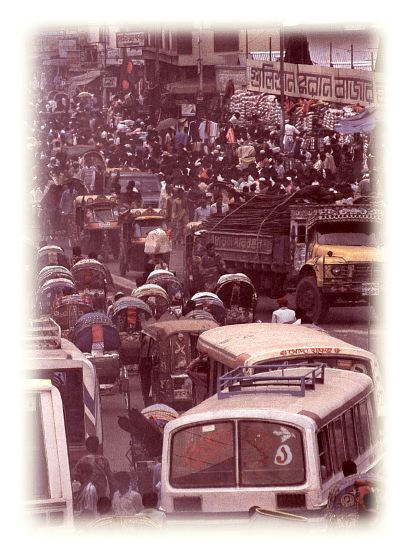
Should we continue to erect massive high-rise artificial monuments by mostly males of the human species (almost like looking at a scene from "How big is my penis?") to show how rich and powerful we are?

Indeed, is it truly love to cut down so many trees in an old natural rainforest when millions of living things have already established a home and are dependent on those trees for their survival (and could also provide us with benefits, such as new medicines and new insights into life and the Universe)? Of course not. We must bear in mind that such differences, or biodiversity, in living things can be a great source of knowledge and insights into solving many problems for humanity, such as understanding how we live, discovering new chemicals to combat cancer, and potentially help provide a reliable source of new foods (and not to kill animals to get it). There is much to learn from our natural environment.
And, why tread heavily on the natural environment to the point of literally destroying our free natural recycling systems just to satisfy the selfish wants of a few and everyone else losing out on the benefits of those difference in living things? No, this is not the way to show genuine love.
For example, with a bit of love, we can help people to learn how to create their own free "recycling" fertiliser using green 'nitrogen-fixing" manure called moocoona beans. Once the green manure has reached maturity and dug into the ground, the soil becomes enriched and fertile in a matter of months to help grow a healthy and rich crop. Such a self-fertilising system is now vital not just for economic reasons where poor farmers simply cannot afford expensive artificial fertilisers (usually sold by big multinational US companies) or to buy more plots of land, but also for environmental reasons where the farmer can keep to the same plot of land without needing to cut down more trees in the natural forest just to acquire fertile areas.
Likewise, it isn't love to force families in third-world and developing countries to pay for termination seeds from companies such as Monsanto just to prop up the massive profits of big corporations and their shareholders selling the seeds and providing short-term food benefits. Should there be cross fertilisation of natural and man-made seeds, there is a risk that one day the genes for terminating the seeds may suddenly become activated again and all of the plants in that species will disappear in a matter of weeks. Then people will starve to death. This is not love. It is too risky to follow this kind of sheer profit-mentality when it comes to the absolute essentials we need to stay alive and be happy. We need to let nature recycle on its own using genetically original and pure plants, and it should be done for free (the aim of all our work to produce it, especially for the needy things to help us stay alive), or low-cost if we must continue maintaining a monetary system to help pay for people's efforts to help one another. Let people access the natural and original seeds for these plants, let them grow the plants where they can if they so choose, make sure there is an abundance of food, and let them show us the benefits of their efforts through those plants, from feeding people, to uncovering new natural chemicals to combat diseases, and so on. If we should make any changes to the genetic code, there has to be significant benefits for all living things and not just for ourselves. And that means properly testing the new genetically-modified species over a long period of time. Or better still, visit other Earth-like worlds and see the long-term testing that nature has already provided to the alien plants. Then see how the plants interact with other plants and animals. Finally visualise, and latter test on a small scale, to see if it will work at home. The aim is to make sure that we are not likely to cause harm to living things on Earth. For example, any new proteins or other so-called "natural" chemicals must be beneficial to the human body and all other living things.
However, for this to happen, we must think long-term. None of this short-term profit mentality from the L-brain types. We must be more R-brain. We need to visualise and use moe of our imagination before we apply our rational skills to making them practical and easier to implement. And we must apply the emotions associated with love to see whether those solutions will help everyone. What's the easiest way to achieve anything? Will people be happy with a certain solution? Is there a better solution that will help more people to be happy and will solve the original problem in the end? Whatever we do, it means that profit should always come last. This is particularly true when we are dealing with our food supply and anything else that will affect how all living things survive. That is the order it should be taken. Not the other way around.
As for the demands of a large human population on agriculture to create enough food, a combination of good education, population control.
Speaking of population control, there should be better sex education, and access to contraception. Or, better still, see the value of R-brain skills and strong visualisation to teach men (and women) not to be controlled by sex and how the opposite gender looks. Seeing another person naked should not lead to immediate sex. The idea of separating the sexes in change rooms, toilets and so on is the result of too much L-brain thinking and letting it have direct control of our primitive and older brain parts that lead to reproductive behaviours. We need to do more thinking and visualisation, as is often done by dominant females who teach men to think differently and control their desires)Add the R-brain thinking (frontal cortex) part and with training, visual pictures can be formed to control the primitive behaviours. Then men and woman can walk happily and safely, even naked, without ever needing to think about sex unless both genders choose to do so.
However, the greatest power of the R-brain has to be the imagination. We should actually be encouraging and helping people to create different forms of employment and solutions to problems, and be rewarded for it. If that work involves growing certain types of beneficial plants to meet our needs for quality nutrients as well as anything to help reduce our need to eat excessively, then so be it.
For example, it is a well-known fact that the Hoodia Cactus of southern Africa contains a special molecule capable of suppressing hunger for up to 20 hours by raising the level of the hormone leptin as needed to tell the brain to eat less. Currently the "vitamin pill" manufacture known as Swiss is making use of this plant chemical to produce its own hunger suppressant pill. Now imagine some of the benefits of this substance to Western society. There is an excellent chance for some people to eat less food and solve obesity issues. It may not help those selling the (junk) food to fatten their wallets through shear profit. Basically some businesses prefer that you eat as much as possible of their tasty fat-filled and sugar-ladened foods. That is how profit is made. But we have to focus on the long-term. And profit is at least several orders of magnitude below the real priority level of other things we should be focusing on today, such as the health of people and not just keeping them alive. In other words, better long-term health for the people and more research focus on this type of substance found in plants would result in far less impact on the environment through massive human agriculture. Who knows? It could greatly improve the public health system, thereby lowering costs substantially, through less patients needing medical help to deal with the consequences of obesity — such as diabetes, heart disease, and cancer.
Now if we could develop more recycling systems and to focus more on plants like this on a grand scale, can we properly help everyone to have what they need?
Well, certainly if all the money spent in the American Defence forces could be redirected to more socially and environmentally useful causes, not only will we have the new world order established and create an environment that is far more socially useful and productive (and immediately arrest the worse aspects of global warming), everyone in the world can be fed and have access to fresh water several times over and still have ample left to feed the poorest people on the planet. Really, as human beings, we do not know how to set the priorities right. We do we not have enough love and balanced thinking within us to help every person and every living thing on this planet to have what they need through this knowledge without asking for a buck for literally everything relating to our survival just to survive? Come on now, for goodness sake!
And what's wrong with talking about population control through sex education? What? Politicians, businesspeople and certain religious people don't like it because they think more people in the world equates to greater love from God, as well as more consumers to consume products, and more voters to keep governments in power all the time? Well, if there is nothing left to consume on this planet, God will not come down from the skies to save us. Instead, everything will be too expensive to buy, and soon there will be nobody around to support the economic system. You can be sure people will destroy themselves through war, disease or starvation. There would be no one around to vote people into political power, no consumers to buy products, and certainly no love from God when it comes to visit you. Come to think of it, there would be no religions in the world for people to promote their beliefs. People simply won't exist. End of story. And no, it isn't God who is punishing us. We have punished ourselves for our stupidity because we can't see any other way of doing things and to balance what we are doing.
In the end, we are the ones responsible for our own demise, not God or the rest of the Universe. We can't even point the finger at the aliens too (they are too far away to come in time to stop our actions, and even if they could arrive in time, we can only be told so much). We have to figure it out for ourselves. If we still can't figure it out, we never really deserved to live in this Universe. Let's face it. No alien is going to come down and shed an alien tear for us. Instead, it will show to its own offsprings the lesson that we have failed to take heed and learn: to love and be more creative and curious creatures. We will be used as the example throughout the Universe of what not to do and the aliens will just prove once again how much smarter they are compared to any human that has ever lived on this planet. We are just too stupid for words to describe.
It is as simple as that.
And now that humans are fast approaching the tipping point where we could face our moment of extinction and nature is becoming less able to support us and other living things thanks to our efforts to affect climate change because of our need to survive and desire to make a profit, the time has come to show exactly what love is all about as the great religions and psychologists should be teaching us. It is our first supportive step we can make before tackling world problems using non-emotive methods of rational and creative thinking. Because love develops the necessary self-esteem, an acceptance of who we are, and an acknowledgement we have everything we need, to be happy with ourselves and ensure others are happy too. Only then can we do the right thing by taking what we need (and not what we want), and give back whatever we take through the contributions we can make to society and the natural environment many times over, without having to prove to everyone and everything who we are and how much we are worth.
If this is not true, then how else are we going to guarantee the survival of the human race? With guns, money, and computers only?
We already have all the manpower, the technology, the language for effective communication, and the resources to keep virtually everyone and all living things alive without having to satisfy all our selfish wants. We have the ability to apply our own imaginations. And we can show the emotion of love to all. So why are there people still struggling and fighting to survive as we speak? And why must we continue to spend money on defence simply because we don't know how to love ourselves, all our brothers and sisters, and the living things on this planet? Is the military there to protect the rich (and perhaps to hide some great secret in the case of the US military since July 1947) and to go to war so that the rich and powerful can continue with their greedy and "extravagant patterns of consumption" attitude after the war?
In other words, should politicians, business professionals and other rich and powerful people have to feel teary-eyed whenever they see their own (or more likely other) people's sons and daughters return home in coffins or terribly deformed after a war and yet expect to see their forgiveness by getting on with what's left of their lives while the rich and powerful continue carrying on making more money and doing what they please? Or has our lust for power and money blinded us to the real aim in life? If this is true, we are truly a pathetic lot of creatures not to see it.
Fortunately there are some people who can see the futility of war. Take, for instance, the words of L. York, a citizen of O'Connor in the Australian Capital Territory (ACT):
'Marching on Anzac Day and meeting so many people who'd lost loved ones, or who'd lost eyesight or limbs, one realises the futility of war.
'When are world leaders going to learn that wars do not solve anything? For life's sake let some wise nation start a sincere conference for peace.' (3)
Why do humans create so many world problems today? Perhaps the answer lies in how primate groups are formed depending on what is happening in the environment.
For example, in the harsher and drier central African continent, the availability of food is limited. In this kind of environment, we see a group of chimpanzees that are dominated by males. In these groups, male chimpanzees have learned to get themselves into a position of power through aggression, competition and even violence. Why? Apart from the lack of creativity and an insufficiently large brain (especially the frontal cortex needed to concentrate for long periods and problem-solve creatively and effectively), it is because life is easier at the top. A dominant "alpha" male will want to have easy access to a wide variety of resources (including any females) acquired with the help of other members in the group, and will often use bullying tactics such as intimidation, manipulation and violence to justify maintaining this dominating position (and all because they think their survival is at risk if they don't). Also the harshness of the environment means food resources are already limited and this often means males will come to the forefront of fighting with one another for survival in order to benefit from the available resources. Thus the male-dominated groups will almost always have a pecking order (i.e., a. hierarchy), there will be specialisation in the functions of each member in the group, and there is regular and intense competition between males (often using violence) as each seek an opportunity to take over the reigns of power.
Do these male-dominated groups remind you of any other species here on Earth?
Look elsewhere in Africa and we find an oppositely thinking and socially-formed group of primates in the food-rich tropical jungles of Africa (i.e., in Congo). Here, a group of chimpanzees have learned to survive just as successfully as their harsher and male-dominated cousins in central Africa. However, the approach to surviving is different. Partially dictated by their environment but also the choice made by the group and reinforced over many generations as a perfectly reasonable solution that works. Here, female chimpanzees have reached their position of power in a group by using sex as the instrument for controlling the behaviour of individuals within the group — mainly among males — and in ensuring everyone has what they need to be happy (e.g., food, grooming, etc.). Sure, there is still a hierarchy, but it is only temporary. You rarely see it when everyone is happy. It quickly disappears once everyone has what they need. The hierarchy and the choice of action to deal with problems only materialises within the group when it is necessary to control unruly male behaviours from time-to-time. Otherwise, why would the chimpanzees need to show a hierarchy when it comes to finding food? It is plentiful and easy to find everywhere you look. Hungry? Get up and walk to your food. Not far to walk. You don't need to be told by a leader to do that, now surely? And certainly no need to be specialising in the skill of finding and gathering food for the group. Everyone can do it on their own. Everyone has the same skills. Everyone is their own leader in finding the food. It is growing up there on the trees. So what is the point of having a leader (or a management team)?
Of course, it does not mean the group never experiences problems. The question we should be asking is, how are the problems solved? As most of the problems are social and tend to come from males, when it comes to controlling male behaviours, the hierarchy only appears at the time when it needs to solve this issue. However, it isn't based on violence. Seriously, why would violence be needed in such a group when the environment already provides all the food, and for the males to have all the sex, the chimpanzees would ever need? It is pointless to fight. Chimpanzees don't know about environmental issues. There are not aware of global warming. They don't see other chimpanzees going around stealing food and stick tools from other chimpanzees. Nothing of these problems exist for the chimpanzees (except for humans wishing to enter the environment and take out what they want). They don't know what war is. They don't know what the fuss is when it comes to power struggles between males. The jungle is there and has always been like that for countless generations. The animals don't know any different. The animals have learned to relax and see the environment as always being there to supply the food, providing protection from the rain, hide from the predators (mainly those roaming around on the ground) and all the rest. That means the only thing to deal with is the internal and natural social conflicts that can occur within the group, which is mainly between males because of the nature of some young males who can get a bit silly and occasionally fight each other for petty things or simply because males have too much pent up energy to expend and may get too rowdy and cause problems. Therefore, it is better for females to deal with this situation and bring back stability and peace within the group by doing things that ensure the males are under control. This means doing anything that keeps the males happy, and in return the females quickly see the benefits from their action. Thus the use of sex as an instrument for solving conflict is not an unheard of approach within the group. Afterwards, the females position of power dissipates. Everyone is able to relax and be happy. They are free doing whatever they like knowing the males are under control and are always co-operative in helping the group when it is needed.
When nature is allowed to do its work of providing food and there is adequate recycling to ensure this is the case and the group sees the obvious benefits of a healthy environment and learns to be happy with what they need to survive, the chimpanzees always become much more placid and peaceful. There is no war between various similar female-dominated groups of chimpanzees in the jungles. They have learned simply to live with one another.
Now if we turn our attention to human society, we see a remarkably similar pattern in terms of the chimpanzees living the drier regions of Africa. How many of our human leaders are invariably male? Quite a few. And the more these humans live in the harsher and drier environments of the planet, such as the deserts (e.g., Middle East and Northern Africa), the more the males behave in a manner that will get them into a position of power and control everyone and everything, including women, other men, the animals and the environment, and do it with fear and oppression. This is all the male leaders have ever learned. And all because they think this is love, or at least the false feeling of love and security when the male leaders seem to get what they want. And if people don't do as they are told, men are more likely to resort to violence to ensure the hierarchy is maintained at all costs. In the meantime, not enough thinking by these males to solve the problems in an imaginative way relating to their own environmental problems means things will only get worse if they continue following their own way of life. The less food there is in the environment, the more aggressive and violent the males become in getting the remaining resources.
So instead of creating natural recyclable resources, repairing the environment, and establishing the recycling systems needed to rebuild the environment, the males of our species have to hoard the remaining resources and fight other nations to prevent the resources from being shared (unless they can be sold at the highest price because these males think money will get them out of any problem).
Welcome to the problem of males and their L-brain way of doing things. Their actions show absolutely no sign of the true love to everyone except for themselves. Not even their own religions for which they dominate in leadership positions are able to show them the way. The love for all that all religions should be teaching has failed them.
Could this be evidence that we have far too many males leading human society and with no long-term vision of how to solve problems and so bring a brighter future for all of us?
Perhaps one day, when women finally make their way into positions of power, can we follow the road like certain female chimpanzees in the Congo and change human society forever. Or can men and women simply learn to work together in a balanced way and do the right thing without even needing to fight each other or prove who is better than whom (either in the bedroom, boardroom, or elsewhere)? It has occurred once in history in one area of Turkey more than 8,000 years ago. Can it be repeated in the 21st century throughout the developed nations?
Whatever our future may bring, one thing is certain. We have got to try something different (i.e., break the male domination and power struggle of this system) before it is too late. If we let males continue to dominate the leadership scene on a worldwide basis and carrying on in the way they do things to get rich, there is a risk they could destroy what remains of our natural environment and eventually result in the extinction of humanity.
On the other hand, one should not think for a moment that an all-female dominant society will work either. Well, it can be much better than a male-dominated society facing a dwindling supply of resources. There will be plenty to go around and keep everyone happy with what they need, as males learn to work on different tasks that ensures more resources are grown and made available. However, go to the opposite extreme and it can lead to imbalances of a different kind in a female-dominated society just like we see in a beehive. In this example, we have a queen in a beehive acting as the female leader. After a while, the queen enjoys her position of power and getting what she wants that soon she becomes paranoid and obsessed in being the only leader to be loved and supported. So she will try to destroy the babies of female workers to stop males emerging into society and creating extra competition for the leader. However, balance comes when workers discover what is happening. Then they get together to destroy the leader, allowing some males to appear and fertilise enough females until the next new female leader appears (or male leader if he can somehow successfully create a male-dominated society, but usually this is not the case when it comes to bees). Should a new leader be found, he/she will develop a new colony and the process of eventual imbalance followed by a balancing act will persist.
Balance will always be the key to avoiding the negative consequences of going to either extreme cases of a male- or female-dominated society.
As the great Indian philosopher Gandhi once said, "There is enough for everyone's need, but not enough for everyone's greed."
So either we learn to love all the remaining life on this planet by giving them food, shelter and a place they can call a home (and later we learn to apply language, science and the arts, interspersed with plenty of rest and quiet time to think) by changing the way we do things and balancing our preferred cognitive thinking styles for solving problems; or we must be prepared to die through war, crime, famine and disease thanks to how L-brain people think on a scale and speed never seen before thanks to our technology and the shear number of people living on this planet.
And if we should ever choose to take the road to human extinction (simply because we all want to have what we want and not what we need), we might as well forget about calling our new millennium a part of the Holocene epoch. It might be more appropriate to call it the Obscene epoch!
Or in the words of Australian National University ecologist Professor Breandan Mackey:
"Welcome to the Anthropocene — the era of human-forcing of global change.' (Beeby, Rosslyn. "Tiny evidence of a very big problem": The Canberra Times. 23 June 2007, p.B5.)
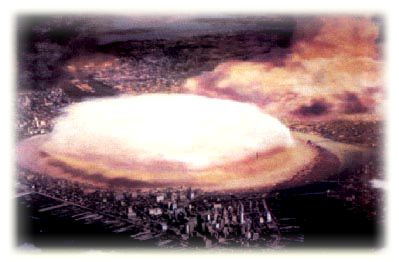
Let us hope there is time for humans to realise this fact, or we will definitely end up joining the scrap heap of so many millions of species that have become extinct over the past 4,500 million years.
0 TO 10 YEARS FROM NOW
Whether certain people in positions of power and wealth living in their mansions and enjoying their spectacularly leafy gardens can't see what the fuss is about, but it seems not enough action has been taken to solve world problems by mostly male-dominated leaders (other than to rely on market forces to see whether businesses will find solutions). Environmental degradation has reached crisis levels in many parts of the world. One classic example of this has to be the massive plastic waste ending up in the oceans and killing off seabirds and fish. Then we have reduced supplies of freshwater in places such as South Africa and any place where conditions are drying up. If any rains can come, the top soil is quickly washed away and what remains is harder to grow food and be productive. Then the dry spell returns, the freshwater disappears, and the land becomes drought-stricken yet again, and this time too difficult to grow food at low costs. We are in serious trouble. Scientists are already talking about the next massive extinction of life on Earth as other life forms struggle to cope on this planet.
It does not take much of a genius to realise that humans are contributing to the problems. Talk of our activity helping to contribute to the warming of the planet was definitely on the cards for some decades, and still we continued to ignore the warning signs at our peril. If we don't contribute something to save the planet's ecosystems and agricultural centers, anything we will have to do in the future will pale into insignificance once one particular environmental problem rears its ugly face thanks to a particularly potent greenhouse gas emerging from the Earth. And it will not be carbon dioxide that will be the killer.
Before we explain what this gas is, it should be becoming clear to the current custodians of this planet we call humans that we do have significant environmental problems. Forget terrorism, refugee influx, crimes on the streets, and every other social problem. A lot of the social problems we see at this time are intricately linked in some way to the environmental problems we are creating (e.g., the cost of producing food, the rising cost of materials to build homes, the difficulty in finding adequate jobs of reasonable pay for a growing population, the expense of keeping ourselves cool as global warming kicks in etc.). There is no better evidence of this link than in the poorer nations. Here, the nations struggle to find enough food for its citizens. Where there is some food, it costs a lot to buy., And when life is hard, there is another consequence to see the the cycle of poverty repeat, grow, and exacerbate the environment problems. People seek love and anything to make life enjoyable (e.g., sex, drugs, stealing from the rich etc.). Before you know it, the human population expands, and the problems of insufficient food and water worsens due to a reduction in natural resources. The environment cannot sustain the freshwater supplies and natural foods from so many people. Unless the nations have an abundance of some other resource to sell, such as oil, timber or something else, and the profits returned to the people (Cough! Usually it ends up in the pockets of the rich and powerful) to rebuild the environment, it would appear that once the natural resources are gone there is nothing the nation can do to support its citizens. Then things get really bad. Social unrest is the expected outcome for this scenario.
Poorer nations on Earth are like the official canaries in the coal mine. They are the first and most acutely vulnerable to the looming environmental crisis emerging over the next 50 years. Not located in the tropical belt? You are in worse trouble than the poor sods in temperate zones. At least in the tropical regions you are likely to have access to timber and a little extra freshwater, and certain animals. Yet even in the tropical regions, the rate of depletion of natural resources is phenomenally high for those countries involved in making a profit from the selling of the natural resources (e.g., rainforest hardwoods in Brazil and Indonesia, poaching of animals etc.). Look at Indonesia for instance: we see a massive human population. Those using up the available resources in the tropical regions will soon face social chaos in the coming years the likes of which they have never seen before.
Apart from high population levels in third-world countries and the general greed and desire for monetary profit by a small percentage of people in all nations, another factor to complicate things is the rise in world temperatures. This is the next and biggest challenge to affect humanity and all life on Earth.
Certain people who are benefiting from the current economic system have tried their hardest to ignore this additional complicating environmental factor. Too preoccupied with making a profit, maintaining the current economic system, and thinking science and enough socially-conscious businesses with profit will eventually find a solution. Or else they are in complete denial of the reality surrounding them (because the problem is too hard) or prefer to convince others that global warming is all natural, or it really does not occur. Among the excuses given include the presence of extra volcanoes spewing out a little more greenhouse gases into the atmosphere, and even changes in the Sun's output (i.e., presumably emitting more heat). Basically, these people think world temperature will go back to normal very soon. How wrong they were. All of our activities are contributing to global warming in far greater amounts than nature is emitting at the present time. Furthermore, our contribution is not slowing down. Indeed, more and more scientists believe global warming from human activity is fast becoming the next and biggest environmental calamity anyone has ever seen.
On the positive side, some people living in the right places on the planet will benefit from global warming. The residents of Greenland, for instance, have long waited for the extra warmth to come to their part of the world. Even better is how the mass migration of a greater number of fish to the far northern latitudes seeking the slightly cooler waters and extra food supplies is going to support these people and potentially grow new businesses in selling fish to other nations. Give it enough time and a sufficiently warmed planet will allow Greenland to live up to its name as the greenest nation on Earth with new trees growing in this part of the world.
Yet not everyone will benefit from these new opportunities.
Mind you, not even those living in the Arctic regions can be expected to be entirely safe as the planet gets warmer. Everyone else living in the more drastically hotter temperate and tropical regions will face extreme stress and social conflict. If these people don't choose to invade the Arctic and Antarctic regions, expect a third world war to begin against nations seeking the last remaining resources on the planet. Use nuclear weapons and you can be guaranteed no place on Earth will be safe to live for anyone, not even in Greenland.
However, it is on the issue of global warming where the greatest concerns will come. And it is all because of a couple of silly greenhouse gases we are emitting into the atmosphere. One of those gases is carbon dioxide. The other is a much more potent gas about to emerge from the oceans and in the permafrosts of Siberia and Canada. We call it methane.
Surely the plants can take up the slack by absorbing the carbon dioxide? Well, yes. But we have another problem: our inability to use our R-brain to see the trends and our impact in creating those trends. As a result, the dwindling freshwater supply is making it harder for plants to do their job of absorbing the carbon dioxide. In fact, a scientific study in Australia has found plants in rainforests actually emit more carbon dioxide if the rainfall patterns go down. And the evidence is in that it is actually happening.
Yet some people cannot see the trends.
For the last 10,000 years, carbon dioxide has been slowly accumulating in the atmosphere (more so since the start of the industrial revolution). Plants have done their hardest for most of that time to absorb the gas and break it down into carbon for storing in the trunk of the trees and the rest as oxygen for us to breathe, but only if the moisture on the ground can continue to support the plants, and humans are not so eager to cut down the trees for wood to build homes and export to other nations. However, for some reason, the water is not staying on the ground, or at least not long enough to do the job of supporting the plants to perform their photosynthesis activity. Why? Could there have been changes in the positions of continents, mountain-building, the flow of ocean currents, and even Sun output and angle of the Earth's tilt to affect the plants and their ability to absorb enough carbon dioxide? However, we are talking about the last 10,000 years. Over that period, there hasn't been substantial changes in the Sun's power output. The Earth's tilt is relatively stable. Ocean currents can change but in recent times there has been nothing significant to change the distribution of warm waters and the displacement of cold waters to warrant dramatic variations in world temperatures. Not even the few massive volcanoes since the end of the last Ice Age have contributed more than 2 per cent of the total carbon dioxide in the atmosphere — not enough to explain the continual rise in world temperatures and especially in the last 200 years where the carbon dioxide emissions have risen sharply and temperatures are just about to take a jump for the worse. Not even the continents can move fast enough in 10,000 years or create enough mountain building to explain the increasing world temperatures. There is only one factor that can explain it in the relatively short timeframe we are talking about here: humans, and their domestic animals. Yet for some reason, the trees and other plants are just not able to reverse the trend quickly enough. Why?
Cutting down trees by humans is a contributing factor. But there is something more fundamental at play here.
The problems seem to relate not just to our activities, but also the way people think about their environment, and what happens to water in the ground when the environment is modified by humans.
It is basically to do with the amount of freshwater available on the surface to help support the plants in their job of absorbing enough carbon dioxide out of the atmosphere. Higher temperatures and less plant cover on the ground will cause more water to evaporate into the atmosphere. Less water for the plants means there is an increased risk of the stressed plants emitting more carbon dioxide than it can absorb into the plant structure, thereby exacerbating global warming. As the plants receive less water, they tend to shed unwanted plant material. The material falls to the ground and dries up. A lightning strike, or fire created by humans, can get out-of-control and burn to a higher temperature all the excess fuel load on the ground left behind by the plants. More carbon dioxide and other materials get thrown into the atmosphere. The higher temperatures on the ground created by the fires also sees many of the dormant seeds get destroyed, making it harder for the next generation of plants to grow and in sufficient numbers. Repeat the process of bushfires sweeping through an area at high enough temperatures, and the environment turns into a desert. Then no trees will grow, and it becomes much harder to sustain animal life.
Our actions can easily amplify the negative effects with other plants receiving less water.
And we should add to this the fact that human lifetimes are short, at least by geological standards, or even the lifespan of most typical trees. People are preoccupied with the here-and-now of how to survive, how to deal with invaders, how to start a family, find efficient ways to grow enough food, and so on. Rarely is there an attempt by certain individuals to spend time recording what it was like in the environment and repeating the process over time to see if there had been some changes. Humans die and the next generation comes along, looks around, and start to think everything looks normal. A few less trees than before? No one knows as nobody ever discusses it. No one mentions how many trees there used to be, let alone the reason for why they had to be removed. No one knows precisely how the environment changed. People think the cleared land for agriculture or the homes of people has always been there and has been like that forever. So how can a cutting of a few more trees now to house more people make a difference? More generations come and go, all thinking and doing the same as in previous generations while the human population expands. Before they know it, a time comes when people start to ask, "Why is there less rainfall?", "Why can't we grow the crops as we used to in the past?", and "Why has that river reduced to a creek or a trickle of water that only comes and goes sporadically over the year?"
In the meantime, the occasional new tree or two may try to sprout out of the ground from the seeds dropped from older trees. Time is needed for these young seedlings to grow into mature large trees. So long as humans don't destroy the new trees, the only other problem is how these seedlings are unaware of the impact humans are having on its own plant populations. It doesn't, for instance, shoot out more seeds every time it sees a human cutting an old tree down. They do not work that way. Even if the trees could somehow sense this, there is another problem. The lack of sufficient water on the ground after some trees were felled and removed by the humans — it will make it harder for the next generation of trees to grow in the ground. Increased evaporation of water from the surface becomes a reality after the removal of some trees from a certain area. And it takes time to grow a tree. Often too slow for most L-brain people, who tend to want to see results straightaway and make their profit. If the attitude is not one of unlimited resources when looking at the total number of trees in the area, then why not replace the slow-growing trees with more new buildings (and now apartments, which are growing faster than any tree on the planet)? Or else pine trees are the only things to grow fast enough.
If things get really serious, the new generations start to think the gods of the Earth and sky just need appeasing with a sacrifice or two in the hope the rains will come and grow the food.
This is the problem. Humans thinking in a L-brain way are living in the here-and-now moment and trust what they see with their eyes as being right or is normal. Nothing to worry about. "She'll be right, mate!" In fact, they are often too preoccupied with sex, family life, gathering food, and protecting themselves from other humans and the predators that they do not have adequate education, information, and a sufficiently well-developed R-brain and frontal cortex development to help them visualise and make sensible extrapolations of the information to see trends based on past knowledge, what we are doing today, and then predict what the future is likely to be. Whatever things were like in the past and what will happen in the future doesn't enter the realm of people's thinking. There are more pressing issues of social interactions and making money. Once people have what they need, why not have a little more money, more sex and make extra babies? Or try a fling or two on the side, in secret, with one or more people to see if you can get away with it, and enjoy the brief excitement. Before you know it, the population expands. Goodness, what are we going to do with these extra mouths to feed and places to house them? Clearly we have to look after those extra people. Cut down some more trees, build more homes, expand the agriculture to grow enough food for a larger population (Oops! That must involve cutting down more trees), find more efficient tools to maintain the whole process of keeping so many humans alive. As time goes by, new generations of humans arrive on the scene and each are oblivious to the one before of what the environment used to be like in the past. They can only see in the here-and-now moment. They think the few trees remaining is fairly normal. It must have been like this always, right? And if not, just blame it on nature and natural climate change. Maybe point the finger of blame at those mountains in the distance for creating a rain shadow. Or for religious leaders, try to imagine the gods as being unhappy about something. In which case, it is time to pray a little more and with more people praying together. Or why not sacrifice a goat or a human to see if this might appease the gods? Then maybe the climate will improve. But humans being responsible for all of this? Nah. They are not responsible. As many will say:
"Don't look at me, I didn't do anything. That is how we found it. It must have been like this all the time, or someone or something else must have been responsible for the less rains, and the fewer crops and trees. Must be the gods or something, but don't look at us. We are only trying to carve out an existence in this neck of the woods. And anyway, how can a few humans affect a large enough area of the environment to modify the climate?"
Don't be surprised if people blame the problems on someone or something other than themselves. They prefer to see themselves as innocent creatures just popping right out of the wombs of so many mothers and oblivious to the changes. Even if they know changes have occurred, they still do nothing to improve the situation because the problem looks too hard, so why bother? It costs too much, and there is too much work. It is easier to pretend nothing is wrong and to enjoy the life they have created for themselves. So we justify our innocence by remaining ignorant of how our activities over a long time have shaped the landscape and affected the natural world. Unfortunately, it is this kind of attitude that has brought humans to where they are today, and it is not looking good.
We are incredibly short-sighted creatures.
Give it a little more time and soon the once lushes forest that once existed when the first humans arrived will start to turn into a desert. Trees make way for large and prickly cactuses and thorny bushes. The once thick grasslands after clearing the land of trees at a time when rainfall seemed plentiful now looks remarkably patchy, and in some places looking like a dust bowl. The great rivers that once flowed like a torrent suddenly look like tricking creeks appearing sporadically at certain times of the year. What's that depression in the distance? Oh, that was where a lake used to be, but for some reason has dried up. Why did it disappear? Humans don't know why apparently. Or else blame it on someone or something else for all the problems.
This is what happens. We are too focused on our current lives. Our relatively short lifespans compared to most trees and geological events can only allow us to observe a tiny slice of history, and all humans can do is rely on their eyes to make all kinds of decisions. If the people think the current environment looks normal, it will be treated that way accordingly. In other words, do nothing to bring back some semblance of what it was like before. Visualising what it was like and having the information recorded of past events is just not in the interest of most L-brain people who are trying to survive. All they can see is an environment that hardly changes or does not appear to have much of an impact on climate. There is no thinking about the past and recording what we have done to be certain about this, or to work out exactly how much has changed. There is not enough recorded data, and limited imagination and visualisation skills in humans to see the trends in our actions to determine where we are going.
Add to this the problem of people trying to survive. When you are hungry, what happened in the past or is going to happen in the future is irrelevant. You are more focussed on getting your belly filled right now by any means. If that requires setting fire to the bush to trap enough animals and have them cooked, a hungry person would do it. Furthermore we are just not educated sufficiently with the right information and with the proper R-brain development to know how things have changed and what will become the reality in the future for all of us. Our rational skills are designed to be focused in the here-and-now moment and have immediate solutions that work in a certain way to achieve an immediate goal. However, this is what has made us incredibly short-sighted in not noticing the changes taking place in the environment over time, let alone be able to see it clearly in our minds and with reasonable accuracy through a well-trained R-brain and look for alternative solutions. We can't see beyond our nose, let alone where we are going. We might as well by blindfolded and let us wander around aimlessly until one day someone shows us the light again. However, by then it may be too late.
So what do we do when environmental problems get so bad?
In the past, humans were able to move on and find another place, only to decimate another area in a similar way after many generations.
Today, there are not too many places left we can go. We are reaching the limits in terms of the planet itself. Beyond that, we will definitely have to change everything we are doing, and that means we must learn to rebuild the environment. No more running away to another corner of the globe and forgetting where we have been. The time has come to deal with the environmental problems and solve them. Better to practice this activity now while we are living on Earth, or else it will be much harder to fix the problem if we have to live on a planet such as Mars.
Funnily, the same short-sightedness can also be seen among city dwellers. For example, city people can see how the city can change quickly to support the growing population. Local councils look at the demands being placed by the extra people on the city and decide where to put in a few more roads. Or else the people are pushed to the outskirts of the city to live in the new buildings. Everything looks normal in the city. People are oblivious to what's happening in the natural world outside.
Yet beyond the immediate surroundings, the city grows, and grows to accommodate the extra people, with apparently no end in sight. Significant number of trees in productive land must be cut down to make way for new homes and eventually high rise buildings. In the meantime, the existing humans living in the center of the cities continue with their usual lives, blind to the amount of cutting down of trees and reduction in water supplies taking place in the outskirts of the city.
Then a few generations go by until a number of the city dwellers start to wonder why the cost of living is going up. This could be just part of the greed of some people in the city selling products and services. But the other reason is because the remaining resources from the natural environment is going down. Without adequate recycling, more land has to be cleared of trees to grow more of the stuff, or to dig it out of the ground. More resources are taken out of the ocean, such as seafood, to feed the large human population. Fresh water supplies in the dams go down. Before long, food costs too much unless massive commercial glasshouses are created. But this will still cost. Fewer people will be able to afford to buy the things they need unless they are rich and powerful. This is what happens when humans do not learn to recycle. Not enough protection and efforts to preserve and grow the natural environment will make things cost more in the city. There has been too much focus on profit.
Before you know it, there is talk of governments looking at the prospect of recycling waste water from sewage, or building desalination plants near the oceans. Well, people need water, right? Yet someone has to pay for it all. Everything costs. People in the city must be forced to take up any job to ensure they have some money to pay for the things they need to survive.
Usually things will have to cost more when supply is insufficient to meet demand. Something has to increase the supply. You must grow or build more of the stuff until supply exceeds demand. Then the price has to go down. However, profit-motivated people don't like the idea of lower prices just as we see in the oil supplies in Saudi Arabia and other places. Might as well control how much is supplied to keep prices just high enough, but not too high to cause a collapse of the economies of other nations. Very important. Or else if you can hide this "low supply" fact and claim in marketing of the high quality nature of the product including any indications of the sophisticated techniques and technologies involved in manufacturing it (or suggest it is handmade for that authentic taste), you can always keep the price high enough among the least educated rich and powerful people to ensure maximum profit is achieved. So long as city dwellers believe in what you are saying and/or can see the benefit in buying the product and think this is normal to pay, well, why not? Indeed, add a "premium" or "limited edition" label on the packaging, and you will have an excuse to sell at a higher price. No one in the city will ever know it is a low supply issue. No one knows if the environment is degrading and the supplies are going down so long as city dwellers see the labels to suggest higher quality as the reason for paying more for the products.
Soon the things city dwellers have taken for granted and was cheap or even free in the past slowly looks surprisingly expensive, even for the things we need for our survival. Water that used to come free from the clouds now has a price tag, partly to pay for the plastic bottle to carry the water and the effort by some humans to fill it up and transport the bottles to the supermarkets, but also people need to be rich too. We can't allow people doing the work to become poor, right? Well, what's wrong with tap water? Well, if the city's dam levels weren't so low and filled with dangerous bugs that require lots of chlorine to kill off, there is nothing wrong. However, local councils need to get rich too, so you still have to pay your water rates. And no, the price for water won't stay the same. It will have to go up over time as the water supplies go down (but city people will not know it other than an increasing price for water over time). Why is that? More profit-motivation? Or is the planet facing a more dire situation at the environmental level in terms of available natural resources? City people won't get told the truth by governments. Politicians think everything is fine. The Titanic of the current economy is sailing through fine. But this is what happens when we do not look after nature. A needy product that should be provided free can no longer be free. Something has affected the balance. If only we did not stuff up the environment and affected rainfall patterns.
The same is true for other things too. Food, electricity, gas and so on. More city dwellers start to ask questions: "Why the higher price?" Whatever is causing the price to rise for the needy things, the city dwellers / consumers ask employers for more money to make it easier to buy things. Businesses try to avoid this by shedding employees from their payroll and/or placing more pressure on the environment to produce more stuff and sell it at a high enough price locally and/or through exports to cover the extra wages. Why? More profit? Perhaps. Or not enough consumers can afford to buy what businesses are trying to sell. A catch 22 situation develops. If enough businesses can't sell to make a big enough profit, the vicious cycle of higher wages will lead to higher inflation. Or else people get sacked or face forced redundancy, or just learn to accept the wages they are on and be grateful they are not unemployed and struggling to make ends meet. If people want certain things, then they will have to work harder or make more money by some other means. Might as well start a new business and see how much money people can rake in with a product and/or service.
While all this is happening, businesses and politicians want more consumers in the economic system to help with this extra profit and tax revenues and the ability to stay in power and earn a high salary with the help of enough voters, and that usually means more babies. If the statistics show well-educated or well-paid consumers choose to have only one baby, it is time to bring in more immigrants. The leaders of the economic system must find ways to encourage more growth. A bad choice when it comes to preserving what's left in the environment. Yet money remains a higher priority for some people. The economy must be maintained, and those who believe in the power of money want to stay in power at a political level or receive their profits. That means more people are needed on the ground and supporting the current economic system and performing some kind of work to help create the profit for others while voting some of these profit-making people in a position to make decisions for the economy.
Baby bonuses are provided by governments to encourage more sex to take place and to help consumers see the financial advantage of starting a family, or to create a bigger one (the Christians have got this idea all worked out). Before long, the consumers suddenly emerge from the sexfests with extra babies. If it is not to make life seem more enjoyable and worth living, then perhaps it is to make some extra money. Or else people will consider making more money on the side through selling porn (now we see the entrepreneur in some consumers coming out).
Special discount cards are provided to ex-service men and women (the patriots who believe in the system) to encourage more spending in the economy. Or else more migrants are needed.
A combination of babies and young migrants are seen as the future new consumers of the current economic system to help pay for everything so long as they can find a good, well-paying job. Of course, not too many migrants or else those who are already alive will struggle to find jobs. And that will impact the social security system. Government do not like to spend money to help the unemployed. Yet we need to prevent social chaos among the existing citizens too.
Any chance to receive education and for those individuals able to reach higher education suddenly discover how high things costs to be trained into new jobs. Finding a stable, full-time job is getting harder and harder as more employers save more money by providing short-term employment.
Or if the migrants struggle to find full-time jobs, guess who else will join the dole queue? Then the only thing worth doing when unemployed is, well, a lot more sex. Except there is a risk of following the trend of third-world countries of having bigger families when there is not enough to survive on. If they are smart enough, people in the cities of developed nations will realise it costs too much money to raise new consumers. Therefore, not too many babies. One or two may be fine, unless you are one of those naive people who think more babies equate to more of God's love as we see in Christian families. No doubt certain governments will try to solve the problems with more migrants by choosing those that have been trained to a high level in their own countries. New doctors and nurses, lawyers and business entrepreneurs are the ones to be selected fom the migrants.
At any rate, city dwellers who are just going about their usual business of earning an income must contend with a sudden influx of yet more, mostly international, city dwellers arriving on the scene given enough time. Congestion increases on the roads. Where are these "little fockers" coming from? Someone hasn't been putting their condoms on early enough or enough times to keep the population under control. And with many of these new city dwellers emerging into adulthood, not knowing how much things used to cost means these people will look at the current prices and think it is normal. Must have been like this all the time. People just have to work harder to earn the money. The reality is, more and more businesses are cutting costs and trying to ask for a little more from consumers every now and then and hopefully no one will ever notice the slow increases in the prices over time. Try to make the products and/or services look like slightly better quality with the right advertisement, and who will complain? Nothing wrong with being greedy. Seriously, it is not against the law to be greedy, so long as your business is legitimate and selling useful products to the mass consumers. Yet consumers will ask, Who made the decision to raise prices? It must be someone down the business supply chain, right? Whoever it is must be seeking a little more profit and so become a little more greedier. Or is the person struggling to pay for the bills? Or is there a problem with supply and in not being able to grow or make enough of the stuff to sell in the city? Yet we hear the farmers are constantly struggling to make ends meet. Surely it cannot be the farmers who are getting rich. Must be someone further up the chain. Then we hear the farmers plead for financial assistance as the droughts kick in. The pleads can back again and again, and more rapidly as global warming gets worse. Must be an issue of whether we can grow the products on the land that is causing the prices to go up. Otherwise, either the population is too big and/or the environment is not able to support the activity for creating those products and/or services.
Or is someone being too clever in marketing to ask for too much?
If the prices get too high, more and more consumers who cannot afford certain little luxuries as they did in the past (such as going out to a fancy restaurant, or taking a holiday overseas) will choose to focus on what's important: mainly food, drink, basic electricity and gas, petrol to drive around a little, and a few cheap clothes. Still too expensive? Junk food is really cheap. Except it will raise the cost for the government to support a struggling public health care system for the increasingly obese and unhealthy people emerging from the economic system. Other people must somehow pay extra taxes to cover the health costs, or force people to pay for special memberships to join a fitness club at a slightly reduced price if they join a private health insurance fund (yet the premiums in such funds never seems to go down every year, only up — either yet more profit-motivated individuals in the health funds, or just too many people in society are getting sick and needing so many health services, and with fewer people joining the health funds after realising how little cover they get despite paying for top cover). Unless greed is kept under control and there is some effort to rebuild the environment for everything we need to be affordable again, only a few people will enjoy the benefits of the current economic system — mainly the rich and powerful. If too many things start to cost too much and not enough wage growth takes place, any adverse impact on the economy such as a housing bubble burst could see a major downturn in the economy. More economic recessions will come and get more severe over time. These recessions are needed for a price correction (bringing it back for certain products and services to where they should have been when people were not so greedy). If these economic recessions come more frequently and gets bigger (mainly because the supply of needy products is diminished), eventually people will say enough is enough. There has to be a permanent collapse of the economy system as we know it today if there is to be any real long-term change to occur.
Perhaps the time for a new world order?
However, by then, the environment would have degraded so much with an increasingly bigger human population and similar thinking L-brain types that it could be irreversibly destroyed. This is the risk for city dwellers. When do they know enough is enough? When will they demand action from the governments to do something? Are they prepared to forego certain luxuries and even help to rebuild the natural environment for prices to go down for the things they need?
Humans are not exactly a selfless, smart, and balanced-thinking individuals with the ability to creatively solve problems and take on a long-term view on life. We usually don't want to do anything (especially if it is too difficult) to solve a big problem until it is almost too late and we see how it impacts our lives. We prefer to delay the inevitable. We don't, for instance, use our creativity and visualisation skills in advance to plan on what to do and then apply the preventable approaches to protecting our environment, and not just our rational skills, to see a better solution and one that lasts a very long time. Nor can we sit down to think and gather information about the trends in order to see where we are going. We only want things to last a short-time (the instant gratification generation) so people are forced to buy more of the same stuff, even if the stuff causes damage to the environment. Or our lifespans (if not the political cycles) are so short that it tends to dictate how long we want things to last or are prepared to act, because in the end we want to see the benefits straightaway (such as earning a profit). We can't really think long term. We don't get enough information from our elders and through the right forms of education to know what it was like before and how it all happened for us to change the situation so much and so make things too expensive to afford. More importantly, we forget the principle of love for looking after all living things because we are selfish in our wants. We keep populating, we need more resources, and before you know it, the place looks arid.
We wonder why?
The vicious cycle for country and city people described herein is not an isolated situation. It is happening in other human communities both in the past and the present. Combine the totality of all such actions and population levels, and it is not surprising that world temperatures should increase. It will keep rising. Slowly and steadily at first, but now it is accelerating in the 21st century. Temperatures are rising quicker in more recent times because humans have not only increased in numbers, but have also suddenly developed sophisticated new technologies and expanded the industrial revolution to help mass-produce and sell products and services in vast quantities to the people, of which many cannot be fully recycled, and most are sold at high prices for the sake of profit. We see the burning of more wood or coal to melt and re-cast iron into new products, while anything that can't be re-used is simply thrown away for nature to take care of. If there are any materials breaking down in landfill, other gases get emitted into the atmosphere, and this can have further impacts on the climate and the quality of life for generations to come. Then the profit-motivated developers and councils come along to sell these lands to people who may not be aware of the toxic waste dump sitting not far underground just waiting to emerge into their home-grown foods.
What a big mess.
The accelerating rise in world temperatures and the damage to the environment is not a coincidence. It is truly a marvel of human stupidity.
Of course, there will always be skeptical humans — mostly religious, political and business leaders, and anyone who is paid enough money — who will want to believe our contribution to global warming is insufficient to cause climate change. As we have seen, these are the ones who psychologists describe as L-brain types. The ones who are too focused in the here-and-now not to know the trends and not to have acquired the knowledge of what it was like before these people interfered and impacted on the environment to make their profits. Yet they have forgotten that the Earth has been on a tipping point for some time now because of our non-recycling (or inadequate recycling) and profit-motivated activities (as well as the need to survive by so many people on this planet). The time is fast approaching when a certain other reserve of another more potent greenhouse gas is about to be unleashed. The release of this gas will come as a massive and unexpected burst designed to make all computer models on climate change look inadequate, thereby accelerating the degradation of the environment through a positive feedback system.
We can only hope humans make the transition to a carbon-free economy and one that values complete recycling and the protection of the natural environment, or else things will look very grim indeed.
10 TO 15 YEARS FROM NOW
Not enough humans have heeded the warning signs or were too slow to make the transition to a carbon neutral economy, so now we must face the next stage in global warming, and the most dangerous time in human history.
The problem humans are facing at this time is in a molecule made of four hydrogen atoms and one carbon atom. Known as methane, this powerful greenhouse gas is meant to be locked away deep in the oceans and in the permafrosts of Siberia, Canada, and other parts of the world, but only if atmospheric and ocean temperatures are kept below a critical level. As world temperatures rise beyond a critical tipping point with enough carbon dioxide in the atmosphere and sufficient melting of glaciers, the oceans warm up enough to unleash methane as a gas. It emerges out of the oceans as a sudden and massive burst and enters the atmosphere. Humans are oblivious to what happened until within a few years, world temperatures jumped up unexpectedly. Not the usual gentle rise prior to the industrial revolution in the 19th century. This jump in world temperatures put all computer models out-of-whack.
Methane is 22 times more potent as an effective heat trap than carbon dioxide. All this means one thing. As the world warms up, a moment will come when methane will suddenly get released in a great bulk from massive reserves stored under the oceans. Already there is evidence of methane emissions in smaller amounts taking place in some parts of the oceans. In September 2019, a US research institution with an observatory in Barrow, Canada, has detected the first signs of a methane burst in the area from permafrosts. But this is small compared to what is about to come from underneath the oceans. The oceans are revealing bubbles of the offending greenhouse gas emerging out of the water. However, by this time, the temperatures in the oceans has reached a critical level. The gas emerges as a massive burst, resulting in a bigger jump in world temperatures than was predicted by the scientists.
Humans are in serious trouble.
If we still do nothing, this process will continue until no more of this gas can emerge and then the temperatures on Earth will be hellishly beyond anything we have ever experienced. Our neighbouring planet Venus may be described as our sister planet because of its similar size and mass combined with its thick cloud covers. Now Earth will look more like Venus with its runaway high temperatures. Should all the methane emerge into the atmosphere, scientists can only hope a widening of the orbit of the Earth around the Sun will help reduce the amount of heat being absorbed by the profusion of greenhouse gases. There is evidence to suggest that this might be happening as we speak. However, if greenhouse gases continue to enter the atmosphere unabated and without any effort on our part to reverse the trend, not even a naturally wider orbit of the Earth from the Sun will guarantee temperatures will return to normal.
The only thing we are not sure of in this extreme case is whether this gas has the power to evaporate the Earth's oceans. Exactly how much methane is lying dormant under the oceans is anyone's guess. On the planet Venus, its closeness to the Sun has helped to raise ocean temperatures to the point where virtually all the methane was released resulting in a massive jump in world temperatures. Whether this resulted in the oceans evaporating or it came later is unclear. One thing is certain, more volcanoes erupted (especially where the crust of the ocean beds was very thin) and contributed to further global warming, releasing more carbon dioxide into the atmosphere. Any remaining liquid water on the ground evaporated under the high heat together with the methane. The volcanoes kept spewing out other poisonous chemicals to replace much of the original composition of the atmosphere and at a thickness to reveal a very high pressure at the surface. Temperatures kept rising. The thick clouds of water vapour made way for thick clouds of sulfur compounds, such as sulfuric acid, as the water and methane escaped into space. The clouds may help to reflect a lot of the Sun energy away into space, but the few percent of the energy that gets through is trapped under the clouds. Temperatures rise further until it becomes as hot as the hottest oven on Earth (or more than 400 °C). Then the heat trickles out into space to keep the temperature stable. This is the reality for the planet Venus. On Earth, there is no reason the same situation could not occur. Such a cataclysmic event happening on Earth would guaranteed all life is extinguished forever. We hope it doesn't get to this extreme level.
History tells us that the last relatively moderate release of methane gas occurred around 11,000 years ago. The amount released into the atmosphere back then was enough to end the last Ice Age. Temperatures rose by a sensible 6 to 8°C. Nice compared to the glacial period when temperatures barely rose above 15°C during the summers in Europe and Russia, and at night dropped well below freezing. Today, it is too warm in most parts of the world for life to cope with another increase in temperatures of a similar amount, especially in the summer time. In 2011, scientists had hoped for a mere 2°C increase by the end of the 21st century. Not anymore. That was a serious underestimate. They simply did not take into account the release of methane under the oceans. All computer models assumed a steady increase in world temperatures, mostly from carbon dioxide emissions (recently re-calibrated to show this optimistic 2°C increase occurring closer to 2030, although there is a feeling of hope that it might come at the end of the century), but not in terms of sudden and unexpected bursts of the more devastating and highly concerning methane. People were far too conservative in the past thinking methane would stay locked away in the oceans. No so. We have no direct and immediate experience of what will happen when the Earth suddenly warms up by more than the predicted increase based on current computer modelling.
Looking further back in history we see that nearly 55 million years ago the temperatures rose 20°C from what scientists believe was essentially the same process. (6)
We can only hope a similar massive jump in world temperatures will not become a reality at this time. Still no one knows for sure. Methane gas is such an unknown factor, and is still circulating in the atmosphere, so more time is needed before we will know the final worldwide temperatures reached.
What we do know, and is more realistic, is that a sudden jump in temperatures will likely exceed more than 5°C and could be as much as 15°C (or even more) above current temperatures just for the initial major methane burst. That is more than enough to cause a massive extinction of plant and animal life throughout much of the planet ranging from 50 to 95 per cent of all species. Only the hardiest lifeforms can survive (mainly insects living underground), or else they must migrate to the polar regions.
Still think we can survive the massive methane burst at around this time? Think again. The economic costs for many nations trying to survive a post-methane-burst era is likely to see many financially collapse. Just imagine the cost to deal with extra refugees, the extra electricity infrastructure to keep homes cool, the greater impact on the budgets of existing consumers to pay for the electricity (food and water) and the likelihood many non-essential businesses will go belly up and cause a recession bigger than anything we have seen before. Fewer people can afford things. Yet the needy resources must be supplied or the economies will collapse and people will fight each other to get what they want. So it seems governments must allow for the development of many desalination plants (run on renewable energy) to provide the freshwater to the people and to grow the food in massive commercial-sized glasshouses to help provide the protection from too much Sun and heat. Okay. Well, think of the costs for all of this as well as to keep the oceans out of coastal cities, or else build new cities on higher ground and the extra resources needed to achieve all of this. Then think about the number of people needed to take over the work of insects to pollinate plants. What about the younger generation getting lung cancer from the smoke left behind by massive bushfires? Who will pay for this? The government knew about the climate change problem but did nothing or very little. A massive class-action from the people could bankrupt the government and put an end to the economy as we know it. Are you quickly getting the picture? It will clearly cost too much. Not even the richest nations will escape the costs, and possibly will not survive financially speaking.
The economic system as we know it will collapse. A new world order must begin. And all because of one lousy molecule in the atmosphere. The Covid-19 pandemic may have been one thing to test the economies. Methane just added the costs to such an extent that no government could maintain the economy in its current form.
Can we truly afford to ignore global warming?
But wait! There is still hope. The amount of methane that was released at this time was relatively moderate. Not a massive one to cause catastrophic collapse of the natural world as yet. A modest rise of 5°C from this first methane burst is bad enough, but not quite enough to affect all of life on Earth. Humans have a chance to still do something to reverse this trend by re-organizing society and establishing new jobs designed to stop all our greenhouse emissions. The first and primary job will be to rebuild the environment and re-capture the carbon dioxide greenhouse gas inside the trunks of new trees being planted in vast numbers. As for freshwater supplies to support the environment and people, society must develop the technology to generate freshwater from the oceans and keep the water protected inside underground reservoirs as best we can.
15 TO 20 YEARS FROM NOW
News in the past of higher temperatures breaking records were mentioned on radio and television in places such as in south-east Australia where temperatures reached 46 to 48 degrees in December 2019. By 2020, a number of beaches around Australia showed signs of serious erosion as the ocean warms up, storms are more violent, and sea levels rise. Slowly at first, but already it is rising faster than predicted. Scientists were thinking in terms of tens of centimetres over the next couple of decades. That was way too conservative. By 2030, humans can see the world's alpine glaciers completely melted.
Suddenly, a massive ice sheet breaks off from Antarctica and starts to float around the oceans. Scientists at this time are concerned about the amount of extra water in the ice and how this will cause a jump in the ocean levels by as much as 5 metres within a couple of years. It seems too many conservative (mostly older) people were thinking this would be a passing phase and soon everything will go back to normal. Guess what? The massive floating ice sheet will make a mockery with that assumption. The younger members of society have been the loudest in expressing concerns. Now they are no longer supporting the conservative types in society. They think this will not stop while we maintain the current economy. Among the young voices are the scientists who are calling for more leadership and an effort to wean ourselves off fossil fuels and rebuild the environment. Yet those older people in a position of power (mostly R-wing types) continue to stick to the old ways of doing things for the sake of profit and maintain power, just like the leaders of socialist nations and yet still remain unaware of the major catastrophe to beset humanity. Perhaps they were hoping scientists and business leaders will solve the problem. However, it wasn't quick enough. Not enough funding. Politicians faced a shrinking budget as farmers struggled to grow agricultural products and consumers faced wage stagnation and so have decided to save money and focus on needy products. The R-wing government can't do anything to focus on the world problem and do something to direct the nation and smart people to come up with solutions. It costs too much. Might as well focus on maintaining a budget surplus and spending big on military defence in the hope that this will be enough to maintain power at the next election. People had to be smarter with less money to solve the world problem of climate change. And while other major polluters of China and the United States were not doing enough to make the transition before and only slowly making changes now, Australian politicians thought they did not have to do much either. The delay in making decisions and properly supporting new solutions had slowed the transition to a new economy, and preparing for the consequences of the global warming happening at this time.
As the oceans begin to rise, the lack of a temperature differential in the oceans between the polar and tropical regions causes ocean currents to slow down and eventually stop.
In places such as Europe, a lack of an ocean current to permit warm waters in the Caribbean and Gulf of Mexico to reach the northern Atlantic ocean near the European continent causes massive temperature swings on land from winter to summer and back again. In the winter, Europe's close proximity to the arctic regions will receive blasts of intense freezing weather leading to a kind of annual mini-Ice Age. In the summer, the temperatures will swing dramatically in the opposite direction. Conditions will be much hotter, and drier. In spring, the melting of ice and snow in the winter will see much bigger floods, followed by extended periods of high heat and dry weather. This will continue for some decades until towards the end of the 21st century the continent loses the benefit of much of this freshwater in the spring. Then things will slowly dry up in Germany, Denmark, France and Poland until they become like the Mediterranean countries in the south.
However, good news! The Europeans have already got their act together, far quicker than China, United States and Australia. They are well-advanced in their efforts to combat climate change. Far more environmentally and socially conscious people in this part of the world. Many European nations, especially those in the north, have implemented a policy to ensure more trees are planted, and more balanced farming practices are employed, together with a move to permaculture techniques over vast areas, including the backyards of people's homes. This will prolong the benefits to be had from the freshwater supplies still available in Europe. It is possible Europe will be one of the few places in the world to do better under global warming at this time.
Elsewhere on the planet, we see land masses close to the equator will only know one season, and it will be extremely hot. In fact, it is unlikely anyone will walk on the surface of the Earth during the day unless there are massive and healthy rainforest trees to keep temperatures cool on the ground. Whether it will also be dry (and with less humidity) will depend on the amount of plant cover present on land. No plants, or places where lots of plants have been cut down for commercial profit-making purposes, will reveal a much drier environment with minimal, if any, rainfall. Expect these areas to turn into a desert very quickly should humans fail to do anything to reverse the trend and protect the new trees that must grow in the tropical zone.
In the temperate zone of the southern hemisphere, we will see consistently warm temperatures in winter to extremely hot (virtually unliveable at times) temperatures in the summer in Africa, Australia and South America. On the occasional years, Australia and South America may also experience very heavy rains along the coast of the Pacific Ocean due to the El Nina and El Nino oceans currents. Otherwise, they will experience extremely prolonged droughts lasting for decades, depending on the amount of plant cover on land and whether any ocean currents are still present to help affect climate over land.
South Africa is already in dire straits after the human population ran out of freshwater supplies in 2018. Things will only get drier and hotter for this part of the world, as will much of Africa. The forests of the Congo may be one of the few refuges for animals and humans to escape the sweltering sun, but given the attitude of most humans when they see the resources here, it will be like taking candy from a baby. Expect the jungles to diminish and turn into a desert unless there is a massive environmental program to mobilise the human population and get them to rebuild the environment as quickly as possible, and pay them accordingly with quality food, fresh water, and a roof over their heads to do this kind of work. If necessary, massive desalination plants and pipes will need to pump fresh water inland to help with this re-building of the environment program on a massive scale.
Forget terra-forming Mars to become more Earth-like. Think about transforming Earth to become a lushes, plant-rich and productive environment.
With no more ice to keep oceans at a cool enough temperature, the oceans warm up further. Melted polar ice on its own would be sufficient to raise oceans levels by 70 metres. This is considered the minimum rise amount. In reality, warm water expands. A heated ocean means the water must expand and cause a further rise in ocean levels. Predictions of around 60 cm by the end of the 21st century were woefully inaccurate from the conservative scientists. Back then the figure was based on a steady and predictable rate of carbon dioxide emissions from man-made activities and a mere rise of 2°C in worldwide temperatures. Unfortunately, back then no one had predicted how much methane would emerge and how high the temperatures would reach at this time. In the post methane burst era and with practically all of the ice in the polar regions melted, the maximum rise in sea levels will be anywhere from 70 metres (if just the melted ice from the polar regions reach the oceans — about 58 metres from Antarctica and the rest from the Arctic regions and Greenland) to 200 metres (with thermal expansion from warmer waters). Then, of course, you have tidal forces from the Moon to help raise the oceans just a little higher twice a month.
Kevin Costner's 1995 American post-apocalyptic science fiction film Waterworld may be closer to reality than you think. Anyone living on the coast would be well advised to move inland and higher ground at this time.
Humans have come to this drastic position because not enough humans could think far enough to implement adequate long-term recycling systems and with adequate investments in these systems. No love on our part to look after all living things. We weren't able to change our ways quickly enough to help all living things survive. Too much concern on the part of politicians about the high costs to do the right thing while thinking about themselves on whether they and others running the economy can remain rich and powerful. We are a greedy and selfish species living on this planet.
For a species that is meant to be the most intelligent, we are doing all we can to act like the dumbest.
R-wing (or L-brain) people in a position of power and high wealth might laugh at what's been said here. "This is too extreme," they might say. "We will be okay. Just maintain the economic system and the solutions will be found."
Yes, and so did the captain of the Titanic thought the same when he decided to go full steam ahead through an iceberg infested ocean thinking the boat was unsinkable. Guess what? It sank. Can we afford to continue with this erroneous thinking for the Titanic that is the current economic system?
25 TO 30 YEARS FROM NOW
If we thought the environmental degradation through climate change won't get us into trouble, wars will.
Of great concern is the high population levels, limited and unequal distribution of resources, rising world temperatures, the rise of China, and the growing number of male leaders facing the stresses of life and how they go about solving the problems, whether through co-operation, creativity and strong rational thinking to come up with new and innovative solutions to help everyone and the environment, or by controlling the people in order to maintain power and wealth as a way of surviving an increasingly insecure world. The latter type of leaders ar ethe most dangerous as they can become more isolated from world problems and can make ultimate and extremely bizarre or dangerous decisions on how to survive and what others should do based on distorted views about the world or the kind of religious faith they may hold. One particular source of contention is the extreme views of socialist leaders and Western leaders. A classic example is in Ukraine that wants to join NATO in Europe and Russian leader Mr Vladimir Putin in Russia wants to keep Ukraine out of NATO for fear of greater insecurities for the leader and not being able to maintain control of his former Russian states to give him power and access to resources to maintain his economic system. Or more likely Putin is showing to China that it is okay to invade Taiwan if Putin can invade and take Ukraine. The kind of thinking that causes pain and anguish to the people who are ordered to make this a reality.
China is already following in the footsteps of Russia to gain more territory and find extra resources. Russia wants Ukraine or at least one portion of it and a significant part of the Arctic ocean, and China wants Taiwan and the South China Sea and at the same time help bolster the Chinese leader's fairytale ambitions of making China whole again based on its past of having the island nation once part of China's long history (but lost during the socialist and democratic fight by the Chinese people), and at the same time help to create a new socialist nation in Myanmar with its extra food resources and trees, and a chance to grab a few more of those wild animals as a Chinese food delicacy. We can only hope no more pandemics emerge from China at this time. Already socialist nations are jostling on the world stage to get access to the remaining resources and acquire as much as they can without hopefully starting World War III in the process with other nations.
As for the Middle East, the seemingly never-ending conflict between Arabs (primarily Hamas in Palestine) and Israelites rages on. Well, perhaps not for long. If the two opposing groups believe in God, it is likely we will see God provide a solution. As the world warms up, sudden bursts of methane under the oceans will see world temperatures rise substantially. This will only heighten levels of tension in this part of the world with hotter conditions in the desert. But then the major ice sheets in Antarctica break off and within a few years, ocean levels increase beyond any conservative estimate given in 2023 for the end of the century. As the oceans rise, Gaza Strip disappears. Palestine (turning into Israel through its silly attempts to acquire more land) will reduce in size. With a bit of luck, perhaps both nations will lose their land. A surefire way to end any conflict in this part of the world. Otherwise, the solution is for Hamas to change its ideology and allow Israel to have a certain territory set aside in the 1947 agreement, and Israel must relinquish the land grabs it has done since 1947. If this can't be done, the war that started in November 2023 would require Palestinian women and children to have free pass across the Gaza Strip into Egypt and all Arab nations must assist them. The Palestinian men are separated and searched within Gaza Strip by independent Arab nations for all weapons and removed permanently. Any Palestinian males who refuse to move south and relinquish their weapons (these are more likely to be Hamas-supporters) must face the wrath of Israel's army. As the men are searched, Israel concentrates on the north of destroying underground storage sites for weapon stockpiles. Under no circumstances should Israel bomb any humanitarian sites established in the south of the Gaza Strip and in northern Egypt.
Add to this the complications in the Middle East by Russia (mainly for economic benefits of selling weapons to dictators) and the United States (mainly for oil), and we have a recipe for disaster in the Middle East. Everything is ripe for a major world conflict. Unless the people in this part of the world wake up, take responsibility, negotiate and create peace, and make sure the few idiots who try to derail peace are kept closely watched and made to learn of a new way to live (and if necessary have an Arab security force at hand to keep the peace), there is very little hope for the future of the Middle East.
The biggest problem in the Middle East is how many males feel insecure about their own futures. They think the only solution is to have power and wealth to gain the sense of stability and survive more easily. Once they get there, they will do anything to maintain power at all costs. Then they become what are effectively dictators with their own brutal and unGodly ways of solving problems. Among the ways these leaders will employ to stay in power include inducing fear among their people as the only means of controlling a large and growing population and accepting the leader's will, religious views, and sense of power and greed. This is a big problem. Males in the Middle East have a bad reputation of getting what they want and treating others badly who get in their way, including women. Bad enough when these males do not know how to wield their power and wealth in a manner that will benefit all of the people and bring greater peace to all nations.
Then the higher world temperatures kick in, as males continue on their merry way in having what they want. You can imagine how cranky most males in this part of the world will be after a long hot day. Global warming will undoubtedly add yet another dimension to the extreme stress that many people in this part of the world will experience. Could this be enough to trigger a major conflict right across the Middle East as people find ways to overcome the oppression from their leaders, from the high heat, and the interference from Russia and the United States in getting their own way in making a profit and maintain the current economic system, and the continuing conflict in Gaza Strip and Israel, and all the while people are continually searching for food and water to stay alive? Or else you can be sure the young and less educated will blame the West, Israel and anyone else in the world for all their problems and before you know it, more terrorism will take place.
In terms of solving the conflict between Palestinian and Israeli citizens, it is time to acknowledge the anguish of all the people caught up in the conflict. We know everyone has suffered (including the people supporting Hamas, mainly because they have lost loved ones in the conflict too). If there is anything in common between Palestine and Israel today, it is the fact that they are both unhappy and have lost loved ones. No surprises. How about doing something different to avoid this unnecessary loss of human life?
It must be remembered by those involved in the conflict that we all have the right to a place we can call a home. A place where we feel secure and happy. To get that security, we must acknowledge the hurt caused to people in Palestine and Israel, then acknowledge the fact that we all need a place we can call our home, and not to encroach on the lands of the other no matter how much one group or the other is hurt. This may be hard for the hardline Palestinians involved in violence against Israel to accept given how close the Israelites live, but the reality is, it is time for everyone to accept Israel as part of the Middle East community and see this country as part of the solution to world problems and not just for the rest of the Arab world.
While some young Palestinian men grapple with this concept of a two-state solution, and Israel leaders need more creativity to think of a new solution and be ready to relinquish their acquired lands as a token of peace, create a permanent agreement with the Palestinians, and acknowledge the more peaceful Palestinians are deserving of a part of the lands forming the Middle East that they were given in 1947 and not to take away more of their land no matter how much Israelites may be hurt. So long as the two warring factions work together on setting a "reasonable" boundary (and Israel must be prepared to relinquish what they have progressively acquired over the decades if they wish to seek permanent peace) can the rocket launches stop. Many people are getting tired of the conflict and watching Israel take more land. The average Palestinian living in this part of the world would rather go about their daily lives in a way that promotes peace and love while getting closer to God through prayer, learning the scriptures, and uncovering new insights about the Universe, while helping one another with food, education and all the rest. It is time the two nations focus on these aspects and not on harming one another.
If the solution is not found, you can be sure nature (or the true God) will solve it for the two nations. Sea levels will rise high enough to pretty much inundate Israel, Palestine and many other places in the Middle East. Then no one will have a home. Sounds like the best, most non-discriminatory solution to the conflict in the Middle East. Because then everyone will have to work together to create a new home somewhere. Not even a "god" of sophisticated technological abilities arriving to this Earth in Biblical times would be needed to help. We will have done the work all by ourselves, and deservedly so.
Or better still, how about we work together on a common quest of solving the environmental issues and preparing for ocean level rises, as well as avoiding the need to harm one another? See each other as the solution, not the problem. That is the way to forge greater co-operation and friendship between two nations. Then, at some point in the near future, the nations can work on the common quest of understanding God (or god).
If only people in this part of the world knew the true principle of love as God should have taught them long ago, then this long running saga would have ended long ago. It is almost embarrassing to see it continuing the way it is to this day.
It is time will all grow up as adults. Stop the conflict and learn to love one another. And be prepared to change our traditions to something that is much more balanced, in keeping with the principle of love, and is closer to the true Kingdom of God. We need to give people hope and a brighter future. In that way, we can all have that closer relationship to God that many religious people seek.
NOTE: If necessary, these people should have access to the new electromagnetic technology (the USAF should take heed given what it knows in this area) to help them get closer to God among the stars. Then, at last, they will properly learn the true principle of love, and to live in peace forever.
30 YEARS FROM NOW
World temperatures continue to rise, and it is not a pretty sight in many parts of the world. Europe is holding out longer than expected and doing the best of all the nations with its massive tree plantings and water irrigation systems, but this is largely in the northern countries. The Mediterranean countries are still suffering badly with extremely high temperatures. Most other nations in the world are not fairing well. These are testing times as scientists predict the winter times in Europe and North America will be particularly cold and feel like a mini-ice age. This is partly because the 11-year cycle of the Sun is reducing its output by 2050. But don't think climate change has been solved. As soon as summer returns, the hot conditions will be felt heavily even among those living in northern Europe. The ice melts and great floods affect major towns and soon the cities. Then the high heat and dry spells sets the tone for the rest of summer. Unfortunately, this is the reality of global warming. We have as a species on this planet left it too late despite our so-called intelligence. Even if we started a new world order in 2010 and changed everything for the better, it will take time to reverse the effects of global warming. In the meantime, extinction of such massive proportions on land will see much of the public rally around the scientists to create a genetic Ark for preserving the DNA of every remaining living species. These animals will have to be revived at some point once world temperatures return to normal in a century or two.
Humans have stuffed up pretty badly. But now, people are seeing the impacts and how everything is affecting them. Talk eventually led to action as a new world order finally begins at this time. Too late until people saw the sudden temperature rise from the initial massive methane burst. Now everyone has been shocked into action and doing everything to reverse the climate trends, as well as preparing for the inevitable increase rise in ocean levels. It will take time before this trend reverses. We will have no choice but to do the right thing now. Perhaps we didn't before, but now we have to do it right.
Oceans rise quicker than expected. No longer does water obey political borders. A number of nations will disappear beneath the waters. Islands in the Pacific, and Bangladesh are at greatest risk, but that's just the beginning. Those who prefer to live on the coast must migrate and live further inland or live in different parts of the world. The reality has finally hit home that something had to change, and at last something is being done, if only we had done it sooner. Now we have to behave as global citizens working together on a common quest to protect the environment and control global warming while living on the remaining land masses.
A new world order was the only way forward. It is going to be a mammoth task to reverse all the damage we have done to the planet and life in general. The new world order may be run by a new world government, or perhaps to have several local governments assigned to manage their own individual land masses (or remaining nations) and the people that live there, and an overarching global government will oversee the changes needed to save life on Earth and the human race? Whatever the way forward, at the very least, the old economic system had to break apart to form two societies. And neither of them would be focused on profit. One became focused on rebuilding the environment with a different set of guiding principles without needing any kind of monetary reward for the people who contribute to the aim of protecting the environment and producing food. The remaining part of society will be a shadow of its former "economic" self. Whether money is maintained or not is something the leaders of this separate society will decide (these will be voted as true male and female leaders with a social and environmental conscious who can be trusted by the people, and certainly not business people or former politicians of the old system). What matters now is for this second society to focus on manufacturing and developing new technologies to help solve the environmental problems. Among the technology to be developed include:
- New large-scale machinery to reshape the land efficiently and effectively to help improve the collection of fresh water supplies in certain areas as needed to water new plants over a wider area once the rainfall returns, or else to pump and channel the water from the coast to inland sites for distribution among a large number of "new age farmers" working along the waterway;
- New massive desalination plants and water pumping stations to provide the water for everyone;
- Smaller tools and machinery for individuals to toil the soil and grow the plants and enrich the soils again from the recycling of waste plant materials;
- Find sources of phosphates and mine for this as a valuable source of fertiliser minerals for plants.
- Build new, small and efficient self-sustainable homes for the farmers and larger communal places for those who wish to help a group of farmers and later these helpers can become farmers in their own right with a designated plot of land and a home of their own from which they can work from.
- Record permanently and distribute the best educational information and solutions. Initially the kind of solutions we need are those to help solve our environmental problems for the benefit of all communities around the world involved in this environmental rebuilding process;
- Some means of living outside the Earth (in case the Earth does not return to normal temperatures) and can travel to the stars to gather new ideas and solutions with the help of other civilisations.
35 YEARS FROM NOW
With the transition to the new world order finally complete, the ones being prized more at this time compared to the rich and powerful (or famous people) in the old economic system, are the farmers and owners of rural properties and anyone else who can work on the land and improve the environment while thinking on a long-term basis on what is needed for the survival of all living things. Without this focus on the environment and people working on the land to rebuild our natural recycling systems, it would have been inevitable for the old economic system to experience another and more significant recession. As Robert Kiyosaki, one of the world's leading entrepreneurs and financial forecasters, said:
The world is in very serious trouble — I foresee a global currency crash, which will wipe out the poor and the middle class — as the rich get richer.
Thanks to this new world order, the situation has changed for the better. People now have to live within their means, including the rich and powerful. It just means more can be shared around and greater goals can be achieved. No more secrets and needing to spend hundreds of billions on defence to protect a nation from other nations. Everyone must work together in a peaceful way. As Robert correctly predicted, "Farmers will benefit as land and food become highly valued commodities."
As for saving animals and many plants, unless we can somehow preserve all the genetic material, it is unlikely we can save much of life on Earth as we know it today. In terms of plants, what little we can save must be kept in cold storage underground somewhere in a technological ark until such time as we are ready to re-germinate the seeds and the conditions are more conducive to growing these plants. Animals will have to be revived later. If we don't preserve the plant materials and what we need by way of food, we will need to replace what we have lost by visits to other Earth-like worlds comparable to our own and introduce new alien plants. There is nothing more we can do at this time while the methane emissions have taken place and done the damage, and it has to be done as a matter of life or death. Because if we leave it too late, the cost will be too great even for developed nations to reverse the damage. No amount of money or technology can repair what we have done. Not even the new world order would save the planet. It would mean our extinction is imminent.
The new world order, arriving just in a nick of time, was really a first and critical stage of initiating a massive solution that humans cannot afford to procrastinate over. It had to occur and done on a massive scale the likes of which we have never seen before.
40 YEARS FROM NOW
It is amazing the work done in the new world order in just a matter of a decade. But thanks to the sheer size of the human population working in unity on a common quest within the new world order to survive and protect this fragile planet as well as sharing of remaining resources to help achieve this goal for humanity, a lot has been achieved. Truly astonishing. Huge amounts of plastic has been removed from the oceans. Massive greenhouses established and plants are growing and getting read for planting. Massive wind and solar-powered desalination plants have sprung up and are pumping freshwater inland at a great rate, thereby supporting the people working on the lands and rebuilding the natural environment. Already huge areas of land in the countryside have been set aside to growing vast amounts of trees and other plants using the freshwater. Much of it is able to supply fresh foods by way of fruits and nuts, or provide the necessary microclimates to grow other natural foods or protect water reservoirs and rivers. We are properly supporting the people on the land to grow and manage the trees and shrubs and making them highly productive to help grow the foods we all need. Indeed, we see dotted around the place numerous small homes for the valuable caretakers looking after plots of land in the new environment. Walking paths can be seen linking many of the homes for people to walk (and stay healthy and fit when exercising). A central area for a group of homes will allow things to be discussed, or enjoyed the end of the day, such as a free meal and fresh, clean water. Communal buildings will be located here for places to educate the people on new ways to work the land, new plants we can grow, and learn of new technologies from the other society. It will also be where new recruits are taught how to grow food and tender the land before they are sent to various areas to practice what they learn and later be given a plot of land to practice what they have learned with the available freshwater they can access and use. This small home will be part of the reward for many years of contribution to the land, given as society's gift to those who commit themselves to this cause. The rest of the rewards will be access to food and water, and new education. Possibly to help and build new technologies for the other society working in tandem with the non-economic system on the land. Or stay on the plot of land where they can teach and direct new recruits to the latest ways of managing the land and growing food.
Already, it is getting harder to see the human activity from above the ground. The trees are growing to a size to hide much of what humans are doing on the ground. Still, we cannot sit on our loins and hope the problems of the world will be solved any time soon. There is still much to get done.
The goal of the new world order is to make the big changes now so that later there would be no more excessive changes. Just minor changes at the micro level, including pruning of trees, replacing old plants with new, helping the neighbours, and generally getting recuits to gather up foods produced on the plot of land and distribute to others, including those developing new technologies. For those who are true leaders on the land and have lived the longest, much, if not all of this work, will be taken over by recruits and others as the leaders relax knowing they have contributed significantly to a better society and in repairing the environment. Certainly, once the trees have grown to a reasonable size, the micro-climate formed underneath will help to retain a lot more moisture to allow a fertile soil to grow other, more diverse range of plants. The plants are clearly looking much greener and lushes under the trees because of this extra moisture. Less freshwater from the desalination plants will become a reality. Take only the water you need and divert the rest downstream for new caretakers and plots of land to get the water they need before things can be self-sustaining. This will help to expand the "green carpet" across the hot baked lands further into the continents.
New expanded vegetable gardens can be seen in many places. Permaculture principles will ensure long-term sustainability of the garden and for humans not to work too hard to get the maximum and healthiest results needed over time. Things should get easier and easier for everyone.
Excellent stuff!
What's that? Do we see in the distance an increase in the number of thunderclouds and rain falling in certain places? Great. A sign that some water evaporation from the leaves of vast amounts of trees are helping to form clouds and so increase the probability of rain. Even less of a need for desalinated freshwater to go inland. Well, no surprises there. We should expect this to become the reality. Soon, the day will come when we can switch off the desalination plants and so benefit from nature providing for free all the desalinated water we need to grow food and a healthy natural ecosystem. How nice?
60 YEARS FROM NOW
World temperatures remain extraordinarily high. What can anyone expect? We did leave our run to fix the environment late and allowed two massive methane bursts to take place. It will take time to reverse the temperatures to pre-19th century levels. As they say, "Rome was not built in a day", and so it is with our natural environment. Little we can do in the short-term to reverse this trend. Only sufficient time under the new world order to rebuild the environment by the worldwide population is the best solution. It won't take thousands of years. The sheer size and number of people working on the land should see global warming reverse its trend in a matter of a century or two. Very quick by geological time scales. The only thing we can't hold back is the inevitable rise of the oceans. We will lose a lot of valuable land. But we will reclaim the land later. We have to remember that we have stuffed up big time several decades before by leaving things too late. We were too profit-driven and power hungry. We were too apathetic or afraid to face the reality and do something about it, even if it meant going against the authorities and doing the right thing. We could not stand up to dictators and dumb young people whose families were lost and have chosen to fight against other nations instead of seeking peace, while still clinging to the old ways of life. Fortunately, by this time, people will be doing different things. They will be working on grand environmental projects to slow down the rate of increase in world temperature and eventually reverse it with enough time. The Earth will do its bit to balance the situation (mainly to raise ocean levels). But fortunately, the vast numbers of people and just enough time will provide the greatest help. The most outwardly visible aspect of this reversal attempt will be the number of people and tools employed to shape and prepare the land and channel the new freshwater inland for new caretakers of the land and helpers to transform it into a pristine and food-producing paradise. A form of terraforming, except its is done on Earth, not on Mars (how ironic?). Beyond that, we also see further increases in sea levels throughout the world. As expected for nature to reverse global warming. Cities along the coast have already been inundated with water unless governments decide to build massive walls to hold back the oceans and seas. Probably too expensive. Otherwise, this must be a massive opportunity to see the influx of city and town dwellers as new recruits for the new non-economic system. Plenty of helpers to work the land before they can have a new home of their own. Or new kinds of water cities in which roads become water ways may see people live a different way in the old urban areas. Who knows?
Rising oceans have swallowed low-lying areas such as Bangladesh and vast flat southern areas of the United States by this time.
65 YEARS FROM NOW
The new world order has already seen an end to spending trillions of dollars on Defence projects by all nations. The cost of rebuilding the environment (and even protecting coastal cities) has exceeded the budgets of the most advanced and richest nations. Pointless to keep building weapons of mass destruction and bigger walls when higher priority tasks of surviving and reversing global warming are pressing on us to achieve. Too many countries are focused on rebuilding the environment. They have learned that they cannot afford to waste time building tanks, or even nuclear bombs. Nor can they expect to protect every city and town along the old coastline. It is stupid. What is the point? All the manpower and resources of the military will at last be directed towards more useful and peaceful activities. Basically to build major infrastructure to help transform society into an environmentally-friendly one. Already a new system has been established where money is no longer the currency for rewarding people for their efforts. Fresh wholesome foods and clean fresh water, and a roof over people's heads in return for looking after the environment will be the aim of the new non-economic system. Sharing of this food with the other society and system in the cities/industries aimed at building the technologies needed by workers on the land will be seen as the currency to ensuring the environmental society gets what it needs.
The new world order will have other important implications for the US military. This is a particularly vulnerable time for this military group to be living within the new world order, mainly because of one thing.
As of 2015, the US military has been trying to make itself useful to society by finding some alternative solutions to the energy situation, such as building a solar farm in space for generating electricity for cities, as well as finding ways to reach and colonise the Moon and eventually Mars. A very good choice, except the USAF also had the ability to go further using the electromagnetic technology it has discovered after it has reverse-engineered one crashed UFO from the late 1940s and studied various UFO reports in secret (ignore Project Blue Book for a moment as this had a different aim to educate and convince the public to see UFOs as nothing alien). After the retrieval, the relationship between gravity and electromagnetism was finally understood by the USAF by 1959 after the U.S. government issued grants to various universities locally and in Europe for people to study this relationship. The work suddenly went quiet after 1959 at a time when the military showed interest in the importance of the radiation reaction force in classical electrodynamics to UFO technology. Next, the USAF also discovered the importance of Thomas Townsend Brown's patented electrokinetic devices for fully understanding the UFO technology during the 1950s, but considerable efforts were made to stop the inventor from gaining the financial support he needed to finish his work and show what else his devices could do (i.e., exponentially accelerate). The inventor died a poor man, still believing that his devices would bring great hope for humanity. The USAF then spent a considerable time in the 1960s and 1970s to build the world's first UFO prototype and by December 1980, a glowing diamond-shaped UFO was tested and flown in an isolated region of Texas (see the Cash-Landrum UFO case). The pilot of this UFO-like object probably made the decision to leave behind symptoms of radiation poisoning on three American witnesses on the ground through the emission of electrons from its negatively-charged metal surface hitting the witnesses' stainless steel car body which in turn emitted ionizing x-rays. Was he trying to inform the world of what the military was doing and thought the world deserved to know the truth by leaving behind some physical evidence? The object was quickly surrounded by black unmarked military helicopters and escorted to a secret military base. Whether this sighting was accidental or the pilot wanted to tell the public something the military was doing, or perhaps it was an opportunity for the USAF to see how the public would react and compare differences between this object and other non man-made UFOs with similar glowing features on symmetrical flying objects and electromagnetic hazards, fortunately for the military, no one has been able to conclusively point the finger of who was responsible for affecting the health of the three witnesses without direct proof.
By 1990, the USAF ran off to hide at Area 51 to conduct further tests of new and improved electromagnetic prototypes, only to be observed at night these glowing objects doing some interesting high speed movements by civilians at a distance.
Then SUNRISE released a book on UFOs to explain the electromagnetic concept and technology being displayed by genuine UFOs. There is a recycling of electromagnetic energy and new ways of grabbing this energy, concentrating it, and storing electrical energy in vast amounts in certain materials, as well as replenishing the energy we extract to do work through high speeds of a moving charged object and the natural energy already available all around us in the natural environment.
It is clear from history and by the beginning of the 21st century (further details are revealing themselves in Can UFOs Advance Science? Making the Case for a New Electromagnetic Technology) to show that the USAF knows how UFOs work. It has the electromagnetic technology, and has tested it by December 1980. The crashed disc it has acquired from the late 1940s shows that it does not require the use of fossil fuels to generate the energy once the energy is already stored and ready for use. While this technology is aimed at achieving tremendous acceleration based on the exponential solution of the Abraham-Lorentz formula thanks to how radiation emissions push against the charged particles making up solid matter, and how charging up a metal surface amplifies the recoiling force, the clever bit is how we store the initial electrical energy to start things off and create the strong oscillating electric charge. Technically there is no need for a fossil-fuel system to generate the energy if we are smart about it. All this is known by the USAF. It knows what the scientific concept is about. But here lies the biggest problem for the US military. By keeping the technology to itself and choosing to do nothing to help solve climate change for so long, it has effectively stated to the world that it was not willing to solve the biggest environmental crisis to face humanity. For the sake of power and greed, the military has chosen to keep the secret to itself. Because the emission from an electromagnetic flying object is of radiation for propulsion and not hot air or carbon-rich waste products from conventional fossil fuels. Furthermore, the methods of storing energy would be different (e.g., a large superconducting ring to store circulating electrical current instead of fossil fuel inside a large tank). To put it simple, the USAF was not prepared to share this technology with the rest of the world.
So much of the fossil-fuel dependent aircraft and spacecraft technology used by humans could have been replaced before the start of the 21st century, or even since the 1960s, with a far more superior and environmentally-friendly electromagnetic flying technology. If the technology had been released by the USAF by the 1960s, or even at the start of the 21st century, history would have been different for everyone. No concerns for global warming. We could have even maintained the old ways of doing things and make as profit so long as more people applied the recycling principles to many areas of life. But the USAF did not do anything. A decision was made. And the military chose to maintain UFO secrecy at all costs and hide the evidence. It is because those in the know want to maintain their positions of being rich and powerful through the old economic system by selling perhaps some aspects of the technology in a slow piecewise way to avoid anyone finding out.
Not anymore.
By this time, the people will know the USAF has cooked its goose under climate change and has left it too late to help people in the new world order. It has made its position clear where it wanted to be in relation to its work on UFOs and the rest of humanity, even when "Rome was burning" under global warming. Now, everyone can see the benefits of such a technology, but there will be fatal consequences for the U.S. military. It may be understandable that the USAF was afraid of the implications in letting the technology out to the public in the early stages until it understood the technology. But since the 1980s, it has decided to keep it quiet and go at it alone while allowing a few to get rich and power. And a careful analysis of why we are still here when other civilisations are employing the same technology and not doing anything to us tells us the USAF is deliberately choosing to maintain secrecy so certain people can enjoy being rich and powerful. Even in the face of global warming, they didn't care. They saw the environment degrade and the people suffer and still nothing was done. Too late now. People have learned about the new technology. And by doing nothing, the USAF could also have sealed itself up for its own demise. Hence the reason why Defence personnel will be given new jobs in the new world order.
The USAF may not want anyone to know about this electromagnetic technology. However, in the new world order, people will have studied more closely the laws of electromagnetism and have discovered what is hidden there, and how it could have solved so many problems for society.
A new electromagnetic flying technology is just the beginning. The next discovery to be made in the world of electromagnetism is the ability to transmit electrical energy wirelessly in the form of radiation where an antenna on a machine can pick up this energy and transform it into electrical power. So why do we need power lines to transport electricity across vast distances, except perhaps to allow power companies to control how much power consumers use and bill them later? In the new world order, it is unlikely power companies can continue to supply electricity in the traditional and highly inefficient and expensive way using power lines and all the dirty forms of power generation to the people. Like the food and water, electricity will be the third essential commodity to be made available free to people in the new world order. And it will be generated where the people live.
When people realise what else is possible in the world of electromagnetism, a new dawn will definitely begin for humankind. People will have a renewed curiosity for the Universe, especially among the young who will take the technology to the next level, as well as visit other worlds, and return with a wealth of new information and some alien samples to satisfy our curiosity.
Human civilisation will enter what is effectively the fourth industrial revolution — this time to focus on the building of new and environmentally-friendly electromagnetic technologies.
But just before this revolution begins, the people will already have built their own prototypes of an electromagnetic flying object for testing.
It would be at this time that more and more people will recognise the similarities in the technological design and side-effects of these "electromagnetic" vehicles to those formerly unidentified flying objects (or UFOs) described in the reports by people in the past, even as early as the late 1940s and possibly even going back to Biblical times when Moses and his people were guided by a glowing cloud he called God. And they will learn about the work done by the USAF throughout the latter half of the 20th century in understanding and building their own UFO in secret. This can only mean one thing. The biggest cover up in human history regarding UFOs will be blown sky high by this time. Not even the US military can pretend the whole situation is bogus or never existed. There will be nothing the military can do to stop the progress in this area. More importantly, rumours of a crashed flying disc in the possession of the USAF with the right kind of extreme lightweight and tough materials and apparently operating on electromagnetic principles will be given special focus by the people. In particular, any support by the scientific community that the electromagnetic spacecraft can be brought down by a lightning strike, exactly as the witnesses reported hearing in July 1947 in the New Mexico desert followed by the recovery of remarkably advanced materials and electromagnetic internal parts of construction techniques, means the military must be hiding the evidence, and will be facing a grilling in some new public hearing. This will be a bad time for the USAF. If it has done nothing to share the technology at a time the world was warming up, you can be sure there will be consequences for the USAF and the military force in general.
The USAF would be wise to release everything it knows about UFOs well before the global warming cranks up to dangerous levels, including the crashed disk and bodies it has recovered and kept quiet. If the USAF refuses to do the right thing even when the planet was getting devastated, people will resent the military. Soon the US military will be increasingly seen as irrelevant in the new world order. The refusal by the US military to release the technology well before the environmental crisis began will effectively seal the fate of the military and all defence spending. Other countries will follow suit to express their disgust at the USAF and question the relevance of defence spending in the face of environmental collapse.
In the end, when we see how advanced alien civilisations survive in the Universe and how peaceful they are, there will be no use for the military in any nation on Earth.
75 YEARS FROM NOW
In terms of cheaper and more powerful space flights in the late 21st century using these electromagnetic vehicles, there will be some unexpected benefits to be had on the environment for those travelling to the stars. The mass of the pilots and for those passengers wishing to participate on fairly long journeys will be much less. Of course, losing body weight can have great benefits in the new world order if it means eating less food. But for those young people who will get excited by the prospects of travelling to the stars to see what is out there, they will have further impetus to lose weight.
As Albert Einstein discovered in his Special Theory of Relativity, when you participate in these long distance flights, the faster you move, the more mass (or energy) you acquire, and the harder it is to accelerate faster to reduce journey times. If you can reduce the mass at rest in the first place, it will make an enormous difference in getting to the stars in a quicker time frame.
And why do people get there quicker when those who sit on Earth claim it takes many years for light travelling at maximum speed to reach those stars? Journey times are significantly reduced because of another law of physics — namely, the length along the direction of motion is contracted. Well, actually, the planets and stars do not jolt from their positions to get closer to the spacecraft. This length contraction concept is actually an optical illusion created by the bunching up of electromagnetic energy of space in front of the moving spacecraft to create a gravitational and electromagnetic lens. Much like the lens inside a telescope. Everything in front will appear closer to the observer sitting inside the spacecraft. Thus his measurements of the distance to the star of destination will come back as being much shorter. In terms of time dilation, or the ability to reach the destination much more quickly at such high speeds for the moving observer, space-time composed of this energy has been "stretched". And like a rubber band, spacetime will pull (or push if the gravitational field is controlled by radiation) through space at a speed that is faster than the speed of light. Or, to put it another way, the density of the energy attracted by the moving spacecraft may be higher, but this has been displaced from another part of space further in front of the spacecraft. The lower energy density will not stay like this. The universe will fill the missing energy from the rest of space. So, the rest of space will gravitationally attract, or the rest of space will electromagnetically push, the spacecraft faster through this lower energy density region. As they say (and is proven by experiments), a lower energy density causes light to travel faster than the familiar speed of light we are used to hearing about. Increase the energy density and the speed of light is reduced. It is this lower energy density formed by the moving spacecraft drawing in this extra energy from space to make it increase its mass that causes the spacecraft to travel faster than the speed of light in a normal energy density region of space. Those participating in the flight will not know this. Their measurements will suggest a shortening of the distance as the cause for short journey times when they use their eyes to observe what is ahead of them. However, length contraction is not actually happening. This is an optical illusion. It is all because the density of space-time has been changed by the moving object and the rest of the universe has a way to re-balance this situation.
So while people on Earth will have to wait years or even decades to get the results of whatever was found on another planet while we sit in the current energy density environment in which the Earth is immersed and moving through, those who participate in the flight will experience a quick and painless visit to distant worlds and back again depending on how far they wish to travel (and how refined the technology is). But if you want to travel further, there is another law to follow in the Special Theory of relativity. It concerns the mass of pilots, passengers and the vehicle itself. In a nutshell, the closer you approach the speed of light, the more massive everything gets according to an outside observer. And faster means travelling further into space. So, for the same energy that can be generated to propel a spacecraft to a higher speed, you want to minimise the mass.
To reduce mass, electromagnetic vehicles built by the late 21st century will be of the strongest, lightest and toughest materials ever conceived by humankind. The whole spacecraft will be fully reusable (clearly much better for the environment) for a very long time using these materials. Newspaper thin metal skin for carrying the oscillating electric charge for emitting radiation on the surface will be the norm. Electrical insulators to separate charges on the hull from the internal cabins will be flexible, yet very strong and virtually unburnable. Electrical generators (with voltage multiplier) will be compact and lightweight as possible and able to generate millions of volts at minimal amperage as needed to generate a powerful oscillating electric charge on the surface. Directing the charge to one side as needed to reach higher energy density in the radiation emissions for a higher recoiling force on the spacecraft to accelerate it will be controlled by curvature of the hull. To achieve this, we should expect human engineers to employ large metal balls or spheres (a minimum of one, but more likely three that are arranged to form a perfectly equilateral triangle and positioned precisely over the center of gravity of the spacecraft) to press against a flexible shape-memory alloy hull to help create the asymmetrical hull shape for movement, and the balls can be withdrawn back in to bring back the symmetrical design to stop the acceleration. These are simple design considerations human engineers will make when constructing an electromagnetic flying machine.
As for the pilots, they will be thin and small, especially for very long-distance travelling to quite distant stars. But even the closest stars will benefit those who participate in the flights to be as lightweight as possible for the journey times to feel quick. Having no head / body hair would be seen in a favourable light, especially for very long journeys, not only to reduce mass, but also to avoid electrical sparks that could damage and burn hair when operating these electromagnetic machines. Don't worry if you are bald. Having no head hair could make you a favourable candidate to participate in a flight to the stars.
Need further reduction in mass? No problems. A clip of the finger and toe nails, removal of body hair, and a good laxative to blow everything out could reduce the time to travel to an extrasolar star from say a few months to maybe an hour or less. Or why not go to the extreme of removing unnecessary organs in the body such as the reproductive regions and to have smaller breasts? Indeed, through effective and well-thought out genetic engineering, the nutrients required by the human body can be concentrated in plant materials to the point where it is unnecessary to have a long gut. Eventually the whole digestive tract can be simplified to help reduce mass. Could this be the reason why some aliens in UFO reports are so incredibly thin?
And why stop there? There is no reason why we could not remove the digestive tract altogether and use special skin patches to deliver the nutrients directly into the blood stream. It is certainly not beyond the realms of science to achieve. (7)
Biological scientists of the future will be looking at extreme ways to minimise body mass for long interstellar flights. At the same time, we will have a team of electromagnetic engineers and material experts working together to look at ways to further minimise weight and maximise strength, maximise power output of electrical generators, and use the most durable, high-temperature resistant and reliable materials, just to keep everything safe for the occupants to use throughout the long interstellar flight.
Whilst a slender and lightweight body might indicate a desire by an advanced civilisation to travel to the stars, it could also be a natural consequence for those idiotic civilisations that have nearly exhausted their natural resources on a planet causing the cost of food for the people to become phenomenally high — a clear sign of a major catastrophe looming for the people of those civilisations. We can only hope it isn't ours. Otherwise, the benefit of a slender body will be to minimise impact on the environment by taking out only those resources needed to keep the body alive and functioning well. People who are slender will tend to eat less compared to overweight or muscular people.
NOTE: It is unlikely to be an indication of an environmental crisis on an alien planet if aliens are thin. That fact that aliens would have understood and seen the benefits of recycling electromagnetic energy for propulsion that many of them would have expanded the use of the concept to environmental issues. It is reasonable to consider the lieklihood that aliens are true energy recyclers and environmentally-friendly entities who probably do know a thing or two about the principle of love.
But even despite a lowering of the mass, the greater inertial forces created by the gravitational field generated by a higher mass at great speeds (also considered by Einstein's Unified Field Theory as extra electromagnetic energy penetrating and pushing on the charges making up all solid matter) is still expected to be felt by the occupants near the speed of light and when accelerating to those speeds. So any marginal increase in speed during acceleration performed at this range will be felt as an incredible inertial force on the body. The only way to get around this is to use a symmetrical metal box to lower the electromagnetic energy (the actual cause for the inertial forces according to Einstein's Unified Field Theory) entering the craft and pushing against your body, which in turn reduces the inertial forces.
90 YEARS FROM NOW
Our environmental and social chaos has well and truly stabilised by this time. We are in the most peaceful period in human existence, compared to the distant past. Well, we don't have any choice. The survival of the human race has depended on our efforts to work together to re-build the environment. It required our environment to be returned to its relatively pristine state, and people returning to a reliable source of natural and low-cost foods and energy while forever embracing recycling as nature intended if we are to avoid another serious environmental catastrophe and social conflict by this time.
And, most importantly, people had to resolve their differences and worked together to solve common problems of a higher priority. The kind of priority that was considered a matter of life and death. The time to squabble over petty things or silly conflicts had ended long ago.
People have been working hard on environmental projects up to this time. Still, we are not quite out-of-the-woods as yet. Sea levels are too high. The underwater cities are now relics of the 20th century only good for futuristic divers feeling nostalgic and wanting to see what it was like in the old days. It will be a long time before sea levels fall again to what they were at the beginning of the 21st century.
The most important thing is that there is hope for humanity.
Signs of a stabilising planet will have other positive benefits for our world community. For example, we want the humans travelling to the stars to know there is a stable and peaceful place called Earth to come back to to share their knowledge and bring back alien samples, including new plants.
Our man-made electromagnetic spacecraft has been flying around for some time now. Already a wealth of information has arrived from the Alpha Centauri system. The two principal sun-like stars of this system are sufficiently far apart to allow two Earth-like alien worlds to exist with great stability over billions of years (in fact, scientific calculations have shown a planet can exist to a distance of where Mars is in our solar system for both stars). Will we find one, or perhaps two, alien civilisations living on one or two earth-like worlds in this star system? If any Earth-like world is identified, alien life will be found, and most likely highly advanced considering the sun-like stars of this system is much older than our Sun. That is a certainty. Getting there means that all it will take is for people at home to wait a minimum of 8.6 years to get the results from pilots travelling to this system and returning home to tell us exactly what is out there. We should not be surprised if the word "alien civilisation" does get mentioned by the human space travellers. There should be plenty of pictures to keep everyone fascinated and willing to learn more.
But already more ambitious human pilots are making journeys to more distant stars. If this has started early, say 25 years ago, there will be plenty of information to arrive of yet more alien civilisations and bizarre planets surrounding red dwarfs to keep scientists on Earth busy for decades, even centuries. Imagine the new types of alien plants that could help us on Earth.
Want to see more alien civilisations and amazing new plant life? No problems. There are enough stable Sun-like stars within 12 light years from our Sun to support more intelligent life on other unseen planets. Take your pick. We have Tau Ceti, which is well within the 12 light years range, and sufficiently sun-like to support an Earth-like planet. Or what about Epsilon Eradani? And all the stars we can focus on are older than our Sun. We are really the new kid on the block so to speak. Assuming aliens are smart enough to have solved their world problems, the majority of advanced alien civilisations will be already experts in controlling climate change and knowing how to apply the principle of love. And sure, their technology will be truly amazing and something we can aspire to have. We should be prepared to see truly advanced alien civilisations.
This naturally leads us to the next important question: Will these advanced civilisations be dangerous? In other words, will civilisations capable of travelling to the stars be hell-bent at protecting their own kind by resorting to warfare and showing their aggression towards us? Or will they be peaceful, curious and friendly?
Most scientists are firmly of the view based on sound sociological arguments that ETs with a technology capable of reaching the stars will have to be peaceful, curious and friendly. Yes, they could always choose to behave the opposite. We all have the power to choose one of two opposing behavioural paths throughout life: either to show love, or to not show love. Earth is a fine example of how humans can go both ways very easily. However, in a Universe filled with other star-faring and advanced civilisations, you have to make the right choice. Make the wrong choice and you will certainly pay dearly for this as more advanced civilisations cam unleash untold damage to any aggressive civilisation that does not apply the principle of love in the appropriate way. However, make the right choice, and there is absolutely no reason why we cannot exist forever in this Universe. So long as people are vigilant and able to handle whatever the Universe throws at them such as asteroids, comets and exploding stars, then the ticket to live side-by-side with other civilisations is available to us. This is the difference. You have choice, but in reality you don't. The paradox of human behaviour is that ultimately you must choose what is clearly the better route.
Understandably, there are some scientists who believe life on other planets will not be friendly. A classic example would have to be John D. Rummel, the Planetary Protection Officer at NASA's headquarters. In his words, Rummel said:
"Well, my guess, is that if there's life out there, it would be interesting, it might even be compelling in its lessons but it wouldn't be dangerous. But that's just my guess. And one of the things that I have to acknowledge is that ignorance is not bliss. I'm not going to be able to guarantee anybody that life out there isn't dangerous." (Quote obtained from the BBC Horizon documentary titled We Are the Aliens.)
When we read this quote, we need to be more specific in the kind of potentially unfriendly life we are talking about here.
When Rummel talks of life as being dangerous, he is referring to life that is still struggling to survive predators and other creatures throughout the standard early part of the evolutionary process. And yes, evolution will take place on other worlds. We are not unique. No living thing will appear as God. It must learn to adapt, understand and grow. In the meantime it has to acquire nutrients and the simplest solution is to develop a digestive tract and to eat food, whether from plants, animals or both. Until such time as truly advanced and intelligent creatures can learn to do away with the digestive tract altogether to use skin patches to deliver nutrients straight to the blood vessels beneath the skin or to rely more significantly on plant-based materials as a source of food, any alien animal must find ways to survive. Evolution on Earth will not be unique. It is a universal law of the Universe for all life. In this situation, we should be prepared to encounter some dangerous alien life that simply doesn't know if you are a threat or not, or thinks you are a source of food. That is normal.
However, what we are talking about here is intelligent, technologically-advanced life that have already dealt with its own predators after millions of years and can now travel to the stars.
When we speak of friendly and curious alien life, we are talking about creatures travelling to other stars, not necessarily those who stay behind on a planet with their primitive technology or are still trying to evolve on the planet.
Don't want to be friendly? Fine. Stay on your own planet and don't interfere with alien life. But be careful when you do get out there among the stars. Any attempt to affect other life in the Universe in a detrimental way, especially those who are intelligent and technological, without carefully thinking about the actions and whether it follows the principle of love, will have dire consequences imposed on the aggressor from the more advanced civilisations in the Universe.
Still not convinced? Let us put it this way. Should any creature in the Universe choose the aggressive approach to solving problems will almost certainly risk the survival of itself and its own species. All it takes is a slightly more advanced civilisation (let alone a really advanced civilisation) to notice what is happening and before long they will introduce, say, an incredibly contagious and deadly genetically engineered virus capable of reeking havoc to the aggressors.
Perhaps some of you might be thinking, "Well, we will just blow these little critters out of the sky with our sophisticated guns and missiles if they try to do that to us!"
In fact, in 2015, former U.S. President Bill Clinton was asked whether an alien attack would unite the world in fighting them. His response? He said it would unite the world. Talk about stating the bloody obvious. Why wouldn't it? It would be a matter of life or death for humans. So if humans want to live, everyone will have to work together to deal with the situation. It would be exactly like the situation with the environmental degradation and climate change where people around the world had to unite after the first massive methane burst resulting in a substantial rise in world temperatures in order to create a new world order just to ensure humans survive on this planet. However, the real question people should be asking is, "Would we survive an alien attack even if we are united?" Not a hope in hell. The extraordinary ability of aliens to use their electromagnetic spacecraft to enter the Earth's atmosphere and bypass our defence systems will make a mockery of our attempts to defend ourselves. Furthermore, once aliens land on the surface of the Earth, all they have to do is introduce an incredibly contagious virus into the air or water with the right genetic code to specifically target the human species and we would have absolutely no way of handling the virus within reasonable time. Certainly we will try, hence the effort to unite the world. But by the time any solution could be found, probably more than 99 per cent of the human population will be wiped out by the virus. And if we think we can retaliate and do the same to the aliens, you first have to know which civilisation was responsible for devastating the human race. It would be like searching for a needle in the haystack.
Assuming aliens are keen to attack other civilisations, do you think you can defend yourself against an alien attack? Yeah right. Think again! Our technology, not even nuclear weapons, will be advanced enough to protect the 'aggressors" (i.e. ourselves) from the kind of surreptitious biological warfare aliens are capable of throwing at us.
Protecting ourselves from (let alone attacking) advanced aliens will be a completely hopeless task. Apart from not knowing which alien civilisation is responsible and where they might be located (really advanced civilisations may live very far away), it'll be like what we see on television with the US military annihilating the Taliban government in Afghanistan, but many times worse because no one will know exactly how dangerous this virus might be until it has infected a large number of people in a very short space of time (and then it might be too late).
Or to put it another way, should the aggressors become infected, the time for their extinction would be near, and all done by an advanced alien civilisation that does not have to show its face to the aggressors. It is simple, quick and highly effective. And the aliens can just go back to whatever they were doing knowing humans will be long forgotten in this Universe.
Don't think this is possible? Well, already the technology for creating a deadly virus (to the aliens the virus would be as harmless as "chicken pox" in their own society) is now in the hands of terrorists and are ready to cause havoc to one or more developed nations of the world thanks to the Internet and readily available biochemicals. As newspapers have reported in July 2002:
"WASHINGTON, Friday: Following a recipe downloaded from the Internet and using gene sequences from a mail-order supply house, researchers have assembled a man-made version of the polio virus to prove how easy it would be for terrorists to make deadly biological weapons.
'Researchers at the University of New York at Stony Brook assembled the virus and then injected it into mice to show that it worked. The animals were paralysed and then killed." (8)
In 2010, Dr J. Craig Venter has successfully combined an artificially developed genetic code with the genetic complexity of a natural bacterium to produce the world's first synthetic self-replicating bacterium. Now Dr Venter is seeing a future where bacteria can be tailored-made to perform any kind of task, even the sinister kind.
Of course, aliens will be a whole lot smarter than this. They certainly won't be going around injecting whatever deadly virus they may create into humans in a direct sense. That's too obvious and time-consuming. Aliens will be much more quieter and energy efficient in their actions. It will be true guerilla warfare "alien-style" to its ultimate extreme. You think the US military had a hard time dealing with guerilla-tactics of terrorists in the urban environment of Baghdad, Iraq in the early 1990s? This was nothing compared to what aliens are capable of doing to us.
If you think about it, it would be very easy for an alien to attach extra gene sequences to help create a virus that floats around in the air, or use another organism as the host carrier to move through say the water. And once the virus enters the human body by breathing it in, or drinking the water, we would easily suffer the consequences. Add a few more gene sequences and the aliens can build a custom-made virus designed specifically to target a particular weakness or common characteristic of humans.
Basically if you should ever make an alien angry because you have not learnt how to control your aggressive behaviours, you might as well put down your guns and start kissing your ass goodbye.
As Dr Eckard Wimmer, co-author of the study conducted by the University of New York, said:
"This approach has been talked about, but people didn't take it seriously. Now people have to take it seriously. Progress in biomedical research has its benefits and it has its down side. There is a danger inherent to progress in sciences. This is a new reality, a new consideration." (9)
The implications for humanity are clear: If you want to go to an alien planet, then shape up (quite literally by showing how big your brain is as well as how well you can control consumption and don't waste resources unless you recycle them, and learn to love) or ship out. Start learning to solve your aggressive behaviours now or you will face the consequences of your actions later from more advanced alien civilisations that will put you in your place very quickly.
Remember, we may think we are overly confident in doing whatever we like in this universe. A look on Earth may give this impression. But we can't do anything to stop aliens from achieving the same goals if they get really p*ssed off with us.
Now let us reverse this situation. Should we think other civilisations will be a threat to us? If we have love in our hearts, absolutely not! We must not think for a moment that technologically-advanced 'star-faring' ETs are going to be a threat to humankind. The day we start travelling to the stars will be the time when humans (and, by implications, all other intelligent and technically-advanced 'star-faring' creatures) learn to put away their weapons of mass destruction and all our negative differences to one side, and start to be curious and loving with all life in the universe. Forget the science fiction movie Independence Day. That's all first-class crap (seriously, we all need to think independently of the way many of these Hollywood producers like to think — not every technically-advanced aliens reaching our planet will be bad asses to us; even if they don't like us, they know the consequences if they do something they shouldn't). Not even Star Wars is anywhere near the true reality of what's happening out there. It will be closer to Steven Spielberg's Close Encounters of the Third Kind. Now that is a more realistic film to watch and based on real scientific facts.
As much as the astronomer and science fiction author Dr David Brin from Encinitas in California likes to think it is possible for ETs to harm us (of course they can, but would they even dare when they know there are more advanced alien civilisations that can kick their pathetic example of an alien ass into smithereens?) when he said in 2007:
"Physical harm is a possibility. A bomb sent through space is much easier to send than a starship full of colonists. There have been many science fiction films in which intelligent bombs can be sent to a new civilisation that is broadcasting into space in order to prevent them from becoming competitors." (Calling All Aliens Part 2: Contact in Space. A television documentary and film by Christian Schidlowski © Vidicom 2007)
The reality is, ETs who venture out into space will have to make a choice. But the paradox of it all is that you have no choice. There will be only one choice. And that choice must be the obvious one when encountering other intelligent beings. Basically, ETs must be kind and respectful to all living things no matter where life is found.
As for sending machines into space to find suitable worlds, extract the resources to build replicas of itself, and send a signal back to its makers of a new world to colonise, why would this occur? The argument given is that these machines can be built to outlast the lifetime of its biological creators, have a simple objective it can follow (i.e. do not think for itself), and can be easier to manufacture and copy itself in large numbers by the machines themselves utilising the raw materials on other planets in the Milky Way. Dr John von Newmann was the first to look at this possibility in the 1950s and he claimed mathematically such a machine could exist and would be easier to achieve for its creators. Scientists call it the von Neumann machine.
Dr Brin is not saying that our Milky Way has millions of these machines ready and waiting to pounce on Earth if they receive a signal from us. Rather he claims "there is no proof that there are not". That's just a naturally L-brain response to what his eyes are telling him.
Well, based on sound sociological principles and how the universe can't afford to allow anything, even a machine, to be aggressive and colonising of other worlds, it is highly unlikely an advanced alien civilisation will allow for a von Neumann machine to exist. If its intent is not good, the machine will be dealt with quickly and efficiently by advanced civilisations. We can safely discount the likelihood of any von Neumann machines flying around through space ready to stumble on or target a life-bearing planet such as our own and doing things to affect the life on that planet. Just like an aggressive alien species, an aggressive alien machine will be dealt with swiftly and efficiently.
If you need further reassurance of the peaceful nature of star-faring civilisations, we have been broadcasting our television, radio and radar signals into space for quite some time now. Such signals would have reached advanced alien civilisations at a distance of more than 100 light years since the present time. Astronomers are already convinced that the nearest star after our Sun called Alpha Centauri at 4.3 light years away has two Sun-like stars older than our Sun and far enough apart to have a stable planetary system up to the distance of Mars in our solar system. If there is a planet lurking in this system and supporting life, it is likely intelligent technological life would exist, have picked up our signals, and would have done something to us a long time ago (10). The reality is that they haven't. Why? It has to be because an alien civilisation with the technical know how to reach our planet must be friendly. The evidence for this is all around (i.e. why are we still here if it isn't true?).
This is a no brainer.
Technogically-advanced aliens will not be bad creatures. No need to fear the aliens. You are guaranteed under sound sociological principles that any kind of life travelling to the stars in some kind of a technology must be friendly. There is no choice really.
Likewise there is no choice for us as well, especially in the long-term and when we do start venturing out to the stars. We have to be friendly and show our love for all living things once we are out there. You have to be good-natured and kind. By practising and making it your life's work to be good, it will feel natural to be good. Then you will know how natural the law of love is being applied throughout the Universe among advanced civilisations travelling to the stars.
Then you will see that you are not alone in this Universe.
Indirect evidence, if we may call it that considering how hard it is for scientists to meet up with ETs at the present time, for supporting this benevolent view of ETs can be seen in UFO reports. In virtually every alleged abduction experience (including unhypnotized witnesses who could recall the events as if they were just another experience) and officially mentioned to the authorities, aliens were universally observed to be curious and friendly.
Another thing to have been observed is that some aliens can have a similar appearance to us (often described as Scandinavian with their blonde hair, large eyes, pale white skin, tall and thin) and tend to be very friendly and communicative with humans. The more exotic variety of aliens with unusually large eyes, large heads, and very short and thin bodies, tend to conduct themselves more like a scientist with a guinea pig. However, at all times the humans were treated with respect and kindness. To further reinforce this positive feeling, it is not unusual for the latter variety of exotic aliens to use their large eyes to communicate this feeling of kindness and love to their human subjects because of the difficulties aliens seem to have in expressing a similar emotion or communicating through their small mouths. Or perhaps aliens are being careful not to smile in case it might be interpreted by the human subjects as meaning, "I want to eat you!"?
At any rate, we do see in a few extraordinary UFO cases where certain aliens looking more like us are likely to engage in some form of sexual intercourse with the abductees. This astounding discovery may not be unusual if we think about some of the reasons why aliens are prepared to go this far with humans.
A closer look at these 'sexual encounter' cases suggest that the aliens are interested from a scientific perspective in obtaining high quality genetic material from humans for their own scientific work (e.g. the use of a glass vial to collect sperm samples) — possibly to prove the existence of alien life from their perspective. However, this is not the only reason.
For example, the encounter (if the abductees are allowed to consciously recall the event) can provide a form of indirect public education through UFO reports of what is really happening in the Universe between space-faring civilisations and how war is an unlikely scenario in space. Could aliens be alleviating our fears of them in an indirect manner through such intimate encounters?
Also, the genetic material may be used to improve the stock of an otherwise isolated civilisation (in this case, the alien civilisation). As Dr Alexander Leaf, chief of medical services at the Massachusetts General Hospital, Boston, USA, said:
"...we generally expect that too much interbreeding in one group produces a deterioration of the species."
Some biologists may disagree due to the significant differences in our DNA with the DNA of the aliens. The only argument against this is, how do we know? Until we venture out to the stars to study alien DNA, we will not know for sure just how different we really are from genuine humanoid aliens.
250 YEARS FROM NOW
This will be the time when our brains have learned many new facts from our space exploration. The brain will naturally evolve and acquire many more patterns as it thinks and learns more about this great Universe and other living creatures. At the same time, the frontal cortex of the brain will enlarge to find ways to simplify all the facts and make it easier to remember the few key facts that will explain the lot using the right type of knowledge.
So either the occipital lobes at the back of the brain will expand to handle a greater range of visual information, and short-term memory will expand to remember the numerous patterns we see, and/or the thinking aspects of the frontal lobes will push the forehead slightly forward as it simplifies the patterns and finds the most common knowledge for explaining everything.
As French orthodontist Marie-Joséphe Deshayes studying the skulls of ancient and modern humans said:
"As far as the immediate future is concerned, the construction and number of neurons is multiplying. That's happening now. On a cognitive level, the neuronal wiring seems to be happening right now, and fast. So cognitive and neuronal evolution in young children is something we can be sure of in the very near future." (Homo Futurus, a documentary film by Thomas Johnson and produced by Hind Saih in 2005, televised on SBS 6 May 2007)
A continually evolving brain learning from its environment and gathering numerous patterns means that our heads will get bigger thanks to the L-brain. This means the overall brain size will get larger.
Usually working in tandem is the R-brain and the frontal cortex. This helps with simplifying the patterns and finding the few essential patterns that help to explain all the observed patterns. This will help keep the brain to a compact size except a well-developed frontal cortex will almost certainly push our foreheads slightly forward and make the front of the head wider to show the tremendous thinking we do.
But then we have our technology to consider.
In other words, our technology could be used to record the patterns and any simplified knowledge tested in computer simulations. So, the potential is there for our technology to explain all the facts with reasonable accuracy and so the human brain may stay to a modest size. This might be important for childbirth reasons. A head that is not too large will permit natural childbirth to continue in human society. But if we allow the head to expand and gets reflected in the genes, an alternative means of fertilising and incubating the next generation will be necessary. And it will have to be done outside the womb. It will depend on what is valued most in society: a larger brain, or being smart with our technology. Do we need more thinking "introverted" beings to unify and simplify the knowledge and range of facts to what is essential and needed to be remembered when explaining everything? Or do we allow people to remember many facts and other specific patterns in memory and so expand the brain?
The same will be true of alien humanoids with a technology travelling to the stars. Thus we will see some differences in other life forms, not just in terms of head size, but body size and certain physical attributes.
For us seeing these differences, we must take note of them to help us better understand how they came to exist and the benefits those differences have brought to the aliens. We will have many interesting patterns to consider. As we know, differences means new insights, ideas and solutions. Yet at the same time we should expect to see similarities too. For example, gravity (actually it is the radiation pressure from space pushing things according to Einstein's Unified Field Theory) is a universal force. It plays throughout the Universe a pivotal role in the evolution of alien life just as it did here on Earth. So don't be surprised to observe creatures emerging with a humanoid shape to their bodies and with two hands to manipulate their environments, and two legs to walk around on land. This will be a common feature of virtually all technically-advanced aliens. Otherwise, any other differences will capture our interest and we will try to understand why they exist. Perhaps large ears will be observed as some aliens value faint sounds in a forested environment that needs to be picked up and detected and separated from other sounds; or no ear lobes at all if technology can provide sounds at a consistent volume with ease (or could be part of the process of minimising mass for long-distance travelling to the stars). Large eyes may be common in the depth of space and when protected behind large sunglasses or visors or else live in a slightly darker environment on an alien world (such as on the ground level in a thick forest). Small mouths may mean a reduction in food consumption because there is limited food on the planet or a desire to reduce weight for long distance travelling. Or perhaps genetic engineering has done away with a need to eat food for nutrients. Just nutrient patches attached to the skin is enough to sustain the alien bodies. You may also see some webbing between the fingers and toes suggesting that some aliens might like swimming a lot and could live on a more watery world compared to our planet. These sorts of differences will not be unusual and we should be prepared for this.
The ability for the more exotic-looking aliens to disrupt human memory during an abduction could also be necessary to reduce stress and shock to the primitive abductees with limited understanding of alien life. It is as if aliens have understood humans have a fear of seeing dramatic differences in the appearance of intelligent life in the Universe. So any method to force humans to forget is more likely to be employed by the aliens.
Even so, such differences will also be seen as a source of interesting new solutions.
The same will be true for humans. There will be physical changes to, for instance, our eyes (our most important sensory organ in the human body) to the darker environment of space. This may result in the eyes getting larger and possibly more wrap-around (and especially if regular protection to the brighter objects and high-frequency radiation is provided through large hi-tech shades through sunglasses), and separate further with a bigger head. Becoming more sensitive and potentially processing more visual information may require the back of our heads to expand slightly as this is the region visual information is processed.

A smaller mouth is likely to develop over time for an increasing number of humans as this may be important not just to increase our attractiveness, but it shows our reduced demand for eating food to achieve a more slender and lightweight body (essential for travelling to the stars). Certainly by the time scientists find a way to eliminate the need for a digestive tract in favour of absorbing nutrients through the skin through special patches will there be a dramatic narrowing of our chin and jawline. A more triangular-shaped face will be apparent. Our mouths might be nothing more than a slit with very small teeth in a matter of a few centuries from now.
Speaking of the possibility of eliminating the digestive tract, we have always needed food throughout our evolutionary past to keep us alive and achieve certain goals. Obviously, one goal is to reproduce, although hopefully there will be other goals we can reach for too. But why eat food? It is because we need nutrients to stay alive, except the nutrients are bound up in the food we eat. Therefore, understandably, after hundreds of millions of years, evolution has provided us with a simple, but incredibly effective digestive tract for extracting the essential nutrients we need from our foods. However, questions arise as to what kinds of foods should we be focussing on in the future to acquire these nutrients? And do we really need to eat food to get the nutrients we need? There will be changes to the type of food we will eat (if we should maintain our digestive tract). More specifically, will humans need to rely on other animals as a source of food to get all our nutrients? With genetic engineering having advanced significantly by this time, proteins and other nutrients will almost certainly be obtained by other means, such as using plants.
However, if food is to be eliminated and nutrients obtained directly through the skin, then there is technically no reason why we should have a digestive tract. If we ever need to find evidence to support this sort of thing, we already know certain drugs in the 20th century can be administered directly through the skin rather than ingested orally. Nutrients in food should technically be able to be absorbed in the same way. And if further evidence is needed to prove this claim, in the near future, when we do visit the more advanced alien civilisations, we will discover just how thin the bodies of some intelligent aliens will be and its benefit to reducing the mass of spacecraft carrying people when travelling to distant new worlds. The reason? No digestive tract. Until then, we can expect that with smaller amounts of nutritionally dense and high quality foods, the digestive tract will reduce in size. For those humans who have not adapted to eating less quantities of food, extra fibre intake will remain a necessity to maintain a healthy gut.
In some ways, the physical characteristics we will evolve over time will not be too dissimilar to a number of humanoid aliens visiting other planets. Our goal to be lightweight will achieve the same results as other star-faring aliens out there.
A larger brain will also create problems during natural childbirth. It is likely that in the future, to allow the brain to grow properly, babies will probably be grown in artificial wombs providing all the nutrients babies need to be healthy and to allow the brain to expand beyond what could ever be achieved by nature inside a real womb.
However, reduced body mass for travelling to the stars will not be the only factor. As a case in point, consider our nose. The size of the human nose is expected to reduce in size not because we need it for travelling to the most distant stars through the extra reduction in mass, but rather the quality of the air will be improved in a new environmentally-friendly society. More trees and extra moisture in the air will help to reduce the amount of dust and pollutants floating around. And that can only mean one thing: the nose will have little need to filter the air through the extra hairs. Expect our nose to change in size in the future with each new generation that appears on Earth in the new world order.
Speaking of looking attractive, this raises another complicating factor in determining how we will look in the next few centuries and beyond — the concept of love. The changes we will see at this time and in the future will be designed not only to help some of us reach for the stars by minimising mass and adapting to the environment of space, but also to feel loved by those who want to see these features as attractive. Our bodies will, therefore, change to support the way people see us. Because we all want to be loved and to know it from others.
Love shapes evolution.
True, we have heard creative stories in the 20th century from science fiction writers suggesting humans may become cyborgs — a creature half human and half robot. Why? Because machines can apparently extend the capabilities of humans thanks to medical science combining artificial materials with human tissue. However, one factor might determine whether humans do actually follow this path — love. Given how we all want to be loved by someone else, to be loved often means asking, "Are we attractive?" If the answer is no, it is unlikely humans will ever look like a machine. We may receive artificial joints and other additions to the body to help overcome clear medical problems or following an accident. But they will be designed to blend in or be hidden. The aim is to enhance who we already are. In essence, the human body is already a remarkable machine in itself. It is the most compact and lightweight machine ever produced. Beyond that, humans want to make sure their bodies remain attractive to their own kind in the future no matter what changes take place superficially. Therefore, images of a camera lens sticking out of a person's eye, for instance, is a highly unlikely scenario for humans. Otherwise, the lack of love by others for these individuals could turn them into something we may not like. You see, the biggest problem with making people unattractive using machines to enhance the body is that we risk turning these people into dangerous members of society who may have little regard for living things. Then we will have a situation we see in Star Wars where the least attractive people have the most machines integrated into their bodies to live a long life and not done in a manner that makes them attractive. So the limited love they receive from others effectively turns them into monsters (and who join the dark side of the force). And their treatment of others reflects the way they have been brought up. As a result, their actions and thinking when they are not properly loved are not exactly in keeping with the principle of love once they go about their daily activities. Hence the reason the science fiction film is called Star Wars. There is expected to be a war where love is not equally applied to everyone. People need love no matter who they are and what they look like. If you don't, other people will receive the same treatment in return, and that may mean affecting society in negative ways.
Similarly for those short and very thin humans with reduced or no digestive tracts, they must be loved as well. One way to achieve this is to make sure there are enough individuals of the same characteristics to intermingle and have common things to talk about, and still be able to seek the love they need. At the same time, the rest of society must accept them for who they are with open arms, and love all the differences no matter what. They have their own unique benefits for us to cherish. Let them exploit their gifts and achieve great things for the rest of society.
Remember, this is our test to show that we have truly come of age and have joined the galactic community. Our understanding of the principle of love will prove just how far we have come on Earth and how much further we will survive in the future.
800 YEARS FROM NOW
US scientists have detected an asteroid on the outskirts of our solar system heading towards the Earth. Known as 1950DA, the rock is 1 kilometre wide and will either hit the Earth or come extremely close to the planet in roughly 800 years from now (i.e. 2880 A.D.).
If, heaven forbid, the asteroid does hit the Earth's surface, it will unleash the energy of 100,000 megatons of TNT, or roughly 10 times the energy of the most powerful nuclear bomb known to humankind in the 20th century — the hydrogen bomb.
A normal 20 megaton nuclear weapon will not stop it. A direct impact of a nuclear weapon with the asteroid will only shatter it and create many small nuclear bomb-like explosions over many continents.
Or better still, scientists could remotely manoeuvre a number of self-accelerating electromagnetic vehicles and gently place them on the surface of the asteroid. Then, by concentrating the radiation and getting it to reach a certain critical density at one end of the vehicles, the electromagnetic vehicles can exert a constant physical force on the asteroid over a greater period of time until it is deflected to a safer trajectory. The aim here is for a more gentle and continuous pushing action (perhaps lasting several years or decades) until the asteroid is thrown off course and away from its likely intended target of the Earth.
Sounds like it is time for humans in the early 21st century to get cracking on building these electromagnetic vehicles. It can only serve as another useful tool in our arsenal of solutions for keeping humans alive for longer on this planet and give us the future technological Ark we need for carrying on life should anything happen to the Earth. Otherwise we are sitting ducks in a Universe that could declare open season to killing off any Earth-like planet in our neck of the cosmic woods.
Before this asteroid has any chance of affecting life on Earth, there will be other catastrophes to worry about. Apart from global warming (which hopefully by this time will be solved), the next biggest issue will be the expected eruption of the next supervolcano. In the past we have seen the great Toba volcano erupt nearly 74,000 years ago. We are now overdue for the next one.
There are a number of places where this could come. Probably somewhere in Indonesia. Or it could take place in the unstable Yellowstone National Park in the USA. Should a supervolcano erupt, enough dust will be thrown high into the atmosphere to blanket the planet and reduce sunlight for many years. The subsequent mini Ice Age would see agriculture collapse and many people starve. (11)
Our antiquated and truly dumb means of distributing electricity through wires on poles as used in the 20th century will not carry the weight of ice forming on them. The electricity network will be serious damaged or completely collapse during a mini Ice Age, making our ability to future proof and protect the network by thinking long-term of all possibilities seem woefully inadequate. As a result of our short-sightedness, many homes will be without electricity. People who don't have the right technology and knowledge will do everything to stay warm, including burning wood, books and finding preserved foods to last the cold period. Hopefully governments at this time will be long-term thinking and provide a better safeguard to all food and electricity supplies. Or else a new world order and method of governing the masses differently and having greater long-term goals will definitely begin. And that means essentially any vestiges of an economic system for making profit at this time as had occurred in the past would collapse unless it can take take a much longer view of how life should survive even in the event of certain global disasters. If we are lucky to think long-term, there should be new technologies capable of maintaining the power we need even when sunlight levels are seriously reduced and can grow the food under some form of shelter to help support a sustainable population.
Certainly the idea of making electricity from a central point and distributing the energy over great distances for people to pay is likely to be curtailed somewhat in favour of technologies that people can employ locally or on their own roofs to give them the best chance of survival.
Or maybe people will be able to grow food in space and distribute it on Earth?
Let's hope humans think far enough into the future to have the right solutions for all living things.
1,000 YEARS FROM NOW
Further simplification for humankind will probably take place. Initially it was with the laws of electromagnetism in the 21st century that has helped physicists to re-align all of physics into a simple and elegant unified field theory that anyone can understand and explain.
This simplification work will not stop with science. Efforts to standardise world languages into one will probably be made by this time (if not sooner). In 2013 there are over 7,000 different languages spoken by people — far too many for everyone to learn (despite the large population of over 7 billion people to help with remembering these languages). If society is stable and with people having plenty of time to think about things and learn extra languages to retain them, that's fine. However, something suggests time is of the essence and many of the more obscure languages rarely used will not provide benefits to other people who have learned one of the more widely spoken languages. Languages are only useful if enough people can learn and make use of it to communicate ideas and share our insights. If not, and very few people know the language, it is a waste of time. Then there is the issue of how to speak to other civilisations, and we will wuickly realise why we need to simplify through a single common and easy-to-learn language may help other civilisations to communicate with us in our native tongue (and vice versa).
In 2013, it is estimated that around 2,400 languages have been classified as being in danger of disappearing forever.
To give as an example, in Mexico, there is a language known as Ayapaneco. It has been spoken among reasonable numbers of people in the past. However, as of 2013, only two people in the world can speak the language and is now facing extinction with the last two individuals having reached an age where they will not be around for much longer. And neither speakers are willing to talk to each other or record their knowledge for future generations. As a result, approximately one language dies every two weeks.
The trend will not stop in the future. As a result of the globalisation of so many facets of people's lives thanks to modern technology, more and more people are seeing the benefits of learning one principal language (or perhaps two or three). It saves on paper, time and effort by everyone. So much resources are used up to maintain the same ideas in different languages. Unless there is an effective translation tool to make communication accurate and quick, the reality is most people will have better things to be doing than learning a multitude of different languages. It is hard enough just learning a language from another civilisation in space, but on Earth as well? We have to be practical about this. Better to use technology to record and understand the old languages for posterity. However, when it comes to communicating to as many people as possible in the here-and-now moment, expect each person to speak one main language in their "country" or locality, which is likely to be very common worldwide.
It is likely by this time, everyone will learn one principal global language, and those wishing to maintain certain traditions and cultural identity in their specific locality (formerly known as a country or province) may choose to learn a second language.
By having one principal world language, it will make it easier and quicker to communicate ideas with anyone using the least amount of resources and effort. And it helps to get more quickly to the solutions to various world and personal problems so we can move on and progress to higher levels of knowledge and understanding about ourselves, life and the Universe.
2,000 to 10,000 YEARS FROM NOW
Much of human activities we performed in the past and still do to some extent (breathing, and burning things for heat, as well as our old forms of chemical propulsion systems of burning fossil fuels) as well as the natural activities (e.g. bushfires) may lower the levels of oxygen in the atmosphere. A point will come where oxygen levels may need to be topped up. Replanting trees and keeping the environment in pristine health and with adequate fresh water supplies is a start, but may not be enough. It is likely that humans will have to allow at least one good natural Ice Age to dominate the Earth's landscape for literally tens of thousands of years. Over these glacial periods, natural sunlight can do its job of converting water ice into hydrogen peroxide. Then, when the ice melts to end another Ice Age, the hydrogen peroxide can react with water to release oxygen into the atmosphere, thereby topping up our oxygen levels for the benefit of life on Earth for the next few million years.
Or will there be a technological solution to this problem?
1.3 MILLION YEARS FROM NOW
A star is headed our way, and it is called Gliese 710. Currently located 64 light-years away in the constellation Serpens, it is predicted that by this time Gliese 710 makes its closest approach to our Sun in 1.3 million years from now, its own oort cloud consisting of various tiny icy and some rocky materials separated from each other by tends of thousands of kilometres of space will pass through our own Oort Cloud. It is possible there may be no disturbance of the paths of rocks and ice in this region given the amount of space between various objects, but this is the least likely scenario. It is more probable that some material in the clouds will collide. It means the number of comets we will see entering the inner planets' domain and encircle our Sun will increase. Whether any of these comets will collide on Earth is unclear. The only saving grace by this time is that humans will have the technology (if we don't destroy ourselves at an earlier time) to deflect relatively large objects away from Earth. Apart from that, we will have an opportunity to visit another star closer to us than Alpha Centauri by this time, and that means the discovery of more planets to investigate. Finding life around Gliese 710 is unlikely. The star is not noted for generating enough light to create any kind of circulation of molecules in the atmosphere and melt water to help create rich and complex organic molecules needed for life. But then again, we might surprise ourselves to see what is possible by the time this star reaches our neck of the universal woods. Best candidate of finding intelligent and technically advanced life closest to our Sun today still remains with Alpha Centauri A and B.
0 TO 100 MILLION YEARS FROM NOW
If by incredible luck we are smart enough not to create conflict with ourselves and other great civilisations in the Universe (let's hope our brains are big enough, and our hearts are large to show the love), we will have to yet again focus our attention towards the heavens. Why? Because this will be the ultimate test of our ability to survive.
Our future is still highly dependent on what happens in the Universe.
It is here where our seemingly stable and safe planet we call Earth will experience many more impacts from asteroids and comets (and perhaps from other stars dying too soon while our Sun travels around the edge of the Milky Way). Certainly they won't be quite as great in numbers as they did nearly 6 billion years ago. But they will come. When? Nobody knows for sure. It could come tomorrow, or we may have to wait for 1000 years or more before it happens. But it will happen!
Because we don't know what the Universe will throw at us or where it will land (we have yet to find and track the paths of cool non-reflective dark matter existent outside our solar system known as the Oort Cloud), it would be prudent for scientists and a world government to at least have some kind of a program in place to look for such marauding rocks and ice flying through space in virtually any direction.
Why? Space debris will collide with Earth. This is a veritable fact of life. Most will probably hit the equatorial and temperate zones if they are not absorbed by the other planets in the solar system. Some space debris may come perpendicular to the plane of the solar system and could collide in the polar regions.
Then there is the size of the rock or ice to consider when they hit the Earth - they could be the size of small moons!
When space debris do hit the Earth, they could land in the oceans, creating massive tidal waves ranging anywhere from 20 metres to 2,000 metres in height (a 2 kilometre-wide asteroid hitting the oceans can create a 600 feet tidal wave) when they reach the continents. Others may hit the land masses, creating severe wintery conditions for up to 10 years throughout the planet as the dust is thrown high into the upper atmosphere by the impact and reducing the amount of available sunlight reaching the ground.
In the worse case scenario, the Earth and all its inhabitants could be destroyed by a big enough asteroid. And all that would be left is a bunch of rocks and ice forming another more spectacular asteroid belt around the Sun (or, with a bit of luck, icy comets flying into deeper space will be ready to fertilise another new Earth-like planet with our bacteria and hopefully harbour more intelligent beings than ourselves). Now wouldn't that be an absolute bugger for all life on Earth; and all because we were too preoccupied with making money and/or still resolving conflicts with our fellow human beings!
We do need to get our priorities right.
Among the rocks needing careful mapping and analysis are those known to the scientists as the Keiper Belt just beyond the orbit of Pluto and Neptune, and the larger Oort Cloud extending to about 1.58 light years. Here the collisional family of rocks range from specks of dust to over 275 kilometers. The biggest piece we know of is 2003EO61. There could be other bigger pieces. We really don't know as yet. Until we finally venture out to these places in some kind of appropriate technology, we are merely guessing and hoping nothing is heading our way.
More of a reason for us to be travelling into space to see what's out there. (12)
100 MILLION YEARS FROM NOW
The rings of Saturn will disappear after the bombardment of countless meteorites passing through the rings.
In another part of the solar system, Neptune will have its moment of potentially affecting life on Earth when it gravitationally tugs on the largest known piece in the Keiper Belt known as 2003EO61. If this massive piece of rock hasn't been affected before this time, the planet will definitely change its orbit. There are three possible outcomes to arise from this situation. If Neptune does not grab hold of the piece and keep it in orbit around the planet, or absorb the rock, or fling it out into the Universe, 2003EO61 will definitely be flung into the inner solar system. Should this happen, scientists at this time will have plenty to worry about. The biggest question is determining where the rock will go.
However, there is good news. We have a new breed of highly refined electromagnetic vehicles, and in reasonable numbers. More importantly, they can be flown by robots and manoeuvred into position and placed onto the surface of 2003EO61. The aim is to gently and continuously affect its orbit artificially in a way that would allow Neptune or one of the other gaseous giants to absorb the object.
Earth is saved once more from another rogue rock in space.
215 MILLION YEARS FROM NOW
Africa merges with Europe to form a supercontinent.
250 MILLION YEARS FROM NOW
Geologists believe all continents of the world will eventually join together into another large supercontinent known as Pangea Ultima. It will probably be a long time before it splits again. Perhaps we require another series of massive volcanic eruptions to break through the crust and force the land mass to move apart again? It has happened in the past when a severe ice age with massive ice sheets covered much of the northern and southern hemispheres and helped to apply extra weight to help buckle the crust a little and eventually crack it. Who knows?
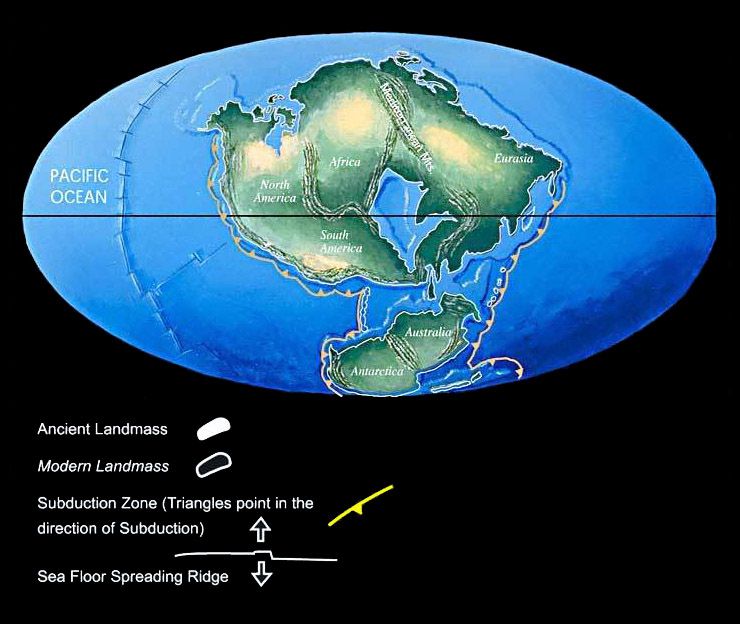
450 to 500 MILLION YEARS FROM NOW
The Sun grows in size. Temperatures on the Earth rise to unprecedented levels. Much of life on Earth struggle to survive under the extra heat without some form of protection. Despite our efforts to reduce greenhouse gases in the atmosphere, the sun will ensure no more ice ages appear on Earth.
This scenario assumes humans have not gone through another period of plundering the Earth's resources to such an extent that life is nearly extinguished except for perhaps a few humans living in the deserts of the world. Or if we are smart enough and can remember the reasons why we need to control global warming, more likely our greater concern for looking after the environment will see a thick canopy of large and tall rainforest trees blocking out most of the sunlight, thereby protecting animals on the ground. Should it be the latter case, life on Earth can continue to exist relatively intact and undisturbed for the next 750 million years. Of course, all this depends on whether humans have learned anything about the principle of love in preserving all life on Earth by ensuring that there are adequate plants and fresh water supplies. Could visits to other planets and watching what happens to alien life elsewhere provide the impetus for us to apply love to our own planet?
1 BILLION YEARS FROM NOW
The moon known as Triton will break up and collide into the planet Neptune. A new and more spectacular set of rings compared to Saturn in the 21st century will form around the planet.
1.75 BILLION YEARS FROM NOW
The Sun has grown to such an extent that Earth is no longer habitable for life. Just prior to this time, certain extremely hardy lifeforms will try to survive inside caves and under the oceans. However, eventually the oceans will no longer exist. They will have boiled away under the heat of the Sun and any remaining methane gas. The plant life we have protected for so long and allowed nature to maintain will finally dry up, burn and disappear, followed by most of the animals. Perhaps a few humans might use technology to continue living on some mountain tops in the far northern and southern latitudes or protected underground. However, by the time volcanoes start spewing poisonous sulfur and carbon dioxide into the atmosphere where the Earth's crust is thin, such as where the oceans used to be located, humans will leave the planet for good. Give it about 10,000 years after the volcanoes erupt and the Earth will look like the planet Venus in the 21st century with its thick and poisonous gases and high atmospheric pressures.
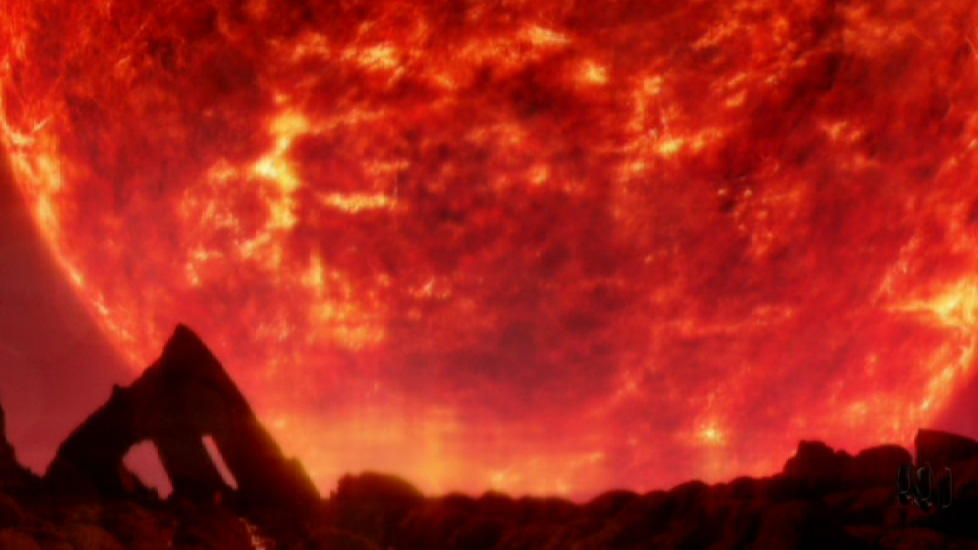
1 to 5 BILLION YEARS FROM NOW
The Moon's orbit around the Earth is expanding. In the early times of the Earth, the Moon was at least five times larger that it is today. However, by this time, it will be about 4 times smaller. However, instead of flying away, the Moon could affect the Earth in a more drastic way. While the Moon orbits the Earth, the Earth's rotational energy is being taken away by the Moon. This means that closer to 5 billion years, although some computer simulations suggest that it could be as early as 1 billion years from now, the Earth rotation will be so slow that it could tidally lock with the Moon. Then nothing will counteract the friction provided by the solar wind. It means the orbit of the Moon will get increasingly more elliptical. Eventually a point in time will come when the Moon will make a final orbit to collide with the Earth, thereby destroying all life on the planet (if the Sun hasn't yet done so).
5 BILLION YEARS FROM NOW
The Sun will expand dramatically in size and turn a distinctly dark orange to almost a reddish colour. Our once reliable long-term stellar partner in sustaining life on Earth with seemingly endless heat and light will finally close the chapter on our planet. It will reach the orbit of the Earth, thereby forever destroying our humble planet.
Not long after that, the Sun will eject its outer layers of material into space. The ejection of matter will not be as great as the ancient star that created our Sun over 6 billion years ago (actually 11 billion years ago from this moment in time). It is more likely the ejection of matter will create what is known as a ring nebula.
Before the Earth is totally destroyed, hopefully humans will have successfully learned to live with one another, with other great civilisations in the Universe, and in dealing with the asteroids and comets flying through the Universe. Who knows? We may need the help of an alien civilisation somewhere in the Milky Way to find us a new place to live. Actually, this might explain why some aliens could be interested in our genetic material as this would allow better adaptation to the Earth if we are welcoming of them in case their own planets get destroyed. Are we ready and willing with open arms to help other civilisations? If so, then expect the law of Karma to apply here for us at this time.
Or the alternative is simply to become vegetarians and build a big enough electromagnetic spacecraft carrying everything we need, including all the plant-based foods. Our efforts in the 20th and 21st century to test the idea of growing plants in space will be seen as essential knowledge at this time
Whatever will happen to us in the future, humans by this time will probably not look anything like we do now unless these people choose to use their technology of genetic engineering and the possible intermingling of humans with other similar-looking humanoid-like alien people in our Milky Way to have a particular set of physical characteristics which we might still describe as "human". Possibly the only thing that will give these future "humans" some connection with us today would probably be in the shape of their bodies (i.e. humanoid form) and the memories recorded on their highly advanced technological storage mediums of where they originally came from (i.e. the Earth).
Don't think humans will look anything like we do in the 21st century. Humans will look more like the aliens by this time.
When the Earth is finally destroyed, humans will likely survive and continue our legacy in some distant part of our Milky Way galaxy.
3 to 5.1 BILLION YEARS FROM NOW
According to researchers T. J. Cox and Abraham Loeb of the Harvard-Smithsonian Center for Astrophysics in Cambridge, Massachusetts, USA, the Milky Way will merge with the much larger Andromeda galaxy.
Apart from the Milky Way, the Andromeda galaxy is the only other galaxy visible to the naked eye (appearing as a faint fuzzy ball of light in the northern sky in the 21st century). Literally at a stone's throw distance of 2.5 million light years (well, anything you throw in space will travel far if you give it enough time), the Andromeda galaxy is the closest neighbouring galaxy to our own. So close, in fact, that at around this time, the night sky in whatever part of the Milky Way we will end up living or choosing to live will be filled with the spectacular view of the Andromeda galaxy.
The Andromeda galaxy is definitely heading our way with an estimated speed of 120 km (75 miles) per second. Latest information on the sideways motion of the Andromeda galaxy — a notoriously difficult figure to calculate for galactic objects — has been finally measured with reasonable accuracy at the end of May 2012 by the Hubble Space Telescope. Scientists are certain a collision will take place at this time and a spectacular one at that too. As Roeland van der Marel, an astronomer with the Space Telescope Science Institute in Baltimore that operates Hubble, said.
"Astronomers have tried to measure the sideways motion for over a century. However, this was always unsuccessful because the available techniques were not sufficient to perform the measurement.
For the very first time, we've been able to measure the sideways motion — in astronomy, also known as proper motion — of the Andromeda galaxy using the unique observational capabilities of the Hubble Space Telescope."
Dr van der Marel dubs the impending collision as "the big smash-up".
What will happen in the collision?
In 4 billion years, the Andromeda galaxy will have its first close fly-by with our galaxy causing the Milky Way to distort and stretch one or more of its spiral arms out into space and towards the second galaxy. Computer modelling suggests that there is a 50 per cent chance (just another way for the scientists to say that they don't really know, but do know it is one of two opposite outcomes) that what's left of our solar system where the Earth once existed will be dragged into a long "tidal tail" extending out from our galaxy. Or we could stay within the Milky Way depending on which spiral arm we happen to be on at this time. If we are moved further away from the Milky Way by the tidal forces of the other galaxy, our Sun will probably become part of the Andromeda galaxy.
In 5.1 billion years from now, the Andromeda galaxy would have encircled and merged with our Milky Way on the second close encounter forming a much larger galaxy in space.
A merging of the galaxies is considered the better of two scenarios. The second scenario, and the worse kind according to the scientists, is that the galaxies could have a direct head-on collision causing all the stars to be flung out into galactic space with no massive central black hole (or super "fast spinning" and reasonably dense star) to keep enough stars together. Should this happen, one can only hope a highly refined electromagnetic spacecraft will be available for the most advanced civilisations to travel closer to the speed of light and so carry enough people and essential equipment to help permit intergalactic space travel. Or else we will have to learn to live on a young Earth-like planet around a Sun-like star flung out into space and stay there for a long time until the star is within range of another galaxy to make the intergalactic hop with the electromagnetic technology possible. Clearly the easier option is to do regular star-hops in a direction that gets us closest to a neighbouring and approaching new galaxy and make the final leap. One would imagine only the most advanced civilisations in the two galaxies (hopefully we will be among them) will survive such journeys to a neighbouring galaxy, assuming, of course, certain galaxies will be close enough to allow for this.
Further details about this merger between the Andromeda galaxy and our own can be found in the research journal Monthly Notices of the Royal Astronomical Society of May 2007.
100 BILLION YEARS FROM NOW
Researchers T. J. Cox and Abraham Loeb have pushed the boundaries of current scientific thinking yet again to explain what they think will happen to the visible universe. However, as other scientists are only just discovering, the grander Universe is acting like God through its paradoxical property. It will throw up an unexpected paradox of its own just to keep scientists busy figuring out which answer is the correct one, except there can be no one answer once we have reached the limits of observations. There will be two answers, and a 50:50 chance it could be one or the other. Some 20th century scientists who started early to understand the size and age of the universe tended to be fixated on the finite model for the universe. New observations and the application of the imagination to re-evaluate and re-interpret existing evidence is revealing a second and opposite possibility (i.e., that the universe could actually be infinite, and hence the Universe, or extremely large to make it impossible to prove exactly how big or old it is). Einstein's Unified Field Theory is leading the charge for this opposing point-of-view.
At any rate, let us assume that the Universe is going in the way of 20th century (and some early 21st century) scientists predict (i.e., the Universe is only the visible universe, and it is expanding).
According to the researchers, the only thing we will watch in this so-called visible and expanding finite universe at this time will be our Milkomeda — the new name given for the galaxy formed after the merger of the Andromeda galaxy with the Milky Way — and a few Local Groups. Why are we so alone? Scientists are fairly sure other galaxies will disappear from sight.
Huh?
"Yeah, but why?" we hear you ask. A good question. It all boils down to one deceptively simple observation made in the 20th century by one scientist and the interpretation he has given to it and the efforts by so many others in the scientific fraternity to support this interpretation without realising that the Universe is a paradox and, therefore, should reveal another opposing interpretation based on the same evidence. It has to do with the red-shifting of the light emitted by other galaxies. It does not happen with our own Milky Way (obviously since we are moving with it) and the Andromeda galaxy (actually it is blue-shifting the light, making it an oddball in the sense that it has been found to be moving towards the Milky Way, but scientists are not expecting other galaxies to be doing the same thing). The interpretation given for this redshifting effect can be seen in the phenomenon known as the Doppler effect. When nearby objects are moving away from us, the wavelength of sound or light has been found to stretch out (just another way of saying the wavelength redshifts). We hear it and see it all the time for any object that moves away from us, so why not the galaxies as well? Light is redshifting for some reason when we look at the light of distant galaxies, so let's use the Doppler theory. Makes sense and seems logical to think this way. However, to avoid looking like we are at the centre of the universe as the religious people of bygone days once did, clever mathematics from the General Theory of Relativity have been employed to imagine the Milky Way as sitting on the surface of an expanding balloon, thereby making us like any other ordinary galaxy in the Universe, each sitting on their own balloon surface and everyone is racing away from each other, and not just from us, but never are we at the center of everything. With mathematics providing a seemingly rational solution, no one is expecting any other answer to come along. Of course, with the exception of the Andromeda galaxy, no one is expecting, say, another galaxy to be moving fast enough in our direction to defy this redshifting effect. The assumption is that the red-shifting of light from these other galaxies must be evidence that they are receding from us and, therefore, at some point, everything started from a single point or highly condensed region (the location is something no scientist will ever know the truth unless we can somehow map all the matter in the universe and determine their direction and speed). So while scientists see how reasonable the idea of receding galaxies is when explaining the redshifting effect, the mathematics has allegedly vindicated the theory.
Amazing how no other 20th century scientist has been willing to question this interpretation.
Furthermore, observations of the light from exploding supernovas in other galaxies are also being interpreted as not only evidence of an expanding universe, but also the claim that the galaxies are receding from us more significantly than previously thought the further away they are located. In other words, scientists now think the expansion of the Universe may actually be accelerating. If this is true, and with no evidence of any other matter or energy, dark or otherwise, that can counteract the expansion of the Universe as far as we can tell, then we are assured by the 20th century scientists that the Universe will expand forever.
If there was no accelerating expansion, the best estimate of the size of the universe based on what we can observe of the visible universe is an age of around 13.8 billion years. Hence the universe is roughly 28 billion light years in diameter. Add the accelerating expansion to the mix, and it is calculated to be closer to 93 billion light years in diameter. That is currently the best estimate as of 2023.
How comforting?
If we accept this current man-made cosmological model for the universe, then as the galaxies accelerate away from us, we will eventually see everything disappear from our view and eventually be sitting in a pitch black Universe except for our new galaxy and a few local groups of stars caught in the gravitational field of our new galaxy. Yet even those things will eventually fall apart. According to the laws of thermodynamics, all highly ordered states eventually return to greater entropy, or a more disordered state, where energy is lost to the surroundings. With nothing to spark our part of the Universe to rebuild and re-order itself, scientists believe that give it enough time, everything will slow down. Objects will move away. Even the atoms will slow down and fall apart. Spin rates of subatomic particles and a lowering of the energy density of space with less radiation will see more and more of the particles disintegrate or explode in a shower of intense radiation before disappearing into the Universe. Everything will eventually disappear including the matter composing our bodies. This is the moment when we enter a very low energy density environment in space where even the self-perpetuating ring-like structure of pure electromagnetic energy to form the fundamental particles of electrons and protons will expand and suddenly lose its ability to stay together. The energy breaks out of the ring and gets thrown out into space as high-frequency electromagnetic radiation and disappears into oblivion. Basically our entire galaxy will disappear and we will reach a temperature at or very close to absolute zero kelvin — the coldest temperature known to science. This is the point at which all oscillating electromagnetic energy stops oscillating (or at the very least is undetectable and, therefore, questions arise about whether quantum fluctuations can still exist). There will no longer be any radiation flying around (or it will be so small at the quantum level that we can't measure it, so we can only speculate on its continued existence depending on the size of the Universe). Effectively there is no space-time continuum. Not even life will survive the great freezer. The end of the Universe as we know it will be reached at this point. And then death will be like what the L-brain people in the 21st century have been saying of complete emptiness and total blackness and we will have nowhere to go. Then the purpose of life will seem meaningless.
And here we have the grand ending to everything according to the scientists because we think the Universe is the visible universe and is expanding according to our interpretation of the observations,, which is the red-shifting effect of light from distant galaxies.
How odd?
But what if there is a different interpretation for the same observations? For a Universe that is paradoxical in its existence, would it be possible to show another future that doesn't have to see us get frozen out of existence and yet still be scientifically feasible and valid?
According to current scientific thinking, the light from distant galaxies is said to be red-shifted. That part is irrefutable as we can clearly see the evidence before our very eyes. The part that is potentially a little dubious is the interpretation of that observation. Based on known scientific knowledge of the 1930s, this observation was thought to be key evidence of distant objects receding from us thanks to how the Doppler effect works for radiation.
It began in 1932 when Dr Edwin Hubble saw evidence in his observations of a particular reproducible pattern in every galaxy he observed (except the Andromeda galaxy): the red-shifting effect of light. More importantly, the further away the light from a distant galaxy has to travel to reach his telescope, the more the light has red-shifted. With this aspect out of the way and one that no other scientist can refute, the next stage, and as required with any scientific endeavour, Dr Hubble also had to find a reasonable scientific explanation for what he observed. After much thinking and careful deliberation over the evidence, he discovered a simple and well-known scientific fact that seems to fit his own observations: the Doppler theory. As the theory states, when an object is moving towards us, the frequency of light or sound emanating from the object and reaching us will be compressed as if the frequency has gone up, and this is how scientists interpret it. Scientists call this frequency shift as blue-shifted because blue visible light is at a higher frequency (or the wavelength is shorter) compared to, say, red light. On the other hand, if the object is moving away from us, the energy stretches out. The lowering of the frequency is then termed red-shifted (or the wavelength is stretched out). Given that Hubble kept seeing this red-shifting effect in the light of nearly all galaxies, it seemed logical for him at the time to interpret the observation as probably the galaxies moving away from us. With no other competing explanation, it would appear that Dr Hubble had found the answer.
However, the next step gets even more controversial. As any rational scientist would logically do, there is a tendency to connect the dots if it seems obvious and has a natural progression or can be extrapolated, assuming the interpretation was right in the first place. This is fine in most cases, except we are dealing with a paradox of the Universe. Something that Dr Hubble had not considered back in his time. As a result, Dr Hubble logically assumed a single "straight-line" answer for the Universe based on his interpretation that the galaxies were moving away, so surely there must have been a time when all the galaxies were much closer together, right? Therefore, for the universe to expand today, there must have been a kind of explosion that took place many billions of years ago. The idea seemed plausible. Yet Hubble needed support for his exploding matter idea from someone else just to make it look scientifically plausible. As scientists often like to "stand on the shoulders of other men" thinking they must all be right, Dr Hubble learned about a priest and astronomer with his radical idea of the universe as having potentially begun as a Big Bang. Why a Big Bang? According to this priest, it made sense. The story of Genesis in the Bible attempts to give the universe a beginning and something had to light the match that initiated the expansion of the universe. Might as well see it as an act of God. For other scientists, they were not quite ready for his radical idea to enter scientific discourse until the scientific evidence and interpretation was presented to them by another scientist. That scientist turned out to be Dr Hubble. Being someone of reasonable scientific standing, he was at the right place and time to provide this information.
At last, Dr Hubble had the standing in the scientific community to present the idea and his interpretation of the observations in a more scientifically acceptable way. And ever since then, scientists have been gathering more evidence to support the Big Bang theory, but not against it. As for the religious leaders in Christianity, they must be rubbing their hands with glee at the prospect that the story of Genesis in the Bible has to be correct. In which case, religious knowledge is vindicated.
As with any new explanation, it is not without a few teething problems. The biggest headache at the time was how the theory reeked of the idea that we must be sitting at the centre of the universe as if God had given us the front seat to the grand show of the universe. Of course, scientists loathe such a suggestion. Surely we cannot be that special. How can we possibly be at the centre of everything? Does this mean something started in our neck of the universal woods (maybe even where our Earth is located) many billions of years ago to cause all objects to be suddenly flung out into space? It sounds a little too convenient.
Then, Einstein came along with his General Theory of Relativity. Thanks to his theory, he predicted a kind of stretching of the fabric of space-time for the universe. How interesting? Scientists now have a new tool to re-interpret this expansion of the universe idea. Using appropriate mathematics, we can imagine our Milky Way as like sitting on the surface of an expanding balloon. No need to worry about us being at the centre of the universe. While the balloon expands, everything else around us can appear to move away from us, but the center need not have to be located where we are. At last, the problem seems to have been solved. The theory that everything (except the Andromeda galaxy and the Milky Way) is expanding has its mathematical supporter.
At last we have the answer!
Or do we?
The Andromeda galaxy is the unusual exception to the "expanding universe" rule only because it is travelling fast enough in our direction and close enough to us (or our Milky Way) to make the reading of an approaching galaxy possible. But so far, scientists are not expecting more distant galaxies to be moving in our direction.
Nevertheless, what if the interpretation made by Dr Hubble is completely wrong? What if there is another way to look at the same evidence? Or, to put it simply, is it possible for this red-shifting effect to be masking another phenomena, just as common as the Doppler effect?
As an example, scientists know that in quantum theory, the collision of radiation with a solid particle, such as an electron, causes the frequency of the radiation to red-shift by a certain amount depending on how direct the collision has been. This is a familiar observation to scientists of the 20th century known as the Compton effect. Yet remarkably no scientist has dared to consider this simple observation in explaining the red-shifting effect of light from distant galaxies. Why not? What's wrong with, say, radiation from the galaxies colliding with other radiation in space to create the same familiar red-shifting effect? It was Albert Einstein who made the decision in developing his light quanta concept and later used to create his Unified Field Theory to see light as like any other ordinary matter. Not only can light move uncharged matter, it can also generate a gravitational field of its own. So, when radiation collides with other radiation, it is like an electron being hit by another piece of solid matter (whether it is another radiation particle known as a photon, or another electron). Some energy is dissipated, and what remains is radiation of a lower frequency. Now leaving aside what is the gravitational field after Einstein realised its link to the electromagnetic field, we can at least appreciate why Einstein thought radiation, or light in its most general sense, is nothing different from ordinary matter. We know light behaves in a classical Newtonian sense like ordinary matter because experiments have proven time and time again this particle-like effect of radiation in moving uncharged matter. Indeed, light can bend in a gravitational field just like a tennis ball can bend in flight when thrown through the air. And the frequency of the light after bending is not exactly the same. It is redshifted! No one disputes it, not even the scientists. Einstein knew radiation should behave just like ordinary matter. The only slight difference is that light never slows down. It always travels at the highest speed possible as dictated by the density of radiation in space. The only way light can lose energy is not by slowing down, but by red-shifting. Amazing.
Therefore, collision of radiation with other radiation, no matter the frequency, is expected to create a tiny amount of redshifting. The question is, is this redshifting "negligible", or significant enough after enough collisions to cause the light on reaching the Earth after to support what we are seeing in the light of distant galaxies?
Certainly there is plenty of radiation is space. There is no shortage of energy there. Also, the higher the frequency, the more light redshifts. Under no circumstances is the frequency so low that no redshifting can take place. It is a cumulative effect. No matter how "negligible" at low frequencies it might seen, the redshifting effect is there all the time and keeps adding up with each collision that takes place. So the question we should be asking is, why should we ignore this Compton effect leading to a red-shifting of light from distant galaxies when light can collide with other light in space to create this effect?
The process is not unlike the way radiation coming out of the core of the Sun will make countless collisions with other particles, including electrons, the nuclei of various different atoms, and other radiation. When the radiation finally reaches the surface of the Sun after millions of years, the radiation has been significantly red-shifted into the lower frequencies. That is how we get the heat, visible light and ultraviolet rays from the Sun. Yet this very same process is happening all the time, albeit to a lesser degree, as light travels the immense distances between galaxies. Space has energy like a star has energy. The space we see is not totally empty. It has energy, much of it by way of oscillating electromagnetic waves. Each wave is like a train, and the train contains electromagnetic particles acting as carriages called photons. Each photon has the inherent ability to act like ordinary matter (i.e., a particle) by pushing and colliding with the light waves emitted by distant galaxies, thereby making the wave lose some energy and so reducing its frequency (or red-shifting it).
To see it in another way, imagine the light from the distant galaxy is like a stone thrown at the center of a great big pond in order to create a wave disturbance on its surface. The extra energy absorbed by the water molecules at the source of the impact by the stone is slowly lost to the surroundings (i.e., other water molecules) as the energy travels through the water and at the same time pushes some of the water with it. As more and more energy is lost to the surroundings, the amplitude of the wave disturbance reduces and stretches out. By the time the wave has travelled enough of a distance from the source, you may find it hard to detect that there had been a disturbance in the pond unless you look very carefully. Well, guess what? The same thing could be happening with light in space as we speak. A light disturbance such as a millions suns in a galaxy, or a supernova explosion, can act as the source. It is the stone in the pond. But give it enough distance and you should expect the amplitude of the oscillating electromagnetic wave to diminish as it loses energy to the surroundings.
In that case, if this new explanation to support the observation is just as reasonable as the Doppler effect suggested by Dr Hubble, how certain can we be that the red-shifting effect of light from distant galaxies is not caused by countless collisions of light with itself as it moves through so-called empty space?
A question was put to two NASA scientists named Michael Loewenstein and Amy Fredericks about the speed of light and the red-shifting effect of light with other light:
Scientists say the speed of light can be made to slow down when light passes through a dense transparent material. For example, light moves slowly through a diamond, than in glass. Generally this is because the electrons of atoms are temporarily excited by the energy of the light and there is a time delay before the energy is released again. In the vacuum of space, we have some electrons, protons and free moving positively charged particles such as hydrogen and helium. However, the most abundant particle is the photon. Photons are said to be ordinary particles as Einstein believed and can collide with each other, causing light to red-shift, bend etc. Speed of light might be 300,000km/s in this vacuum, but what's the speed in a perfect vacuum containing no radiation?
Loewenstein said:
Thank you for your question. The constant that is usually referred to as the speed of light *is* the speed of light in a vacuum. As you note, the Universe is not empty, but the chances of a photon colliding with an atom along the way is exceedingly small. Photons are much more numerous (by more than a factor of a billion), but the probability of interaction between two photons is very small unless the photon energies are much higher than is the case for those contributing to the cosmic microwave photon background. For that reason the actual speed of light in the universe is indistinguishable from that in a vacuum.
Really, is it so negligible? Or is this just another way for the scientist to say, "We don't think so, but we are not sure. And we haven't tried performing some calculations yet to find out".
Loewenstein is quick to be dismissive of this alternative theory for the redshifting effect mainly because at low frequencies (or photon energies), the probability of interaction is thought to be exceedingly small (but not zero, which is which it means when scientists say it is "negligible")) unless the photon energies are much higher. At high frequencies (or high photon energies) the effects of such interactions are observable (e.g., Brodsky, Stanley J., "Photon-Photon Collisions — Past and Future". November 2005. SLAC-PUB-11581, downloadable from https://www.slac.stanford.edu/cgi-wrap /getdoc/slac-pub-11581.pdf). However, the probability of such interactions occurring in the natural "vacuum of space" (which we know is not a true vacuum while the radiation exists) above the Earth's atmosphere is low due to the number of these high energy photons in the cosmic microwave photon background. Even if the volume of space for photons to travel through is made very large, such as the distances between galaxies, the effects of such interactions with both low and high frequency photons in space resulting in light bending and loss of energy allegedly do not multiply the effects over time with each successful interaction. Or if they do, the effects are still imperceptible by the time light from a distant galaxy reaches our instruments.
Are you sure about this?
Then we find the response for the speed of light. The assumption made here by Loewenstein is that energy density does not change the speed of light. Is this true? Not so according to the following article:
Light hits near infinite speed in silver-coated glass
17:33 07 January 2013 by Jeff HechtA nano-sized bar of glass encased in silver allows visible light to pass through at near infinite speed. The technique may spur advances in optical computing.
Metamaterials are synthetic materials with properties not found in nature. Metal and glass have been combined in previous metamaterials to bend light backwards or to make invisibility cloaks. These materials achieve their bizarre effects by manipulating the refractive index, a measure of how much a substance alters light's course and speed.
In a vacuum the refractive index is 1, and the speed of light cannot break Einstein's universal limit of 300,000 kilometres per second. Normal materials have positive indexes, and they transmit at the speed of light in a vacuum divided by their refractive index. Ordinary glass, for instance, has an index of about 1.5, so light moves through it at about 200,000 kilometres per second.
No threat to EinsteinThe new material contains a nano-scale structure that guides light waves through the metal-coated glass. It is the first with a refractive index below 0.1, which means that light passes through it at almost infinite speed, says Albert Polman at the FOM Institute AMOLF in Amsterdam, the Netherlands. But the speed of light has not, technically, been broken. The wave is moving quickly, but its "group velocity" – the speed at which information is travelling – is near zero.
As a feat of pure research, Polman's group did a great job in demonstrating the exotic features of low-index materials, says Wenshan Cai of the Georgia Institute of Technology, who was not involved in the work.(New Scientist, 9 January 2013.)
How interesting? Speed of light can actually change in space and quite significantly too with any variation in the energy density of space. Perhaps we should not be surprised by this discovery? It kind of makes sense. We are told by astronomers that when light bends in space near the Sun's domain, the higher energy density of space caused by the presence of the gravitational field of the Sun helps to slow down the speed of light. As soon as light stops bending and travels through the normal energy density of space, light speeds up to the standard 300,000km/s figure. Clearly energy density of space controls the speed of light.
Yet there are some scientists today who remain aware of this possibility. In that case, what does this mean for the red-shifting effect of light through photon-to-photon collisions? Can we truly be certain that no multiplying effects with each supposedly imperceptible collision will occur to make this "redshifting" detectable at distances beyond a certain point so as challenge the "expansion of the universe" theory?
Here reveals the great paradox of the Universe, and how little we know of what is happening.
Think of the new interpretation as not unlike the way two mirrors facing each other can cause light to bounce back and forth. With each collision with the electrons in the atoms making up the mirrors, not to mention the presence of other radiation and air molecules between the mirrors, eventually the reflected radiation going back and forth will naturally red-shift until the frequency falls below the visible range. Then everything is pitch black right at the centre of the mirrors. This is essentially a red-shifting effect. Extend the distance between the mirrors to the edge of the visible universe, and the blackness of the Universe can be explained in the same way.
If we don't do the necessary experiments to test this alternative idea out, then we must assume the Universe started from a Big Bang. It is an idea that has got Christian religious leaders all warm and fuzzy inside to the point where they are willing to jump onto the bandwagon of scientific thinking and support the Big Bang idea because it smacks of creationism in every sense of the word. Well, let's face it, how could the Universe appear out of nothing? What do we mean by nothing? Sure, we have some scientists willing to say that nothing is really just a bunch of quantum fluctuations in space where the changing and dynamic nature of it over time can potentially create particles out of what appears to be nothing. It means that there can always be some energy present at a level that we can't detect. We just don't know it exists. This is a bit like how a photon can appear out of nothing if the electromagnetic energy reaches a critical energy density for it to be detected, but can easily disappear through destructive interference. In that case, perhaps the Universe can somehow be created in the same way as a photon. It all depends is what is going on in those mysterious quantum fluctuations.
Sounds perfectly fine for scientists to imagine the Universe as having formed out of nothing. Either that, or we have to believe in God, much to the delight of the Christian religious leaders. While scientists are debating this issue, religious people must be enjoying the prospect of allowing God to enter scientific discourse. So long as scientists can't find or prove the answer and the Big Bang theory is maintained, everything will be fine for Christian religious leaders and their Biblical knowledge.
Unfortunately, there is a big problem for the Big Bang theory, especially in regards to the grander Universe comprising of both the visible universe we can observe with our eyes and instruments, and the invisible part beyond the visible boundary. Just prior to the Big Bang, the entire Universe must have been compressed into a point or region of space. However, any effort by some mechanism to achieve this would mean that we would have a perfect vacuum surrounding this region. Remember, we are talking about the entire Universe, whether it is infinite in size or not. All matter and energy has to be brought together into a well-defined region just prior to the Big Bang. Unfortunately, any such effort would be tantamount to saying that what is left outside the region must be a true vacuum. No mass, no energy, and no radiation. The perfect vacuum where absolutely no energy exists — not even those pesky little quantum fluctuations. We are talking about complete nothingness. But here lies the problem. How can we have a perfect vacuum? We know a perfect vacuum is the kind of thing we see when scientists use simplistic mathematical equations. That is good and fine on paper, and hopefully the results closely relate to reality in most situations. However, there are times when mathematics do not match reality. A classic case is, at the moment, of the Big Bang. Why? It is because the real Universe will never allow any region of space to have a perfect vacuum. It is impossible to achieve. If we need evidence of this, just ask yourself, "Why is it that scientists can never reach absolute zero kelvin?" As we know, absolute zero kelvin means no radiation of any kind, not even the presence of other particles that could emit radiation by any means. This has to represent the perfect vacuum. Yet no matter how hard we try, no scientist can ever reach this perfect vacuum no matter how much energy we apply to extract the electromagnetic energy from a given region. Something in the universe is pushing the energy back in and as quickly as we try to remove it.
Indeed, the force of the radiation that is coming out from this hot ball of compressed mass and energy a perfect vacuum is infinite. Radiation in a perfect vacuum travels at infinite speed. It will counteract any force you try to create in order to pump out the radiation in a given region of space. It means that not even the most advanced alien technology can ever create a perfect vacuum. You can't cheat the Universe or create a rip in the fabric of space-time that would allow you to take advantage of a perfect vacuum. The Universe confined to a region surrounded by a perfect vacuum will instantaneously apply an equal opposing infinite force on itself to expand and fill the perfect vacuum with energy (and mass).
One of the physical laws of the Universe we cannot violate is "never create a perfect vacuum". It does not exist in reality and we must face this fact as a fundamental limitation of living in this Universe. It doesn't matter how dense the walls of the container might be or how much energy in the Universe we throw at the experiment to force the energy out of a certain volume of space, radiation will always seep into the region as quickly as we pump it out thereby preventing it from ever reaching absolute zero kelvin, and hence a perfect vacuum. Mathematically we can create it and imagine what happens in this perfect Universe using formulas (such as Newtonian equations, which predict infinite speeds of any solid etc.), but not in reality. Never can you do the same in the real Universe we live in. Energy must always fill the void making up the Universe.
Therefore, not even the biggest black hole in the Universe can survive for an instant by keeping its energy to itself in the presence of a perfect vacuum around it. It will be instantly split apart and made to cover the entire Universe. In that case, the Big Bang could never have occurred in the real Universe. Not even for an infinitesimal time frame. The energy and all the particles would never have compressed in the first place to create any kind of perfect vacuum surrounding it. Any attempt to do so would see the Universe extract the energy and push it out to fill the Universe. In a perfect vacuum, this pushing and filling of the Universe will be instantaneous. Remember, the speed of light in a perfect vacuum is infinite. Mass and energy had to be spread out everywhere and instantaneously knowing the speed of light is infinite in a perfect vacuum.
In recent times, scientists try to get around this thorny problem of compressed energy in a perfect vacuum by saying a gentle Big Bang occurred in the sense that there was some energy in the Universe. Ha! Funny that. So perhaps there were a series of little big bangs throughout the Universe and we were part of just one of them some 13.8 billion years ago. Are scientists referring to the last supernova that made out star and solar system? Or was there something much bigger to have caused a sudden gentle expansion of the visible universe? How convenient? Except no one can actually prove it. More disturbing, a slower expansion only means that there was already measurable energy and mass in the Universe in the first place for the visible universe to expand into, albeit slowly. So the Universe cannot have started from a Big Bang. Our visible universe must have started from a smaller big bang. However, we should expect from this scenario a slowing down of this expansion as it merges with other mass and energy throughout the Universe. It can't be accelerating the expansion.
Yet here lies the problem: How do we know?
For all we know, the visible universe could have already expanded by now to wherever the edge of the Universe should be (if at all). In which case, any observation of red-shifting would have to represent another phenomena. Surely it cannot be the Doppler effect.
Yet all this hasn't stop scientists making more bizarre interpretations of what they can see at the edge of the visible universe.
For example, observations of blobs of light at the edge of the visible universe are being interpreted as the primordial beginnings of the Big Bang. Huh? But what happens if a 21st century scientist comes along and says those blobs are nothing more than heated gases surrounding very distant galaxies and clusters of galaxies. Just because we can't yet resolve those galaxies with our telescopes does not mean they don't exist. "Absence of evidence is not evidence of absence", as Dr Carl Sagan would say.
As a case in point, the James Webb Telescope has already forced the Big Bang theorists to revise where they think the edge of the visible universe is (and hence how old and big the universe is) after noticing how certain blobs of light previously observed in their older Hubble telescope have resolved themselves in the James Webb Telescope as actual galaxies and clusters of galaxies. How interesting? So scientists attempt to look further. They can see more of those mysterious blobs of light at the new edge of the expanded visible universe. The only problem is, what if a more powerful and bigger telescope gets built in space and discovers these more distant blobs are yet more galaxies already fully formed? Apart from realising the redshifting effect is more extreme the further we look, the question we need to ask is, "Should we continue to keep pushing the boundary thinking the Big Bang started at 98 billion years ago, 500 billion years ago, or even 1000 billion years ago with each successive and bigger new telescope we build in space?" Or, to put it another way, "Where exactly is this official boundary to make us certain we did have a Big Bang and thus the universe is finite?"
This is the fundamental problem of all cosmology — no one really knows, especially at such extremes in distances and how light gets affected when it travels those distances.
In that case, how can you definitively prove which one is true? In other words, how do we know the visible universe is the Universe (i.e., both visible and the grander invisible part we are trying to resolve and observe) and that the Universe is finite and came about from a Big Bang, or that the Universe has always been here and is so large that for all intensive purposes we should imagine it as being infinite? And if someone came along and said the red-shifting effect of the light from distant galaxies is actually caused by photon-to-photon collisions (and shows these collisions are not insignificant as some scientists had originally thought), what then? How confident can scientists be in their views that the galaxies are receding from us? It would be a real party pooper of an idea for those supporting the "expansion of the universe" theory should it be found the redshifting effect is merely energy losses in the photons from the constant collisions with other photons over vast distances in space.
So either the visible universe is finite, or we live in a much bigger universe (and whose timescales to find out and see any changes to help us determine the actual truth is too great). Indeed how can we disprove the "infinite Universe" idea? Likewise, can you prove the "finite universe"? You can't. The Universe is a paradox. Unless you can physically visit the edge of the universe instantaneously through a wormhole (an impossibility one might add as this is merely another example of a perfect vacuum), scientists are effectively making educated guesses when, in fact, no one knows what is happening.
Cosmology is not a lot more different that asking a crystal ball gazer for an answer to the size and age of the Universe. Who really knows? And how can we be God to know the answer? The Universe must hide its secrets, and this size and age thing is part of the ultimate mystery we have yet to solve.
All scientists can say at the moment is that we live in a very big and very old place. How big and old is anyone's guess. Finding the truth is difficult because the visible universe at the extreme of human observations is throwing at us a paradox of two possibilities. The Universe is acting like the paradox we see in the true God (the one that has no true name) in Eastern mysticism. We simply do not have enough evidence to decide which one is correct. We just have to accept two opposite answers.
So either we accept one grim possibility from 20th century scientists of how the universe will end and life will be destroyed, or we can accept the opposite 21st century possibility that the universe will probably always be here and so will life as well.
The choice is up to us to make.