Silurian period

438 to 408 million years ago

443 to 430 MILLION YEARS AGO

During the early Silurian, Earth experienced several short but significant extinction pulses known as the Ireviken, Mulde, and Lau events. These disturbances affected marine life, such as conodonts, trilobites, and graptolites, reshaping ocean ecosystems as they recovered from the Late Ordovician mass extinction, while shallow‑water reef communities were comparatively less impacted. These events also coincided with fluctuations in sea level and climate changes, influencing the distribution of shallow seas and reef systems.

438 to 390 MILLION YEARS AGO

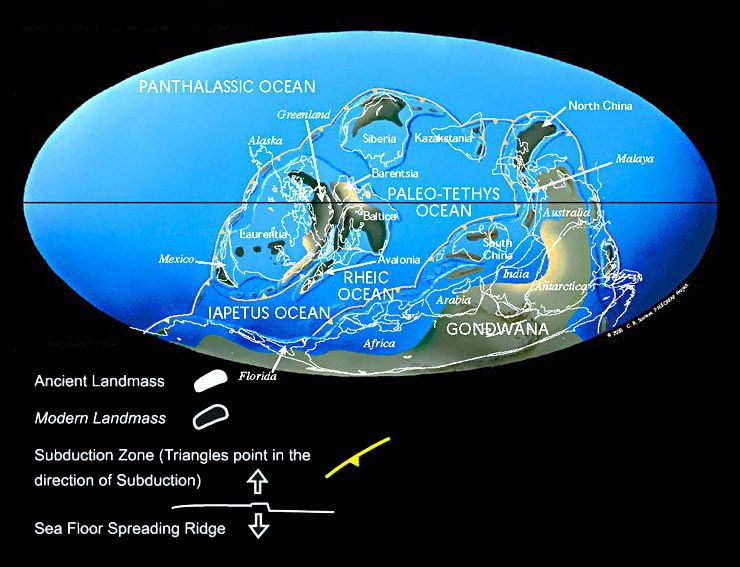
The Silurian climate was generally warm and stable during this period of Earth's history. It was warm enough for glaciers to melt, prompting global sea levels to rise. This led to flooded continental margins, forming extensive shallow marine habitats. As a result, the conditons became ideal for the growth of vast reef systems while promoting high biodiversity in marine animal and plant life. Extensive shallow seas existed around the Paleo-Tethys Ocean region, which would permit the growth of massive and widespread coral reefs far greater in size than the Great Barrier Reef we see today.

Earth in Middle Silurian nearly 425 million years ago. Image © 1997 Christopher R. Scotese. As of 2014, an updated map can be downloaded from the Colorado Plateau Geosystems, Inc. web site and created by Professor Ronald C. Blakey of Northern Arizona University (NAU).

This was also a good time for simple plants like Cooksonia to adapt to the drier environment of land. The first plants to take hold on land grew initially in marshy areas, with their primitive root systems still embedded in nearby water, and over time encroached into the desert-like expanses inland.

While Cooksonia represents one of the earliest known land plants, the Silurian also witnessed the appearance of the first vascular plants, which possessed specialised tissues for transporting water and nutrients. This innovation allowed plants to grow taller and colonise drier environments, accelerating the transformation of barren landscapes into vegetated ecosystems.

As these plants adapted to the drier conditions on land and with oxygen levels in the atmosphere rising above 16 per cent, wingless insects became the first creatures to crawl onto land, following the vegetation ashore. While true insects with wings would not appear until later in the Devonian, the Silurian period did host some of the earliest known terrestrial arthropods, including millipedes and scorpions. These pioneering animals were among the first to exploit land-based habitats, feeding on decaying organic matter and microbial mats and contributing to the early development of soil ecosystems.

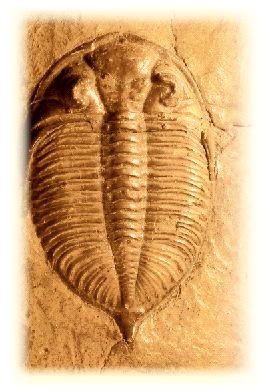
A trilobite of the Silurian Period. Source: Mackness 1987, p.63.

430 to 420 MILLION YEARS AGO

The Silurian seas saw the emergence and diversification of the first jawed fish, a major evolutionary breakthrough that transformed marine food webs. These early gnathostomes, including placoderms and acanthodians, developed improved mobility and feeding strategies, allowing them to dominate ecological niches previously occupied by jawless fish.

420 MILLION YEARS AGO

A temporary cooling period, with the potential for some glaciation, may have occurred at this time despite high levels of carbon dioxide in the atmosphere. Scientists are not too sure why. Perhaps massive volcanic eruptions have sent debris high in the upper atmosphere to reduce sunlight? But as soon as the air cleared, the higher carbon dioxide levels remaining in the atmosphere probably helped to increase worldwide temperatures.

Photograph of a complete fossilized armoured fish of length about 5cm called Athenaegis. This fish appeared during the Silurian period. Source: Long 1995, p.49.

400 MILLION YEARS AGO

The region where the capital city of Australia is located — Canberra — was once at the bottom of a tropical shallow sea containing reefs, sea shells, corals and beaches along great expanses of land containing volcanoes with plants hugging the shores, rivers and lakes for water and nutrients.

Elsewhere, the places we call Scotland and England were joined together. A mountain range is created over the next 50 million years known as the Highlands. The rest of Europe lay much closer to the equator as part of the ancient continent Euramerica. This region was warm, humid, and dominated by shallow tropical seas teeming with early fish, corals, and reef systems, with only scattered islands and rising mountain belts forming where tectonic collisions were underway.

What is now Russia was divided between two major paleocontinents: Baltica in the west (by then part of Laurussia) and Siberia in the east. Western Russia shared the equatorial, shallow‑marine environments of Europe, while Siberia lay at somewhat higher latitudes but still experienced relatively mild climates under global greenhouse conditions. Both regions bordered active subduction zones, and their long‑term movements would eventually contribute to the assembly of the supercontinent Pangaea.

China existed as two separate microcontinents, the North China and South China blocks, drifting in the oceans between Gondwana and Laurussia. These blocks occupied tropical to subtropical latitudes and were fringed by shallow seas rich in corals, brachiopods, and early fishes. Volcanic arcs along some margins produced rugged coastlines and fertile volcanic substrates where early land plants could establish. Their relative isolation likely fostered distinctive and diverse marine ecosystems.

North America was fused with parts of Europe within Laurussia, positioned near the equator and largely flooded by warm, shallow seas. Vast reef systems and marine basins covered much of the continental interior. Along the eastern margin, ongoing collisions with other landmasses were raising the early Appalachian mountain belt, a process that had begun in the Silurian and continued into the Devonian. Low‑lying coastal areas supported increasingly complex plant communities, though true, dense forests would not develop until later in the Devonian.

South America formed part of Gondwana, which lay mostly in the Southern Hemisphere and extended into temperate latitudes. Despite its position, the greenhouse climate kept conditions generally mild. Large areas were occupied by inland seas, deltas, and coastal plains, where marine life flourished along the continental margins. Early land plants spread along riverbanks and floodplains, gradually stabilising soils and influencing local climates.

As for Antarctica, this continent was also part of Gondwana and lay near the South Pole, but it was not yet the frozen continent of today. Instead, it likely hosted cool temperate environments with ice‑free coastlines, river systems, and sparse but growing vegetation, including mosses and small vascular plants. Offshore, cooler‑water marine ecosystems thrived in the surrounding seas, while much of the interior remained relatively barren rock or tundra‑like terrain.