Average longevity of species is about 5 to 10 million years according to the fossil records. But now man has reduced the longevity of species to under 100 years.
—Unknown
14,000 - 10,500 YEARS AGO
Earth is in the grip of a major ice age around 14,000 years ago. Any thoughts of humans feeling safer and warmer by moving to the equator may have to be seriously curtailed at this time. All the extra competition from predators (such as wild cats, snakes, biting insects, and all the rest to keep all animals on their toes), and other hominids congregating in the warmer region might put a dampener on any such exploratory thoughts. Perhaps a better idea would be to migrate with the seasons in temperate regions. Alternatively, do as the few hardy brutes have done in the past, which is to endure the cold in the winter by choosing to stay put in more icy temperate zones sheltering in caves or making use of thick animal skin hides for clothing and creating tents. No doubt the latter option has been a favourite for the Neanderthals.
However, around 13,000 years ago, something began to warm the planet. Slowly at first, as one would expect as humans found ways to burn wood to keep warm and cook food, not to mention the unmentionable regarding the innumerable belching and other gaseous emissions taking place from the orifices of enough animals (including humans). However, a moment came when the warming process had suddenly accelerated. Not the normal and natural warming of the planet as in previous ice ages. Something else had triggered a sudden increase in world temperatures.
The question is, why the sudden warming?
What we do know is that the continuous burning of wood by humans to keep warm can release tiny amounts of carbon dioxide into the atmosphere. Carbon dioxide is a greenhouse gas, meaning it will warm up the planet by doing its famous jiggling in the air as it absorbs energy reflected off the ground, and emit it back to the surroundings as heat, making everything warmer than they should. At the rate this gas gets emitted by human activity and the fewer humans that lived at this time, it can take up to 30,000 years for the planet to warm by a couple of degrees. Get enough humans to carve out an existence in the colder regions by burning enough wood and we can expect to see some reasonable contribution to global warming over a few thousands of years. The only complicating factor is whether the soot from burning wood could enter the atmosphere to cool the planet rather than warm things up. It all depends on how high the human population was at this time and where they congregated in certain regions of the planet, and also if there was regular rainfall. Like the chimneys of modern houses in a valley can leave behind a layer of soot in the air to stay in the valley, burning fires and cooking food would have the same effect. Of course, the rains will come every now and then. Plenty of rain could see much of the soot brought back to the earth's surface, leaving behind relatively clear skies. Not so for the carbon dioxide. This gas is too small and lightweight to be entirely collected by rain and fall to the ground. Clearly this gas will have to contribute to some global warming in the air until such time as the great and healthy forests can soak it up in their trunks.
The other greenhouse gas we need to consider is slightly more potent and challenging for all animals on land should the level of emissions get a little too high. We are talking about methane entering the atmosphere. Methane does warm the planet. However, unlike carbon dioxide, methane is a more effective heat trap. Indeed, the big elephant in the room of planet Earth is how much methane can enter the atmosphere at certain times to warm the planet. It doesn't take much methane to affect world temperatures. Although one can imagine humans contributing their own fair share of this gas around the campfire (the proverbial Blazing Saddles scene), we think this contribution would not be quite enough. More could be contributed by other animals grazing on the grassy plains; and the bigger the animals, the more noise they make, and the greater their contribution to the global warming debate. Look out if you are behind one of those Wolly Mammoths, as big as they are. However, the majority of methane emissions would generally make their sudden appearance at certain times in Earth's history from other natural sources.
Those sources we are referring to here are from permafrosts and deep under the oceans.
To put it simply, there is a kind of balancing act going on between methane and carbon dioxide in determining how warm or cold the planet gets. Sure, one gas or the other can, on their own, contribute significantly to global warming if released in reasonable quantities. In the case of carbon dioxide, it usually requires a quarter of the planet or more to be suddenly in the hot molten state for the gas to come out significantly to affect world temperatures. We have seen this occur once in the late Devonian era. The only other way to greatly affect world temperatures is to release a reasonable amount of methane. Not as much as carbon dioxide, but enough to cause significant increase in world temperatures.
You see, how it normally works is that one gas or the other will not be solely responsible for warming the planet. In nature, both have to play in tandem. Usually the carbon dioxide is the one that initiates an increase in world temperatures for whatever reason until a tipping point is reached when just enough ice over the oceans and to a lesser extent over land melt and enter the oceans. This will be followed by melting of the permafrosts causing more nitrous oxide and methane to go into the atmosphere. There will be the occasional spike in emissions over this region in certain consecutive years, especially during the summer months. Temperatures over these regions may rise here. However, the real tipping point gets reached when the oceans are unable to supply enough cold water to sink and keep the methane hydrate ice structures intact. All it takes is an unusually warm summer to see the oceans become suddenly warmer than expected. The warm waters expand and reach down far enough. There is a breakdown in the icy structures leading to a massive and sudden burst of methane gas that emerges out of the oceans and enters the atmosphere. When it happens, virtually all the animals on land will not notice this. It is all quiet and invisible can turn into a potential silent killer on those animals not adapted to much high world temperatures. It will be like one year it feels warmer than usual, followed by a couple of years that seems okay but very warm as the methane gas circulates in the atmosphere. Then a few years later, the weather will feel atrociously hotter than most animals are used to. That is the time when a massive rise in world temperatures takes place, and animals will tend to notice it worse in the summer time, and with much fewer cold days in the winter.
In terms of geological timescales of millions of years, the sudden emission of methane and subsequent rise in world temperatures would be like a "switch". One moment things may look normal, but the next everything is suddenly and unexpectedly hot. It is this "switch" that can effectively end an ice age, and do it in a fairly dramatic way (even if it takes a few decades, or years if the emission of methane is substantial).
In the case of this ice age nearly 10,500 years ago, the rate of warming was too quick even for humans and other animals to have reached the "tipping point" needed to cause a methane emission to emerge from the oceans. Not even the massive ice caps at this time could keep ocean temperatures low enough to prevent an unexpected surge in the amount of methane spewed into the atmosphere. Something else had driven global temperatures to rise at a more rapid pace, and ultimately put an end to the last Ice Age.
According to geological evidence gathered by scientists, the cause for this sudden warming started in North America of all places. A rather curious location where we see massive ice sheets melting rapidly for some unexpected reason. Certainly not the normal melting scientists have come to expect from previous ice ages. Whatever the cause of this melting, not long after this, the Gulf Stream in the Atlantic Ocean was re-activated where warm waters in the Caribbean sea and the Gulf of Mexico moved across the Atlantic Ocean to reach northern Europe. On reaching this continent, the warm ocean currents pushed the colder waters back to the equator. Without this warm ocean currents reaching Europe, the cold and dry air coming in from the northern Atlantic Ocean would have only added to the already harsh and bitterly cold Arctic winds coming from the north to keep Europe pretty much locked in an almost perpetual ice age. Now, at last, the warm and moist air coming from the mid-Atlantic Ocean was breaking the ice age stranglehold over the European continent. Once this happened around 10,500 years ago, all it took was one unusually hot European summer with temperatures of 6 to 8°C higher than usual to begin melting a significant amount of solid ice from glaciers (1). Give it another 5 to 50 years (a blink of an eye in comparison to Earth's geological history) for the Ice Age to come to an abrupt end throughout Europe.
With all this extra fresh water flowing into the oceans from melting ice sheets and glaciers, sea levels around the world rose significantly. As a result, the island of Tasmania was formed south of the Australian mainland as water rushed over the flat plains to create the sea of Bass Strait. As for the great valley separating Europe from Africa, this would get slowly flooded by salt water from the Atlantic Ocean as it toppled over a canyon lying between Spain and Africa. At first it was a trickle, but as the ocean levels rose higher, it appeared as a large waterfall. About 1,000 years later the Mediterranean Sea was formed and joined with the Atlantic Ocean. By the time all of the ice sheets in Europe, Russia and North America had melted, scientists believe sea levels rose by at least 74 metres. This was a fairly quick event in comparison to the rather slow rise in temperature lasting thousands of years when the world was in the midst of the ice age. After that, a slow increase in world temperatures helped the oceans to rise further to its present-day maximum of 120 metres over the next 3,000 year.

While methane and a bit of extra carbon dioxide did contribute to world temperatures at this time, not all scientists were in total agreement about how the last ice age came to an end. The big problem with the natural methane and carbon dioxide theory for global warming is that many large mammals of the megafauna era, including the Wolly Mammoths, died out soon after the end of the last ice age. We are talking about the same animals that survived a number of previous and more intense ice ages followed by several interglacial periods. And yet incredibly, many would not survive the end of the last ice age. Why should the end of the last ice age be any different?
Then we have the issue of how quickly world temperature rose and how abruptly the last ice age ended. Too fast for normal natural emissions from human activity, other animals, and the planet from volcanic eruptions. Something else had triggered this world event.
Some scientists have considered a range of possible explanations.
In the case of the demise of so many large megafauna, was it to do with the rate of melting of glaciers that took many slow moving large animals by surprise with sudden floods in low lying areas? For other animals, the melting ice sheets could have created numerous large marshy areas causing large animals to struggle and eventually got bogged down in the mud. Without adequate food to provide the extra energy and muscle development, these exhausted animals probably starved to death where they stood, or overheated in the summer sun with the extra fur they wore to survive the ice age.Then again, the animals could have simply migrated to the colder regions further north to help avoid the wet marshy areas and hot summer days.
Or was it a situation of humans being a little too eager to hunt down the last remaining large, cumbersome and slow to reproduce animals to extinction (knowing how easy it was to catch them)? A kind of smorgasbord of meat-lovers delights just sitting out there for the taking.
Now, according to archaeologist Professor Ken Tankersley from the University of Cincinnati, he thinks he could have the answer to at least the sudden world temperature rise, and quite possible the reason for the extinction of certain animals.
In a place called Sheridan Cave located in Ohio, Tankersley noticed a thin layer of distinctly reddish dirt known as the Clovis layer below 10 metres of soil. The depth of this reddish material is significant in the sense that it has been dated to around the end of the last Ice Age, approximately 13,000 years ago. A fairly useful observation. Now we just need to know what is this reddish material. Fortunately, Tankersly has gone further to make another important discovery. It seems that this same reddish layer has been observed in at least 20 other sites dotted around the continent suggesting that whatever had deposited this material was a widespread event. Furthermore, after analysing the soil, he noticed unusually high concentrations of iron (up to 50 times above the expected level in the surrounding soil both above and below the layer in question). This naturally had Tankersly wondering, "Where did this extra iron come from?"
One clue lies in outer space.
After realising some rocks in space can contain high amounts of iron, Tankersley put forward a theory to suggest that an asteroid may have impacted somewhere in North America causing the end of the last Ice Age. If not an asteroid, then perhaps a comet scrapping the Earth's atmosphere and creating a partial combustion of the air. What it was and where precisely he doesn't know for sure. Indeed, the biggest problem with his theory is the lack of a crater and one that is much bigger than the thing that hit Arizona nearly 50,000 years ago. Then again, after further studies were made by planetary geologist Professor Peter Shultz using a high speed gun in California developed by NASA, it suggests that the great glacial ice sheets of North America were up to a mile thick and this may have been sufficient to erode evidence of an impact site (.e.g, crater) once the ice melted making it virtually impossible to locate. The theory is sounding more plausible by the day.

If this isn't convincing enough, Tankersley has discovered bones of mega mammals living on the continent have suddenly stopped existing above the crucial iron-rich red layer. As Tankersley said:
"We're looking at the Clovis layer. It's a very distinct layer here in the case. Beneath it, we have mega mammals remains. Above the layer, there are no more mega mammals. This literally represents the extinction event." (Quote from the BBC documentary film Catastrophe, 2010.)
On closer examination, the bones within the layer appear to have characteristic signs of flesh having been burned off the bone at temperatures above 300°C which no ordinary cooking method by humans could achieve. The seemingly sudden nature of the extinction of the mega mammals in North America and the widespread nature of the iron-rich layer of soil is not suggesting to Tankersley of any possible human contribution to the extinction (well, at least in the North American continent). As Tankersley stated:
"One of the things that intrigues me about this time period and about this site is we have no clear cut answer as to what caused the extinction of these mega mammals. Over hunting, people killing these animals just does not fit. And when we look at all the other Ice Ages which came to an end, these mega mammals did not go extinct. So why now? And why here? This is one of the most intriguing questions that I've ever faced." (Quote from the BBC documentary film Catastrophe, 2010.)
It is most certainly intriguing by any account.
Yet we have a problem with this asteroid theory as the sole explanation for the extinction of all mega-mammals, especially those in Europe and across northern Russia and Asia. This single catastrophic event that allegedly took place in North America was not sufficient to cause an immediate extinction of all mega mammals in other parts of the world, most notably the Wolly Mammoths in northern Europe and Russia. These animals were far enough away from the action in North America and had survived previous ice ages, and even more severe than this last ice age. Why should these animals die out after the alleged impact event even though they were unaffected by the event?
It is understandable to think that in North America these major floods creating marshy grasslands would have been an impediment to the escape of these large animals. Get stuck in a marshy bog and you can also be a sitting target for early humans living on the continent. Or else you get tired and die, or get cooked in the summer sun (if not over a hot fire by the humans). However, in Europe and Russia it would take longer for the ice to melt, probably a few months, and so permitting enough time for these animals to migrate to higher ground and in places where there would be plenty of food. And why would the Wolly Mammoths of Europe and Russia eventually disappear from the face of the Earth at least a thousand years or so after its cousins in North America did? The extinction for the European animal counterparts did not coincide precisely with the reddish layer. The animals would continue to survive for quite a big longer after the cataclysmic cosmic event.
Not even the fact that the conditions could have got colder after the collision because of extra dust in the upper atmosphere to block the sun would have been enough to kill off all mega-fauna. The Wolly Mammoths of Europe have survived much colder conditions for a longer period of time in previous ice ages. We can discount the possibility of high heat or extreme cold as the cause for the eventual demise of the European mega-mammals, as these animals can migrate and find higher ground. In fact, the impact wasn't even big enough to wipe out or severely curtail a large two-legged creature we call humans in North America or Europe. Something else was playing a role at the time to see many of these animals become extinct. We wonder what it is?
Perhaps it would be more reasonable to say that there was a reduction in the number of mega-fauna at the time of the impact as suggested by Tankersley. However, in Europe and Russia, the large Wolly Mammoths persisted for longer. Any short period of slightly colder and drier conditions following the impact would probably not have affected the animals in Europe. Or else they would have migrated further south to escape the cold. Then conditions began to warm up. Sure, the warming of the planet can reduce the vast grasslands spread across southeastern Europe right to the far eastern edge of Russia as a valuable source of food for the large animals. There is even talk of extra snow falling in the United States after the ice sheets melted forcing the warm and moist air to travel further north and leaving the eastern United States in extra snow in the winter and a drier desert-like environment in the southwest of the continent. But all this would simply mean the large animals would migrate to where the food would grow, which is usually the indicator of the right temperatures suitable for the animals to survive. And as evidence would have it, we learn that after only cold period following the cosmic event in North America, conditions began to warm up and this was the time for Wolly Mammoths and other large animals did migrate north to follow the ice sheets while staying on higher ground to enjoy the dry and thick grasslands. Following them were reindeer, bisons and other animals that still exist to this day. Yet despite all of this, and given enough time for temperatures to stabilise and animals to work out new routes to areas of high food abundance and keep to the cooler conditions, it seems that not even the largest animals would survive. Something else had affected these larger animals. Combined with a slow development of the reproductive system and the possibility it took up to a couple of decades for the offsprings to reach adult maturity and size, it is more likely the constant pressure of humans hunting down Wolly Mammoths led to the extinction of the species.
Not all extinctions at the end of the last Ice Age can be blamed on an asteroid/comet impact.
On a Russian island in the northern Arctic region, the last place to find the most recent remains of Wolly Mammoths showed they indeed migrated north and survived. Interestingly these animals became smaller in size to adapt to the environment on the island with less food. That must have taken a while to adapt to a smaller size. Yet the animals did not survive beyond more than a thousand years after the cosmic event despite adapting perfectly to the environment. Something stopped them from reproducing and allowing enough time for the offsprings to grow. There is only one explanation: humans must have reached the island and eventually played a decisive role in the ultimate demise of one of the largest animals of the Ice Age era to have ever lived. The humans must have continued to think there were plentiful supplies of these animals just sitting out there ready for the taking. All they had to do is move further north or wherever the animals went. When humans finally reached the island, they still had not realised the last remaining Wolly Mammoths on the entire planet were living there. Once the animals were slaughtered, years went by and these humans walked around in the summer thinking, "Where have all those big hairy elephants with large tusks gone? Have the gods been mean to us for not giving enough of our offerings to appease them and so give us a bountiful supply of wild game for us to hunt for the summer?"
Yet humans continued to come up with the idea of hunting animals of the smaller variety and later sacrificed a few to the gods thinking that the large animals will somehow return. Why weren't these animals not coming back? Well, it doesn't take a genius to work out why.
Now, at last, we may have the complete picture. Mega-fauna were on the dinner plates of prehistoric man for those living in Europe, Russia and North America. The most recent evidence from American scientists of damage to bones of Ice Age giants show that the increasing population of humans was messing up the ecology of the mega-fauna. There are signs that humans may have targeted the larger male mammoths in an unsustainable way until eventually the female mammoths didn't have a stable social structure and a reliable source of breeding stock to help support a population that essentially was too slow to breed and took too long to look after the one or two offsprings born every so many years. Once this happened, extinction was inevitable.
UPDATE
April 2017
Research work conducted by Dr Martin B. Sweatman, of the University of Edinburgh’s School of Engineering, has effectively sealed the case for a comet hitting the Earth as the most likely explanation after discovering another anomaly in the soil. This time platinum was found in higher concentrations than expected. But what really swayed the case in favour of the comet theory hitting North America is the discovery of what could be the oldest known man-made stone carving showing a record of an important astronomical event. At first the symbols in the carving were interpreted as animals. Later, computer simulations of constellations as they would appear in the sky for the time supporting the age of the carving through carbon-dating has pretty much confirmed the symbols represent a constellation in the sky and the arrival of a comet. Scientists were also able to pinpoint the date of the event that led to the comet hitting the Earth from the position of the symbols and computer modelling as well as carbon-dating of the carved stone to 10,950 B.C.
Following the impact, scientists are confident that nomadic hunters in the Middle East had to adjust to a change in climate. Initially the vast areas of the Middle East grew an abundance of wild wheat and barley with relative ease and a plentiful supply of water. After the impact, conditions in the Middle East got colder and drier. This forced humans to come together and figure out ways to grow and maintain the crops, through effective watering techniques and selective breeding. It is from this moment on that farming truly began on a vast scale, allowing the rise of human civilisations as we know it today.
As Dr Sweatman summed up the work:
"I think this research, along with the recent finding of a widespread platinum anomaly across the North American continent, virtually seal the case in favour of (a Younger Dryas comet impact).
Our work serves to reinforce that physical evidence. What is happening here is the process of paradigm change.
It appears Göbekli Tepe was, among other things, an observatory for monitoring the night sky. One of its pillars seems to have served as a memorial to this devastating event – probably the worst day in history since the end of the ice age."
Details of this research can be found in Mediterranean Archaeology and Archaeometry (Volume 17, Number 1, pp.223-250), titled "Decoding Gobekli Tepe with Archaeoastronomy: What Does the Fox Say?"
While those events were taking place in the Middle East, more land in Europe was getting freed from the ice and snow. Soon humans saw the benefits of living further away from the equator and not have to migrate quite as much to find food. From this came the establishment of invisible boundaries known as territories, and later those territories became nations, as a crucial next step for humans to keep their homes, protect natural resources, and to feel safe again.
UPDATE
November 2019
The same attitude by humans to decimate long-lived (mostly hardwood) trees is taking place in the 21st century. Humans are not giving enough time for trees to grow a decent size before they are cut down.
10,500- 10,000 YEARS AGO
Interestingly, a study of some great civilisations, such as the Aztecs, have revealed fascinating stories of a great flood occurring at this time. Not a surprising finding considering the ice sheets were melting, and quite quickly too thanks to a dramatic rise in world temperatures, together with rising sea levels. It all kind of makes sense. As the stories indicate, some civilisations were thought to have been destroyed and new ones formed as a result of the great flood sweeping across different parts of the world. If there is any truth to these stories (and why would we doubt them?), it would seem as though some people were oblivious to the impending disaster heading their way at the time. People were too focused on their own lives and the petty things they were doing within a group situation or village that they could not develop a science, record patterns, and eventually get a bigger picture of the environment to tell them what was happening over time.
Despite some environmental disasters occurring at this time, prehistoric man at the end of the last ice age continued to hunt and gather food and lived in groups of between 20 and 100 individuals, averaging about 40 people. On rare occasions, some groups in different parts of the world would swell to greater numbers (approximately 10,000 people) forming what are crudely known as human civilisations. Human population throughout the world probably didn't exceed 5 million.
Michael S. Bisson from the Anthropology Department at McGill University, Montreal, Canada, said:
"At the end of the Pleistocene, there was a dramatic warming of the climate that had very important ecological consequences. First, the polar ice caps melted back significantly as well as the continental ice sheets. This raised ocean levels and isolated North America from east Asia, and also isolated Japan and parts of Indonesia from the Asian land mass. This allowed genetic drift to create new forms of new species in these different areas. At the same time, cold-adapted animals — particularly the large mammals such as the Mammoths — no longer had an environment in which they could survive and they became extinct, perhaps helped by human hunting. In other parts of the world, however, increases in temperature generated much bigger increases in biomass. Animal and plant productivity increased and this created important opportunities for humans." (Quote from the French documentary film Homo Sapiens: He Domesticates Nature produced by France 3 Production Sud-Ouest, France 5 TSR RTBF, To Do Today Productions (Belgium), CAB Productions (Switzerland), Productions Pixcom (Canada), Ballistic Pictures (South Africa), Tang Media (China), Danit Rossner (Israel). 2004.)
UPDATE
April 2017
Professor Alexander Tollmann from the institute of geology at the University of Vienna has studied numerous myths of a great flood, recorded in almost every prehistoric civilisation. The timing for these myths seem to coincide with the geological evidence for a comet impact in North America. The flood has led to many islands and caves being filled with ancient bones showing a great catastrophe had occurred in our distant past.
9,800 - 6,000 YEARS AGO
For a couple of thousand years after the end of the last Ice Age (certainly by 9,800 years ago), food was in plentiful supply even by human standards (despite animals of the mega-fauna variety having been wiped out at this time). With a smaller body and less energy requirements, humans only had to walk a short distance to gather food across the countryside with relative ease.
In the more seasonal temperate zones, humans would migrate to the equator during the winter to continue the tradition of foraging and gathering food before returning to their familiar hunting grounds. These foragers would have acquired a taste for a wide range of interesting plant-based materials, such as seeds from grasses and certain fruits. In the summer time, people built stone huts to stand the test of time and weather conditions, stay cool, and quickly become habitable again the following spring to summer period. Actually, could this speed of habitation of existing or previously built man-made stone huts helped in the development of another human activity known as agriculture and farming? Whatever the truth, scientists do know that by around 9,000 years ago, there is evidence to show humans were minimising this travelling around between the seasons. Losing valuable territory and other resources, including stone huts, could have been a drawback to all the migration.
For example, at a site near Motza, Israel, we see a decision by a group of people to come together around 9,000 years ago to live and become specialists in sheep-keeping. The area also yielded a number of flint tools, including thousands of arrowheads, axes for chopping down trees, and sickle blades and knives, to name a few items.
For a number of humans choosing to stay in a certain area, this approach became an increasingly popular choice. With enough similar thinking individuals seeing the benefits of doing the same thing, the time eventually came for humans to learn to stay put, work together, and establish an area to grow foods, domesticate some animals, and later expanded into agriculture. Well, the last thing you want to do is lose the place you called a home. Seriously, that stone hut to protect the family took a fair bit of effort to build. One has to be careful of those opportunistic humans arriving in the area sooner than expected and making use of the "facilities" and other resources and potentially fighting to protect it should others arrive too.
With the decision to stay put, humans began to cultivate specific plants and bred certain types of animals kept in an enclosed paddock or pen to help maximise and stabilise the food supply for humans in a specific region and, therefore, staying on their preferred plot of land all year round. This was a smart decision. Among the foods being cultivated and bred extensively for humans around 8,000 years ago include wheat, rice, oats, barley, cattle, sheep, chickens and goats to name a few. So successful was this approach that the largest agricultural regions would appear in Mesopotamia where a corridor of increased rainfall and higher temperatures running from southern Turkiye (formerly Turkey), Syria and into northern Iraq could be seen. Furthermore, oceans levels have not yet rose to their present-day levels at this time. The full expected 120 metre rise in the oceans have yet to take effect.
As for those humans still living in the far northern and southern latitudes where the ice may have persisted, they would continue to rely almost exclusively on hunting animals.
With all that agriculture and growing more food-producing trees (such as figs) and wheat over vast areas in the Middle East taking place, a decision was made by some humans to store grains to last the cold winter months. To co-ordinate the work on the land and perform this food storage activity as an essential food security activity and ensure he survival of the human settlement, similar-thinking individuals speaking the same language and living in nearby villages would work together to grow and share in the vast resources being generated by all this agricultural work.
As people learned to settle in specific regions, new territories were established. It was only a question of time before other people outside the territories saw the benefits of extra food and other resources and wanted to find ways to access some of this valuable resources for survival, and later for greed. If they could not trade something of value to get some of the surplus food on offer, there was a risk of warfare. For those individuals storing foods and amassing other items of value, a greater need to protect the resources became necessary. This effectively began the push to create countries and have the borders protected by a dedicated military force, and with it the Neolithic Age had truly arrived with a solid stone-age thud.
Not long after, there was another sudden and anomalous rise in the levels of two principal greenhouse gases in the atmosphere — methane and carbon dioxide. The presence of these gases prevented what would have been, as the scientists have predicted according to recent computer models of world climate over the past 400,000 years, the next expected cooling of the planet and possibly another Ice Age starting around 5,000 years ago. Today, scientists are certain we have entered the warmest period of the planet's history in more than 1 million years, and it is highly unlikely that we will ever see another ice age emerge on this planet. The only exception would be if a big enough asteroid were to hit the planet.
So what was causing world temperatures to increase?
Did humans suddenly evolve into a new species known as Homo Flaturectumus and the males had regular competitions among themselves to see who was the biggest and loudest (it is amazing how one can amplify the effect while sitting on a hard rock floor and listen to it echo off the cave walls)? Highly unlikely. Even if humans could have become the kind of such flatulent emissions in the animal kingdom, it would have required a massive surge in population growth and a massive consumption of (mostly plant-based) foods to create this amount of gases in the atmosphere. Or were the cattle, chickens and other farm animals generously contributing vast amounts of the greenhouse gases? Certainly methane is 22 times more potent in trapping heat in the atmosphere than carbon dioxide. Perhaps humans needed to produce more animals for food? On top of that, we do know cows (a domesticated animal in the Neolithic Age) can produce considerable amounts of methane than humans.
Or what about the cutting down of trees and the burning of wood by humans? The smoke might act as a cooling mechanism in the initial stages to prevent sunlight from reaching the ground, but once it clears up, what remains is the extra carbon dioxide to warm the planet.
There has even been talk of some massive volcanic eruptions in Europe and Indonesia contributing to some of the carbon dioxide emissions. However, scientists have calculated the total contribution from volcanoes over the past 10,000 years is at most about 2 per cent of all the carbon dioxide on the planet. A far greater contributor to global warming is hiding among us.
Whatever the cause, evidence is supporting an increase in two important greenhouse gases by around this time. Precise measurements into the amount of each gas found in the atmosphere through tiny ancient air bubbles trapped in the Antarctic ice reveals the clue. As Professor Bill Ruddiman of the University of Virginia said during a meeting of the American Geophysical Union on Tuesday 9 December 2003:
"[An analysis of the gases trapped in the ice shows] You have 395,000 years of history, which sets some rules, and 5000 years that break those rules." (2)
The observations indicate methane and carbon dioxide were on the rise at this time. Ruddiman has suggested one possible reason for the increase. Humans were affecting the climate in a slow and steady rate over a period of 3,000 years because of the way they were organising their natural environment on a greater scale than ever before nearly 8,000 years ago. This was followed by the occasional minor burst of methane at certain times to help bump up temperatures. He believes it is possible the clearing of forests, planting crops, and raising large quantities of livestock were integral to explaining the anomalous rise in greenhouse gases at this moment in history.
8,000 - 7,000 YEARS AGO
We know life got a little easier for people at this time thanks to an increase in food supplies, not to mention a decision to grow agricultural foods in certain areas during the start of the current interglacial period and to have it stored for later use during the colder months. As people learned to stay in specific areas and build more permanent homes, farm the land, and grew more livestock and grains, one can imagine excess food kept in storage could have been used on occasions to exchange for other needy (and later luxury) items acquired or produced by different people living elsewhere. This was a time when trade became an integral part of human society.
Trade is an essential human activity. It is the means by which people can acquire, sell and buy (or barter) foods, tools, clothing and other services from a central point (usually within easy walking distance from a major population centre and/or food producing area where the source of the materials to grow and/or make the products are easy to obtain). This whole process probably started off by wealthy male traders who owned a productive piece of land, and later paid enough people to maintain the agricultural plants and later more specialised gardens until they were self-sufficient. As food supplies increased, some of the food could be sold to other people, allowing the wealthy traders and their families to acquire other things. Later, the beauty of these gardens were emphasised by some influential and leading females after inheriting the property from the father and had an eye for creating beauty in the land of plentiful water and foods.
At any rate, among the new and valuable materials being discovered back then and made available for trade is a rare and one of the hardest substances on Earth known as obsidian — a black-coloured glass-like substance formed by lava cooling rapidly. Because of its hardness and durability, this tough material was fashioned into cutting implements considered more sharper and tougher than stone implements. Its use to protect humans from other humans or a range of other dangerous animals quickly became legendary and considered the hi-tech solution at this time for many humans. On a less violent note, this was also the material of choice for making the world's first artificial and portable mirrors for humans to look at themselves (3). Not such a bad idea considering humans were having an increasing influence on the environment. Hopefully humans are smart enough to know what they are doing before it is too late.
8,000 YEARS AGO
We enter a strange and controversial period in human history, specifically in the Middle East, known to archaeologists and religious leaders as the Biblical times. Biblical not just in the sense that some events in history were biblical in proportion, such as the appearance of natural disasters and the effect they have on a large number of people at the time. Rather, it was a time when humans started to be influenced by a mysterious entity with some grandiose aim of changing human society for the better and in warning a few selected and worthy members of society with an understanding of the principle of love of impending natural disasters.
Among the stories to get created, told, re-told, and recorded onto papyrus to form what would later become a sacred and important religious text of great social value included the great flood leading to the formation of the Black Sea, as well as the mass exodus of people from Egypt led by an old, wise and charismatic guy and surviving a volcanic eruption. But we also begin to see the emergence of an entity somehow influencing and entering the minds of certain men (and women) at this time. It is not entirely clear what was going on at this time as archaeologists are still trying to piece together these stories and link them to important historical events and natural disasters. Of course, you will always get a few biblical scholars and archaeologists who will disagree and believe the stories do not relate to historical events, but that is what happens when the stories are not encyclopedias of great knowledge and of considerable details of what was happening in the world and the people who lived at the time just before the disasters or certain major events began. Thus, it can be difficult to put a timeline on certain stories. Mostly the stories reflect more the ordinary, compassionate and humble nature of the folks who find themselves with unexpected knowledge from some mysterious source giving insights into something important and/or warning of an impending disaster. Whatever we make of these stories, scientists are learning more as the archaeological evidence builds over time.
The one common theme that gets talked about at this time is a mysterious entity who appears from the sky who enters human discussions and helping certain humans in history. Whoever this entity is, it was around this time when some socially useful ideas started to emerge, often interweaved into stories designed to help humans remember certain important concepts, but with just enough tantalising details to suggest that these stories are connected to real events. The ideas were not just to learn to show love and compassion, to work together to achieve a common goal for the good of everyone, but also to make the land productive and to share in the abundance of food with one another as a form of love, as well as how to preserve life and food supplies in the event of certain natural disasters that occur from time-to-time. There are even stories of certain groups of people in the Middle East who were praying to a mysterious entity that may have arrived at one time and now hoping for a return of this mysterious entity to receive further guidance through socially-useful teachings.
The idea of God may have entered the minds of humans at this time, for some reason.
Naturally, we must ask, Who or what is this God? We will have more to say about this mysterious entity a little later.
As for the stories themselves, there are important concepts to learn from them. But could the stories be true in the sense that they relate to real events? While considerable care must be taken not to assume that absolutely everything written in the Bible is factually and historically correct, there are enough examples and connections to geological events, and of important human events, such as major battles and the reign of certain leaders, to make one re-think this position. Among the interesting and persistent stories mentioned in the Bible include the "great flooding" (as one would expect to see as the Ice Age ends and sea levels increase), the mass exodus of people in Egypt at a time the biggest volcanic eruption in the last 10,000 years had occurred on the island of Santorini, and the appearance of a rather unusual young and charismatic man in the Middle East with exceptional knowledge of:
- the principle of love (knowing that this will be essential for any star-venturing civilisation encountering other civilisations in the universe);
- the concept of God (or to be more precise, it is the unnameable thing that is in common with all matter and keeps everything in balance, although there is confusion among religious leaders between the concepts of God and god, with the latter being someone who can influence someone else, as well as who or what is coming down from the skies to talk to old wise men at certain times to influence humanity); and
- a vision of where society should be heading (i.e., the Kingdom of God),
while at the same time providing his own medical insights into healing common ailments suffered by people at the time, as well as showing the food abundance available to everyone when he demonstrated the ability to have enough food in the baskets of bread and fish that he was able to offer or directed some fishermen to gather from an inland sea.
Yet there is one disturbing element that keeps linking these stories together. And it is something we cannot ignore. It concerns the sudden appearance and/or discussion of a God having a need to influence human affairs, for lack of a better description or word at the time (and still in use by people in modern times, with some variations among different religions). Without a clear definition of what this entity is in reality, all we can say for now is that there is increasing archaeological and geological evidence in support of a number of these stories from Biblical times, yet people at the time want to attribute or link these stories to God for some reason. It is not entirely clear why. Nearly every story could have been told without mentioning God and still the concepts and the outcome of what may have happened would be the same. Yet people at this time want to raise the spectre of God as somehow being real and having influence in the lives of the people in this part of the world. It means that we cannot, and should not, totally ignore them all as wishful storytelling from creative people with nothing to do except to grab some free feed from a group of people after entertaining them with these fabulous stories. No matter how controversial, we cannot afford not to include these stories in a proper discussion of the evolution of life on Earth and the history of humans. There could be useful information to consider when getting a complete understanding of our long history on this planet. If we don't, there is a risk we could be missing out on certain important discoveries, and even the possible connections to something else that might be having an external influence on our affairs, no matter how unbelievable it may seem for some scientists.
The first story worthy of discussion is one of the most controversial. Being such an old story that has survived through the millennia, very few historians would consider it a worthy inclusion into a timeline mainly because there is not enough proof and difficult to pinpoint the exact location of where the events happened. Just to make it seem too incredible, there is a mention of a strange entity making its appearance in human society just to make some scientists sit up and question the reliability of the story. Yet more open-minded and modern 21st century scientists are prepared to consider the possibility mainly because they know more about the universe and what is out there to make them realise that there could be an explanation, no matter how incredible it may seem. A study of the universe using modern instruments is telling us lifeforms should exist throughout the universe and, depending on whether a technology exists to permit interstellar travel, there is no reason why someone else could not arrive and make the decision to influence human society along a path that it considers to be in keeping with the principle of love. The only question is, could it have happened already?
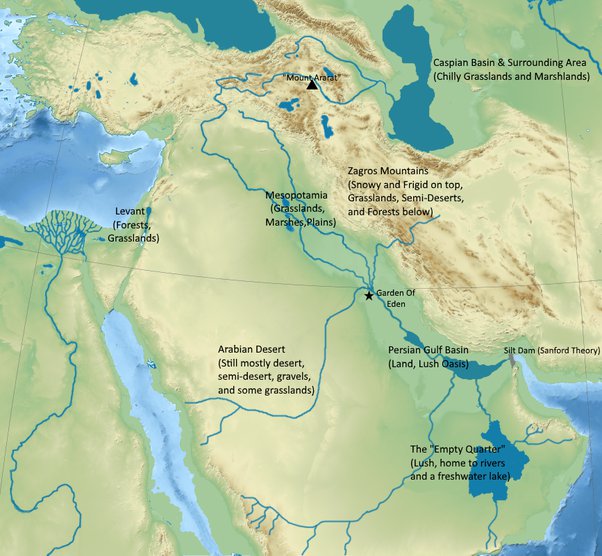
Well, to begin with, let us look at the first story. It concerns the presence of a great garden located somewhere on this planet.
It sounds very much like we are talking about a place in Mesopotamia where gardens were in abundance. Here, we know that the trees and other plants were productive in the foods they grew. And these were not small garden plots. They were quite vast and supplying an abundance of fresh food for the people living and working on the land in this part of the world. Seems logical to look at the first story relating to some great garden and what some humans were doing at the time. Furthermore, there seems to be a lesson to be taught from this first story, which covers things like food abundance, having everything we need and being grateful for it, and what happens when we can easily access what we need until we are tempted to have what we want if we have no other positive and worthwhile goals to reach for. There is a risk of us becoming corrupted in our thinking when we acquire everything we want. Even the way we treat our fellow human beings and the rest of life on Earth can reveal a lot about the harm corrupt people can cause when getting what they want. Furthermore, such corruption could see certain people claim they are God and that would be time when the wheels will have fallen off.
The only problem is, there can be only one God. There is no room in the Universe to support another. But this is part of the great lessons humans must understand. Hence the need to present this interesting story of the Garden of Eden and the appearance of two young individuals named Adam and Eve.
However, there can be other interpretations to emerge from this story, such as the idea that the "tree of knowledge" for which God wanted humans not to eat its fruit, represents everything we could hope to know, including the knowledge of what is good and evil. Of course, what is good and evil can be subjective. A good guiding principle is to look at how people would feel when an action is performed to affect them and whether the emotions to come from it is likely to be good or not. Otherwise, listening and empathising are essential to determining whether to improve one's actions or not. But at other times, it is not so clear cut. What seems to be important here is that people are not restricted from learning as much as they can about the universe and themselves, but having all that knowledge to become God is not possible. Even if we could become God, it would see humans and their propensity to become corrupt more evident when everything is served on a platter with no goals to reach for. Thus, we would be prone to committing evil (even if we do not see it as evil due to the level of corruption reached by certain people) including having more and being greedy and everything else that comes from this.
Whatever interpretation we should give to this story, one thing is certain. We do see God entering the story in a silent and seemingly necessary way. A God that seems happy to wander (in fact, walk, rather than slither, or even materialise as you would see in Star Trek) through the garden, while allowing a couple of young humans to do the same and benefit from the food abundance in the garden. And here we learn the first important lesson for human beings. It might still be considered a story, but a story-teller could quite easily have avoided mentioning God and just explain the consequences of living a totally stress-free life with nothing to work towards or achieve goals and expect everything to be served on a platter (e.g., through a well-established and productive garden). But somehow we cannot ignore God in this picture.
To what extent does God need to play in the development of our knowledge on how to live our lives in a harmonious and meaningful way, as well as show our love to all living things? Or is God there to act as the overseer and someone who could be watching us all the time and making sure we do the right thing as if we are children needing a parent to keep us on the straight and narrow?
Or, is there meant to be a clue about what has happened in human history and people simply want to remember this important event, including this mysterious entity from the sky?
The emergence of God does complicate things for the scientists and more so than it should, thanks to certain ancient texts that have come out of the woodworks in recent times. The most notable of these is the Zadokite Document discovered some fifty years ago in an old synagogue in Cairo. The document is a series of fragments representing various copies made of previous copies (no one copy can be considered an original as far as carbon dating is concerned). Each copy appears to have additions made, and others not. No one copy can be considered a complete text in its own right. A kind of compilation of writings that would get added or subtracted by different authors with each copy re-written onto new papyrus, depending on which information is considered relevant to include for future generations, but later certain people would settle on certain information and maintain it for generations to ensure the essential story remains essentially intact and to the original. At any rate, there is talk in one copy of the "Teacher of Righteousness" in the Damascus version, but is not mentioned in the combined scripts of Qumran. The fragments of the Damascus version do mention the very earliest text of the Old Testament, namely Genesis, Exodus, Leviticus, Numbers and Deuteronomy, but nothing else. These very early "biblical texts" appear to be faithfully recorded with accuracy on every copy. But there is other information in certain copies that is unusual and suggests that something else has been happening at around the time the great gardens were being established, or had been established, to have people thinking what could have happened. It is almost as if certain people, in re-writing the texts to create copies were deciding whether or not to include certain "controversial" information, such as the idea of God having influenced human affairs, or whether to focus on the core stories to help teach the essential concepts. Clearly there is an indication of one mysterious Teacher who appeared unexpectedly and was considered a kind of God and wanted to present these earliest stories to humans as if there are important lessons we can all learn from them.
The ancient texts give more details beyond mere concepts, including indications of how God would show its pleasure or displeasure at whatever humans were doing at this time. In terms of the decision by humans to grow gardens, this seems to be an activity considered in favour with God. Was this the time when God had an opportunity to inspect or wander around in the gardens and saw how humans lived and decided to mention one story about two humans living in the gardens? Maybe this God had seen something that could have been a concern and was best explained through a story to teach those who were willing to listen and learn. Indeed, any mention of a pitfall in this idilic lifestyle in the garden may act as a kind of "canary in the mineshaft" or litmus test from the perspective of this mysterious entity to help reveal what could happen to all of us if we don't keep things in balance and be aware of when things get out-of-kilter (or moving to one extreme opposite of life) in human society and what needs to be done to keep things in check. One of those issues relate to not having absolutely everything we want. Another is the concept of reaching for certain worthwhile goals for the benefit of others. Then, we have this situation where certain humans elsewhere in this part of the world were engaged in warfare and were kind of doing just that, taking and plundering the things available from others and not doing anything to replenish and rebuild as part of their life's work or goal to reach for. Regular warfare would occur among a number of men in this part of the world in an attempt to acquire things they considered valuable and make themselves rich. It is clear that God wanted to see people have worthwhile and positive goals to reach for, as well as to help others in need. To express this emotion of the good and bad, positive or negative, of all human decisions and actions and reflected in the decisions and actions of this God, the mysterious entity would show love and guide those people who do the "right thing" (as well as share ideas encapsulated in interesting stories passed down to humans), or no actions for the people doing the "wrong thing" but let the impending negative consequences occur (such as getting killed in human warfare or some natural disaster that was about to occur) or else do something to make it harder for certain people who are doing the "wrong thing" from reaching a certain destination, such as destroying key stone markers when travelling long distances. For example, the fragments will state the following:
Of God's vengeance and providence:
Now listen, all right-minded men, and take note how God acts: He has a case against all flesh and exacts satisfaction from all who spurn Him.
Whenever Israel broke faith and renounced Him, He hid His face both from it and from His sanctuary and consigned them to the sword. But whenever He called to mind the Covenant which He had made with their forbears, He spared them a remnant and did not consign them to utter extinction.
So, in the Era of Anger, that era of the three hundred and ninety years, when He delivered them into the hand of Nebuchadnezzar, King of Babylon, He took care of them and brought to blossom alike out of the priesthood and out of the laity that root which had been planted of old, allowing it once more to possess the land and to grow fat in the richness of its soil. Then they realised their iniquity and knew that they had been at fault. For twenty years, however, they remained like blind men groping their way, until at last God took note of their deeds, how that they were seeking Him sincerely, and He raised up for them one who would teach the Law correctly, to guide them in the way of His heart and to demonstrate to future ages what He does to a generation that incurs His anger, that is, to the congregation of those that betray Him and turn aside from His way.
If one could rely on these early texts for insights into our past, it seems to be a strange and complicated part of human history. How does one interpret these texts? What was happening to people at the time to make them write these texts and whgat did they see or heard to make them believe in the texts? What we do know, according to the archaeologists, is that Babylonia was a state in ancient Mesopotamia, and the city of Babylon was at the centre in central Iraq around 4,000 years ago. This would suggest that the above story may refer to the period after the gardens were established, but not as plentiful as it once was for whatever reason. There is no doubt that things were changing at the time. For example, we see this cave painting from Manda Guéli Cave in the Ennedi Mountains in northeastern Chad dated some 2,000 to 3,000 years ago as if the Sahara desert was not a desert, or at least not as extensive as it is today.
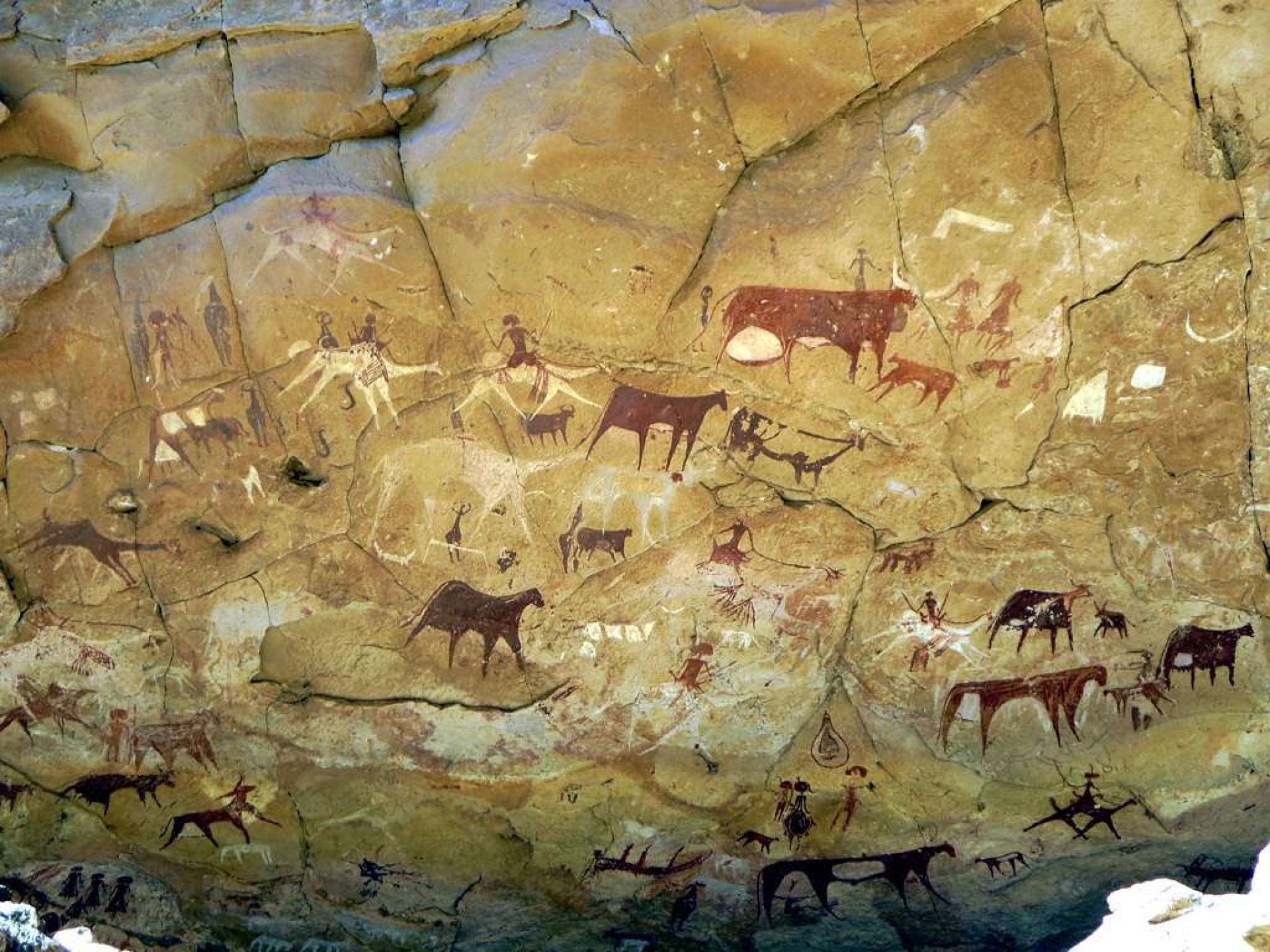
Indeed, the further back we go in time, the easier it would have been to establish a strong agricultural center. Get close to around 8,000 years ago, and the conditions in the Middle East would have supported a vast swathe of gardens in a number of areas across the Sinai region right the way through to the place we call Iran. However, just a few thousand years ago from the present day, the reign of such wonderful gardens came to an end. What was causing this change on the landscape? Was it to do with climate change? Or, were a growing number of humans affecting natural underground springs and becoming corrupt from the riches they could plunder from the area? Then again, it could also be through regular warfare and attempts to conquer resources and destroy other tribes who were in the way. This could have changed the landscape after destroying these gardens and affecting the effort of dedicated gardeners to tender to these gardens?
Or, perhaps the Himalayan mountains were just casting more of a rain shadow in the Middle East, and as world temperatures rose a little higher, things became too hot and the natural waters on the surface and underground were used up and could no longer sustain plant life except for a very few corridors along the last vestiges of underground water supplies in certain valleys and where rivers use to flow.
Whatever the reason, we also find other odd things occurring at the time. In particular, this was a time when an entity called God arrived. If the stories written by humans at this time could be relied upon as providing some insights into our past, then it it seems as though this God as the people called him and the "sons of God" were attracted to the sight of the great gardens in Mesopotamia. There is some indication these sons may have wanted to have "wives" of their own. As mentioned in Genesis 6 of the New American Standard Bible (NASB):
6 Now it came about, when men began to multiply on the face of the land, and daughters were born to them, that the sons of God saw that the daughters of men were beautiful; and they took wives for themselves, whomever they chose.
Scientists, of course, are a little unclear about what was going on at this time, or what the documents and this intriguing quote were referring to in relation to this matter.
If we can rely on this Zadokite document, we can see that God was unhappy by the level of interference and behaviour shown by his "sons". Even after dealing with his sons, he also noticed how some humans would behave when corrupted, presumably from the plentiful foods and other temptations in this part of the world. It was enough to see one story get created and past down through the generations to at least one human with an understanding of God's will and use the example of two humans in the garden to emphasise this point to those who were willing to listen and learn. It would appear that if this behaviour is not curtailed in some way, humans have the power to destroy whatever they may have created, including their local environment as well as the great gardens, and potentially cause serious harm to other humans who get caught up in the situation. If there is to be true peace and true sustainability, people must learn to live within their means, be happy with what they have got, focus on their needs, maintain the gardens for prosperity and productiveness (and even try to expand and improve the land to help maintain a humid and favourable weather pattern), don't try to be God and have everything, and help other people with their needs as part of the worthwhile goals we need to work towards and achieve in our lives.
Could this be the origin for the first Bible story relating to the great garden of Eden?
One thing is fairly certain: the Middle East back then was nothing like the deserts we see today. It was a time when the area soon after the end of the Ice Age had enough moisture from the rains, flowing rivers, and a number of lakes to allow large and beautiful gardens to exist, most of which were looked after by a number of people living in the area, and probably under the direction of men and later their daughters who inherited the land. After a period of time saw the gardens and agricultural areas properly established and productive in the food it could produce, little maintenance was probably required thanks to the prevailing rains on certain days, a land shaped to capture enough water to form lakes, a number of rivers could be seen flowing to direct excess water to the sea, and enough dedicated gardeners to make sure the plants grew well. And as time passed, much of the water could have seeped into natural underground aquifers that can bubble back up to the surface from natural volcanic hot spots or get released more slowly in another location.
The story of Adam and Eve in the Garden of Eden
Okay. So we have the first story in the Bible to discuss. It concerns two seemingly innocent-looking young humans who appeared in a garden somewhere on Earth, known as the Garden of Eden. Interesting that we have a garden mentioned as if it could be relevant at this time. We can safely assume this is probably in the region known as Mesopotamia, since the story originated here. Furthermore, there were great gardens flourishing in this part of the world thanks to some expected rich traders and their families paying others to create the gardens. Or perhaps it was a mutual decision among people in certain areas to establish the gardens? No one knows for sure.
At the same time, it is also a story designed to teach humans certain lessons. The kind of lessons that someone had conjured up and told to humans.
As the story goes, God created two humans. Hmm? How interesting. Why mention this? In fact, what type of God are we referring to here and how can it create the humans?
According to Eastern mystics, the true God is a paradoxical entity that is found everywhere we look and also within us. No one thing can be called a true God in total isolation to everything else. Instead, it requires us to see everything in its totality, including ourselves, before we can have a chance to fully understand this one and only true God. The true God is never localised in a statue, a person, a particle, or any energy that comes out of this particle. Like a piece of a hologram representing a smaller part of the overall picture, you need the whole hologram to see the complete picture. Thus, our choice of words, sounds and any other descriptions we may give to this type of God has always been limited and not perfectly representative of the true nature of this mysterious entity. Thus, to the Eastern mystics, they prefer no word or sound to describe this thing and instead use paradoxical statements as the best way to experience the true concept of God.
Throughout this journey, the true God (unnamed in Eastern mysticism) or whatever this mysterious paradoxical energy actually is, has been always with us all the way. It has been with us from the beginning, and will continue to stay with us to the end (if there is an end).
Thus, if anyone tells you that a particular person in history is the "son of God", that may be true. You can either take it literally to mean that someone we call God (a rather poor decision to name or describe someone with this term) is a father of certain children. However, this would imply God is a localised form. Or, for a true God you may see it in a more subtle way as establishing the natural hierarchy between God and every living thing. The true God has created everything. Therefore, everyone is the "son of God" and "daughter of God" (if we include all the genders in a balanced way), or more simply "god" (or "gods"). But if someone says he is "God in flesh form", this is nonsense. Nothing can be a true God in the flesh. As soon as you mention the "flesh", you have localised God into a biological form that moves it completely away from the true God. No one individual can ever be the true God. It would be complete nonsense. Likewise, if someone says to you that a given piece of land in the Middle East is God's land, this is not true. The person who says this has no understanding of the concept of a true God. A true God never discriminates and is never localised in a piece of land. The true God is found in all the lands and beyond. In fact, it requires one to view the entire Universe for a better understanding of the true God.
Well, remarkably, in science, we do see a similar paradoxical entity behaving in this God-like manner thanks to the oscillating electromagnetic energy known as radiation (or light in its most simplest way). This paradoxical behaviour was the sort of thing that had got scientists confused in the late 19th century, such as whether light is a wave or a particle. After much thought and thanks to efforts by people like Albert Einstein to understand the nature of light, scientists decided to accept two different pictures of how this energy behaves and see them as one with the help of mathematics.
Now, if we were to use this oscillating energy idea of science to represent God, then you could say in the most simplistic way that this energy did create two humans. In fact, it created everything in the universe. At first, this paradoxical energy (oscillating between the positive and negative opposites) can, under extreme conditions and very high frequencies, lead to the formation of ring-like structures to help create the fundamental particles of nature (i.e., the electron, the oppositely charged proton, and the combination of the two called a neutron). Once these particles exist, the simplest atom is formed, known as the hydrogen atom. Inside the very earliest hydrogen stars of the universe, more elements were cooked up under tremendous pressure, temperature and great energy density. Soon, heavier stars are formed and eventually the rest of the chemical elements get created and released into the cosmos through supernova explosions. After a passage of more time and the right places on the surface of rocky planets, certain molecules are formed from this incessant heating and cooling until eventually the first DNA-like molecule is created, and with it life. Give it even more time and a humanoid creature with reasonable intelligence will evolve on the planet. Hence, through this approach, one could say that God did create two humans.
However, people in the past would have a hell of a hard time understanding anything about electromagnetic energy. Far too confusing for the folks in Biblical times. Instead, the one thing that people do understand is the difference between light and dark. Therefore, it is more sensible and often better as an effective story-telling tool to start things off by saying, "Let there be light, and the universe is formed". The fact that the Book of Genesis in the Bible kind of mentions this might be entirely a coincidence, but it is far easier for simple-minded folks in Biblical times to visualise light as doing these things than having any kind of scientific talk of electromagnetic radiation.
Okay. So all of that sounds good and fine, except we do have an oddity emerging in the story in relation to this God figure.
You see, we have this situation in Mesopotamia in which some people think God is this "thing" that comes down from the sky and appears in a localised form. This "thing" has not frightened the people. If anything, there is talk that the people want this "thing" to help them solve social problems. Sounds like this "thing" is human-like. Then we see in the story of the two humans in the garden how God is able to walk through the garden, and speak to the humans. Huh? We already see localisation of the entity into a physical and shapely form with legs. And it has a voice to generate sounds that the humans can understand, and with it a brain, and with eyes to observe the environment. There is a problem here. This is not the true God talked about by eastern mystics. This is clearly a different type of God. And if God is not biological in form,. we see other stories in the Bible (which we will look at later) of how this God appears to humans, either as a great cloud in the sky, a burning bush, or even the sounds of a voice emanating from somewhere and making some old men think they are going mad or losing their marbles until the voice is so clear that they cannot mistaken the voice from the usual chatter in their minds.
If God refers to a localised form, then to explain God as being able to create two humans means that God can either rely on simple biological means of creating two humans, or there is a technological solution. In the former, sex is an obvious route, but this naturally takes the longest to produce the two humans and have them grow. If God is patient and has returned to see his children, does this mean God has fathered at least two children in the garden of Eden? If so, who is the mother of the children? What happened to her? Are the children twins or just a normal brother and sister combo? Or, did God have two wives, and each produced an offspring that later came together to run around in the garden?
All these questions are highly controversial.
However, if the above biological method was not employed, then the only other method, and probably faster with the right highly advanced technology, is to use genetic engineering and cloning techniques. But does this imply God is technically-advanced? If so, where did he come from?
Again highly controversial.
As you can see, it all depends on how you define God.
This is the thing: if we can rely on Eastern mystics on a more accurate and deeper understanding of the concept of God, then a true God is not meant to be localised in any form. You cannot point to, say, a statue or something else and say that is God. Not even a human being on its own can be called God. Even in science when some scientists talk about the "God" particle, this is nonsense as no particle in sole isolation of everything else can ever be described as "God". The reality is, God is here and God is everywhere just like the energy can be found here (and inside of you) and everywhere. Again, using the hologram metaphor, we are part of God, but we are not God in any singular sense of the word. No one person can ever be God in the ultimate truest form. There must always be a hierarchy established between the true God and all living things. We can represent this true God if our knowledge and experiences are sufficient to help other people (i.e., we become a god), but no living or non-living thing in a localised form can ever be called the true God. The only thing we can say is if it is a living thing that can influence other living things, it is acting as a god (or is God-like if it is done with love and balance). It kind of represents God, but under no circumstances can it ever be called a true God for it does not know everything about love and have all the knowledge to know exactly what to do in any situation to its ultimate level. A god is always learning and adjusting based on the feedback of others who have been influenced or interacted with this representative of God. While we are learning and capable of influencing other life forms and other things around us, we are merely gods in potential need of improvement. In which case, anything that can be observed from the sky in any localised form to influence human affairs on the ground might get described as God by simple-minded folks in Biblical times. However, in modern times, it is nothing more than a god (or gods). Therefore, we must face the possibility that whatever was seen in Biblical times and described by certain people as God is almost certainly nothing more than a god, or gods. A god with highly advanced technical abilities to reach us. And it is a god that has a remarkably solid knowledge and insight of how to socialise and look after living things. The kind of knowledge that might get shared with some humans at certain times to help influence us.
Does this mean that we have to consider the possibility in the story of Adam and Eve of a god (or gods) with the technological ability to do things like cloning techniques, and some genetic engineering, to create these two humans? Or, was it a natural sexual encounter between a (male) god and a (female) human leading to the "creation" of these two offsprings? This is where things get controversial. Yet the story is clearly pushing us in this direction rather than see God in the truest form as described by Eastern mystics.
Yet if one looks more closely at other stories in the Bible with a connection to God, it is strongly supporting a localised form of God. For example, we see a crucial moment when Moses asked God for a name, and the entity from which Moses thought was God chose not to give itself a name.
In Exodus 3:14, Moses asked God for a name, and the reply he allegedly received in Hebrew was, "ehyeh esher ehyeh". When translated to English, it literally means, "I am what I am", indicating that God did not wish to reveal its name. The only problem is, by saying this, God has effectively localised itself through the sounds representing these words when it spoke to Moses.
As another example, we see in Exodus 33:20–23 the following statement from God when he said to Moses:
"But," he said, "you cannot see my face, for no one may see me as and live."
Then the Lord said, "There is a place near me where you may stand on a rock. When my glory passes by, I will put you in a cleft in the rock and cover you with my hand until I have passed by. Then I will remove my hand and you will see my back; but my face must not be seen."
However, in Exodus 33:11, God allegedly said:
The Lord would speak to Moses face to face, as one speaks to a friend.
Huh?
The only way this contradiction in God's statements can be resolved if we realise God is not a true God. Rather, we have a "god". Whoever this person is, the one doing the talking could be a leader of a group of individuals who might be going around helping different primitive civilisations to evolve and better understand the principle of love. But since this leader has a better understand of the true God and knows it cannot be directly observed, it attempts to explain this by saying "face-to-face" observing is not allowed by anyone. No one will survive if they try. However, this leader, on knowing it is not a true God, can bend the rules a little when he encounters a person like Moses. Thanks to Moses' deep understanding of the principle of love, this leader is willing to let Moses observe him face-to-face.
But if God is meant to be localised, why would God say to Moses, "I am what I am"? Couldn't God suggest a name to Moses by giving some kind of a specific sound pattern for humans to pronounce and a symbol to write down? In fact, after Noah’s encounter with God, we find humans did exactly that, by creating the sound "Yah" and its corresponding ancient Aramaic symbol to represent God. Later, the Jewish scholars made their own contribution by extracting "yeh" in God’s response to Moses (i.e., "ehyeh esher ehyeh"), and merged it with the Aramaic version to form the word "Yahweh" (or YHWH). However, what we think is God had deliberately chosen not to do this at all. It chooses not to give itself a name of any kind. This is not because God could not speak the language spoken by Moses and create a suggested sound pattern and symbol, but because God, quite rightfully, wished to remain nameless. Either it was being incredibly modest in its response, or more likely it definitely knew it cannot be a true God and did not want to make a false representation of being God, but rather act in a God-like way in front of this human named Moses. Already localised in its decision to use a voice to represent what Moses thought was God, whoever spoke those words to Moses had to be another "god" (or gods), and it seems like this god is trying to influence humans to follow the right path with the help of Moses. Of course, for Moses, he wouldn't have known. To this "god" entity, it must avoid Moses thinking that this voice may not be God. Any indications that Moses might think this entity could be the opposite (i.e., the devil) would be sufficient to ignore the voice and nothing would improve in human society even if it seems the ideas or recommendations to act and do certain things are good. From the entity's perspective, it is better to be cryptic in the answer. As this mysterious entity understood, there really should not be a name, or a sound pattern to use for a true God. And it knew it cannot use itself to claim it is God when it is fully aware it is not God at all. Hence the cryptic answer it gave to Moses. Very sensible. It was being cryptic in its answer because it is not the true God, just a representative of God. But because humans in the past needed simplicity in the answer, God left it to the imagination of people like Moses to interpret what was seen and/or heard from this mysterious representative of God. And in the minds of these humans, it is the closest thing to being called "God". Even if the concept of God according to these humans in the Middle East is completely wrong, it is something we have continued to maintain right to this very day. Otherwise, the voice could have given a name if it wanted to. But it didn't. It could have given a more accurate answer to help give us more insights into this nameless entity and who was speaking to Moses. For example, why not say, "I am what I am, but I am not what you think I am" just to add to the cryptic nature of the answer. However, to avoid any doubt creeping into Moses' mind about who or what this entity speaking to him is, this thing for which Moses believed to be God kept it simple and sweet and yet open to the possibility of what it could be in reality. A kind of leading Moses along the path that he wished to believe was speaking to him. And fortunately he thought of this entity as being on the good side for him to listen and follow. To Moses, he thought this entity was God based on his understanding of the concept, but not realising the God he was speaking to is a localised form and not the true God. So whatever Moses or anyone else may want to call this entity, the entity itself has chosen wisely not to give itself a name and a sound pattern for us to pronounce with any absolute precision. Otherwise, it would be a false God. It sensibly knew not to call itself a true God. The rest is just a creation by humans wanting to localise this entity and help fill in the gaps in an attempt to put a name to this mysterious entity. This seems to be reinforced elsewhere in the Bible where we find another statement allegedly made by God in Exodus 23:13 (King James Version):
"And in all things that I have said unto you be circumspect: and make no mention of the name of other gods, neither let it be heard out of thy mouth."
This entity is telling us not to worship other gods (or the false God). Once humans decide to categorise this entity with a name or sound, or brought to life into a statue or whatever other form of representation of God people creatively come up with, you are effectively localising God into a specific form. But as soon as you do that, you have effectively moved away from the singular true God of unity and absolute balance of the universe, which has no name or sound or anything we can use to say this is God. Once you have chosen to localise the entity, no matter how balanced you think you are, you fail to see the complete opposites and everything it represents in the universe and life itself. You miss the point and you lose all understanding of the true nature of God. Basically there is nothing within this universe that can ever be used to identify as God. The entire universe is probably closest thing we have to God, but no one can be certain about this. If the universe is finite in size, it is localised and hence cannot be the true God. But if this visible universe is the Universe (i.e., goes beyond the boundary of where we can observe) and could potentially be infinite, that could be a different situation. However, because we don't know the true answer (not even the scientists in their belief in a finite universe have got it right), for now, all you can do is get a sense and feeling of its presence all around and inside of you through experience, and hopefully helped along a bit by some insights learned from gathering the right knowledge to help you focus your senses on the entire universe and so determine whether this mysterious unity of the universe is actually true. But whatever we do, we have to remember that the aim is not to speak or create through one's own hands a representation of what you think is God. As soon as you do this, you will lose all understanding of God.
Yet it is amusing to see how Jewish men want to put a name to anything and everything, including God. And since then we have continued to fall into the trap of using this name or any variations on the name in different languages (i.e., God in English) and cultures to help represent this ultimate unifying thing, but never actually fully understand it. As a result, our understanding of God has continued to confuse many religious leaders in nearly all world religions to this very day. Amazing! It reveals how little humans have grasp the true concept of God.
To better appreciate how easily we can move away from the true God through words and sounds, the problem with trying to name this mysterious thing with the word "God" here on Earth is what happens among other primitive civilisations in the universe? Surely, each civilisation will have to come up with its own unique or different sounding name and visual symbol for God from its own history and culture. If they choose to maintain the word and sound representing God, we will soon have an infinite variety of different ways to name and pronounce this thing called God. In fact, in an infinite Universe, there could be a sound pattern out there in the universe that reminds us of the worst four letter word in the English language. Not a flattering word no doubt. But to the other civilisation, it is perfectly alright to name and pronounce the symbol in its own way. However, where the problem begins is what happens when the two civilisations meet. As soon as you do this, our civilisation will get confused and even offended by the sound. We start to think the other civilisation is not showing respect to this God of the universe. No wonder people will get confused about what God you are talking about. Imagine if you don't choose your sound patterns and pronunciation very carefully. You could end up starting a war with another primitive alien civilisation all because it sounds like someone is being disrespectful, rude or offensive. Yet what is not understood among people of primitive societies is that everyone will naturally have a different picture, word and/or sound for God based on their personal understanding of what God is. The problem in doing so is that certain primitive societies may not realise that no one is technically wrong. This is already a common problem here on Earth. You only have to talk to Muslims to see how they view God, the name given to it (i.e., Allah), and the different sounds used to represent it, and it will somehow be seen as different from the word "God" of Christianity or Jewish religion. In fact, wars have been fought between Christians, Jews and Muslims over the millennia because of these supposed differences within their religions, including this concept of God. And countless people have died as a result. This is the fundamental problem of religion. No one can agree even on the word and sound to use for God. Therefore, for simple-minded folks, how do they know if we are all talking about the same entity? Well, to get around this problem, you start by not giving God, that is the true God, a name or even a symbol, and hence a sound to use. It just is. You don't need a statue or painting to represent God. You merely experience it. That is how you simplify the situation and avoid the confusion among simple-minded folks. This is the only and simplest solution.
Thus, we may use the word "God" with its capitalised first letter in an attempt to get closer to the true God, but as soon as you pronounce this word or have the word written down, you will have immediately lost any understanding of this true unity of the universe.
Does this mean the Eastern mystics are closer to the truth in their understanding of this mysterious entity by choosing to see it as nameless and without a sound? Perhaps.
But there is also another good reason not to try to name any object "God" or create any sound to represent "God". When people start idolising, say, a statue, thinking this is God, at some point in their lives they will start to believe that this statue will help them to solve problems, whether at a personal level or more globally. Maybe they hope for some kind of divine intervention to take place or hear those voices enter their head as the prophets in the past have experienced. If this happens, perhaps they will act and do something to solve the situation. Well, apart from not knowing what kind of solution people will come up with from their own imaginations, it can also see people do nothing for a long time until they think the statue has provided them with a solution. What people do not realise is that the one true God is never in any one thing or sound. You have to look at everything to understand the true unity of the universe and what it does to restore balance. In fact, this is seen as a very important first step to solving any problem. You gather information from a wide variety of sources. If people ever wish to think and decide in a manner that is more closely befitting that of God, you need to consult widely and listen to everyone, including your enemies. You need to understand what it is like to be in the shoes of all the people, especially those who are affected by a given problem. Only then can you begin to see a solution, and a balanced one, that approaches how God would solve the problem as well. You do not stay in your own little group or by yourself and expect to know the answer. How can you? Because then the answer is often to do the same things that maintain the problem and yet expecting a different result to come from it. But it won't happen that way. In fact, this is just the definition of madness. You have to do something different to solve a problem before you can see balance restored. You must listen to everyone, even those you may feel comfortable because they are your enemies. But don't worry. This is just the sign of someone who is showing true empathy and a willingness to show compassion when we understand how others experience the problem.
In conflict resolution, you have to learn to become more God-like in your knowledge and experiences when understanding a problem to its deepest level before you can have a chance to solve the problem permanently and peacefully. For that to be possible, it requires you to gather as much information as you can from all sources, including those people who are involved in the conflict.
For now, and in order to keep things simple for the masses, we shall continue to use the term "God" in this discussion. This is the God that is seen as localised at certain times in history and has probably appeared to humans in the past with the aim to influence us to follow a path with a heart.
As for the story of Adam and Eve, here we have two humans wandering through a great garden. We also learn that this man allegedly came first and walked alone for a while before he mentioned his loneliness. Not long after, the woman appeared and became a companion of the male. Her origin was said to be from a portion of the Adam's ribs. Sounds almost like whoever this God is, may well have a sophisticated technology to create at least one extra human through genetic engineering. As for the male human, it is not clear how he came to exist unless we have a true God able to create out of nothing this first human being, or we have a god who has acquired this young human male by some mysterious means. Perhaps it was a natural birth and we are none the wiser who the mother is. Speaking of the mother, no signs of human parents to be seen anywhere, which is quite odd. Or is God the father? Either these two individuals were orphans, or perhaps they were related to God in some way? Or should we consider this as nothing more than creative story-telling?
The order in which these humans appeared should also not matter either (at least not in today's society, and certainly not for a true God). Like we don't treat a newborn boy who comes out first any differently than a girl who comes out second or vice versa, balance should always prevail for both genders by treating both equally. Just as a true God does not discriminate, so too should we do the same with the genders. It just so happens the Bible tells us that it was a male who appeared first followed by a female, but this could be like asking what came first, the chicken or the egg? Someone or something has to start first. The choice of a male to start the process could well be a decision by the story-teller to start from this point (just like the Universe must have a beginning given the linear way most people tend to think and find easiest to understand when looking at the world). Or else the person was influenced by his own gender to think males should be the ones to start first. Or was it because God's first encounter with humans began with a male human? Or did God's voice and eventual appearance with one old wise man influence the initial gender for the storyteller? In other words, was God a male? Or did God decide to perform a genetic experiment and made the decision to try a male first before introducing the female (perhaps a case of trying out the draft form first to see what it looks like before releasing the much improved Version 2.0 female later, which would explain why a number of males today might say their female partners represents their better half)? It probably does not matter.
Indeed, why is the couple named Adam and Eve? For all we know, the couple could have been named Jack and Jill, or Romeo and Juliet. Religious leaders will no doubt find hidden meaning in these names.
We can also see the couple had been permitted to live in what was effectively a paradise. More specifically, a garden. Hence the name, "garden of Eden". Not the cactus variety of desert gardens we are familiar with today in the Middle East. Rather one with lots of edible and productive trees and shrubs given how much emphasis has been made of the food in the garden (e.g., figs, grapes, pomegranate etc.) as if it was made by the hands of some handy gardener(s). Sounds familiar. Are we referring to the great gardens in Mesopotamia? As we will learn later, the gardens contained many fruits. Not likely to be a rainforest as the trees grew figs as needed by the couples later to grab some large fig leaves as we shall see later. Sounds more like we are referring to a garden in the temperate zone. As the story was only told in the Middle East, it is probably referring to some place in the northern hemisphere located between northern Africa and India. Certainly has all the hallmarks of relating to the Middle East given that this is where the story originated and a number of great gardens did appear not long after the end of the last Ice Age. And does this mean the couple were vegans? Whatever you may wish to believe. At any rate, whether the couple knew this garden was a paradise would require them to do some comparing with something else. Apparently they did not know of another garden (and so make statements like, "the grass is greener on the other side" just to reveal this comparison ability) other than they took it for granted that they had this garden to do as they pleased (well, they were not described as gardeners, but ones to enjoy the fruits of someone else's labour). It did not seem the couple ventured far from the garden. Or else the garden was very large with no perceivable boundary. But why travel far? A paradise is all humans ever need to survive and be happy on a plot of self-sustaining piece of land, as God thought. There is no indication from the Bible that the couple saw the place as anything special or needed to travel far to gather their sustenance or be curious about what is out there in the wider world. Everything seemed safe and plentiful in the garden for the two to enjoy. But if they ended up being bored by the garden, they could easily walk a great distance to reach some kind of boundary. Apparently not. It looked like the couple had no experience of a different environment. And no real need to explore beyond the boundary of the garden out of sheer boredom. About the only other thing we can glean from this simple story is that we have a very big garden given that they do wander around a lot and don't mention anything unusual beyond some prescribed boundary. Too big for the couples to wander off and reach the very edge of it (or could be a metaphor for the Universe we live in and how it can be seen as a "garden", especially around those habitable planets surrounding Sun-like stars).
As paradise was seen in the garden by the couple (due to the abundance of food, effective shelter, and plenty to keep the couple entertained and playing games), we can safely assume trees naturally grew in relative abundance and were of a size and maturity to bear enough fruit. Indeed, talk later of the couple hiding from God suggests that the trunks of the trees were quite large (with the trees themselves well-established) and/or there was a prevalence of thick bushes in various parts of the garden. And where there are plants, there should be water. Makes sense so far. Also, as far as the food was concerned, the humans only needed to be vegetarians by sticking to a diet of eating fruits, grains and any other plant-based material. Not as bad as it sounds so long as Eve had knowledge of herbs and cooking to make the food more tasty and provide variety, except God had one rule for the humans to follow. Sounds simple enough. Surely the couple could not stuff up this basic request from God, right? You've been given this paradise to do as you please, so what more do you want? You should have everything you need to be happy. The humans occupying the garden should have no need for anything more. Be grateful with what you have got. So, as the rule was explained to the couple, God would allow the humans free reign in the garden on the proviso that neither one eat the fruit of the forbidden tree. And it seems God pointed out the tree in question for the couple to observe so that there would be no confusion. "You see it there? Good. Now don't eat from it." as we can imagine God might say. Still, this did not stop Eve, the one who was most restless and curious and the first to be tempted sometime after God had left from trying out one of the fruits from the forbidden tree. And she would do it when God was not around just to see what was so special about the tree.
Perhaps there is a clue as to why God created man first before a woman. The needs of males are simpler. Some food, a bit of wine, a place to sit down and relax (give him a remote and let him watch football) and he is as happy as Larry as they say, and that's just about it. Men usually don't complain or get too creative in trying something different if they have everything within easy reach and can meet their needs. Once males have what they need (and are not aware of the existence of females, so they won't realise what else they might need), there is nothing more males ever want. However, bring in a woman and before you know it, the male has to work harder, usually to satisfy the needs and wants of the female (understandable as she must create a comfortable nest to support her offsprings). But the female in question was not a woman. No indications of a marriage between them, let alone one that was consummated in the garden at some point with a sexual romp. It was like the couple had no idea the purpose of their reproductive organs, or why one had enlarged breasts and the other had this thing dangling between his legs. They never saw each other as having any other purpose or benefit to each other, sexually or otherwise, except as friends, someone they could talk to, and play some relatively innocent games together just to pass the time.
These individuals were very innocent-looking, almost child-like in their thinking. Nothing clicked in their minds to see each other other than like two children playing in the garden.
Despite having everything the male could ever want, he wasn't a particularly strong-minded individual. Perfectly understandable. Being child-like with limited experiences and education means there isn't much to know. He didn't have adequate knowledge to know what's right or wrong, let alone enough experiences to gather this knowledge. Therefore, he would be highly susceptible to Eve's persistence to do something she wants even though he knows he shouldn't because God commanded it. He must have thought about it. Probably not much to think about if the knowledge wasn't there. A case of the 1984 movie "Dumb and Dumber" starring Jim Carey and Jeff Daniels you might say. The decision must have arrived rather quickly for the male given enough pestering from his female companion. His conclusion in the end was to support Eve in her decision to try out the fruit. Reason? He too couldn't quite see what the fuss was about in not eating any of the fruits in the garden. Of all the trees, why would this one sacred tree need to have special treatment? And there are enough fruits on this forbidden tree just to weight in a litle more on their decision and make them think it must be okay, so what's the harm in eating just one. Or instead have a nibble in one end. Who would see what they did? Perhaps even keep the fruit on the tree and nibble at the back of it and let it continue to hand there and walk away. God wouldn't see anything unusual in the fruit. In fact, put Eve on Adam's shoulders and lift her up high enough and let her have a nibble at the back of the fruit. Much harder for God to see anything out of place.
If you think this sounds like a test from God, you are not alone. In psychology labs, tests have been performed on children to see how they behave when left alone in a room and given something tempting such as a cake on the table for them to look at. Even if just one child is in the room, the result at the end of the experiment is always the same. Basically, how it works is that you tell the child not to eat the cake. The rule is clear. The child has heard your request. The child can see the cake, so there is no mistake about what item we are talking about. You leave the room and the child stays in the room, with the cake nearby to tempt him/her. However, no matter how simple and clear this rule might seem, it is inevitable, given enough time, to see the child eat a small portion of the cake when he/she thinks no one is watching and then tries to squeeze the cake together to make it look like he/she has not eaten it. Not long after, the adult returns and asks if the child has eaten the cake. The child will look elsewhere and say "No". The adult draws the child's attention to the cake. The child looks, but naturally denies eating it. Tries to show that the cake is still there. When the adult looks at the cake and says it is a bit too small, the child will claim an invisible friend had eaten some of the cake (trying to rely on creativity to find any old reasonable explanation in his/her young mind). A clear sign of the lack of knowledge and experiences in the child to come up with a better explanation. Keep pressing the issue and eventually the child will have to cave in to your constant questioning and admit he/she has eaten some of the cake even though the child was expressly told not to and yet he/she made the decision to eat it because he/she couldn't see what the fuss was about. It is just a cake. Well, maybe. But what if the cake was poisonous? Would the child still eat the cake? Perhaps made by the hands of an alien chef and certain ingredients are completely incompatible with the human gut system. Without explaining why, it is very easy to see how humans behave when there is a temptation put in their way and don't understand why it exists and the importance of leaving it alone. It is not yours to have should suffice as an explanation. Learn to live within your means. Go without and maybe you will be rewarded later, Yet some people do not listen. Very naughty. Well, the exact same scenario was taking place in the Garden of Eden.
In Eve's case, she was a little on edge about trying out the forbidden fruit at first. She kept walking past the sacred tree and ruminating in her mind about what was so special about this tree. At first she was not sure if she should go ahead with her wish to eat one of the forbidden fruits. Then she came up with the brilliant idea. Why not get support from someone else. Someone who could say it is okay to try it. She naturally approached Adam (basically the only person she could consult with in the whole garden). Adam, who is obviously not God, looked at her. Probably wasn't terribly forthcoming with his support at first. Good lad. Perhaps he told her they shouldn't. Should we not listen to God? Yet the nature of God in the eyes of Adam and Eve was not of a strange "non-human" entity who looked bizarre. God looked like any other person, but perhaps a little older and wiser. God did not seem to be a monster of some sort. And anyway, how does God get his sustenance? Never once did the couple see God eat anything from the garden. From this sacred tree, perhaps this is God's source of food? Who knows? Yet Eve was restless. But to feel safer, she wanted to get Adam's agreement to make it seem alright. Eve needed to tempt her companion Adam to try the fruit and make him believe there is nothing wrong with eating the fruit if all the other fruits could be eaten. It took a while to get to an agreement as they walked past the tree a number of times. She must have been bored by the garden and wanted more, and she kept walking past that strange-looking tree. Her creative mind must have been working overtime, and she couldn't understand why God was denying her the opportunity to at least taste the fruit. What's wrong with a little nibble on the fruit? Or even a lick on the sides? No one would ever know, right? If she could get Adam to, at least, agree to do it with her (apparently he was prepared to do the right thing if he was left to his own, but now he had this woman to contend with and he hadn't learned enough to know what the consequences might be if he caved in to Eve's demands). He could have said no, but he too became tempted by the idea introduced into his mind by his female companion. He too could not see what the fuss was about over one fruit on a tree. Surely the tree will grow a new piece of fruit and everything will be back to normal. Or maybe the tree was loaded with fruit? More of a bigger temptation no doubt. What's the big deal in having just one fruit to share among the two? All Eve needed was to hear Adam say it is okay thanks to a little peer pressure from her to help gain his support for what was effectively her decision, and at the same time perhaps give her an opportunity to point a finger at him should she get into trouble with God. Geez, thanks Eve! After much pestering, Adam couldn't see what the consequences would be, so he eventually agreed (probably explains why the IQ of men tend to go down quickly in the presence of females in order to agree with just about anything the females want), and both of them quietly crept up to the holy tree bearing the forbidden fruits. They looked around. No sign of God to be seen anywhere. They must have started to feel guilty in making their decision. Doubt was slowly entering their minds. However, a little extra temptation came from the snake that just happened to be lying in the tree. And the argument this animal posed to the humans seemed to have made the case of eating the fruit a little more convincing to the couple. Finally the decision was made. The couple grabbed one of the fruit and together they both promptly ate it.
The fruit was not described in the Bible. A popular thought was an apple, but apple trees were not part of the Middle East food bowl. Whatever it was, it didn't frighten the couple in the garden. Either a fairly earthly-looking fruit, or something more exotic that looked "interesting enough" to eat. If only the fruit had numerous thorny spines all around it, then perhaps it would have changed the outcome. But as God created the universe, this was something God hadn't considered just to make life easier for the humans.
At last, Adam and Eve tasted the fruit. Turns out it wasn't poisonous to their body. They were able to survive it. Furthermore, the fruit must have tasted okay. Nothing really exciting for them to say to each other, "Ooh yummy! Let's eat another fruit, and another..." and so on.
Apparently such thoughts are not considered relevant to the story as we are told by the story-teller.
Naughty as Adam and Eve were in going against God's request, they potentially could have got away with it considering they did not die from eating the fruit. More importantly, it would be hard for God to know for sure what had happened (unless God was like the psychologist in the laboratory already watching the children in the room from a distance). Plenty of fruits on the tree would easily cover up the evidence of the couple's wrong-doing so long as God was lousy at maths and couldn't count (and wouldn't have the time to spend just to find out), and the couple could keep quiet and acted normally like nothing ever happened. Certainly God did not immediately notice any change to the tree on his arrival. He didn't say, "Hey, you two, where did one of the fruits on the sacred tree disappear to?" Surely, God must have walked past the tree and yet saw nothing out-of-the-ordinary. He simply didn't notice anything missing. Well, that would have been extremely good for the couple, so long as they could remain simple and innocent in their thinking and behaviours. However, what the couple discovered after eating the fruit and had not anticipated was the effect the fruit had on them, and they apparently could not act normally because of it. It looks as though their brains were not large enough, nor did they have the sufficient time to digest all the knowledge and use it in a way to help get them out of any new problem they were seeing, let alone use the knowledge to achieve good things for all living things. They experienced for the first time a sudden acquisition of so much knowledge that the first thing it did was make themselves self-conscious of how they looked to each other. No doubt they were naked. Probably a testament of how warm it was in the garden, as if we are in the summer time in this temperate zone of the planet. Yet it never crossed their minds to think why, other than the fact that it was very warm in the garden, so no clothes were needed. Indeed, they had never thought about this very issue of their appearance until now. They were always innocent and child-like, even right down to not knowing the purpose of their sex organs. Even despite being well-developed at the moment of eating the forbidden fruit, they would not be bothered by their appearance. However, now the forbidden fruit had changed all of this forever. The fruit had given them extra knowledge. It made Adam wonder why Eve's breasts had started to look more appealing to him. Even Eve was having thoughts about that thing dangling between Adam's legs and wondered, "Hmmm, I wonder what that might feel like". Well, instead of having sex and finding out (and even using the knowledge of natural contraception), this excess knowledge was apparently too much for them to handle. They were afraid. Not knowing how to handle their emotions and bodily behaviours on seeing each other, the couple decided to pull off some large fig leaves from a nearby tree and found a way to place them on their bodies to preserve their modesty and so avoid playing around with each other in more intimate ways. We now know the garden had plenty of fig trees, and fairly large ones at that too. Nice large fig leaves to help with covering those intimate regions of the body. But unfortunately, the couple's decision to hide their modesty from each other revealed another major problem for which neither of them had thought about before — they would lose their child-like innocence and could not act child-like in the presence of each other, or to God. They were worried that if they saw each other naked, strange bodily reactions would take place, and they would have trouble controlling them. Then, sure enough, God will know something was up with the couple (not necessarily in a literal sense, although that could be the reality). Obviously, if the couple were smart enough, the secret to solving this problem would be to apply more imagination to visualise something else to help stop those unwanted sexual urges from appearing. This is a common technique applied by female dominants with submissive men to force men to use their imagination to help control their sexual behaviours. Indeed, the ultimate aim for these females is to be able to comfortably sit on a guy's face naked or in an underwear and they can read a book or have the remote control to watch TV and the guy should be able to visualise and not see anything sexual in the situation. Even if the females ask the male underneath to stick his tongue out and start licking, it should be seen by the male as like licking ice cream from an ice cream cone. No erection occurs in licking ice cream, so if the male visualises hard enough, he should be able to convince his mind and body to see the situation as exactly like licking ice cream, and with it have absolutely no sexual urges coming from this situation, no matter how intimate this may appear at a superficial level. Hence the need to train men to develop the brain to handle this situation with ease is a solution. And females are usually more naturally creative and imaginative to do the same with their own bodies, so they can do it more easily than most men can. But this is part of the fundamental knowledge the couple in the garden had not realised. The story makes it clear to us that Adam and Eve didn't know how to visualise in their minds to force a different behavioural outcome. Funnily enough, this is the same problem men of Islamic states have. They must create a law designed to forbid women to expose their faces or heads, and certainly not their legs and arms or any vestiges of a pair of female breasts. They must all be covered in clothes from head to toe. And the only reason why this is necessary is because men of the Islamic faith, especially those of the fundamentalist kind, have not acquired the skills to visualise and see things differently in order to overcome any perceived sexual behaviour that might come from viewing women in a more "naked" form (i.e., with a short dress, exposing the face, making everyone aware the female has breasts, and so on). Well, we see the same situation with Adam and Eve. The knowledge was there and they didn't know what to do with it and how to implement it quickly enough to help each other learn to overcome their bodily behaviours and sexual urges. The couple were simply not trained in the art of thinking about something else that wasn't of a sexual nature to help control their bodily behaviours. A case of mind over body as needed to control the body's behaviour using the frontal cortex, except this region of the brain wasn't fully developed and able to understand or handle this kind of knowledge. Therefore, it seemed the only simplest solution, which at the time seemed reasonable, was to wear the fig leaves (and hence the origin of clothes, not just to keep warm, but to hide those things that might affect other people's bodies in intimate ways). Out of sight is meant to be out-of-mind as the old saying goes. And if it is not in the mind thanks to this rudimentary form of clothing created by the fig leaves, the body does not have to follow with its own instinctual behaviours. The choice of using fig leaves was technically a good solution to the problem they were having, but they did not think it through the consequences right to the end, including how God would react. They did not think about the questions God might ask to get to the truth to the matter. Consequently, and thanks to their limited thinking skills, the decision to wear the fig leaves turned out to be their undoing. Because, as the story goes, we discover that when God returned, the couple did not know how to lie to God and take the risk to see if they could get away with it (well, not likely if God was a psychologist watching the experiment at a safe distance. You might as well be honest with God, right? In which case, why did the couple do it anyway? Again, too child-like, and with limited frontal-cortex development to think through the situation and see the consequences of their actions). Seriously, it wasn't really hard to figure out. God did not even have to count the fruits on the tree to discover anything amiss or notice any one fruit had a nibble at the back of it, or watch the couple fornicate like wild rabbits in the garden. Although it would probably be preferable to fornicate under the circumstances and remain naked because at least you had a chance to relax those sexual urges, get rid of those sexual hormones racing through the body, and kind of look more normal at the end of it. Then the sight of those sexual organs would no longer continue to have a physical effect on the body. Hence another solution to the problem. But even if God caught them in the act of making-love, one could argue that they had reached an age of sexual maturity and physical readiness that the idea had just suddenly popped into their heads, coincidentally at the same time for both of them. So what are they to do? God might as well let them find out what it feels like. In which case, God might be totally understanding of the situation. But that was not how it went. The couples thought the fig leaves would solve all their problems and avoid any chance of sexual contact with each other, which kind of worked to a certain extent. Well, let us put it this way. How strange would it be to be talking to God and Adam stood there with an erection each time he glanced over at Eve? Whereas Eve would be showing her puffed up and pointy nipples. But then again, perhaps this would have been more preferable under the circumstances. Or, would it be another give away like wearing the fig leaves? At least the latter would be just as incriminating as the former. God must have known as soon as it (or He) saw the fig leaves hanging on the bodies of the two humans. No need to see sexual organs getting stimulated. The fig leaves did all the work to tell God something had happened in the garden. But he couldn't quite put his finger on what it was. He hadn't noticed anything amiss on the sacred tree, or so it seemed. Or maybe he hasn't walked past it yet. Whatever the situation, God could see something had changed in the couple. Now if only God could figure out what it was the couple did.
In case there was an innocent explanation, such as the couple wanting to play around by wearing these leaves just for a bit of harmless fun or perhaps they had accidentally brushed past each other and touched their intimate regions and suddenly felt something they never experienced before but were too embarrassed to explore the idea, God asked them why they covered themselves. The couple were not very good liars. If only they could came up with a brilliant story, such as the snake having forced them to eat the forbidden fruit while their hands were tied behind their backs by the snake (well, the snake did have a big enough brain to talk in the language of the couple, and it had limbs prior to God punishing the snake by later forever forcing it to slither on the ground, so surely it could manipulate the environment). Just throw in some evidence of broken twine or rope at the base of the forbidden tree and some marks on the wrists of the couple and God would probably have to believe the couple's story. Well, let's face it. The words of two people corroborating on each other will probably go down better than the word of a snake, unless God was hiding among the trees and had recorded the whole scene to show the couples later on what had happened. Unfortunately for the couple, they couldn't handle the knowledge to be like God and use it appropriately for positive purposes, let alone lie effectively enough (not that it would help them a lot if God was already testing them) through a plausible explanation to get them out of their predicament. Nor did they have the imagination to find at least one good explanation, let alone control their sexual behaviours on seeing each other naked. As a result of all this, the truth came out faster than you can say, "OMG!" and this led to the fall of man from God’s grace and banishment of the couple from paradise.
Then again, it is always possible such a story was designed by a crafty story-teller (in this case, none other than a man named Moses) to explain certain things about humans (and, by implications other living things). Such a story could have absolutely no bearing on any real event in history.
In summary of the lessons this story is meant to teach us, they are as follows:
LIVE WITHIN YOUR MEANS
Be happy with what you have got. You have food, shelter and ability to think freely and not be controlled by anyone other than follow God's principal of love. If you are given paradise, why would you need more? If you want more, learn to grow or build more of the things you use and make it available to others for their use as well. Do not hoard what you have and not share it with other people.
CREATE A GOAL AND REACH FOR IT
If you are living in paradise and you are getting bored, create a positive and socially-useful and worthwhile goal that you believe is achievable and go ahead and achieve it. Otherwise, you will do things and be tempted by things that you should not get into.
BEWARE THE PITFALLS OF A PERFECT AND IDYLLIC LIFE
Whilst the goal of a perfect life can seem alluring and almost within reach, living a perfect life all the time has its pitfalls. The most obvious one being that when humans are constantly served on a platter everything they want and need (in the case of Adam and Eve, it was the garden and all its food), they tend to get lazy, eventually bored, and soon they look for something else as if searching for meaning to their lives. If there is something tempting placed in front of them (and with no other goals to work towards and achieve for the benefit of others), eventually they will think they are entitled to have it and anything else they want. Eventually they cannot set limits on how far their greed can go. Eventually people living a perfect life all the time will become corrupt if they do not set positive and worthwhile goals. Without these goals of a meaningful and positive nature for us to work towards and of benefit to everyone in the long term (what those goals should be is something each human must decide for him/herself and how feasible it is to achieve within their lifetime), humans start to become what religious people call "corrupt". They will do anything to have what they want and quickly lose sight of what is right or wrong, or the genuine reason why they are here in this Universe. With no goal to reach for and no long-term plan on how to achieve a positive outcome, soon the corrupt people forget the principle of love and what it means to help people and other living things. They choose not to achieve something of great benefit to everyone. It does not matter if certain actions can affect other people in a negative way. A corrupt person will usually not listen and improve his/her ways if told the actions are not right. The corrupt person will pursue the actions for his/her own personal gratification and without due regard to the feelings and harm caused to others when the corrupt persons is getting what it wants. Thus, this situation of becoming "corrupt" through a constantly perfect life is seen by God and certain knowledgeable people as an inevitable outcome for all living things in the universe unless we learn to set a boundary (e.g., do not eat the forbidden fruit, or the cake when we are told not to eat it for whatever reason there might be) and, instead, we learn to create goals for ourselves to work towards in order to get a better understanding of why we are here, what our purpose is in life, and how best to help others and all living things. And all the while we acknowledge our inherent limitations and need to improve ourselves all the time to be closer to God. Be a child, and think of yourself as a person willing to learn new things no matter how much of an expert you might think you are. Remember, no one is perfect. We are all learning something new everyday. See the Universe as your Classroom, and the true God is your Teacher. If we just learn to be modest and realise our need to be continually learning (and even be prepared to relinquish power by teaching others to become their own leaders), then we are capable of getting closer to God. Balance will be restored. And through balance, amazing goals will be reached and implemented for all to benefit. Otherwise, a person without worthwhile goals, especially those designed to promote love, and instead choose to live a perfect stress-free environment where everything is offered to him/her on a platter will eventually fall into this "corruption" trap, including the harming of other living things just to get the thing the corrupted person wants
DON'T TRY TO BE ANOTHER GOD
When people become corrupt, they want to be God. They fail to see the reason for not breaking the number 1 golden rule needed for the Universe to hang together properly and with absolute balance of not trying to become another God. There can be only one God, and no one of a localised form can ever be God, no matter how sophisticated or advanced you or any living thing might be in the universe. Without a proper understanding why you should not break this golden rule or the problems associated with being another God, chaos will develop. People will be hurt. You see, there can be only one God. A lonely God no doubt, which is why the garden of the Universe was created to amuse the entity and feel part of the Universe and in the lives of those living. But you can't have more than one God. It is because this other God can potentially do things that are not in keeping with the principle of love or maintain absolute balance because of their limited knowledge and experience. They don't know how to use the knowledge of a true God for the benefit of all living things and the Universe. Humans are inherently faulty creatures with so much to learn to become perfect. But while the knowledge is not there and properly understood, humans are more likely to be selfish and have whatever they want when given a perfect life and have access to whatever they think they are entitled to. Humans will use any shred of knowledge that they understand and works for them to satisfy their own selfish wants and desires. And that knowledge may not be balanced and done with love. Furthermore, they won't stop on getting one thing. They will acquire everything and before you know it, much of life on Earth could be destroyed by the selfish needs of just two human beings. No longer can humans be seen as God. They will be seen as doing the opposite, with bias and a lack of love. What humans do not understand is that they are not ready to be a true God. No living thing can, at least not over a finite period of time. We have to work at it. And only then, through learning and experiencing this universe and our interactions with living things, do we approach a better understanding of what it is like to be God, but never can we be God.
In a nutshell, without a positive and worthwhile goal to reach for, you will lose sight of why you are here. Live a perfect life all the time and you will feel like you are entitled to have everything. There are no boundaries in what you can do after a period of time, not even the boundary between you and God. You try to become God, and a corrupt one at that since you do not have the knowledge and experiences to know what is right or wrong and how to help others. And all you will succeed in life is causing harm to others in your presence. You should no regard to how you treat other people, and you feel the only God is you and your local environment that you can control is your kingdom.
This is the thing. Corrupt people cannot accept the true reality behind God's kingdom and why we are here. Rather, these people prefer to create their own kingdom. In the true Kingdom of God, the only hierarchy should be established between God and the people. No other hierarchy should be present, not even between living things and humans. In human societies, everyone are leaders in their own right when they learn something and become experts in their own fields, and they all should be treated equally and with respect no matter what. No one human is greater than another. That is why we treat people who are experts in cleaning things (i.e., "the cleaners") the same and with respect (and should be paid the same) as a person who has been trained to become an astronaut. We only need to look at history during pandemic periods to fully appreciate this work. We all need everyone to play their part in their own way, no matter how menial or simple it may seem, as all this contribution helps to get us closer to this ideal world for all to benefit. This is the true Kingdom of God.
The same is true of living things that provide the air we breathe and the food we eat. How can one see this contribution, even if seen as not work (the aim of all living things is not to see things as work but something we can enjoy and find it easy to do with the skills we have) due to way the living things excrete as a natural by-product, as any less than a human? One creature's shit is another creature's important resource. Plants excrete oxygen for animals to breathe, and we shit back at the plants with our excrement and carbon dioxide. With a little water and time, the plants are happy to grow in the shit we give it, only to recycle everything. It is what helps creatures to survive through the contributions of other living things. Even an animal excreting waste is a valuable worker of nature as it provides the nutrients to feed the biomass in the soil and with a little water, plants grow and become healthy and show an abundance of fruits. We need to have these things at the same equal level as all living things if we are to survive for as long as the Earth exists and protect our natural environment.
For the corrupt person, this is not the case. The only hierarchy is not between the person and God. It is only between the corrupt person and everything else. He/she will raise his/her own importance and will try to control everything they want. At first it is to the level of a king (or even try to be God) in their own contrived kingdom. The person will believe, from this position of power, that receiving anything is perfectly fine, and even to treat others in any manner no matter the level of harm it may generate. It does not take long before greed sets in. It will be seen as perfectly acceptable. Trying to accumulate everything for the shear personal enjoyment by any means possible (even illegally) is certainly not outside the normal realms of these people. If corrupted people cannot immediately get what they want, they will be upset, chuck a tantrum like a child, and eventually employ any devious means of getting what they want (even to lie, or kill others). Corrupt people are prepared to do this because they will think this is perfectly normal and the only way to be happy. It does not matter about everyone else. In reality, they are never truly happy in the deepest sense. They know something is missing, but they do not know what it is. They just need to acquire as much as possible to find out. They will keep trying to grab more things from others and the environment to get that false feeling of temporary happiness, false sense of self-importance, and false sense of security and self-belief that others will admire them, but deep down they are getting lonelier and less loved with each passing moment.
In addition to this, the corrupt person will see no other purpose to life other than to enjoy the here-and-now moment, thinking it is all for them and they do not have to work for it, or even to help others to achieve certain goals before sharing in the benefits that those goals may bring. Without a purpose, the moment of death is usually the most frightening and hardest to accept. It is too difficult to understand why there is death for the corrupt person because he/she cannot imagine or see the hidden patterns of the universe showing the cyclic nature of life and death and the re-birth expected of all living things as a normal part of how this universe works as needed to remain in balance. The corrupt person is hopelessly short-sighted.
So while the issue of death is inevitable and at some point will enter the mind of the corrupt person, the corrupt person will do everything to prolong life by any means. Build the pyramids? Why not? Buy a fancy car? Sure. Or drink oneself to oblivion? It does not matter. Otherwise, he/she must believe in his/her own "gods" and worship them regularly in the hope that these gods will revive the person at the right time to continue his/her corrupt ways.
Furthermore, the corrupt person will also believe that there is nothing after death. So why not continue the corruption? Indeed, the corruption itself can help to get the mind of the corrupt person away from thinking about death. And if there could be something beyond death, it is to accumulate the wealth and have it brought into the tomb on the naive view they will come back to life and continue with their wicked and selfish ways. Unfortunately for corrupted individuals, the Universe does not work this way.
It is clear that there is something missing in the corrupt person's life, except he/she is unable to see what it is or put a finger on it. However, by then, the person has gone too far. Any chance of reversing the corruption may be too great. Unless the person can wake up from this warped view of reality (he/she must make the decision to do so), the planet really can't afford to harbour even just one corrupt creature given its endless desire to get as rich as possible, maximise power, and acquire everything.
But are these the only lessons we can learn from the story of Adam and Eve?
Technically yes, except over time, and with religious leaders searching for additional meaning behind the story, there was been one other inadvertent consequence this story would bring to humankind. In particular, the story has been interpreted as explaining the role of men and women in the family unit and in society. Certainly in the centuries after the Adam and Eve story was told, religious men had to work harder to get back into God’s good books (often by having their own religious discussions away from women, while praying for guidance from God). And if they were lucky to do so and have worked hard by being pure in their thoughts and actions, these men may receive insights from God. However, not for women because of what Eve had allegedly done (or are men implying the story is based on a real event in history in order to go to all this trouble to punish women? Little do men know, they are just as responsible for going along with and supporting women when they agree to do the same). Only men were permitted to follow this path to God. And the way to do this was for the more religious men to avoid the seven deadly sins, including any form of temptation from women (hence the belief in Jewish religious leaders never having sex, and why celibacy for priests had to be maintained in modern Christianity by those Jewish men who couldn't let go of their traditions).
So what happened next?
Eve, now seen as the representation of all women in the world (and by implications all females throughout the universe), would be punished for disobeying God’s rule by bearing the pain of childbirth. However, more was to come. Men would also add to the punishment on women by making them less important in areas involving decision-making and in not receiving religious knowledge pertaining to the nature of God for which men believed they were entitled to receive because of being the first one to see and/or hear (unless they were suffering a mental illness to hear voices in their heads) God or be made in the image of God as if God favoured men only (was God a male? Or should we interpret this to mean all humans were made in the image of God because God is a humanoid being, and one that looked not too dissimilar to us at the time given the fact that Adam and Even were not afraid to approach this entity in the garden). It would explain why in Jewish and Christian religious communities the males had to be seen as the dominant gender and head of the family unit, at least for religious reasons although it has expanded into other areas, such as in business and politics in general, far more than it should. And all because of one story in the Bible to give some men a reason to treat women as second-class citizens.
Then again, if the law of balance was applied correctly to this story (and how a true God of any localised form would do), the man should be equally to blame because he was the one who agreed with Eve's decision. If he knew it was wrong, he should not have been influenced by Eve. It is as simple as that. The analogy can be seen in human sexual behaviour. Men are too easily tempted by the appearance of females when they look pretty, but why? If males use their imagination to think of another way to view the situation, they doesn't have to think about sex at all. For example, if you imagined a female as like a spider ready to eat you alive if you come close, then a male would quickly control his sexual urges and look elsewhere, especially if he wants to preserve his own life. In nature, female spiders are the most dangerous. Even if you could get one in a trance and quietly sneak one in without her noticing, it will not take much for the female spider to wake up and see the male as just another piece of meat. If human males want to survive long enough, you can easily create thoughts along these lines to make you re-think your behaviours and ways of looking at the opposite gender. Thus, even if the females were naked, men should be able to ignore it and walk away, or just act normally. As for religious knowledge and the vigorous rational discussions by the men in those days to understand God and other religious matters, there is no reason why one couldn't train a women to "think like a male" and be able to have robust and rational religious discussions. Why should women be denied this opportunity? It is only because we have this Adam and Eve story that has swayed certain men to think in this misogynistic way, and it has been going on for a long time. It is amazing how one story can affect the lives of the females and make males think in this male-dominated way for so long.
However, this story would eventually be challenged by at least one religious leader in the Middle East when the time came to balance this situation. We will learn more about this individual later in this page.
So, here we are. It looks like some men have not received the memo from God that it is just a story, right? The real knowledge to learn from it is much deeper than merely treating women differently and with contempt. It has nothing to do with the gender or how women should be treated. Or else men should be treated just the same as women if the story is to be relied upon as even vaguely true and based on some kind of reality. In which case, female dominants should be out and about and using the whip to punish men in the bedroom.
Both men and women must share in the responsibility for their actions when they agree on something. One cannot just blame a wrong-doing on the person who first instigated the idea. As soon as men and women agree on something, the responsibility is shared. So don't treat women as second-class citizens.
Good news! Today, the role of the genders is changing, albeit very slowly. Balance is returning to human society. We are acting more like a true God working together as a balanced team with a better understanding of the principle of love and balance. Admittedly at a very painfully slow rate as we get held back by certain male-dominated religions and the men who follow them and control various parts of human society. These are the ones acting as shackles on the feet of humankind and preventing us from reaching our true potential through a more balanced and compassionate society. But one day, hopefully very soon we will no longer have to follow the traditions of modern-day Christianity and Jewish laws, or to accept the outcome of the story of Adam and Eve as the only way society should be and how the genders should be treated. Of course it does not have to be this way. There is nothing stopping us from changing this situation right now if we so choose. We should have grown up by now, taken responsibility for our actions, and be able to forgive any shortcomings of the genders. If we think about it, greater gender balance in society can only help us to get a closer experience of the true nature of God in all its glory. God is true balance. God does not discriminate. God is love. It is something for which one wise young man from the Middle East born to an apparently virgin mother was already aware of and trying to bring balance by teaching at least one woman to think and communicate in all the logical and rational rigours of religious discussions like a man, while showing the men that women can do all the things that men can do (short of trying to write one's name in the snow with one's urine, as men can do more easily).
Further details about this interesting young man and the woman at the centre of his teachings will be discussed later in this page.
Okay. What else can we learn from this story of Adam and Eve? Well, according to Genesis 3:8:
"They heard the sound of the Lord God as He was walking in the garden in the cool of the day, and the man and his wife hid themselves from the presence of the Lord God among the trees of the garden."
We have some further insights about God. Apparently, God can walk. That is very specific. Not sure if Moses is revealing a little more than he anticipated here as if he has some knowledge about who or what God is. Perhaps he has seen God and knows what he looks like? Fascinating. Clearly it isn't a true God we are dealing with here. This is a god, like you or anyone else. Not only that, but God doesn’t fly (personally, or in a UFO at this precise moment of the story), or slither around, or suddenly materialise like we see in Star Trek. That should help us to narrow it down a bit about who or what this entity is. In other stories, as we shall see later, sometimes it is a mysterious voice that can come out of nowhere (now where are those sophisticated drones hidden in the bushes with its built in speakers and transmitter?). It is easy for scientists to think God is a hallucination as if some people could be suffering schizophrenia. However, we do find a passage in the Bible of one old man (i.e., Moses) who has allegedly seen God up close and personal;. No longer do we have a voice coming out of nowhere, but a shapely figure that humans can look upon and say exactly what it is. And so far, Moses isn't exactly running away from God. Indeed, his reaction isn't suggesting an entity of unimaginable shape and appearance. Seems more like just another person. The same goes for Adam and Eve. Indeed, each time the two humans meet God in the garden, they did not get frightened by its appearance. If this is true, then this makes God kind of real and physical and seem, well, rather localised into a certain predictable and physical form with legs and potentially a face that isn't too dissimilar in appearance to ourselves (either that or it has to be something so cute and cuddly that no one can be frightened of it, like Yoda in Star Wars). And it is not a particularly large physical form at that too.
However, as we have alluded to before, there a problem here. Any localising into a physical form means the rest of the Universe is not under the strict and continuous control of the true God. By becoming a physical being, it effectively cannot be everywhere at once in order to maintain balance and keep matter solid and the energy flowing to move things around and create the planets and stars, and eventually life. Just to hit the message home more clearly, we should expect primitive and evolving life to exist on other planets throughout the Universe. These creatures would surely do things that may not be in keeping with the principle of love. Given the size of the Universe and how many planets there are with these sorts of primitive creatures (mainly those that do not travel to the stars), we do not see God instantaneously going to all these places to provide guidance to the lifeforms. For example, we certainly do not hear God say in front of Moses, "Now today's lesson you shall learn about....er...hold on! It appears I must duck away for a moment to do something, but I will be back before you know it." Yet here we have what we are led to believe is God in a localised form arriving to Earth to influence some humans. How strange? Seems like God has plenty of time to focus its attention on humans, but no time to help life in other planets. Well, just long enough until it feels comfortable that perhaps things might change for the better. Then God can disappear. And yet today we are still harming other living things and God has not returned to put it all right and teach humans some more lessons in the principle of love. So what about those life-bearing planets not under the control of God while it is preoccupied with humans on Earth? It seems highly unlikely a true God is a physical entity that we can see and have a well-defined shape and general appearance. It would have to be a "god" with certain abilities. The kind of abilities that has got primitive lifeforms to consider this entity as "God-like", and indeed why not call it call "God" in the primitive language of these lifeforms as the best way to describe this entity?
How interesting?
In that case, this has to be the first clearest hint from the Bible that we are dealing with a "god", not a true God.
Okay, let us continue.
The idea of God "walking through the garden" at the end of a hot day (it would explain why Adam and Eve were oblivious to their own nakedness) might suggest a human-like entity in physical form. But any kind of creature with legs can literally "walk". At the very least God has evolved to emerge from the oceans to walk on land. That seems to be a given at this stage. Furthermore, it seems like God does have some understanding of the principle of love by figuring out why living things are forced to evolve and move onto land. And it has a decent brain in order to communicate. There is an intelligence to be found with this God. No further information can be gathered from this basic quote other than the fact that subsequent and more wiser old humans have not run away from God even when it was sighted. Then we see in Genesis 3:9–10:
"But the Lord God called to the man and said, 'Where are you?'
The man answered, 'I heard you walking in the garden and I was afraid because I was naked, so I hid.' "
Notice how the couple were not saying, "...I was afraid because I saw what you look like and you look really hideous and ugly, with sharp teeth ready to eat me alive and all the rest, so I hid."
The reaction of Adam and Eve to the voice and later the sight of God walking through the garden and eventually speaking to this mysterious entity in a direct face-to-face encounter is not responding in any negative way about God’s form or appearance. Far from it.
As mentioned before, the behaviour from the humans is not suggesting that God is a creature of unimaginable body shape and/or size. Definitely not a monster like Godzilla, or an alien with bizarre features such as a big head, pointy ears (hello, Mr Spock?), large eyes and everything else (as we tend to observe in creative Hollywood films of aliens, or even one of the small and thin UFO occupants with big eyes and a large head observed in modern times by some humans). We can safely assume God's appearance is, well, remarkably similar to us. Perhaps we should not be surprised by this revelation? There are UFO reports of some occupants that do look remarkably similar to us, perhaps with only a few minor differences. As an example, the Antonio Villas Boas UFO abduction case gave considerable details of the occupants appearance (with one in intimate detail), noting some minor differences (e.g., height, colour of hair, a slightly more pointy chin and triangular like face with slightly larger, slanted eyes and head). But if you asked the creature to wear a pair of dark sunglasses, you probably wouldn't notice anything unusual. It would look like another human being walking down the street. That is probably why the sight of the humanoid was not enough to cause the abductee to be horrified by the aliens' appearance.
Does this mean we do have a group of people out there who look like us and is responsible for influencing us to follow the path of love and balance back in those Biblical times? Controversial? Hell yeah! But one should not apologise for it. It has to be asked. We know this God is not a true God. It is a god (or gods) influencing human affairs. It is of a localised form shaped remarkable like a human, and features that appear not so out-of-place with a human. Certainly explains Moses and the two young couple's reaction on sighting this entity. So, is this god (or gods) looking more like us and trying to influence us meant are the spokesperson(s) for a group of more diverse alien species out there that are trying to guide newcomers evolving on a planet on what to do and give advice on the principle of love in preparation for what will eventually be an encounter with other alien civilisations once we develop the technology to meet with these people of the stars? Perhaps if we were dwarfs with large eyes, a different group of dwarf alien visitors might choose to do the influencing. But for us humans at this stage of evolutionary development and physical appearance, we just so happen to have the taller and more human-like people out there choosing to help us follow the path with a heart through certain indirect interference work with certain old wise men.
Very controversial indeed.
One thing is certain: the story shows how the couple in the garden of Eden stayed put, even with all the knowledge they had acquired after eating the forbidden fruit and realising their own nakedness (and presumably the true nature of God and why it looked the way it did), and eventually answer God’s questions. Sounds like God is a fairly ordinary looking bloke. Probably not unlike the small, vulnerable old man in the Wizard of Oz playing with his big and almighty technology to make himself sound grand and all-powerful to the people, but in reality he is just like you and everyone else. A simple and vulnerable individual. Nothing out-of-the-ordinary. Given the reaction shown by the couple when God arrived, this is looking more like God has the same physical shape in the body and probably looked not too dissimilar to Adam and Eve.
This is the thing about UFO occupants — they are all invariably humanoid in shape. Not only that, but we can also safely say that there are no strange octopus-shaped aliens, or creatures with two heads, flying in their own versions of an electromagnetic spacecraft. On closer inspection of the reports, it is possible to identify around three main groups of humanoids visiting the Earth: the short, big-headed and usually large-eyed grey-skinned creatures with unusually thin bodies and tend to be quiet or communicate very little with humans during any kind of examination of human abductees; another similar short-stature and thin-bodied group with more exotic looks such as very big ears and eyes and with webbed feet and hands, and who tend to be unusually playful and extremely curious; and a third group that looks remarkably human-like (some have been described as Scandinavian in appearance with white hair and skin, and being tall and thin). We know that the latter group of human-like aliens do communicate a lot more with humans during an abduction episode, and may even goes as far as to study our language and have ways to communicate directly with humans in their native language. Knowing these UFO cases do exist, maybe it is the latter group of people who have decided to make direct contact with humans?
No one knows for sure if all this is true. All we can say at this stage is that this god (or gods) are not so frightening in their shape, as if they are genuinely humanoid in form and look not too dissimilar to us and could walk among us as if they were human. Whatever the truth, we probably should not be astonished by this "humanoid" discovery. Evolution and the desire for animals to survive and find solutions to difficult problems when pushed by the environment and/or their predators will always see the development of two arms to manipulate the environment and a technology at some point, and, of course, two legs to walk around for mobility. Any more limbs and the energy requirements would be too great. Nature has a way of minimising energy usage and getting rid of redundancy as the way to stick to the essential limbs that do the job just as well if not better.
Being humanoid in shape while manipulating a technology and its environment may not be a fluke of nature or oddity, but rather a common outcome of evolution on any planet given enough time.
Can we be sure God is humanoid, possibly human-like in appearance? About the only closest thing we do have to indicate a possible human-like form of God, assuming it is of a physical nature, is revealed in Genesis 1:26:
"Then God said, 'Let Us make man in Our image, according to Our likeness; and let them rule over the fish of the sea and over the birds of the sky and over the cattle and over all the earth, and over every creeping thing that creeps on the earth.' "
This quote is obtained from the NASV version of the Bible, updated in 1995. Note the word "image". This is essentially another way of saying a "copy". Now this could be significant. It seems reasonable to see this term as referring to the physical shape and potentially how it looks. Nothing else would make sense. We have to see this as dealing with the physical attributes that we can observe and not just the ability to communicate in our language. So if this is the case, then this strongly suggests God is human-like just as Adam and Eve were (perhaps with a little more knowledge, and a few sophisticated tools at its disposal). And just to add another layer of complication to this issue, we see that God is made to look like it is not alone (i.e., "Us"), according to the NASV. Are we to infer from this the possibility that multiple physical human-like entities of both feminine and masculine types are acting together in a God-like way to influence human affairs along the right path, and that there is a spokesperson for the group who is prepared to make direct contact with a select few older humans (sometimes called angels, but God or the leader of the group of gods, may choose to come down to make direct contact with select individuals)? Or else the only other explanation is that we could be dealing with further bias from whoever wrote the original text containing this quote. The original authors of the Bible have been written by men in the early stages (and no, God did not write it down as some Christian fundamentalists might like to believe) and, perhaps in modern times, by some women who are trying to balance the situation within the Bible through a sense of inclusion of all genders (i.e., the word "Us").
Whether God is a real entity of humanoid form, the presence of such an entity can either be seen as either a great story-telling tool from the writer(s) to help grab the attention and interest of simple-minded folks and get them to listen and learn new ideas through captivating and imaginative stories in biblical times, or it represents someone real who has come down to affect certain events on the ground. For a lack of a better word, we will call it God. In reality, a true God should not have a name. And any localised form of a God (in the humanoid form) should not be seen as a God. Rather, it should be seen as a "god" with sophisticated abilities, quite likely technological in nature. But for simple-minded folks, we have to use the word God (at least when compared to us, who are gods too), or a messenger of God (e.g., an angel).
Whatever is the truth behind this mysterious entity, what we do know is that there was a place in Mesopotamia where the gardens were great and luscious at around 8,000 years ago. Sure, there are other places where a forest and plenty of food could exist and humans may have been roaming around to benefit from the fruits on the trees. A classic example would be in the rainforests of South America or in central Asia. However, there is something artificial about "the garden" and the regular appearance of this mysterious "God" in the Middle East over the past 10,000 years to suggest that the story may have occurred in the Middle East. And there were fig trees, which is not a common sight in a rainforest. The one place scientists have found to strongly support a land containing many great gardens, mostly created by the hand of humans is in Mesopotamia. If there is any place such a story could have occurred in the slightest, this would be as good as any.
7,000 to 7,500 YEARS AGO
The Black Sea made its grand entrance on the Earthly stage at around this time when the Mediterranean Sea rose high enough to break through a wall of rock and soil of several miles in length. It is also quite feasible, being in an earthquake-prone region, for movements in the Earth's crust to have contributed to the collapse of the wall by weakening it. The latter remains a matter of speculation as there is no geological evidence left behind to explain how it happened. What we do know, however, is that the water was definitely rising and the Black Sea did get suddenly formed roughly 2,000 to 4,000 years after the Mediterranean Sea was created.
The location for this great flooding to form the Black Sea is rather interesting because it is believed that this is the place where the fabled story of an old man named Noah, his few "chosen" people (mainly family members), and various animals he rounded up from the region, had survived a great flood thanks to his remarkable effort to build a large vessel described as the Ark, and his foresight to know when a disaster would come.
Did such a story take place in reality? Or was it another fabulous way for humans to teach the next generation of the importance of taking what you need to survive major calamities, as well as the benefit of behaving in a good way and with love (if you want to be warned by someone of an impending natural disaster heading your way, either in a dream or through God)? Apart from knowing there was a flood leading to the formation of the Black Sea, we can only go by what's mentioned in the Bible. A dubious source? Perhaps. Still, the story has not changed for thousands of years by essentially Jewish men who are noted for using their memory to retain an exact copy of the story, word-for-word, without embellishment of any kind. As Father Dwight Longenecker, a pastor from South Carolina, U.S.A, has observed among men in the Jewish community, he stated:
"A strict memorization of the Scriptures is part of the Jewish tradition. Jewish boys even today for their Bar Mitzvah have to memorize parts of the Scripture and are checked for it word by word. In the first century, with the scarcity of manuscripts, boys were taught to memorize the entire Old Testament, and to recite the accounts of the history of their people word for word."
Knowing this fact about Jewish men (and there are many ways one could have created a story to teach the principle of love to ordinary folks, but strangely not so when people began introducing God into the story as if there is something very important to take note here), the story might be worth a mention, with the potential for some historical importance. Indeed, if the story had been made-up by some creative genius within the Jewish community as a means of entertaining simple-minded and less-educated children and adults alike for the sake of making a bit of money on the side (or get a free feed) and yet still managed to pass on an important message of how to survive disasters (relevant to today and in the future for any civilisation), the story would have changed many times over and been embellished with ever increasing and more elaborate scenes and entities and by now we would know the story would be impossible to believe. Or why not change the story completely? Leave out God. Seriously, who needs God to be in the story if there is a concept to be learned? It only adds confusion to the listener. What shouldn't change is the concept, which in this case involves the principle of love, to listen to the one true God when you are told of an impending disaster, and the importance of preserving the life of certain animals in the face of an impending natural disaster, right? Apparently this isn't the case (so long as we ignore the latest "over the top" Hollywood movie starring Russell Crowe having its more than fair share of the creative license applied to the story). The great effort to remember this story by many generations of people in the Jewish community in its original form, together with God getting into the story for some reason, suggests that there could be some reality behind it (whether the more rational scientists like it or not). If only we knew why God had to be in the picture.
If one could accept this story as having some basis in truth and related to an actual event in history, there is a more disturbing element to the story that we must acknowledge: God. Yep, it has made a come back to haunt humanity once again, and certainly one of the most difficult to understand. Why mention it if people can create a story that does not require God to be in it? Just say the old man had a dream and the dream became reality, just coincidentally at a time when a flood was heading his way. Unfortunately, this is not how the story went. If there was ever a moment when the story was devoid of God, it seemed not enough people would believe it or would not listen and learn unless God was somehow in it. Now that it has made a comeback, scholars are once again forced to consider this God issue. It is almost as if God had to be in the story because there was a risk people will not believe the story unless there was an explanation of how the old man knew when to build the boat. But in adding this mystery entity into the story, it does make some people in modern times wonder who is this God, and how could it possibly know when a disaster was coming? Or how could it influence the environment to start such a flood? How do we explain it? And how could we allow God to be localised into a voice or something that would convince Noah to take heed of the advice of what has to be done. Well, we could always go the totally supernatural way by depicting God (and its various "angels" designed to help God by being the eyes and ears of God and even to assist certain humans in achieving certain things) in all sorts of fancy CGI graphics as we have seen in Russell Crowe's Noah. Unfortunately, this will only confuse the matter further (a bit like all the names we give to this mysterious entity from different human cultures and languages, let alone different civilisations throughout the Universe, and before you know it, we are all lost in our ways to understand and describe this mysterious entity). Or, for greater realism to this story while considering the possibility of a God guiding humans along the right path (given how many times this entity gets mentioned in the Bible), we could picture this story as someone out there in the sky wanting to influence human affairs.
Sounds too incredible?
Or we could imagine the old man suffered a form of schizophrenia. Possibly. However, for the disaster (i.e., the flooding) to be a genuine event, the timing to save himself and his family makes it unlikely. Also, the story first began to be taught after the Black Sea was created, and in the Middle East of all places. Apart from someone who must have known and helped the old man to coincidentally build a boat at the right time, it is hard to imagine the story as not relating to this geological event leading to the formation of the Black Sea. But if we were to accept this mysterious entity as somehow affecting the decision-making process for the old man, ordinary folks would find it hard to imagine this God in a story. But without it, the story would be even less believable. Somehow God had to be a part of it in order for the old man to know when to build his boat. And how would the old man explain the timing? He could only use the God excuse for how he did it.
How strange, and convenient.
If we can give this story and God in the Bible some credence, then it would appear that this old man called Noah probably lived in a highly fertile valley at the time. Everything was available in reasonable abundance to the point where he and other men (and women) probably never had to venture far (sounds familiar after learning about the garden of Eden and the story of Adam and Eve). There was little need to see the world beyond the mountains that bordered this valley. There is also a sense that this old man probably lived his life, together with his wife and children, in relative independence from other people in the valley. Perhaps this was at odds with the other people, as if he did not "fit in" with society. Or was this because of Noah's concern for the direction in which his fellow humans were heading, which in a valley that had everything people needed wasn't to his liking? He may have seen a lot of corruption and bad behaviour that wasn't promoting the true principle of love and people were getting greedy and wanting more. If this was the case, it would be understandable if he chose to keep away from the people as much as possible. Interestingly, the people did not appear to interfere with Noah's life. A rarity for corrupt people considering non-interference is one of the principles of love we should aspire to but not something the corrupt person would follow. At any rate, a point came in his life when Noah suddenly decided he would build a rather large boat while the days remained sunny and the land was relatively dry. A strange decision you might say? Actually it was. The decision came almost right out of the blue. No one was prepared or expecting this kind of decision to come from this old man. Crazy you might think? Perhaps. One can imagine the people living in the valley had thought so too. For as far back as people could remember, it seemed impossible for a rainy period to be big enough to flood the valley. There are even indications that some of these people watched Noah build his Ark and laughed themselves silly at the sight of a man who they thought had lost his marbles. Why build a boat in a place where they did not expect a flood to come? Yet something convinced Noah to do exactly that. Luckily for him, he saw the goal of creating his boat as a necessity, and could see he had all the resources he needed in reasonable quantities to build his boat (probably revealing more about the abundance in the valley, including quite likely lots of trees and vines, and certainly not some kind of miracle of God instantly building the forest out of a desolate region for Noah as we see in Russell Crowe's movie). Yet something had convinced the old man to pursue his ambitious plan to build the boat all the way to the end. Why? What gave him such confidence to pursue this extraordinary and seemingly unimportant goal? These are very good questions to ask. And probably the hardest to answer because we have come to the one and only sticking point in this whole story. It is the part where things do get a little concerning for the rational scientist (especially when the evidence remains lacking). Well, according to the Bible, the old man claimed his inspiration to build the boat came from a mysterious entity called God. As we are told, God came to him one day or night and spoke to him and recommended that this is what he should do. If it was a hallucination, it was a particularly powerful one. Otherwise he probably would have ignored it, especially if he had some rational skills (which apparently he did given his skills in building a formidable and effective vessel to protect his family and the animals he would carry inside). Yet something drove him to do what he did, no matter how incredible this God-human intervention might seem, or outrageous and totally out-of-character his action would be viewed by other people, including probably his own family.
One could argue that Noah had suffered from schizophrenia given the voices he heard in his head. However, he isn't the only old man in history to have heard voices from God as we shall see later. And to somehow know when a disaster would come in a very timely manner? Now this is the kind of story that should be on the famous U.S. TV show "That's Incredible!". It would be a true ratings success.
It seems reasonable to say that Noah was definitely not experiencing any form of mental illness. Just a dogmatic and persistent thought in his mind that he had to build "the boat". And, of course, he put his trust in this mysterious voice. Fortunately for him and his family, it turned out to be a wise thing to do under the circumstances.
Speaking of sticking to what he had to do, it is good to see that Noah was not influenced by a woman (e.g., his wife) not to do the work. He must have learned fast from the Adam and Eve story. God could not have been more proud of this man even if other people thought he was bonkers.
Whatever we might think of this God, among the words spoken to Noah was the idea that he should bring into the boat two of every animal. Obviously the animals had to be of opposite genders as Noah was not noted as being an expert in cloning and genetic manipulation techniques should the animals be gay or something else. Better to keep things relatively simple for the poor old man by keeping a balance in the genders. Very sensible. In terms of the number of different animals allegedly brought onto the boat, this would be described in the written story, perhaps with a little creative license, as "all the animals in the world". Well, as we all know, the man's understanding of the world probably extended to no more than 50 kilometres from where he lived. The valley itself must have been isolated and contained everything he and his family ever needed. So maybe this is just a play on words. As for the idea of preserving things (in this case the animals and nothing else), this is an interesting concept. It is one of the most important lessons any civilisation in the universe can learn. Even by today's standards, we already know of the upcoming calamity of global warming and the extinctions that are taking place. Surely it would be prudent even in the 21st century to create our own technological Ark to save the DNA material of those animals (and plants) expected to disappear from this planet. And what about in the much more distant future when the Earth eventually disappears as the Sun grows bigger and we must survive elsewhere in the universe? Should we not take some animal and plant materials with us to help continue evolution? Or better still, start to become a vegetarian. Much easier and less energy requirements to grow plant-based foods in space. In the case of Noah, we can see how he wanted to preserve as many animals as he could, but surprisingly no evidence of plants as well. How odd? If this disaster was meant to be a global event, surely the plants would get wiped out too. Or are we to infer from this interesting little insight that the impending disaster would not be as widespread as we have been led to believe in the story? In which case even this tiniest of detail in the story could be rather telling and may help us to understand the true nature and extent of the disaster.
As further evidence on the unlikelihood of this flooding disaster affecting the entire planet, in the Book of Genesis it is claimed that only 8 humans, Noah and his sons and their four wives, survived the great flood. After the event, these humans somehow quickly procreated to repopulate the Earth. The question is, How many people could a family of 8 procreate in, say, 500 years? The answer might surprise you. According to biologists who have carried out detailed calculations and simulations in a computer model to determine the absolute minimum number of people that must be needed to have migrated to Australia across the Sunda Strait to establish a continent of Aboriginal people, the answer they came up with is 24. This is the absolute minimum amount of people needed for humans to survive, and in all likelihood, a few hundred in reality. Repopulating a continent, let alone a planet, from 8 individual humans is not possible.
Sounds about right to consider the disaster as relating to the formation of the Black Sea, and definitely not a flooding of epic global proportions.
Whatever we might think about all of this (it sounds like this God must have the technological tools and gathered some pretty amazing information to know what was about to happen to this fertile valley, and told Noah at the right time to prepare), luckily for the old man he listened and followed God's word right down to a tee. A particularly wise decision no doubt as it turned out the time of the flood was during an unseasonally rainy period lasting many days and nights. Those people living in the valley and carrying on with their wicked ways thought this was just a particularly wet period and would soon pass as it normally does. Or if a few did feel a sense that perhaps Noah could be right, some may have tried to convince Noah to allow them to get onboard the Ark. Noah refused as he and his family, together with the animals, remained high and dry inside the boat.
Suddenly the wall of rock and soil separating the Mediterranean Sea from this ancient deep and fertile valley broke. Great timing, since Noah had just finished building his boat. Makes one wonder whether God played a pivotal role in the weather patterns leading up to this unusually rainy period. You know, the cloud formation that God comes masquerading in on its arrival to Earth, and the link between clouds and rain? You are starting to get the picture, right? God must have one almighty piece of flying technology to affect the air pressure and allow clouds to form in regions of reasonable humidity. And if there is enough moisture in the atmosphere, why not a bit of rain too? It all depends on how long God wanted to hang around to keep the rain coming and softening the wall of soil and rock until the structure was sufficiently weakened to allow the water from the Mediterranean Sea to push through. At any rate, the once impossible possibility of a great flood was fast becoming a reality as the waters from the Mediterranean Sea did began to rush into the valley with great force and tremendous volume. A real testament of how little people knew of the wider world around them. In fact, when the flood did arrive in Noah's local environment, it would be very easy for Noah and his people to think the entire world was engulfed in water. Certainly the story gives us this impression. We have to say these people in the valley didn't travel very far and had no idea what was about to hit them.
Then the floods came. The people on land quickly drowned. With the Ark resting on top of a small hill to protect it from the full force of the water coming in from predominantly one direction and so allow the rapidly rising and turbulent waters to surround the boat and lift it off its moorings, those "chosen by God" (via the old man) including the animals were kept relatively safe and dry. Things naturally got a little rough as the turbulent waters tossed and turned the boat in various directions, but eventually the waters would settle down and the wet weather subsided.
For a period of up to 5 months (according to the Bible) the boat either drifted aimlessly or was pushed around by the flow of the water. Again this reveals a little more details about the purpose of the boat. It is fairly obvious that this boat was not designed for sailing the winds to get to a destination fast, but rather to save the animals and selected humans and survive for a period of time on the newly-formed sea. When land was eventually sighted again, it would be either on the new shores of the Black Sea or the boat could have been pushed up onto the slope of a large hill as the waters receded. If it happened in the latter way, the boat would have came to ground somewhere in the country we call Turkiye (formerly Turkey).
As one would expect, Noah didn't come out of his boat straight away. Sensible man (not the sort to be hallucinating things). The ground was too wet. He waited at least another month for the soil to be sufficiently dry. Combine this with the period of rain that allegedly lasted more than a month and another week or so prior to the rains and we must presume Noah was in the Ark anywhere between 7 months and perhaps up to a year. That's a long time. It would certainly make some scientists wonder how big the boat would have been to hold enough animals and the food required for the journey. And could one man or even with the help of some people around him build the boat? The truth is, we really don't know. Or perhaps there wasn't that many animals in the first place to gather — only those that lived in the valley. If this is the case, the boat could have been a whole lot smaller and more easily built by one man and his small family. The boat could easily be smaller if the time frame for the whole journey was not in months or a year, but perhaps a few weeks, and with less food to carry around.
Whether or not such a story is true (it has certainly not stopped many Christians in modern times from searching for the evidence in the hope of ultimately proving the existence of God), some scientists are starting to question how likely this story could have occurred, as well as who or what God is given the way this mysterious entity keeps managing to crop up more than a few times throughout human history and at the right times to warn certain wise and good-natured old individuals of natural and cataclysmic events (the Bible has revealed a few examples of this at certain times). Perhaps these events are nothing more than a mere coincidence? Or could there be something special about this mysterious God?
Update
2009
The story of Noah has been recorded on a clay tablet dated before the earliest Old Testament writings of the Book of Genesis were uncovered. The deciphering of a clay cuneiform tablet found in an area known as Mesopotamia and first shown to curators at the British Museum in 1985 reveals the same flood story right down to the idea of building a large boat to survive a great flood and carrying two of every animal as well as the family of the boat builder. The only difference between this earlier story and the one told in Genesis is that the boat was originally round and it was made with large ropes held together by bitumen, whereas the version in the Book of Genesis added the existence of a God that had influenced the man to build the predominantly wooden boat. It looks like the two stories are almost certainly the same but with slight changes, probably due to the fact that some people who listened to the original story were asking questions about how the builder could have known when to build the boat at the right time just before the flood hit the area. It just does not make sense to be a true story. It sounds too perfect "my ass" for the old man to know precisely when the disaster would happen. Even the adults were choosing not to take the story seriously. Therefore, a decision was made by whoever the storyteller was to add the God connection.
There is something about the need to include God in the picture to help:
- Make the story seem more believable, at least in terms of the timing for how Noah could have figured out when to build his boat.
- Make people think to themselves, "I better listen to this story because it has God in it."
Nothing like a bit of God in a story to get people suddenly attentive, and willing to listen and learn!
The translation of the tablet was finally achieved in 2009. Irving Finkel, the curator in charge of translating the clay tablet, was astounded to learn about the similarities with the Genesis version. More importantly, the earlier story gives more details about the shape and how the boat was constructed. As Finkel said:
"It was really a heart-stopping moment — the discovery that the boat was to be a round boat."
The exact date of the flood is not mentioned in the clay tablet. If the original story does represent a true event, it could have happened any time before 1,700 B.C.E when the tablet was made (which is more than a millennium prior to the first Old Testament writings of Genesis being unearthed). Archaeologists are finding some evidence of a giant flood plain in Mesopotamia around 5,000 B.C.E. However, the story could easily have dated to the time when the Black Sea was formed.
Engineers are currently looking into the original story as it gives remarkably clear details on how to construct the boat, right down to its size and type of materials used. There is an effort to determine how the vessel could have been built.
Update
2019
In an effort to digitally preserve the Dead Sea Scrolls—the ancient religious manuscripts discovered in the Qumran Caves in the West Bank near the Dead Sea—further details about the design of Noah's boat has been revealed. As part of Leon Levy Dead Sea Scrolls Digital Library project, a laboratory established by the Israel Antiquities Authority have digitally scanned the religious manuscripts using different wavelengths of light. In the visible spectrum, it was hard to see any additional text, but outside the visible range the scientists observed additional words and text fragments near areas of the document that were burned. After translating the text, scientists learned that the roof of the structure sitting on top of the boat was closer to being a pyramid in shape. This piece of detail is supported by the Greek version of the religious manuscripts known as the Septuagint, and also by a medieval Sephardic Jewish philosopher named Maimonides who became one of the most prolific and influential Torah scholars of the Middle Ages. He too came to the same conclusion that Noah’s Ark had a pyramid-shaped roof.
5,000 - 7,000 YEARS AGO
World human populations reach around 50 million nearly 7,000 years ago (i.e. 5,000 B.C.E).
At around this time, ancient people visiting the island of Malta in the Mediterranean Sea were initially greeted with a natural environment abundant with vegetation and a reasonably fertile soil. However, by around 5,000 years ago (i.e. 3,000 B.C.E), the societies on the island effectively denuded the fragile landscape of its natural vegetation, allowing severe soil erosion to rob the land of its productivity. Soon many humans living on the island had to go through periods where agricultural yields became unpredictable and costs to produce food went up. To deal with the problem, some people decided to establish a hierarchical structure, mainly by certain rich and powerful leaders in order to control the remaining resources. The farmers became less educated and worked tirelessly for a few powerful extraverted and rich people who had knowledge of the outside world and used whatever methods available to control the information in order to maintain power over the working class people. Those who did not do as they were told would experience extreme poverty (or even killed by the authorities). Then the people of Malta had less and less produce to sell to people in Italy and the rest of Europe. People on the island relied less on imports from other countries. Life was getting harder and harder. It wasn't long before people turned to religious sculpture and art where the people began worshipping the gods, hoping the foods would be plentiful again by the next season (sounds familiar?).
As starvation and death became a common sight in Maltese society, the people showed a great religious obsession with life and death.
Small stone statuettes from the island showing images of obese human figures as a sign of fertility were common. The large numbers of such stone artefacts gives an indication of the obsession these people had with religion when the environment was already seriously damaged.
To make matters worse, a cult society with a religious hierarchy consisting of male priests at the top appeared in the final stages of the society's collapse around 4,500 years ago. People were made to feel compelled to honour the dead, placing the dead in burial chambers and caves, following many religious rites, making statuettes to link the dead with animals and human obesity, and expending immense energy to build temples at the request of the priests. All this in the hope the gods would be appeased and give the people the food they needed.
Soon the death toll rose and the need for people to remove the older bones to make room for the dead became paramount.
Then suddenly something changed. Not long after all of this religious activities, all the temple building suddenly ceased, the priests lost power, and a new religious practice began. By around 4,000 years ago (i.e. 2,000 B.C.E.), the old religious culture disappeared in favour of cremation burials. No more statuettes of fat women would be created from this moment on. It is as if the people finally saw the light and decided to start a new life.
Today, the people of Malta live on a hilly relatively treeless island with very little fresh water and a land seemingly inhospitable for farmers to grow anything. The people rely more on fishing as the essential source of food, the tourism dollar, and food imports from its neighbouring countries to survive.
5,300 YEARS AGO
German amateur mountaineer Helmut Simon and his wife discovered in September 1991 the remains of what has not become known as "The Iceman" or Ötzi as many local people in the area would affectionately call him. Believed to have lived in central-northern Europe through careful DNA analysis, the 159-centimetre tall iceman died in late spring or early summer while sheltering behind a rock in the treacherous Alps nearly 5,300 years ago (i.e., the Neolithic, or New Stone Age period). So dangerous is this part of the world that Mr Simon fell to his own death in October 2004 near the spot where Ötzi was discovered just when the weather suddenly turned bad.
Other people were also caught in the storm and had to be rescued by helicopter. Such bad weather is believed to be how Ötzi came to his end.
Analysis of the body suggests the Iceman died at the ripe old age of 46 years. Evidence of arthritis can be observed in the lower spine, right knee and ankle suggesting that he did a lot of walking through the mountains and probably carried some heavy items. A look at the contents of his last meal suggests that he may have been a shaman relying on medicinal mushrooms and grains for his sustenance, but he also ate red deer and alpine ibex (wild goat) to complement his diet.
Clothing consisted of a bearskin hat, three layers of clothing — leggings, loincloth and jacket made of deer hide and goat, and a cape made of grass and bast — and shoes made of bearskin soles, goat-skin uppers and grass to insulate his feet.
The man had been involved in some fighting with x-ray images revealing an arrowhead in his shoulder blade according to Paul Gostner and Eduard Egarter Vigl of the Regional Hospital of Bolzano in Italy. There is also a deep cut between the index finger and the thumb on the right hand. Histological analysis of the cut suggests the injury happened between three and eight days before his death. And DNA tests confirmed traces of blood on his clothing from four different people according to Tom Loy of the University of Queensland.
In trying to understand what had happened to the iceman, scientists have speculated on the iceman's life based on the emerging evidence. The first explanation is that he was a shepherd preparing for a usual trip over the mountains in early alpine springtime. Except on this occasion the weather turned nastier than expected and his health for such an old man was not as good as he thought. Maybe this was how he died.
However, the nature of the injuries found on the iceman is suggesting a different story.
Some scientists, notably Professor Walter Leitner of the University of Innsbruck, has given an alternative explanation as more forensic details emerged since 2003. The appearance of an arrowhead in the shoulder blade and the presence of a sharp axe the old man was carrying around suggests that he may have been a travelling trader and blacksmith dealing in recycling copper for local communities. Being a stranger, it is possible he may have got himself into a fight with young rivals and tried to escape by foot over the mountains where he hoped the rivals would not pursue him. This he may have succeeded. But on this occasion, despite his experience with the mountains, he may have timed it badly when the weather suddenly turned nasty and a blizzard ensured he paid the ultimate price. Either that or this old man was being pursued into the mountains by his rivals who wanted him dead but decided not to hunt him down after seeing how quickly the weather was turning bad. Or maybe these assailants did manage to catch the old man and saw his wounds and decided to leave him for dead when they saw the weather closing in and getting worse?
However, the latest forensic evidence is now pointing to a third and more disturbing explanation. It would appear that the iceman was not a stranger, but a local. Trace isotope elements in the teeth composed of strontium 87/88 and oxygen suggests he didn't travel further than 60 kilometres from where he was born. Combined with the deep fresh cut in his hand which could be a defensive move against a sharp implement and there is blood from four different individuals on his clothes and axe, it is quite likely the man was involved in a major fight between tribal groups in the area where he frequented near the end of his life (and probably defending himself at the time too).
The iceman may have succeeded in seriously injuring or killing whoever was fighting him given the amount of blood found on his clothes. However, he did sustain injuries of his own. Weakened by his wounds, and possibly being pursued by his aggressors, he could have decided to make a desperate attempt to travel over the mountains to return to his homeland only to be caught in a severe blizzard.
The truth is, scientists don't really know for sure. We have tantalising glimpses into the life of the iceman, but not enough to give a firm answer as to what really happened to him.
5,000 YEARS AGO
The first known evidence of writing has been dated to this time. Writing is essential to recording how much of something was available (useful for trade), as well as anything else worth recording. Most record-keeping was written on animal skin to mark how much or how many of something was available, who did what, and when is the best time to grow food and perform certain ceremonies (considered by some psychologists as a strongly L-brain activity compared to, say, drawing pictures, which is a more R-brain activity).
As the development of writing was taking place, the Bronze Age began at around this time (i.e. certainly by 3,000 B.C.) in the area we call Mesopotamia. Prior to the invention of bronze, people were still using stones, copper and obsidian as the materials for making tools.
Apart from the L-brain skills needed to develop effective writing and communication, this was also an inventive time (i.e. R-brain skills) when the lands of Mesopotamia were sufficiently fertile enough to grow enough food for everyone, allowing certain individuals to become specialized craftsmen learning to experiment in making fine works of art and practical everyday implements and tools using different materials.
It was at this time when certain craftsmen learned to combine tin and copper in their smelting furnaces to create a new metal called bronze. Bronze had the benefit of being a much harder material than ordinary copper and resulted in the development of more durable products.
At first bronze tools were made for the rich and powerful in society (the ones who thought this metal was the most amazing thing in the world). As time passed, the natural trickle down effect would take place as more people acquired the new technology or could purchase reasonably cheaply or barter for second-hand items made of the alloy. Otherwise, for very low costs that the average person on the street could afford, pottery made from clay and heated in a furnace still remained the best option for most people when carrying food and water or storing other items.
However, being rich can still bring out the worse in people. Some would be corrupted enough to seek ways of fighting for the riches and acquire more lands. Having some bronze metal to protect the rich and give others the tools to achieve the aims of the rich people became an essential ingredient for the military in the building of more sophisticated and tougher weaponry.
At the same time, there is evidence of some rich and power female leaders in Mesopotamia taking on a different path. There were enough of these female leaders willing to show more interest in directing others to create spectacular gardens. Also, watching the stars, understanding the universe, and in learning ways to stay young and live as long as possible, was certainly on the minds of these females. This tells us that not all rich people were bad or misguided. It just depends who is at the helm. If it is male, expect competition and war to be integral to the growth and expansion of some societies. If it is female, more co-operation and a willingness to share would likely be on the cards.
In the meantime, some of the writings eventually progressed beyond the mere recordings of quantities and the names of people to eventually retaining important stories and other knowledge told by the wiser people of the land.
4,900 - 3,000 YEARS AGO
Humans have discovered the usefulness of metals in creating very sharp and extremely tough cutting implements considered vital for hunting, protection, and in fighting other predators (one cannot ignore humans among the list of potential predators too).
In the early stages, metals tended to be of the soft variety (e.g. copper) resulting in many sharp implements getting easily damaged after repeated blows or for cutting. As more metals were discovered, human were clever enough to combine the right metals and add certain impurities like carbon to help increase their hardness and durability. From this came the first bronze tools at around 5,000 years ago, and later the much more favoured hardened iron at around 3,300 years ago.
Leaving metals aside, horses became the next animal to be domesticated by humans. The ability for humans to carry large amounts of accumulated possessions, including weapons and enough food, over relatively large distances in almost any environment (except for the deserts where camels came into their own as a more effective transport solution), and to overwhelm the enemy with their shear size and speed together with the skills of the rider to wield a sword and other weapons, made these animals a particularly fearsome and valuable commodity (of which many had to be sacrificed too for the sake of greed and power).
As we can see, military wars still remained common at this time as some people tried to enjoy a sense of stability and greater freedoms in being wealthy and hopefully become powerful enough to turn into leaders of a society. For some, power and greed got to the better of them. As a consequence, leaders would see the advantages personally of expanding their own territories as an effective means of gathering more valuable resources without having to pay anyone else for anything, or learn how to produce them, and at the same time destroy the lives of many people along the way and for thopse who had to fight the wars to make these leaders' dreams come true. The use of metals was just another essenmtial tool in the military arsenal.
Of course, today, humans are no different except for the metals we prefer — we have now progressed to the use of titanium metals and their alloys for building tougher jet fighters and missiles.
4,600 YEARS AGO
It is quite likely civilisations appeared well before this time. It is just that we don't know about them until archaeologists dig holes in the right places. For now, what we do know is that the world's oldest known human civilisations have been definitively dated to this time, and with some new evidence emerging of some civilisations appearing just after the end of the last ice age.
One might logically ask, "Why create a civilisation?" The answer may lie in the sorts of benefits people can receive while in a group situation and, as wealth increases, the least amount of effort (i.e., usually within short walking distances from people's homes — in the early 21st century, this has progressed to being within arms length of a computer when ordering products and services on the internet and watching them get delivered — wow, what muscular fingers you have there!).
Already we can find a variety of interesting products made with metals, mirrors (for people to look at themselves and discover how important it is to look attractive to a potential mate, or perhaps a little more questioning of their own actions might be in order), more variety of foods and spices from further afield and not just grown locally, hallucinatory drugs from various interesting new or familiar plants, new clothing materials (such as silk) or for better protection against the consequences of war (such as metal helmets, a shield and body armour), and other services (e.g. sex) to meet the needs and wants of a growing number of people at this time and so make life more bearable and enjoyable. The presence of these products and services meant there had to be trade. Trade is the means by which goods and services are exchanged, either in a barter arrangement or to devise a monetary system to measure how much one's contribution is worth to the rest of society and to get paid a certain amount for you to use to buy products or services as part of your goals to achieve something, which may be nothing more than to survive. Where there was significant trade in a confined area, the propensity for humans to develop a large civilisation would have been great. As for everything else needed to maintain a civilisation in terms of building houses, laying down the roads, and any other infrastructure needed by people, this would come naturally in order to make the trade easier to take place and give people more of a reason to stay in one spot knowing the products and services are essentially there whenever they wanted to walk outside the door to get them. In essence, a civilisation just makes life easier for everyone to acquire certain things.
At the same time, civilisations can have their drawbacks. People can become oblivious to what's happening outside the civilisations in terms of remaining resources and how the environment is treated by humans, let alone whether an invading army is preparing to storm the city. Perhaps some news might trickle through to a few people in the cities to think about the wider world around them and possibly try to convince others that something different should be done. Sometimes leaders within the civilisation may find ways to control the population in order to maintain power and the current way of life, instead of reassessing one's priorities and fixing the problems created by the civilisations through a change in the way of life and how things are done. Humans are,, on the whole, a lazy lot when they get rich and/or comfortable, or there is a lot of apathy when people feel powerless to change things for the better. Either we like things to be easy, or the authorities are too forceful in keeping people where they are and supporting the system no matter what. Changing things for the better is rarely an opportunity taken unless the problems are widespread and clearly affecting everyone. But by then, people may already be dying, fighting each other and those in power, or trying to escape the madness. In which case, that would be the time a civilisation might collapse.
Other than that, should the civilisations be sustainable, the advantages often outweigh the disadvantages. Hence the reason why people tend to congregate in the cities.
It is fairly obvious why a civilisation would exist thanks to trade, but it isn't the only way to create a civilisation.
The old classic approach of waging war can lead to the development of a civilisation in its own right. Crude, but effective. As people have discovered, getting into a group situation would often improve the chances of all the individuals in that group to survive when fighting against other humans. However, in periods when no fighting takes place, these fighting men needed other people to provide the food and various services to keep the "military" group alive and in return provide protection to these other people from marauding invaders. Hence the development of fences and later large, tall and very thick stone walls as a means of keeping the enemies outside.
Once a civilisation is formed, how long can a civilisation survive for? Or to put it another way, would the people of a successful and sustainable civilisation look for other reasons to maintain it, such as an opportunity to develop more of the R-brain activities such as the arts, solve grander problems that would eventually lead to science, and a chance to venture out to more distant lands to see what else people can learn about the Universe? Or does religion become increasingly dominant in people's lives as they search for solutions to the dwindling resources? Otherwise the only purpose for religion is when contemplating the issue of death, why we are here, what happens to us when we die, and is there anything else beyond what we experience and learn from our environment? Or do the L-brain skills continue to dominate a civilisation to continually fight on and conquer distant lands (perhaps because invaders are still fighting them, or there is a desire to acquire more wealth from further afield)?
Or could there be another reason?
Whatever maintains a civilisation, people living in that civilisation will want to have some kind of meaning to life, and hence a belief in the system that supports the civilisation. Otherwise without a belief, brute force and fear may be the only way to keep people working together under the rulers (also called dictators, and is a common theme among all communist countries) who have created their own beliefs and purpose in life for themselves (mainly to stay in power). In fact, this latter approach is something we see in ancient Egypt.
For the Egyptian civilisation that first flourished nearly 3,100 B.C. (or 5,600 years ago), great wealth and power were seen as the dominant theme for the leaders. Why? Certain rich traders realised they could live longer by being rich and powerful. At some point, a new belief was born to suggest people can live forever by being the richest and most powerful leaders and acquiring all they could from the known world just to maintain this irrational belief.
We can sort of see how this belief might come about.
Just imagine it. We have certain Egyptian traders getting fabulously wealthy. With all this wealth came the opportunity to relax and enjoy life. All the traders had to do was employ others to carry on the business while continuing to benefit from the profits. More time was freed up for the rich people to contemplate the grander issues, such as the moment of death, and to make some interesting observations. From these observations came certain common patterns, and with it, certain interpretations of what the rich people thought was required to overcome certain unwanted experiences (e.g., death). One of the observations to make its round in the early stages was how much longer these wealthy traders could live compared to ordinary folks on the streets (assuming these poorer people were not killed prematurely by others in terms of unexpected accidents, food poisoning, or some other means). It seems being rich by having higher quality foods and water, and having better protection from the sun by staying indoors for longer inside buildings made of stone instead of tents made of animal hide or basic wood, had some inherent mysterious powers of extending the life of human beings. It is almost like some god was favouring the rich and powerful.
It wasn't long before a belief was formed in the minds of the rich and powerful suggesting that the richer and more powerful you became, the longer your lifespan would be (assuming no genetic problems, which turned out to be a common problem for the pharaohs with their decision to do a certain amount of inbreeding with family members)..
Yet death continued in the families of these fabulously rich people. No matter how well preserved from the Sun one could attain to look young, how reasonably healthy, or how enormously rich one could get and surround oneself in expensive gifts, something was ending their lives. Was it the gods? So why not pretend to have other gods protecting the family?
Yet it made no difference. Somehow these people could not understand the reason for death and why it exists in the Universe. The fallacy of living forever must have hit home. Something else had to drive these rich and powerful people to believe in a new way of understanding what happens after death and so maintain the civilisation. At the same time, they had to convince the people working for them that there is a purpose for what they were doing.
How do we get around this thorny issue of death?
It looks like that at some point in the history of the first Egyptian pharaoh, the leader must have took it upon himself to believe that death is not much different from sleeping. Furthermore, as we all know, people sleeping will eventually have to wake up, right? In the case of death, we just don't know when. Until that moment comes, how do we prevent the body from decaying too quickly so that the gods will have the power to bring them back to life or enter some kind of a new afterlife?
The obsession in understanding the secret to immortality among the early Egyptian pharaohs meant that the belief had to be extended to not only include riches and wealth as a way of living longer in life, but also a means of preserving their bodies when they do fall into what they thought was the ultimate deep sleep of their bodies. So they gave other people what they needed (mainly food and basic shelter), and in return they asked the people to build the extravagant stone pyramids of Giza and other monuments and riches to help these dysfunctional leaders achieve their ultimate goal of travelling to the afterlife and being preserved for the longest period of time under heavy stone. There was something about the stone material that helped them to live longer, perhaps by staying out of the sun and looking younger than most other Egyptians.
This is one religious belief we all know about after studying the lives of ancient Egyptians and their leaders.
Of course not all people of a civilisation would follow this belief.
In other civilisations (and possibly in Egyptian life), sex may have been a way to achieve immortality (especially among rich women) as it made some people believe they were younger (4), or felt younger when they could see they were being loved (and possibly live longer when they are happy) so long as men continued to perform and provide the necessary carnal pleasures these women sought. In some cases, women in these civilisations may work their way to become matriarchies (or leaders where the inheritance is transferred down the female line from mother to daughters). The men, however, will not complain as they are happy to perform work to produce the foods and have what they need and later provide the necessary sex to make the women think they will live forever young. Well, at the very least, it makes women feel happy knowing someone is there to see their attractiveness while the males can continue to "get it up" for them so to speak.
Or some people in other civilisations may simply see men and women as equals. In other words, there was no need to create a hierarchy or an overarching belief system based on strange ideas about immortality or anything else. They would work together to achieve a common goal and later become leaders in their own right based on their particular area of expertise. And yet somehow see each other as vital to their existence. Never would one or the other take to the extreme of trying to be God, or a dominant leader of the group with ambitions of maintaining power by any means for as long as possible. An example of this is the group of Neolithic people living at the edge of a river on the plains of central Turkiye nearly 9,000 years ago in a town now known as Catalhoyuk. In this society, men and women lived under the same roofs, performing similar tasks on an equal level, and were buried together under the floor at the time of death. In this ancient Turkish society, statuettes and paintings of a dominant woman with a wild seed lodged in her back and placing a hand on the heads of leopards together with statuettes of a dominant man or an animal with an erect penis or an association between a man with a wild animal, such as a bull, were quite common. Are these artefacts telling us women were important for agricultural activities and men for hunting animals or tending to livestock? One thing is certain, both men and women within this society saw each other as important and equal members as revealed from their elaborate artworks and way of life.
In other situations, civilisations may come and go often around large stone temples and monuments marking important seasons in the yearly calendar. This is vital information in terms of knowing when to sow seeds for food, or keep a record of the animals in the local region at a time when the land was plentiful and green as a means of teaching the younger generation of humans to hunt for these foods when they arrive. A classic example of the latter type of stone monuments can be found in Gobekli Tepe in Turkey. Actually, these Turkish monuments are interesting in that these were carved out by humans more than 10,000 B.C., or around the end of the last Ice Age. The monuments are particularly well preserved raising questions among archaeologists as to how they were carved with such craftsmanship when no tools have been found. However, one thing that has helped with the preservation was the decision by the people at the time to bury the monuments in sand perhaps to avoid them being discovered and destroyed by other humans. This discovery does suggest that human civilisations may have existed earlier than archaeologists think. We have the potential to say that the oldest human civilisations appeared around the end of the last Ice Age. More work is being carried out to determine how true this is.
4,100 YEARS AGO
Around 2,184 BC, the ancient "Old Kingdom" Egyptian civilisation plunged into chaos during catastrophic climate change.
Initial analysis of satellite images for the Nile delta region made by Dr Sarah Parcak of the University of Alabama suggested that something had abruptly stopped pyramid building followed by a significant collapse in the number of "Old Kingdom" settlements soon after the death of the pharaoh Pepi II Neferkare (reigned c.2,278 BC - c.2,184 BC). Why the collapse?
The key to explaining what happened has to do with the Nile River during certain weather conditions prevalent in Ethiopia and the temperature of the waters in the North Atlantic ocean at the time.
Running along the shores of the Nile River stretching from Aswan to the Mediterranean coast (where the Nile's river's delta region is located) lies a thriving agricultural centre. So important was agriculture to the Egyptians that many of them clung to the Nile River for their dependence on fresh water and in growing or acquiring ready-made natural foods. This includes capturing fresh and clean fish as well as making bread, which both foods are now understood to be low in iron given the amount of exercise needed by the Egyptian people to build the pyramids and tombs. The rich and fertile soils created by silt deposited along the shores and delta region by the Nile River during annual floods helped to replenish the soils with fresh minerals (including iron) and organic matter, which in turn helped to grow food to feed literally tens of thousands of people who worked for the pharaohs as tomb and pyramid builders, as well as the people who did the growing, gathering and supplying the food and all the various other services needed by the builders and the pharaohs. However the success of the Nile River to provide such fertile soils depended crucially on the annual floods to continue depositing rich and fertile silt to Egypt on a regular basis.
Then something in the environment would affect the annual floods from depositing silt for a long period of time around 4,100 years ago.
Thanks to the work of paleoclimatologist/oceanographer Dr Peter deMenocal from Columbia University and the Lamont-Doherty Earth Observatory in Palisades, New York, U.S.A, the cause for this was likely to be a catastrophic change in climate. Dr deMenocal analysed drilled core samples taken from the Gulf of Oman downwind from Egypt and noticed a two to six times increase in the amount of dolomite (or sand/dust) deposited over the ocean to fall to the ocean floor as sediment at around 2,200 B.C. give or take 100 years (dated by analysis of carbon-14). The only other time this had happened was during the last ice age until about 10,000 years ago. This told Dr deMenocal there had to be a rather severe and century long drought affecting all of Egypt and other neighbouring countries.
Other drilled cores obtained from the "Old Kingdom" sites by Dr Fekri Hassan of the University College London would show a similar increase in the amount of sand during this great drought period compared to the long periods of silt deposits during the more prosperous years.
When faced with this evidence, it seems that the only explanation why the Egyptian system had collapsed was because the annual Nile floods for delivering the silt to the shores and delta region had significantly diminished for an extended period of time. It meant that rains higher up the river in the Ethiopian region were not falling as they should. As a result, Egypt experienced an extended and severe drought, and people faced severe food shortages.
Scientists believe at least 80 per cent of the water in the Nile River had disappeared during the great drought. The severity of the drought would also coincide with the collapse of around half a dozen civilisations in Greece, Turkey and Iraq.
In more recent analysis of drilled cores in the Great Lakes sediments of North America by Walter Dean of the U.S. Geological Survey in Denver and a Peruvian mountain glacier by Lonnie G. Thompson of Ohio State University and his colleagues, there is indication that the drought had a global impact at this time. But unlike the Egyptians, the native North and South Americans did have places to find or grow food.
Why was it so severe and widespread?
Dr deMenocal thinks he may have the answer. He believes the only way it can happen is for the natural conveyancing system of the North Atlantic for delivering warm water and with it a warmer and wetter climate to Europe had somehow stopped. The result was a mini-Ice Age in northern Europe and North America, and a severe and extended drought period in Egypt, northern Africa, Turkey and the Mediterranean coast.
The desertification of North Africa to form the Sahara desert was also thought to originate from these drought periods made worse by the fact that humans were extracting the last remaining vegetation from the land for their survival. It is just that the drought of 2,200 B.C. probably made the whole situation so much worse than expected.
A papyrus written centuries later after Egypt had recovered (i.e. in what is called the "Middle Kingdom") gave indications of how bad things got for the people of ancient Egypt. It made the gruesome claim that people had to eat their own children in order to survive the drought.
Further details can be found in the 2008 documentary The Fall of Ancient Egypt (produced by IWC Media Productions for the Discovery Channel).
4,000 YEARS AGO
Asian seafarers introduce the wild dog known as the dingo to the Australian mainland.
3,750 - 3,250 YEARS AGO
Another incredible Biblical story handed down through the generations by the Hebrews, and later written down in the Jewish Old Testament scriptures by religious leaders and eventually combined with the New Testament stories by ruling Christian patriarchs to form what is now called the Bible, would have its origins at around this time thanks to some rather persistent (yet very good) work by archaeologists, and the efforts of a Jewish Canadian filmmaker named Simcha Jacobovici to find scientific clues to help support the story and to bring all the available evidence together.
According to the Book of Exodus in the Bible and latest archaeological findings, it is claimed that sometime between 3,750 and 3,250 years ago (or 1,750 - 1,250 B.C, but more likely to be closer to 1,620 B.C.), the Israelites known as the Hebrews led by a man named Jacob moved into a small fertile area in the Nile delta (possibly at Avaris, the capital for a group of mysterious foreigners called Hyksos, as discovered by Professor Manfred Bietak of the Austrian Archaeological Institute). It is not clear whether the land was leased to them by the Egyptians. What we do know is that the land was fertile and enough was made available (located next to where the city of Rameses would later get built by the Egyptians) to allow these foreigners to exist and make full use of the land given to them in some special deal with the Egyptian pharaoh of the day. They grew a veritable abundance of food, and with a bit of variety to see Egyptian people get interested to try it out and buy the stuff. For at least 7 years, these clever foreigners soon developed some serious trade with Egypt and Greece. When Jacob passed away, his son Joseph took over the reigns of leadership where he soon became a powerful leader.
Now if only Joseph pretended to be rich by wearing ragged old clothing and lived in a modest home, and didn't say too much or show himself to be a leader (and carried out his trade in secret, delivering the goods overseas at night as a good time), then history could have been kinder and a little different. Just complain about how expensive things were in Egypt, how well the Pharaohs were doing, and kept to a "one child" policy (or certainly no more than two) and perhaps the rulers of Egypt — who we know did want to be ostentatious about their wealth and maintain their ruthless power among the people — would not have noticed anything unusual in these foreigners. The only problem was, in all that trade going on and ability to influence people by the foreign leader, it would have been hard to hide the fact that you were exchanging a lot of goods in return for money. And people were talking. Perhaps it should have been done in the cover of darkness just to be safe? And ask these people receiving the goods to keep it quiet. Pretend like they don't know where it all came from.
Unfortunately for Joseph, it was hard to hide how well he and his fellow foreigners were doing on Egyptian soil.
Well, this was the backdrop to what was about to befall the foreigners.
So, closer to around 3,500 years ago, the Egyptian pharaohs of the "Middle Kingdom" saw the rising wealth and power of the foreigners, not to mention, of course, their increasing population. Furthermore, these foreigners may not have agreed with the methods and approaches of the Egyptian rulers in achieving their wealth and preparing for the afterlife. There were clearly too many people effectively working under these rulers as slaves, and in many instances quite brutally too. At the same time, there was a fear brewing in the feeble minds of the pharaohs that a revolution was somehow on the cards. How anyone could think this was beyond anyone, but any such action, if found to be true, could undermine the pharaohs' power and authority on the land. Therefore, it wasn't long before a policy was instigated by the ruthless Egyptian leaders. The aim of the new policy was definitely not based on the principle of love. Rather, the Egyptians would drown every Israelite male infant in the area to prevent a possible uprising against the Egyptian rulers at some point in the future.
Not everyone agreed with the policy. Someone heard about it and decided to leak details to Joseph and his people.
When news of the deadly scheme reached the Israelites, there was very little time except for Jacob's great, great grandson, a baby at the time, to be placed in a basket on the shores of the Nile river and left to nature to take its course.
Luckily for the baby, the young male infant drifted some distance and got lodged in amongst tall reeds on the shore of the Nile. A short whiole later, the daughter of a rich and powerful Egyptian pharaoh was walking along the shore and happened to notice the basket and its contents. Not knowing who it was owned by, she looked at the innocent and handsome baby. Did she think it was a gift from the gods? Or did she know the baby was an Israelite? It was probably the former since the Egyptian woman decided she would take care of it. Remarkably there were no signs of disagreement from the male Egyptian pharaoh (her father) over her decision.
Not long after, the Egyptians rounded up the remaining Israelites from the fertile land and forced them to work as slaves.
Over the next 20 years, the baby was brought up as an Egyptian with the knowledge of how to read and write and all the etiquette of upper class life while living a life of relative luxury.
Then one day, the young man emerged into the real world, looked around, and tried to make sense of what he saw. He noticed how a group of foreigners, consisting mostly of Hebrews, were brought in as slaves and worked tirelessly for the pharaoh. More importantly, he saw how badly these slaves were treated by their Egyptian captor. Based on his understanding of the principle of love (his adopted mother must have taught him well compared to his adopted father and pharaoh), he knew this was wrong. Something had to change.
It is hard to tell at this point whether he realised this group of slaves was part of his own heritage and blood. Were there similarities in facial features? Or was it simply his upbringing from a more caring adopted mother had taught him differently compared to other males he observed in his surroundings, including the male pharaoh acting as his adopted father? All we know is that he witnessed the mistreatment and knew in his mind that it was wrong. For a young man seeing these terrible acts of cruelty by one human to another, he plucked up the courage and conviction to do something about it.
The day came when the young man decided he would confront the Egyptian captor after seeing more evidence of brutality with the slaves. Somehow a fight took place, the Egyptian was killed (perhaps it was nothing more than a firm physical push by the young man that caused the Egyptian to fall over and hit his head on a rock). Now the young man knew he could no longer remain in Egypt as such a crime was punishable by death. Realising his predicament, he fled Egypt together with the people he saved to a place in the desert where the Egyptians couldn't find him.
Forty years would pass and the likelihood of any Egyptian remembering, let alone recognising, the old man was virtually gone. Yet something happened to the old man — now living a simpler and more frugal life — to make him come back to Egypt. Given his memory of what happened, you would think going back to the brutal country was the last thing on the old man's mind. Why go back there as things haven't changed. Yet something drove him to complete one more task before he could be allowed to live his remaining part of his life in peace and happiness. This final task was to free the remaining Hebrews still working under the pharaoh's rule. What drove him to perform such a task? Unlike the story of the great flood and how the earliest recorded story of the event avoided explaining what inspired the old man to build a boat only to be later enhanced with an explanation based on something mysterious affecting the old man, the story teller for this latest event in Egypt would dispense with the idea of hiding what influenced the old man in this latest situation. Might as well be open about it. It means that we again see the return of the same controversial figure talked about in previous Bible stories — good old God. It is hard to tell how to interpret what happened to the old man to make him decide to return to Egypt. He would claim that it was a mysterious entity that came to him one day. The best he could describe the experience is by saying that he met a mysterious entity called, for a lack of a better word, God. We are told it had to be God and not some devil because it seemed the request from this strange entity was to help the remaining Hebrews still captive in Egypt. No devil would ever suggest such a thing. A devil would just simply tell the old man to ignore the slaves and walk away, or do something much worse. Or why bother saying anything? There is nothing this old man can do to change the mind of a pharaoh and his way of life. And the pharaoh has a mighty military force to support the leader. It is too comfortable and convenient for the ruling class living in that country to maintain the status quo. If it works for these rich Egyptian rulers, might as well stick to what they know. And, anyway, those pyramids won't build themselves. Someone has to be there to do the work. But no, we cannot have the pharaoh and his family doing the work. We can't have those people busting their butts off building their personal monuments to themselves. Might as well get enough slaves to do the work for them. Therefore, leave the poor old man alone. Perhaps someone in the enslaved group can make an uprising and everything will be okay again. A return to balance, you might say. Or so one would have thought. The only problem is, many years have passed and nothing has changed. But to actually say to the old man that he needed to help these people, it must surely be God, right? It is a God that became concerned by the lingering suffering of the people under the rule of the ruthless Egyptian leaders (So what was God doing over the years? Was it preoccupied with something else in another part of the Universe? Or did it think these humans will fight back and restore balance?). Things were not changing, or not quickly enough. In that case, how would God make the change? You either go ahead and make the change using its great powers. Or you must find someone to convince the pharaoh to let go of those slaves. Interesting for God to choose the latter. In that case, you need an old man to do the work. Someone who is more likely to be listened to because of his experiences and wisdom. And in case the pharaoh would ignore the old man, there must be something else on the side to increase the pressure on the pharaoh to make the right decision. For God to ever hope to interfere in human affairs, part of every good negotiation is knowing you have something up the proverbial sleeve of God that humans didn't know. The question is, what is the thing humans didn't know was coming? Remember, it had to be big and powerful to make people think twice.
Now what could that be?
If all this sounds a bit weird and perhaps even contrived, you are not alone. The question is, why mention God at all if this is just another story created by a story-teller? And why wait for more than 40 years to make the change in human society just to restore balance and bring back the principle of love?
Unfortunately, as the story goes, we have to consider God as somehow necessary and integral in the involvement of this important event because the old man and his people said so, and even observed evidence for the existence of God (which would make it a god since no true God can be localised in any form, and hence we have someone out there who is concerned about our future). Furthermore, a natural disaster was coming to cement the story to a real-life event, thereby making it harder for archaeologists to ignore.
How odd that one has to include God in this story? It seems like it was the only way anything would get done on Earth and hopefully change the attitude of certain leaders running the show on the ground. But is it the God that Jewish men think it is?
This is the thing. In truth, a true God with immense powers would never need the help of one human, or any number of humans for that matter, to achieve some kind of balancing act on humans or the environment. A true God could easily do the work of changing people's views or beliefs on its own with ease if it wanted to. Certainly it would not hesitate or wait 40 years to find something to use as a negotiating tool. It would just do it. Remember, God created the Universe, right? Surely God can throw hail, lightning, and earthquakes at the Egyptian leader anytime it likes and for as long as it likes until this guy caves in to God's demands. Sounds simple enough. But no. God, for some reason, cannot do this. And it had to wait...and wait...and wait. Forty years as it turned out. Huh? With all the powers bestowed on God, surely it could have had this balanced and resolved the moment the slaves were enslaved by the Egyptian captors. But this wasn't the case. God never did anything until at a very late stage. Better late than never as they say. But this delay suggests that it was afraid to do anything straightaway because it didn't (and probably still does not) have the immense power we once thought it had in order to make the necessary changes on Earth as a way to influence human leaders. It had to wait to find something it can use to change the mind of one ruthless human being. Furthermore, it needed this old man to take the risk of doing the work on the ground on behalf of this entity to assist with influencing the pharaoh. Makes one wonder what happens if the old man succeeded in persuading the pharaoh to let go of the remaining Hebrews. Will this other thing used to convince the pharaoh later actually take place? In other words, could God stop whatever natural disaster was about to hit Egypt?
If God couldn't start a natural disaster in reasonable time, what was the probability of stopping one?
Somehow the plan had to work precisely and follow a particular approach. It is as if God was supremely confident of the outcome and how the pharaoh would react.
Thus, the plan was to send the old man to Egypt (of course, he would do the walking — no flying for him to make a sudden nighttime drop off in Cairo somewhere when people were asleep). His task was primarily to let the Egyptian leader know what he should do and that it was in the pharaoh's interest to agree with the old man's request. He had to explain that this is the right thing to do. And if he refuses, even despite a brief mention of the consequences to come thanks to some advice from the mysterious God to the old man, then let the shitstorm begin. Or maybe it wasn't so much of a risk for God to follow this plan. As we know, old men in these times were naturally respected in a patriarchal society no matter if you were seen by others as a potential enemy. Men listen to other men, especially older men. However, God must have had considerable confidence in knowing what the answer will be from the Egyptian leader, as we shall see from the consequences. Was this confidence well-founded? If it wasn't, it would look rather embarrassing for God to "get it wrong" should the Egyptian leader agree to the old man's demands and still have the disaster hit Egypt. People might have second thoughts about God, thinking it was not powerful enough to stop the impending disaster. But luckily for God, everything went as planned. A bit of fundamental 101 psychology in understanding how males think, especially in positions of power and wealth. And from that basic knowledge of human behaviour, God knew what the answer would be. Very good. All we need then is to make the old man look good to his enslaved Israelites, especially when the consequences do eventually take place (well, how else are we going to get everyone to believe in God, right?). This poor old man was probably at the right place and time for God to ask him to do a favour and be part of "the show", so to speak. And incredibly, there must be considerable confidence from God in knowing how things would proceed, right down to the type of response the Egyptian leader would probably provide, irrespective of what the old man would say. But here is the problem: why bother asking an old man to do this work? A true God would not bother. Unless, of course, we are dealing with another "god". A god that is watching, but is not quite powerful enough to shake up all of the Middle East in a literal and physical sense.
One gets the impression that we do have another encounter with an extraterrestrial civilisation(s) having this grandiose vision of influencing humanity towards a road of greater balance and love but needed the old man to help with this goal. Well, how else can we explain this long delay to do anything? Fortunately for the old man, he did interpret this entity as sufficiently powerful to think it was probably the one and only true "God" due to the fact that it had a reasonable understanding of the principle of love (i.e., help the slaves, even if this "God" waited a very long time) and magical way of communicating with him and looking so powerful in its abilities. Well, anything with a technology will always be indistinguishable from magic for humans at this time. A veritable treasure trove of miracles all waiting to happen — exactly how simple-minded folks would see the situation at this time — using technology as well as timing things to coincide with one natural event as a way to provide the necessary fireworks for creating a spectacular open air show for everyone.
It is interesting to see how God can't solve the problem on its own. Where is this immense power God allegedly has to keep humans on the straight and narrow? Surely God would have the power to influence anything on the ground. As people have been led to believe in the Book of Genesis, God created the Universe in 7 days (probably another play on words from a great story-teller to help simple-minded people to visualise the almighty power from this entity in doing things and achieving great goals within a timeframe that people can see is impossible for them to achieve but can at least grasp the timeframe and can create the picture in the minds of these simple folks of an all-powerful God). It should be clear by now that the true creator of the Universe would have absolutely no trouble moving mountains and destroying anything in its path if for any reason anyone or anything was not in the good books of this mysterious entity. Not showing love by any chance? Get ready to have your ass kicked! A true God would be very good at that. Yet we are given the impression from this old man of an entity that is afraid to exercise its power on the people of the Earth, let alone on the rest of the planet. How can it possibly be worried? Worried in the sense that it could affect other good people? Difficult to discriminate when throwing those big boulders at the Egyptian ruler? Yeah right. Give us another one. Seriously, God can choose to be highly selectively by geography on who to target. Can you see the pyramids? You can't miss it right? Knock them out. Maybe do it at night to have the fewest slaves working on the site. Or do you know which building the pharaoh resides in? Surely that couldn't be hard to work out. It is the one he often disappears into at the end of the day (presumably to go to sleep) and does it on a fairly regular daily basis. It is a building that is large and rather well fitted out with luxury features. You really can't miss it. Well, throw a big stone at or near the building as a calling card and stick on a message to the stone that says, "Hey dude! Change your wicked ways now or you will get more of these stones heading your way! Signed God" Apparently not. God cannot do it. Yeah right. What kind of God is this? And why should it be so hard for God to do the job of restoring balance? Surely God can kick anyone's ass if it wanted to, and do it well and in a highly targeted fashion. No human weapon can ever counter the actions of a mean God hell-bent at changing human society and dealing with ruthless and selfish leaders. Or would it be closer to the truth to say that God is not quite as powerful as we are led to believe (i.e., the thing that came to see the old man could not have created the heavens and the Earth, but a lesser god, whoever it might be)? If so, then one can understand why it chose not to have greater intervention on human events. It does not have the technological powers to move a large amount of mass and throw it at the pharaohs' place of worship and living quarters just to get the message across. Or if it could, it might be an asteroid, but something is telling us it would be difficult to aim it precisely at the intended target. So, it would be better to find other options. Or why not God come down in person to give the message to the pharaoh? Probably not. If God had to intervene at a personal level, it could have felt more endangered of its own life if it is a lesser "god". Furthermore, it would be a far less frightening experience for humans to see another human doing the task rather than an alien coming down from the sky and scaring the living daylights out of the Egyptian people. Even if the alien was humanoid in design, looking at this creature would probably still reveal certain physical characteristics that might well be considered sufficiently different in appearance from any human (no matter if the alien might be prettier than us). Or maybe God feels it is too young to influence a male leader? Somehow it needed someone "older" to do the work. But then that would definitely make God a lesser "god". And if it came down in person to make the recommendations of doing good to your fellow human beings no matter how similar it may have looked to us, the alien would probably be more in danger of its own life if the feeble-minded Egyptians decided to solve any fears he had from this entity by killing the visitor. More of a reason to let a human do the job. Choose an old man to pass on the message and men would more likely listen. Older men were generally respected and listened to by other men than any young bloke (unless he happens to have a sword in hand and an army behind him to sway enough people to follow his beliefs, or else spend lots of time healing people and teaching the concept of love in order to convince enough people to see the young man as someone to listen to).
Nobody knows for sure exactly what happened. All we know is that the old man was shaken by the experience with what he believed to be God and he knew he had to fulfil a great promise he made with this entity.
Either that, or his group of followers must have given the old man some pretty powerful drugs from certain opiate-making plants in the area just to make him hallucinate in this highly vivid way (and make him believe in God). Well, if this is what will take to get people to do the right thing and show more love in the world, might as well share this hallucinatory drug with the rest of the humans on this planet and the world should be a better place by now.
Whatever really happened, we see the old man was prepared to do something to help the remaining Israelites in Egypt in accordance with God's wishes. Very good. Armed with certain additional secret knowledge acquired from God to give him confidence God was on his side, the old man returned to Egypt. He probably didn't look too cocky at the time. Being an old man, he must have chosen to look innocent and modest and not one who could harm a fly. He pretended nothing unusual had happened to him. So, he approached the pharaoh (the exact name is not precisely known as the years of reign for some of the pharaohs also coincided around 1,600 to 1,650B.C, and archaeologists have uncovered a new pharaoh in 2014 named Woseribre Senebkay whose mummified body has been carbon dated to 1,601 B.C. and appeared to have exercised his reign from around 1,650 B.C. making it harder for archaeologists to be certain who was around at this time to talk to this old man). As he stood before the Egyptian leader, the old man demanded (or persuaded might be a better word) that the pharaoh release his people, in a respectful way of course. The kind of "ass-licking" an old man had to do when faced with a ruthless Egyptian who only needed a tiny excuse to have you killed on the spot for any disrespect. One can see why an old man was put on the job. More tactful in his approach. The pharaoh looked at the old man who spoke unusually well for an outsider (and ignorant of the fact that this old man was taught well by his adopted Egyptian family more than 40 years earlier, so it was clear that no one recognised who he was — probably helped along a bit by that large white beard). This old man probably wore shaggy looking clothes from another country, and had a long walking stick. Probably reminiscent of a wizard from the Harry Potter books if he wore a pointy cone-shaped hat to complete the picture. However, back then, this was an ordinary man. Just someone who should be given a little more respect given his age and great wisdom.
| Dynasty XVII: 1668-1570 B.C. | ||
| Pharaoh | Throne Name | Reign |
| Inyotef (Intef) V | Nubkheperre | c.1668-1663 |
| Rahotep | Sekhemre-wahkhau | c.1663-1660 |
| Sebekemsaf I | Sekhemre-wadjkhau | c.1660-1644 |
| Djehuti | Sekhemre-sementawy | c.1644-1643 |
| Mentuhotep VI | Sankhenre | c.1643-1642 |
| Nebiryerau I | Sewadjenre | c.1642-1623 |
| Nebiryerau II | Neferkare | c.1623-1622 |
| Senwosret V | Seweserenre | c.1622-1610 |
| Sebekemsaf II | Sekhemre-shedtawy | c.1610-1601 |
| Inyotef (Intef) VI | Sekhemre-wepma'at | c.1601-1596 |
| Inyotef (Intef) VII | Sekhemre-herherma'at | c.1596 |
| Djehuti'o I | Senekhtenre Ta'o | c.1596-1591 |
| Djehuti'o II | Seqenenre Ta'o | c.1591-1576 |
| Kamose | Wadjkheperre | c.1576-1570 |
| Dynasty XVIII: 1570-1293 B.C. | ||
| Pharaoh | Throne Name | Reign |
| Ahmose I | Nebpehtyre | c.1570-1546 |
| Amenhotep I | Djeserkare | c.1546-1527 |
| Tuthmosis I | Akheperkare | c.1527-1515 |
| Tuthmosis II | Akheperenre | c.1515-1498 |
| Tuthmosis III | Menkhepere | c.1504-1450 |
| Queen Hatshepsut | Maatkare | c.1498-1483 |
| Amenhotep II | Akheperure | c.1450-1412 |
| Tuthmosis IV | Men-khepru-Re | c.1412-1402 |
| Amenhotep III | Nebmaatre | c.1402-1364 |
| Amenhotep IV | Akhenaten Neferkheperure | c.1350-1334 |
| Smenkhkare | Ankhheperure | c.1336-1334 |
| Tutankhaten | Nebkheperoure | c.1334-1325 |
| Ay | Kheperkheperure | c.1325-1321 |
| Horemheb | Djeserkheperure | c.1321-1293 |
(Source: Portrait Timeline, LLC.)
One has to give it to this Egyptian leader. For all his failures as a leader, at least the pharaoh was prepared to listen to this old man, even if he probably laughed a lot as he did. Watching what he thought was an excellent bit of theatre from a funny actor who has foolishly travelled such a great distance to make this tearful request, the pharaoh probably coughed a little as he tried to clear something from his throat and look serious again. Somehow he tried to maintained his gaze into the old man's eyes from a distance. However, he probably struggled to contain his laughter at times. Still he could not see what the fuss was about or the obvious benefits he would receive from releasing the people in the manner the old man was seeking. At the same time, this old man wasn't a threat to the pharaoh as he could see he was old and somewhat frail and didn't carry a weapon (except for his innocent-looking walking stick). Unfortunately the stick was no light saber from Star Wars. Presumably just a normal stick to keep the old man from falling over at his age or used to indicate a wise man.
The pharaoh thought long and hard about what he had heard...a generous 3 seconds or so apparently.
"It has always been like this, so why change now?" the pharaoh probably thought. And anyway, these slaves helped form part of the life blood of the nation. Without those slaves, the pharaoh could not enjoy his life of luxury and great comfort as well as preparation for his afterlife. So why risk losing all this extravagance and richness in his life by letting the slaves go? And now this silly old man will have to walk all the way back to wherever he came from empty handed. No wonder the pharaoh felt so incredibly amused by the whole situation. It seems the only benefit the pharaoh got from this discussion was to receive some entertainment and a welcome change from his usual boring tasks of ordering people around all day.
Just to add to his amusement, the Egyptian leader probably could not contain his laughter when he realised this old man had no army behind him to even vaguely carry out his request with any force or persuasion should discussions with the pharaoh fall apart. With the way things were progressing, the pharaoh was not feeling charitable, and the old man was quickly seeing this meeting as a waste of time. Or maybe he already knew what the outcome would be?
Then there was a moment when the pharaoh felt a little challenged by the old man when he spoke of a Lord God of Israel. The pharaoh must have thought, "Oh really! Now who or what could have a higher authority than my gods and I?"
Maybe he wanted to amuse himself a little further with the old man's seemingly outrageous idea. Well, the pharaoh did make a reasonable effort to listen to this old man (one must consider it a slight improvement from the Egyptian captor who mistreated the Hebrew slaves forty years earlier). At least we can give this pharaoh some credit. However he wasn't entirely convinced of the old man's explanation. He stubbornly stuck by his beliefs and denied the old man's request. Even when shown some interesting tricks from the old man including his stick turning into a slithering creature reminiscent of a snake, the pharaoh still wouldn't budge from his position (did God provide the old man with a new type of technological walking stick? And did it happen to have a camera and a microphone for God to listen in on the conversations within the Egyptian temple to learn what the outcome would be?).

Yet the old man was in an unusually confident position for it seemed he knew what the answer would be from the pharaoh (not to mention the impending disaster that was about to befall Egypt). Why the confidence? Was this well-founded? It is not clear how God could possibly affect the outcome of an imminent natural disaster quite as well as we are led to believe. Remember, this entity is almost certainly not the true God that created the universe in 7 days, assuming the Bible can be relied upon as a trusted source of information. All that waiting for 40 years. It is just inconceivable. In which case, we must have a lesser "god". An entity from the sky who had been finding it a little more challenging to start a natural disaster and use it to its advantage, unless it did a lot of testing, applied some mathematics, ran a few simulations on a computer, and came up with a probability figure explaining how likely the natural disaster will take place. Might explain why this "god" had chosen to wait 40 years to tell the old man to do his work on behalf of the mysterious entity. This "god" must have known when the disaster was going to happen and had timed it beautifully by letting the old man know what was about to happen, how it was going to happen, and probably roughly when. Unfortunately, it could not be earlier, or find ways to hasten the disaster. This so-called God was clearly not powerful enough to achieve that seemingly miraculous task. Obviously a big risk for God to wait as long as it did and eventually say something. What if the predictions were not right? Certainly it would be embarrassing for God (and would make the old man re-think whether this God is real, or more likely the devil) if the disaster did not take place. Or what if it couldn't stop the disaster should the pharaoh make the unexpected decision of letting the Hebrews go? If that happened, very few people would ever believe in God, and then this mysterious God would be in big trouble. Fortunately, as things turned out, God was remarkably right about the psychology of dominant and ruthless male leaders, and the old man knew what the outcome would be from his discussion with the pharaoh. The old man didn't seem all that disappointed. Going to see the pharaoh was just a formality. And its predictions were remarkably accurate and timely too thanks to God's predictions using whatever tool it had at its disposal. The fixated nature of the pharaoh's thinking and enjoying too much of his extravagant lifestyle was enough to convince God, and the old man, of what the decision would be. Whatever this God and the old man knew was coming and how everything was figured out, he would then declare to the pharaoh that if his people would not be released, the pharaoh and his own people would experience a great plague, the Nile river in the delta region where the pharaoh lived would suddenly turn red, the Egyptian people relying on fish and water from the Nile would suffer health problems, a great darkness would fall at a time when the Sun should be shining, and lightning and hail would come and other frightening events, unless the pharaoh released the slaves.
Not surprisingly, the pharaoh's highly rational mind and set ways of doing things as well as no record of a similar event in the past to make him re-think his position had not persuaded him to do anything different. He was enjoying life too much, and the slaves were too valuable to let go. All he could see was the ramblings of an old man making an unheard of request together with an unbelievable story of an impending disaster to hit Egypt. Carrying a clever magic walking stick had only added to the pharaoh's entertainment and personal amusement. He must have thought this old man was losing his marbles, or a very funny man.
Sounds like a familiar and repeating theme in the Bible for corrupted men set in theirs ways and too focussed in the here-and-now moment of enjoying life at the top. Could this theme have continued on into modern times?
However, the events described by the old man did apparently happen. As extraordinary as this may sound, archaeologists in the late 20th and early 21st century have found evidence of what was the biggest explosion of the last 10,000 years occurring on the Greek island of Santorini less than 200 kilometres from Egypt. It is believed around 1,500 B.C. to 1,650 B.C. (probably closer to 1,613 B.C.), a sudden movement of the African continental plate as it slipped below the European plate caused a massive volcano to erupt (the equivalent of a pimple on the face of mother Earth which the true God had decided to pop open with its fingers, although in this case, a lesser "god" must have waited for this to happen and knew the right time to inform one individual of this upcoming calamity). It blew such a huge hole through the island that plumes of smoke, dust and ash were sent 40 kilometres high into the stratosphere. Just to make it more remarkable, the wind was coincidentally blowing the dust in an east to south-easterly direction where Egypt was. Geez, God must have been lucky to predict the winds and how this natural disaster was going to unfold.
As a result of the volcanic explosion, an earthquake of magnitude 4 to 5 on the Riechter scale was felt 200 kilometres away. It was enough to topple numerous Egyptian statues. Soon afterwards, darkness fell on the Nile delta as the volcanic dust clouds moved over Egypt, just as the old man had predicted. It would be accompanied by intense lightning and a generous serving of volcanic hail (ash and water crystals) just to make the pharaoh think for a moment.
Still, there was more to come. An increase in the number of bugs and bacteria was enough to affect the health of the fish as well as the people who drank from the water and later ate the fish. The Bible also indicated a red colour appeared in the water looking like blood due to a sudden release of carbon dioxide gas inside the Earth reacting with iron dissolved at the bottom of the water and the oxygen, leaving behind a distinctly reddish iron oxide. Soon the fish died from a lack of oxygen in the water following the chemical reaction.
It this wasn't enough, an unusual number of insects and frogs were mobilised and, as they were trying to move away from the prolonged darkness, cold and lack of fresh water, came across the Nile delta to be witnessed by the Egyptian pharaoh and his people.
The pharaoh must have wondered what kind of magic trick did the old man manage to conjure up for this calamity to become true.
Even today, it does make some scientists wonder what kind of scientific instrument the old man had in his possession to help him predict this catastrophic event. Maybe he stuck his finger in the ground and pulled it out and saw the future for Egypt and did not realise or hadn't been told that some men had designated the area as a communal latrine? Assuming it wasn't one of his fellow men's morning ablutions left in the ground, the only other way he could have predicted a disaster was if he noticed in the air the smell of hydrogen sulphide and other sulfur compounds on a mountain top where the winds had been pushing the gases from the rumbling volcano in the old man's direction. Or perhaps that hole in the ground was letting out the rotten egg smell? Then again, if it was a latrine he found himself in and managed to punch a hole in the ground to release some of the gases, then perhaps he worked it out all by himself with such details and accuracy and timed it so well that it seems this is more incredible than the idea that God had come down from the sky to influence the poor old man. The only problem for scientists is that there are no stories mentioned in Egypt or in other civilisations in the Middle East to suggest something was about to happen. Or did some men in the Middle East did notice the smell lingering in the air at certain times and apart from making a few jokes about it, decided it was best to keep quiet after getting consistently blamed for it by their wives (probably with words to the effect of, "No more sex for you big boy while you keep breaking wind all the time!"). Still, even with rotten egg smells, one had to know the relationship between smelly sulfur compounds and volcanoes. And if this wasn't enough, the old man had to predict precisely when the volcano was going to erupt and in which direction the wind would be blowing the volcanic ash at the right time (lick the finger and lift it up in the air to see how the wind is blowing). For him to achieve all of this with uncanny accuracy using his finger or walking stick and understood the impact of the disaster on Egypt would be an extraordinary feat of genius, or an amazingly good educated guess. Very risky if it was the latter. Unless the old man had experience with volcanoes at some point in his early life (no evidence to suggest that he was aware of such a connection, or ventured far across the Mediterranean region to observe the potential hotspots for volcanic eruptions) it seems unlikely he could have known on his own that a volcano was about to erupt.
Or should we conclude that he had a truly amazing instrument by way of his finger? Certainly makes one proclaim the finger is mightier than the sword on this occasion, or any sophisticated scientific instrument available to scientists in the 21st century. A truly astounding feat indeed.
Still, despite such remarkably accurate and insightful knowledge of the natural disaster, the old man had managed to hide one more trick up his proverbial sleeve just to impress yet again modern scientists in the 21st century. He returned to ask whether the pharaoh agreed with his request. Still he refused. No surprise. So the old man said that his first born child would be affected by the recent catastrophic event.
Knowing that the pharaoh's first born is the most valuable to him as the child would take over the reigns of power when he died, the old man somehow knew this was going to make the pharaoh change his mind. As so many humans are so close to their family and will do anything to protect them or agree to any request in order to stop further harm from coming to the family, it is reasonable psychology to see whether this was going to work. Not so for the Egyptian ruler who, without being aware of the old man's knowledge he acquired from an unknown source, decided he would refuse once again the old man's request thinking his own gods would be more powerful and help protect his first born. As for the earlier predictions, this must be beginner's luck. The old man must have guessed the event and was lucky it happened as he said it did. So, to have another prediction would unlikely occur. The pharaoh's gods should be powerful enough to protect his son.
How wrong the pharaoh was. Not knowing the science behind volcanic eruptions, earthquakes and rupturing deposits of toxic gases underground, something else was about to happen. And it would affect his first born (as well as many other Egyptian infants).
As the story went, that very night, all Egyptian first-born males sleeping on low-lying beds on the ground floor were asphyxiated by a sudden outburst of a large amount of carbon dioxide that emerged from the water. Females, on the other hand, in sleeping on a higher level would be spared. Again the old man knew about this and how to protect his people by asking them to sleep in the upper floor (remarkable knowledge for a wise old man with practically no scientific training and apparently no experience in volcanic eruptions and their effects on various things until now). He certainly must have listened to God very well indeed. Excellent job!
When the pharaoh's baby was fatally affected by the event, the pharaoh's intense grief saw him cave in to the old man's request. The slaves were released, and together with the old man, they went away with quick haste and seemingly unchallenged by anyone as they began to make the exodus from Egypt.
Now that would have been the end of the story, as remarkable as it was, except we all know that all good stories never quite end perfectly, and certainly not if based on historical events. Something else had to complicate the issue towards the end and provide some kind of a brilliant climax just to hit home the message to those willing to learn from the story. Brilliant story-telling no doubt, but then life is not always as we plan or expect. So either it is based on reality, or there was a great story-teller among us back then. As we learn from the Bible, the pharaoh calmed down from his intense grief. He thought about everything he witnessed and kept wondering in his mind, "What kind of a magic trick did this old man manage to pull off on him a second time? Does this mean this old man's God is more powerful than the gods he worshipped? Surely not!" Soon his thinking changed to one of violence. It wasn't long before he foolishly decided to try a trick of his own to show to this old man and so prove how powerful his gods were — as a form of revenge, he would allegedly send 600 Egyptians on chariots to intercept the old man and his people and have them wiped out in a bloodbath. No more old man, and no more Hebrew followers. "How's that for a magic trick of making them disappear", according to the feeble-minded pharaoh. Unfortunately for the pharaoh, he was once again unaware of yet another magic trick the old man had up his proverbial sleeve (he would have made any 21st century magician proud of his efforts). And more importantly he would receive extra help from this outside mysterious source to ensure everything would coincide precisely to help save his people. Even more interestingly, this God would partially reveal itself in the sky to the people and Egyptians at this crucial time.
What happened next is interesting to say the least, especially if it represented a real-life event. As we are told, the old man and his people had reached the marshy sea. Once there, there was a moment of waiting (sounds familiar?). Then the old man was permitted to show a bit of theatrics to the people by raising his arms and stick in the air and calling out God's name. Just at that moment, the Hebrews allegedly witnessed the water parting on either side of the old man. They called the place Yam Suf (or Reed Sea, prior to being drained by the Suez Canal in the 19th century). Connected to this sea was a place called Lake El Balah, which when translated from Hebrew means quite literally, "The lake where God devoured". It is here where the Hebrews back then described what happened in imaginative language as a wall of water being scooped up by God on either side of the old man and so allowing him and his people up to 3 hours to walk across an apparent land bridge previously hidden by the water. The brilliant timing for the water to recede would have convinced his people of the reality of God.
Actually, it wasn't quite precise. As we would expect from a real-life event, when the old man and his people did arrive at the right spot, he had to wait. But that's not all. Getting to the spot to make the crossing was not quite quick enough. The Egyptian army was rapidly gaining on the group. If there had been no intervention from God, the old man would have failed in his quest to save his people. But as luck would have it, this mysterious entity suddenly made itself visible in the sky to frighten and keep the soldiers from advancing further as the story of the Exodus reveals. Well, suddenly might not be the right word. A cloud-like structure shaped like a pillar and described as a "pillar of fire" due to its intense glowing effect to light up the cloud appeared in the sky early one morning and appeared to everyone who woke up from their tents and emerge. Furthermore, this mysterious glowing cloud was apparently there to help guide the old man and his people to the right spot, especially at night. During the day, it remained hovering as a "pillar of cloud" as a kind of marker of where the old man and his people should head towards. But alsothe cloud would do something that would make the idea of a natural explanation seem pointless. Apparently it would move and retrace its path in an attempt to keep the Egyptian soldiers at a safe distance from the other group of people fleeing from the scene. As the exodus took some time to complete, we see that God was around for quite a long time for everyone to see. Not even the Egyptian soldiers could ignore the spectacle in the sky. And as the soldiers tried to advance and get closer to the escaping people, this cloud would move on its own accord to get behind the old man and his people, descend to get closer and loom larger near the ground, and become darkened (perhaps helped a bit by the Sun disappearing behind the cloud) as it approached the Egyptian soldiers.
Then, as the soldiers stayed put to see what God would do next, and understandably frightened by the experience, enough time was given for the old man to walk away from the group. Whether to check on where the soldiers were waiting, or more likely to receive further visual signs from God on when to return to the front of the group and stand on a high part of the ground for the people to observe, face the waters, and raise his walking stick and arms to ask God to do its trick.
The old man continued to remain unusually confident, even right down to the fact that he knew when to tell his people to start walking across the land bridge once the waters receded. But there was more to come.
While the Egyptian soldiers stood still and unable to see what was happening from their vantage point, the old man and his people made the crossing as quickly as possible, taking roughly three hours for everyone to reach the other side. What happened next is fascinating. Instead of telling people to run for their lives and/or hide in the hills as the soldiers were coming, the old man showed his confidence once more by asking his people to look back while standing on high ground. That was when God decided to move away. Thinking the Egyptians were free to advance on the old man and do their dirty deed, they galloped on in their chariots. What the Hebrews (and certainly the Egyptian soldiers pursuing them) didn't realise is that a wall of water no less than 2 metres high was about to return and sweep across the valley. At first the water receded for a few hours because of the movement of the African continental plate allowing the Hebrews to walk across the floor of the valley (but elevated somewhat on a kind of land bridge hidden by the water — Moses managed to work out where this was very well, if he really did get help from God to know where to find it). But once the old man and his people reached the other side, the African plate suddenly slipped back. The Egyptian soldiers were oblivious to their surroundings. They were more focused on capturing and killing the old man and his people, or else face the fear of being executed themselves on returning home if the task was not fulfilled at the request of the pharaoh. As the tactic of fear and death was used to force soldiers to do the dirty work, the soldiers were ordered to go across the land bridge in a great haste. Not thinking and realising as to why the water had suddenly disappeared and whether it would return, the Egyptians continued on their merry way across the valley. However, the decision to cross the valley at that precise moment was the Egyptian soldiers own downfall. When the waters did return, it would coincide remarkably well with the deaths of these Egyptian military men. The carnage and destruction was witnessed by the people who stood safely on the other side of the valley.
As you can see, the situation was not precise for everyone. To emphasise this point, we see the following passage:
"By day the Lord went ahead of them in a pillar of cloud to guide them on their way and by night in a pillar of fire to give them light. Neither the pillar of cloud by day nor the pillar of fire by night left its place in front of the people."
But more importantly,. this cloud had to be present to love on its own back and forth to keep the Egyptian soldiers at bay. The old man clearly had to wait, and so too for the Egyptian solders thanks to the intervention by God to stop their advancement. The cloud in an otherwise clear sky was witnessed by the Egyptians, assuming the fleeing Hebrew men and women were telling the truth. In fact, we learn of several opportunities for the Egyptians to reach the old man and his followers only to hesitate and stop. On each occasion. the mysterious cloud performed intelligent manoeuvres designed to affect and frighten the Egyptian soldiers on the ground. All the UFO did was move forward and back across the sky on its own accord and low enough to a position where it made the Egyptians stop and wait. It was large enough, and dark enough, to scare the Egyptians and stay put for a while. It was just long enough before certain other natural events would take place and for the old man to do his trick of "dividing the waters" so to speak in front of his people and walk across the marshy sea. If things had been more precise, we would have to conclude that it was a made up story. But for the timing to be imprecise and needed intervention to get things timed the right way for the right group of people to survive, now that has the hallmarks of a potential real event. A story-teller making up the story wouldn't go to those elaborate lengths for no good reason.
Here is how the King James version of the Bible in Exodus 13:21 explained this situation:
"And the angel of God [in the sky], which went before the camp of Israel, removed and went behind them; and the pillar of the cloud went from before their face, and stood behind them: {14:20} And it came between the camp of the Egyptians and the camp of Israel; and it was a cloud and darkness [to them,] but it gave light by night [to these:] so that the one came not near the other all the night. {14:21}
And the Egyptians pursued, and went in after them to the midst of the sea, [even] all Pharaoh's horses, his chariots, and his horsemen. {14:24} And it came to pass, that in the morning watch the LORD looked unto the host of the Egyptians through the pillar of fire and of the cloud, and troubled the host of the Egyptians, {14:25} And took off their chariot wheels, that they drave them heavily: so that the Egyptians said, Let us flee from the face of Israel; for the LORD fighteth for them against the Egyptians."
A fascinating observation. For a great story not to be exactly perfect because it needed a third entity to intervene in the events on the ground to make things coincide in the right way, it does make it more believable and potentially representative of a real event. The only tricky bit is that it did require a third party to be involved (i.e., God) — the only incredible thing to have some rational people today scratching their heads over the veracity of the story. While this is not definitive proof the story is true, it does provide food for thought. Are we dealing with an extraterrestrial connection? It certainly wasn't the first time that this God in the clouds would warn the right people of an impending disaster. Hard to see it as a coincidence. Maybe we need to look at reports of genuine UFOs in modern times to see how they might appear in the sky — are there any similarities in terms of cloud formations around symmetrical flying objects that we can mention?
Or else we could assume the story was nothing more than the classic ramblings of an old man and his people trying to instil fear in their own children to do the right thing by conjuring up a remarkable story to coincide with the natural disaster that hit Egypt? Yet somehow the story would never be forgotten and was maintained over many generations and eventually included in the Bible. No embellishment of any kind, or efforts to change the story and remove God from the picture, or turn God into a more powerful supernatural being doing more amazing things on the ground. How odd? To maintain such a story right down to a mysterious entity from the sky doing very specific things strongly suggests that we may have something representative of a real event in history. But is it really true? Today Christians, Jews and Hebrews believe this is among the best evidence available for the existence of God.
In other words, certain people are confident the story is based on a real event, but it does require humans to also accept the existence of God.
Or perhaps we are dealing with one of the earliest recorded evidence of ETs helping humans?
Or, as some skeptical scholars would like to think, perhaps the stories are just myths created by people over time based on "different traditions that are brought together to construct a foundation myth" as Thomas Romer, a renowned expert in the Hebrew Bible and professor at the College de France and the University of Lausanne has said.
Take your pick!
Luckily for the scientists, the 21st century has arrived and the latest scientific research into those mysterious flying objects known as UFOs (with special emphasis on those observed at close range) is showing evidence of a technology capable of creating clouds, as well as supporting the mysterious glowing cloud of 1,600 B.C.. For example, we know that air pressure can be reduced near the metal surface of these symmetrical flying objects. Firstly a negative charge is applied to the metal surface. We use an oscillating electric charge because we want to emit radiation and create a recoiling force on the object using curvature of the metal surface at the right spot for movement to take place and to travel in a straight line. Leaving aside whether there is enough force to move a large object, the charge can help to electrify the air through its emissions of electrons from the surface. Thus you have a combination of large-scale electromagnetic waves (or radiation) being emitted from the charged surface to help push some of the air away, as well as the emissions of electrons to help knock out electrons in the air molecules. Should the radiation be substantial enough to push away the air, and there is a large-scale magnetic field being generated internally to deflect ionised air, more air will get pushed away. Either way, the result is a reduction in air pressure near the surface. The main benefit of this is to allow the objects to travel faster through the Earth's atmosphere without creating a sonic boom or creating extra heat to the metal surface from the frictional forces with the air, not to mention deflect icy comets and small rocks in space if one wanted to clear a path while travelling great distances. But there is another natural side-effect. When air pressure is reduced in slightly humid air, UFOs can come masquerading as a cloud in the sky.
As an example of a modern-day UFO revealing this cloud structure, see the UFO case from Finland in 1970 observed by two skiers, Aarno Heinonen and Esko Viljo, not far from the town of Imjarvi. More interestingly, there are some observations of UFOs that are able to get into a vertical position and rotate the whole body while generating a cloud like structure all around it. Hence the origin of a "pillar of cloud".
Hence descriptive words used to describe God in the Bible such as:
"God stretches out heaven over empty space, and hangs the earth upon nothing. He wraps the rain in his thick clouds and the clouds are not split by the weight. He shrouds his throne with his clouds." Job 26
could be easily explained using the latest UFO knowledge we have about cloud formations and the effects of electric charge and electromagnetic fields on the electrified air.
So when you hear modern-day military observers say the following things:
"No agency in this country or Russia is able to duplicate at this time the speeds and accelerations which radars and observers indicate these flying objects are able to achieve… there are objects coming into our atmosphere at very high speeds. Reliable reports indicate there are objects coming into our atmosphere at very high speeds and controlled by thinking intelligences." (Quote appeared in the New York Times, 17 January 1957, p. 31.)
as mentioned by Admiral Delmer S. Fahrney, former head of the Navy’s guided-missile program in the mid-1950s, we should not be surprised by this revelation. We should expect this sort of observation to be perfectly feasible.
As for the glowing nature of UFOs, again we should not be surprised. This glowing effect is attributable to the charged metal surface being heated sufficiently to glow like an electric light bulb. That is what happens when the charge is oscillating, forcing the electrons to move around in the metal very quickly. As the electrons bounce around and collide with the atoms and other electrons inside the metal, they will emit radiation of a frequency that heats up the metal. Make it hot enough and the metal will naturally glow and emit visible light and not just in the infra-red region to produce some heat. So when a heated glowing metal is surrounded by a cloud-like structure, it can give the appearance of a glowing cloud at night.
So yes, it is possible for ETs to have visited our planet today, and in Biblical times. Looking at the Bible quote for the glowing cloud like structure and knowing there are similar UFO cases on record in recent times, it seems these electromagnetic side effects do not change over thousands of years. It's all a question of how refined the technology gets over time by each advanced civilisation when it discovers the electromagnetic concept and implements it in its own way.
So what we are seeing today in the UFO reports could easily have existed 3,600 years ago.
At the moment, all this may seem too incredible to believe for some readers. Too contentious you might say. Fair enough. Until the experiment is carried out to confirm the electromagnetic concept, let us be conservative by saying that it is not out of the question for such observations in the Bible to have taken place. We just have to keep an open mind on the matter.
In the meantime, observations in the Bible of glowing clouds moving on their own in different directions could still be seen as a fancy story-telling tool. Either that, or should we imagine the presence of glowing ionised gases in the atmosphere from the volcanic eruption which had lingered just at this precise moment for many hours (or days). Of course, we are talking about a cloud of ionised gases that can move forward and go backwards on its own as seen by the old man, his people, and the Egyptian soldiers to affect human events on the ground. Quite a remarkable feat for any natural object in anyone's language. It kind of makes the ET explanation sound a little more plausible compared with this natural explanation.
The truth is, no one knows for sure what we are dealing with here. Perhaps it would be nicer if we had corroborative evidence from someone independent. Why not the Egyptian ruler, for instance? Unfortunately not even the pharaoh at the heart of this story made any reasonable effort to record from his perspective what had happened on a stone wall in one of his temples or on a wall inside his tomb. Rather understandable considering the pharaoh would not want Egyptian people to remember him as a failure and hint at the possibility that he was just an ordinary mortal with no powers from his gods to control people or events on the ground since he couldn't physically stop the old man and his people from escaping Egypt. Better to keep the whole thing quiet and get the military leaders to sworn secrecy and that should be enough for the people of Egypt to remain ignorant. However, it would appear that whoever was the pharaoh involved in the Moses story, he seem to have disappeared, and this was the time for Ahmose I to make his appearance in Egypt. So what happened here remains a little hazy for the archaeologists.
As for the people who remembered and later wrote down the story with the kind of determination to re-tell the story exactly as it was experienced (or first told by the story-teller), the old man would go down in the history books by Jewish and Christian scholars as the legend of Moses (the name given to him by his Egyptian princess turned his adopted mother), in memory of the man who saved his people from incredible oppression and cruel mistreatment under the rule of an Egyptian dictator, and who seemed to have the uncanny knowledge of knowing when a certain catastrophic event was about to beset Egypt and what to do about it and when. A truly amazing story if it is true.
The story doesn't quite end there. Three months later, Moses made his secret walk on his own up a mountain and later came down with a set of rules on two stone (or some tough material looking like stone tablets and fairly lightweight to carry around — well, we don't want Moses to work too hard carrying these tablets down to his people after all he had done so far) from, you guessed it, none other than God himself (yes, he still spoke in a male voice, and Moses could see this could with his own eyes), of how people should live. Known as the Ten Commandments, Moses revealed a series of practical rules on how to live socially. In summary, the rules are all based on the fundamental principle of love when brought to their essence.
Think of these rules as a necessary evolution of the mind through effective education. In the case of these Hebrews who had to live on the Earth and in harmony with others, these people needed to see things with their own eyes, and be reinforced. If what the people have witnessed so far during the exodus was still not enough to convince them of the existence of God and why following the principle of love is a good idea, we have tablets fashioned by the hand of God too. It is looking like people in Biblical times usually have a hard time to use their imagination to see why the principle of love is so important. Too focused on the here-and-now and the everyday petty things that they must do to survive. They need to see things with their eyes to convince them of the reality of what they need to believe and do. With the tablets at hand, people can at least touch them and see it is from God. Should be no more doubting God anymore and what to do to follow the principle of love. Everyone can see the evidence.
So if this concept of love still remains challenging to understand, the following commandments may be seen as the first important steps to helping a L-brain society to do the right thing and practice it in reality everyday:
- I am the Lord your God. You shall have no other gods before me
- You shall not make for yourself an idol
- You shall not make wrongful use of the name of your God
- Remember the Sabbath and keep it holy
- Honour your Father and Mother
- You shall not murder
- You shall not commit adultery
- You shall not steal
- You shall not bear false witness against your neighbour
- You shall not covet your neighbour's house, and you shall not covet your neighbour's wife.
It is fairly clear to see how these rules are based on the principle of love. You don't want to harm other people should you go against these rules. People will be hurt, and the consequences can be quite dire to the person who caused the harm. Better to not go against these rules. It is easier for all concerned, and maintains a certain sense of balance and harmony that everyone seeks in life. Just having these rules helps some people to see and visualise the practical steps in what to do for this principle of love to be put into action. Themn we can all see the benefits to everyone in the long term. With these rules etched into the stone tablets with a sense of permanence, and hopefully in the minds of the people who see it (L-brain people need to see things with their eyes in order to believe and do), people would call this holy mountain where God allegedly revealed the laws to Moses as Mount Sinai. (5)
Thanks to some interesting investigations by Canadian filmmaker Jacobovici, the mountain may have been tracked down. Assuming a daily walking distance of 15 kilometres and using the Bible to give an indication of how many days it took to reach the mountain from three locations (one of which is Lake El Balah or 15 days to walk to the mountain and the other two known to the archaeologists as Timna where Moses tended to his flock and was allegedly no more than 45 kilometres from the mountain, and a 11-day walking trek south of a place called Kadesh Barnea) together with some interesting geological features considered extremely rare for this mountain (such as a former fresh water spring on top of the mountain) and a natural geological amphitheatre, it seems the filmmaker may have finally found the landmark. He claims the mountain is likely to be at Hashem El Tarif.
Now if only we could find the Ark of the Covenant containing the Ten Commandments to help complete the picture. The presence of the tablets would certainly prove the reality of the story of Exodus, and potentially the existence of God. All that is required for the latter is an analyses of the material making up the stone tablet. If it is found the material is too purity, artificial in nature, and/or involves a combination of elements not seen on Earth and certainly not available in the Middle East more than 3,600 years ago, or even by today's standards, then we have something interesting. Even a simple determination of how the information was etched into the tablets could tell us a lot about whether the right tools were available to humans in those times. Too much precision and we may have something worth investigating. A pity we can no longer find these pesky tablets. As for the Covenant itself housing these tablets (thought to be made of gold), it is believed the Roman General Titus Flavius sacked the second temple in Jerusalem. His brother recorded the event in a stone carving showing Titus marching through Rome with his loot. If the Ark of the Covenant was anywhere among the loot, it s is likely he melted it down to make gold coins. Everything else inside would probably have been thrown out and destroyed.

Archaeologists have discovered the ruins of a temple in the Jerusalem suburb of Beit Shemesh, where the Аrk with the ten commandments of Moses was kept. The temple once stood proud and pristine at around the 10th century BC. Unfortunately, there are no signs of the relic. To this day, people have been searching far and wide to find this mysterious relic for more than 2,500 years — ever since it mysteriously disappeared from the capital of the ancient Jewish state.
Before Moses disappeared into obscurity (with only his people and the Bible to remember him), the old man wrote one other story of the first time God had a relationship with man. He began the story with a beginning as L-brain people can appreciate. He claimed "God created the heaven and the earth" but there had to be light for all this to happen. As the story goes, Genesis 1:3-4 stated:
Then God said, "Let there be light"; and there was light. God saw that the light was good; and God separated the light from the darkness.
Great to see light is mentioned. We know the true God behaves very much like radiation in science with its paradoxical properties. The kind of thing that many Eastern mystics get all warm and fuzzy hearing about. But whether light is God is still the great mystery. Either light is God, or it might be closer to the mark to say that light is like pieces of a hologram: we can see a representation or image of God in the individual parts (i.e., matter and radiation), but to see the true ultimate God in its full picture requires us to combine all the parts into one.
As for the separation of the light from the darkness, this is the easier way of saying the universe can only exist in the presence of opposites. These opposites must continually switch back and forth (almost like there is a constant and eternal battle going on between good and bad) and this is how we create the solid matter. As light is an oscillating energy, this is a good example of "switching opposites".
Also, creating the light for the first time could be a metaphor for the first encounter of God (or an extraterrestrial god) with humans to begin the process of passing on the knowledge of the principle of love.
Then again, the light could represent in a scientific sense an accurate way of saying that radiation is the key to understanding how matter in the universe is created. Without radiation, and the oscillating nature of that energy, there would be no matter and nothing to observe and that would mean total darkness. So when we hear God say, "Let there be light!" and there was light, it is not a fluke to realise light is needed to create the Universe and let us observe it. Radiation really is important, not just to religion, but also to science too. It kind of neatly sums up the reality of our universe in one simple statement. It avoids having to explain to simple-minded people back in these times about certain scientific concepts such as electromagnetic fields, quantum fluctuations, dark matter etc. None of the people back then would have a clue what you are talking about. Might as well keep it simple for everyone.
Next, we find the story attempts to explain how things were created in a kind of rough order. The things God does during this creation period does get a bit long-winded. We have to wade through more than two dozen sentences via Genesis 1:1 to 1:31 to describe how things came to be. If one had a little more knowledge, Moses could have simplified the whole beginning of the story by saying that God brought light into the world, and then all matter in the universe was created, followed by the stars and planets, including the Earth and all the things we see in the heaven, and later the animals and plants, and eventually man who, incidentally is made in the image of God (funny that Moses would include this tiny piece of detail considering God could have looked like anything except he just so happens to look humanoid in shape — did Moses actually see something during his encounter with God to suggest that this entity really is shaped like a human, and perhaps may have looked not too dissimilar to us? Well, if God is a human-like figure, it cannot be a true God. No God would be seen in a localised form). That is all Moses had to say. By simplifying the story in this way, it does help to make it more understandable and still be technically correct from a scientific viewpoint. For example, scientists do know that the universe does need to have light (or radiation) first before it can be compressed to form self-perpetuating rings of energy needed to build atomic particles of electrons and protons. And then these particles must come together to form atoms of different elements inside stars. Initially hydrogen first. But once the element is cooked inside the nuclear fusion reactors of stars and released into the cosmos by supernova explosions, they can create a multitude of different elements, and with it came the formation of planets, more stars, eventually life, and with it all the creatures in the sea and eventually on land as they evolve over millions of years, and finally the creation of humanoid creatures capable of manipulating the environment and themselves as well as create a technology, which on earth we see this has happened called humans (well, at some point two limbs will have to be freed to manipulate the environment and build tools and for the other two limbs to do the walking, so this could be a universal feature of the cosmos for those able to build a technology). Certainly fits in with the way evolution has taken place here on Earth with man created at the very end of a long evolutionary road.
Looking further into the story, we see Moses puts a timeline for all this creation work by God. However, people in those times would have had enormous difficulties understanding the scale of time required for all this creation to take place (a billion years is way too hard to imagine for almost anyone today, let alone the passing of 10 years in the mind of a simpleton living 1,600 B.C.). Much better to introduce the days of the week as a tool to make it easier to visualize, and it would have the unintended but useful consequence of making God a truly all-powerful omnipotent being capable of doing amazing things in such a short time. Probably powerful enough to get people to see the value of listening to God whenever he speaks to us if we don't want our ass kicked. But then again, as we have seen, God has its strange ways and decisions on how to solve human problems. And not all is consistent with the way we expect a true God to behave and do things. At any rate, we see the story ties in all the creation events within 6 days, and on the 7th day we learn that God took a rest and look upon his creation as "good".
Geez, did God really need to rest on the 7th day? It is hard to imagine God being so tired after all this work. Yes, it is a big job, but God shouldn't be tired, surely. Or can God be worked to the ground and die from exhaustion and the Universe be left Godless?
Or perhaps the idea of resting is just a clever way of saying how humans need to spend a little free time to think about things beyond the normal daily grind of surviving. A kind of balancing between our L-brain and R-brain, and recharging our emotions by having some rest and quiet enjoyment. As they say, all work and no play makes for a boring person as they say. Even today people need at least the weekends to relax, try their hand in other areas, solve other problems, and just generally have some fun. Give humans enough time to relax and eventually they will contemplate the grander things and even want to know where we are going, the purpose of the universe, where we are heading in this journey of life, solve different problems, and to ensure our path is one that shows true love and a greater sense of balance.
Moving on, we see good old Moses making a mention of all the various people who once existed and died and the descendants of those people right up to the present time (i.e., 1,600 B.C.). Today, religious people have attempted to estimate the timeline for when all this began (that is the beginning of Biblical times corresponding to when God first appeared to a human) to approximately 6,000 years ago (or starting from 5,400 B.C.). It is a numerical figure based on rough educated guesses of the ages of the various people revealed in the Bible and certain known events that took place in human society in this part of the world. If any familiar names are mentioned in ancient stories carved in clay tablets, they kind of help to get the timeline more accurate. Otherwise, when we add together all the numbers, it is probably around 4,000 years of biblical history was covered in the stories before Moses walked the Earth. Forget some religious people today taking this figure in a literal sense to think this is when the universe came to be or at least when the Earth was created. This is what happens when the knowledge is not properly balanced with a thorough understanding of the scientific facts and archaeological evidence. It is closer to the truth to say that this very rough timeline of events presented by Moses in his story probably goes back to the time when Noah was probably alive and had just received word from God to build his famous boat. However, Moses adds that God created man and his companion (a woman) in the Garden of Eden. Perhaps Moses was referring to two other individuals who received special treatment by God somewhere in the ancient valley where Noah lived, or was it in Mesopotamia? Or maybe it was nothing more than a simple message embedded into a creative story that explains how people generally become corrupt when receiving too many temptations presented to them on a platter (or branches of a tree by way of fruit) and become eventually greedy, and cause so many other problems after a while.
From this story of the Garden of Eden, Noah appears on the scene. We again see more of the corruption among the people living in the ancient valley. Then we are told of another message from God to tell Noah to build his boat, followed by the great flood to wipe out the corrupt people while saving the one family who was doing the right thing, thereby reinforcing the importance of doing good things (i.e., follow God's word, which is just another way of saying, "follow the principle of love", and God will look upon you, and you may also receive help at the right times).
The story of Noah effectively ends there. It would later require the writings from other people in the generations after Moses to gather more details about some of the subsequent and apparently important events that took place, who else may have received messages from God, and uncover more knowledge about the principle of love through the various stories told over the generations.
However, as we have mentioned, something else is missing from all of this knowledge. Following God's ten commandments in such a precise way or else be punished by God according to Moses in order to promote this principle of love was just the start and perhaps considered by some people to be a little too rigid. indeed, there was a time 2,000 years ago when not following the commandments was tantamount to "going to hell" or not deserving of any help unless people repent and hopefully God will help them. Or worse still, break one of the rules, such as "You shall not commit adultery", and you could be stoned to death. It doesn't matter if a woman is unsupported and left on her to survive and the only thing she can find to help her survive and pay for the food is to get involved in prostitution. Interestingly, enough Jewish men who claimed to follow the commandments and teach them to their families at home would quietly break those rules as a way to take advantage of single woman. Rather than help those woman in other ways, some men are prepared to keep the single women committing the sin of adultery (as adultery and prostitution were seen as the same in those days). Then, the men can be selective about when to punish the women by stoning them to death in order to save face for the men who kept the women in that position in the event their families were to find out. So why not blame the women in prostitution for tempting the men to do these things? It was the woman in the Garden of Eden that started the temptation. Surely women in prostitution is doing the same thing, and we all know what happened in the end to punish women by God. For men, the next step is to stone these women to death.
However, there is no thinking of the circumstances these women find themselves in, and what they must do to survive.
This is what's missing in people's lives. Instead of constantly focusing in a simplistic way on the commandments and taking on a "black and white" view on people who Jewish people thought were committing sins, there needed to be mopre thinking and understanding, and even being prepared to forgive people for the circumstances they find themselves in for no fault of their own.
This is what's missing in society, especially in the Jewish community. It is simply for people to think for themselves and make their own decisions on what the principle of love should be about and work out a way to show it to the world through their own actions (i.e. reaching for goals, such as helping people and solving their problems so they don't have to "sin" as they would call it).
It isn't as simple as just "follow the commandments" from God. This was a first stage to begin the process of how to implement the principle of love. It is not the be all and end all for humans. The commandments were created because God had to decide what was the best approach to teach the principle of love. Back then, it was a choice of showing a masculine form as a way to influence human society, which was male-dominated at the time (and still is to some extent today). However, the approach taken at the time need not have to be applicable in modern times, especially as people are getting smarter, have access to more information than ever before, and are learning more about various things, including God and the Universe. At the same time, the application of such commandments does not work for every situation. There are circumstances where such rules cannot be applied, or there are extraneous circumstances that forces people to do things that we may not think is the right thing to do.
Also, you don't want people to live in fear of God punishing them in they do not do as they are told or as commanded by God.Otherwise, people will find it easier not to do anything and let others take the blame for certain "sins" and get punished in accordance with whatever Jewish laws were established by the men. People should not be living in fear of an authoritarian and "masculine-like" God. You can't just constantly punish people if they make a mistake and they want an opportunity to do it right and in a better way. We are not children that may need to be slapped on the wrist for being naughty. We are adults. You need to let people think for themselves and make reasonable decisions on what is the right thing to do. Let people work it out for themselves. Let them talk to experts from a wide range of sources. Let them evaluate the evidence and decide what is important. If you don't, you will end up like the story in the Bible of the father who was commanded by God to kill his only innocent son as a sacrifice to prove he was willing to follow God's word precisely (as in the case of the Old Testament story of Abraham and his son Isaac). As the story goes, the father was willing to do exactly as he was told and had the knife in one hand raised and ready to kill his only son. Why? Is it because you must always follow what God says all the time? Where is the thinking behind all of this? And is this action of killimng an innocent young lad following the principle of love? As we learn from the story, God saw this and just in a nick of time told Abraham not to do it (because God knows the principle of love very well and could see it was not applied correctly in this circumstance). But why tell Abraham initially to prove his willingness to follow God's orders with such precision? Well, this is one of the great dilemmas Jewish religious leaders have had to debate and understand for a very long time. But what they don't know is that the whole situation was a test from God (just like the Garden of Eden and other examples in the Bible) to see how far humans have come in their development and what help might be needed to teach people to do the right thing. If this mysterious so-called God is going to intervene in human affairs, how should God approach humans to teach the principle of love? There are two ways to go about it. Either treat humans like they were children that must follow precise rules they can see with their eyes and do as they are told or else punishment is necessary in order to get people to fear God and follow its teachings precisely, or we can occasionally disobey God at times and make our own decisions if we believe the principle of love is not being applied correctly? This is the fundamental question lying at the heart of the story. Basically how far have we come to understanding the principle of love and how should it be implemented in the real world? And if we need guidance, should we be taught like a child with a parent and with constant fear of being punished if we don't follow precisely what we are told? Or is it better to give us stories and opportunity to discuss and understand through effective thinking to see the principle of love in action and its consequences, so once our mind is developed to think effectively, we can create our own solutions on how best to solve any other problem. This is the thing we need to be aware of. To learn the principle of love, should we be treated more like adults with a little more flexibility, some education, and have the opportunity to make reasonable decisions on our own on what is right, and to go ahead and do it? Or should we be treated like a child being told what to do by a parent all the time, and with the constant fear over our heads that we will be punished and no forgiveness or we do something different? To put it another way, should we let God be our only leader (and occasionally some of the prophets who have appeared from time-to-time because of their connections with God) and let them decide everything about what we should be doing? Or should we become our own leaders, not just in the areas where our interest and expertise lies, but also of our understanding of the principle of love? Of course, no one is perfect. We must acknowledge a higher authority who probably knows a thing or two about love. And as genuine children, it is always good to listen to more knowledgeable and wiser older people. But as people get older, you cannot treat them as children forever. Sure, you may have some people say that we are children in the Universe and with God. But this is just to acknowledge that at times we should be prepared to listen and learn as no one is God. We are not perfect no matter how much of an expert we might become. Even the religious leaders are not God. They have their own interpretations (and sometimes rules they want to follow), which may work for them and for some other people, but in other circumstances could still be subject to significant improvements in order to promote the principle of love in a better way. As for ourselves, we have to apply ourselves using this knowledge by making the right decisions fon how best to apply our understanding of the knowledge behind the principle of love and any extra knowledge we learn to better promote this love to a deeper level with everyone. We can imagine and think through the issues and see what is the balanced and loving approach to solving problems. As soon as we figure it out, we can become leaders again in implementing this knowledge. We don;'t need to necessarily follow God and all the prophets pof the past all; the time. We can make our own decisions of what's right.
Sure, we will make mistakes. No one is perfect. Not even the God seen in a localised form in biblical times is perfect in every respect. We are all still learning to do things in a better way. God can choose one way to teach humans, but in making that decision can make a mistake or overlook something else that is missing in people's lives —' that is to let people think for themselves. The critical thing here is that we learn from those mistakes. Let people think about their actions and see where things could improve. When you learn from your mistakes, people will forgive you when they see your good intentions in trying to help as well as evidence of your learning and trying a different approach. The same is true for God. As far as God making mistakes is concerned, it too can experience them occasionally (if they are not tests from God). As we realise that whoever came to influence human societies in the Middle East is not the true God, we can expect it to make some mistakes too. For example, choosing a male voice all the time to influence some humans is now understood not to be the wisest thing to do in the long term after learning what it does to human societies and the treatment of women in the hands of men. Men are no better than women. Everyone makes mistakes and we can all do better. We can be more balanced in our actions and the treatment of others. God will understand our decision to be more balanced. God will realise the folly in its ways. Using a male voice once or twice may have been fine in Biblical times, but not all the time.
Thus, if Abraham did properly understand the principle of love and thought about the situation correctly, he would have realised killing his son was not in keeping with the principle of love. He would have stopped the action himself and told off God that his commandment to kill is not the right thing to do. If God wanted to kill someone, kill the father, but leave the child alone. He has done nothing wrong. Or else the voice that commanded him to kill his only son would have to be seen as not from God, but the opposite. Now that would have put God back in its place, and made God see how humans have passed an important milestone in their intellectual and social development. Humans can think for themselves (finally!). They can apply the principle of love to various different situations without needing God to be there constantly telling people what to do.
Humans have finally come of age and turned into responsible and loving adults, as we should by now.
In which case, do we need God to tell us what to do? Do we need to stick so closely to the Old Testament? Can we do something different that is still in keeping with the principle of love? Why does God need to come done to keep telling us what to do? Are we not capable of figuring it out for ourselves? Are we that dumb and incapable or paralysed that we constantly need to be held by the hand of God to do the right thing? Okay. Nothing wrong to listen occasionally, especially if God decides to have another visit and wants to give us a few lessons. It will know a thing or two about the Universe and the principle of love and we can all benefit from this knowledge. But at least we shouldn't have to be taught the principle of love again, again and again. People should know by now what to do if they have thought about it themselves and put it into context with the various problems of the day. Sure, use the ideas and certain rules or commandments from God from the past as guidance. However, at the end, you must decide what is the best approach to applying the principle of love that truly helps everyone and all living things.
That is the problem with the Old Testament. Too many religious people who follow it can only see fear when it comes to God, not love. Soon they themselves become fearful of doing anything to change events and situations even when they can see the principle of love is not being applied correctly by others. If people fear too much, they will stick to rigid rules or pray all the time until God can return to change things. They effectively become paralyzed in finding a solution on their own. They expect others, a religious leader, or God to provide the answers. And if the religious leader can't find the answer but wants to maintain his position of power in the community, he will say God will provide the answer. When? No one knows. We just have to be patient, and pray. But what many people do not realise is that praying is effectively another way of saying, you are "thinking". And if you do it right, you should come up with a solution. You are telling your mind what the problem is and letting the subconscious mind find a solution. Praying enough is like saying you are thinking enough. Eventually the mind will create a solution. Then it is up to you to decide whether to implement it. However, the additional problem people in Biblical times had to contend with were ruthless leaders hellbent at maintaining power, and using fear of their own to keep people in their place. Take for instance the Romans. They had their own brutal techniues to instil fear in the people. Some religious leaders understood this very well. So instead they thought it was better to wait for God (or a prophet who will hopefully have been visited by God) to come back and everything will be solved, or at least tell them what they should be doing, while dealing with those people in power who are oppressing the rest of the people. People do not want to deal with these poor dysfunctional leaders in society because they fear death itself. Being so L-brain in their thinking that they cannot see beyond death. And they cannot see the power of large numbers in making the social transformation needed in society. Until someone can come along to explain all this and give examples to show there is no fear but only love, forgiveness and compassion, people cannot move forward from the Old Testament. And those who do not believe in God or choose to believe in multiple "gods" will continue in their ways to achieve power and wealth as the only reality they know about.
If we don't think for ourselves and make reasonable decisions and find out if it will solve problems, we can never get past being a child afraid of anything new or different. As a child we seem to fear that a parent might be holding the stick to punish us if we do the wrong thing. The only way we might do something different is if more rules are added to the Ten Commandments. Only problem is, God knows how many more centuries (or should that be in the millennia given how few prophets have appeared throughout history?) people will have to wait (Zzzzzz...) until the next prophet with great wisdom can appear to refine our understanding of the principle of love through extra commandments while having this connection to God to give the hard-headed evidence to the more L-brain religious leaders confidence it is from God. It is clearly going to take a long time. We cannot afford to wait. World problems exist and we still cannot resolve them properly. At some point, we have got to think for ourselves and do the job properly on our own. Don't wait for God to come back and solve our problems. Sure, be aware of God and what it represents (i.e., the epitome of true love) and imagine what God would do to solve problems, but also think for yourself and decide what is right under the principle of love.
But hold on! There has been enough time for one person to try something different and teach some lessons on how to think for ourselves. This "next stage" in our social development and mental thinking skills came all 2,000 years ago thanks to another wise man, this time a young bloke, who would come along to tell us of this fact. When he finally did arrive (better late than never), it would be in defiance of the older prophets of the past (that is, the ones from the Old Testament, including Moses) and even a number of the Jewish high priests who were following too closely those older prophets and spending a lot of time praying in the temples for divine inspiration and hopefully a solution. Unlike the old men in the past who saw God as an authoritarian and "masculine" form, this new wise man was a younger person with sufficient knowledge and a solid understanding of the principle of love and God itself to give him the confidence and courage to challenge the human authorities at the time and question their interpretation of the Old Testament stories, the nature of God, and what the principle of love should be all about. Instead he would choose a more loving, forgiving God. The kind of God with the required "feminine" side to make us see another side to God, and what we can all do to implement that new approach for ourselves.
We will have more to say about this young individual later.
3,300 YEARS AGO
The Iron Age is truly upon us when the Greeks developed their own formidable army and iron weaponry. It was a time for Greek legends, such as Achilles, the greatest Greek warrior, who fought in the 10-year war against the Trojans at the city of Troy near the Dardenelles in Asia Minor in the 13th century B.C., to make their mark on the world.
The Greeks relied not just on a strong sense of social skills to stick together and fight the enemy but also displayed unusually intense and brutal male competitions at home (which later gave rise to the idea in the modern world of starting up the less violent Olympic Games). The competitions helped to physically bring out certain individual traits and skills (e.g. throwing spears at seemingly impossible distances, showing signs of remarkable endurance and strength, and much more) that eventually saw certain Greek men reach almost God-like status among their own fellow country men and women and later spawned some amazing tales.
Some of these legendary skills may have been seen by those outside of Greece as "a gift from the gods".
3,000 YEARS AGO
World human population reaches 100 million.
2,560 YEARS AGO
While the Middle East had its fair share of old wise men with an understanding of the principle of love and the importance of living frugally and simply (but with the added complication of God appearing in their lives just to make people wonder what is going on), on the other side of the world, we learn of another balanced individual who had also became disenchanted by the wealth and power accumulated in what was essentially a complicated, hierarchical and profit-driven L-brain society and the subsequent warfare to emerge from this approach. He saw the suffering that most ordinary people had to go through when supporting this approach, as well as life in general. Then one day, he decided to let go of his own material wealth, walked through the forests of India and meditated over extended periods of time. After about a couple of years and without any indication that he had been influenced by a mysterious localised God, he re-emerged from the forests. What he saw about life and the universe and the simple technique he developed to understand our purpose in life and reach a more balanced mental and spiritual state in a process known as enlightenment would see hundreds of people support him.
His name was Siddhartha Gautama (ca. 563-483 B.C.) and his ability to reach a more balanced state without the use of drugs and instead through meditation power turned out to be the key to breaking free from his own shackles of human conditioning or pre-programmed patterns he had learned from other people in society (including the essence of human language itself), a deeper understanding of the concept of God and other interesting insights. This allowed the man to experience true freedom from all suffering. On seeing this, those who knew the man tagged him the "Awakened One" or simply "the Buddha" by some of his slightly more L-brain followers (the ones inclined to find a word to describe someone and memorise it).
Here is the story of how Siddhartha became a balanced and more spiritually-enlightened individual:
Siddartha Gautama was born in the fifth century BCE.
Siddhartha's father was a Hindu king and his mother died when Siddhatha was still a baby.
When he was born, Siddhartha's parents had his horoscope prepared. This said that he would either be a great ruler or a great spiritual leader. Naturally as his father was the king, he was keen for Siddhartha to be a great ruler so he made sure that while he was growing up he never saw anything to disturb his mind or encourage him to think about things in a deep way.
As Siddhartha reached adulthood his marriage was arranged and some time later he had a son. But he had led a very sheltered life within the Palace estate. As the time for him to become King approached he began to wonder what the world was like beyond the palace, so since he knew his father would disapprove, he arranged to go out secretly, with his friend Channa who was his charioteer.
Siddhartha was enchanted by the world outside the palace, but then he saw something very strange. A man was coming along the street, but he was bent and walking slowly, using a stick. And his hair was grey. Siddhartha had never seen an old man before and when Channa explained that everyone grows old, he was really shocked and upset. So they went back to the Palace.
Next day Siddhartha went out again with Channa. He hoped that he would not see another old man, and he did not - but he saw someone lying down, moaning and covered in sweat, breathing with difficulty. Siddhartha was curious and keen to help the man in some way - but Channa urged him to stay away, explaining that the man was sick. He was suffering from pain and a high fever. Siddhartha was upset, especially when Channa explained that he might catch the sickness if he went too close, and that everyone gets sick once in a while.
On the third day, Siddhartha asked Channa to take him a different way. He did not want to see any old people or sick people this time. All was well until they noticed a group of people approaching. Some people led the procession playing sad music and then some people passed by carrying a narrow bed. A man lay on this but he was covered in cloth which was piled up with flowers. Siddhartha could hardly see the man at all and asked Channa why this man was all covered up and why people were carrying him. Channa explained that this was a dead man. Siddhartha did not understand. When Channa explained about death he was horrified. Everyone has to die? Even his beautiful wife and sweet little son would die? It was unthinkable.
Again his day was ruined and when they went back to the palace Siddhartha was in a very quiet mood, thinking about all the things he had seen, the old man, the sick man and now the dead man. He was deeply shaken up by finding out about all these things.
They went out again next day and this time Siddhartha said he wanted to go somewhere right away from everyone. He just wanted some peace and quiet. So Channa took him down by the river where they could walk together enjoying nature's beauty. And there, by the river, sitting under a large tree, Siddhartha encountered another unusual sight. He saw a Hindu holy man sitting in deep meditation.
Siddhartha asked Channa who this strange man was and what he was doing. Why was he being so lazy? What was he doing with the beads he held? Channa explained that he was a holy man. He was repeating the name of God, using the beads to keep track of his chanting and praying for infinite peace, infinite bliss.
Siddhartha wanted to know what the man was doing. He wanted infinite peace, infinite bliss, himself. But Channa said that they should not disturb the holy man, so they returned to the Palace.
All the things that Siddhartha had seen occupied his mind from that day onwards. He could not go back to his old unconscious life of pleasure. He realised that he must find a way of ending suffering not just for himself, but for his wife and child too — indeed for everyone. Siddhartha decided that he must leave his family and the Palace. No more the life of luxury, he would renounce his former life and embrace the life of an ascetic, a wandering holy man, owning nothing, begging for his food and spending his days in prayer, meditation and spiritual discipline. He had to find a way of overcoming suffering.
After six years of travelling and studying at the feet of the wisest people he could find, practising exercises and disciplines to develop control of his senses — including fasting and practically starving himself — Siddhartha said enough was enough. He sat under a large Bodhi tree at Bodh Gaya in Northern India and vowed that here he would either discover the truth or die in the attempt.
Siddhartha entered into an unusually deep state of meditation and remained there for days if not weeks without moving from the spot. A woman who lived nearby was impressed by his sincerity and intensity. She brought him food each day and he accepted it. He came to see that everything should be done in a balanced way. It is not necessary or helpful to starve the body any more than it is necessary or helpful to live a life of luxury. The middle way is by far the best.
The Buddha never spoke about God but he did describe the demons that attacked him while he was meditating under the Bodhi tree. They were desperate to distract him from his quest for the truth. But he was able to remain in his deep meditation and ignore them completely. As he reached new levels of awareness and understanding, he broke free from the shackles of human ignorance and limitation. He touched the ground and called on the Earth to witness his victory over the demons and his inner achievement.
Siddhartha was now enlightened. He felt that for the first time in his entire life he could see the world as it was, with a new clarity and understanding. He said it was like waking up. 'The Buddha' means "The Enlightened One".
The Buddha was not sure if it would be possible to share the insights he had discovered, but he met some ascetics who he had known before he was enlightened. They could tell from looking at him that something special had happened to him. They could sense the extraordinary new wisdom and light that radiated from him and they asked him to teach them what he saw. So there, in the Deer Park at Sarnath (near Varanasi, in India) he began his teaching.
The Buddha spent the rest of his life teaching his philosophy and setting up 'The Sangha' a community of Monks and Nuns whose lives were dedicated to following his teachings.
After a very full and fruitful life, at the age of eighty, The Buddha died and entered into his final Nirvana. His students cremated his body and took his ashes to places which were important to them. They erected memorials there and these are still places of Buddhist pilgrimage.
The leading Buddhists met and collected together all his teachings. These were memorised and passed down by word of mouth for many years. Much of a Buddhist Monk's time would be spent in learning the teachings perfectly so that they were passed on unchanged until they were eventually written down.
The religion to emerge from this ordinary man with a heightened sense of reality and understanding of the principle of love and God would affect over 50 per cent of the Indian population 2,000 years later. It would be called Buddhism.
Yet no matter how non-violent the Buddhist religion and the knowledge it promotes might appear, the Universe has a way of showing the opposite just to keep things interesting. Thus, an opposite group of people existed who would choose to disagree with the enlightened one and his beliefs. These are the predominantly L-brain types with power and a willingness to control everyone and everything. Being rich and powerful was the only thing that mattered for these people, mainly because they could not see the future beyond death and what will become of them. They didn't not believe in any after life, so they wanted to have everything they wanted in the here-and-now moment, and nothing would be allowed to interfere in that aim. Nothing, not even the enlightened one, would be allowed to change the status quo. As a result, this opposing group of people thought it was better to destroy the leader and his followers forming this early group of Buddhists. The only way to prevent anyone undermining the reality of the L-brain types (because of the concern of losing the wealth and power acquired under this preferred reality they have created for themselves and force everyone else to support it). It didn't work as word reached the people of this new religion. The religion would survive thanks to the decision of the supporters and their leader to quickly escape the impending warfare and later settled in various parts of India.
2,500 - 2,000 YEARS AGO
Despite more people gaining important knowledge of the principle of love, and living a more balanced, sustainable and simple life, certain L-brain societies and their leaders would continue to exist after intense and regular warfare to acquire territory and fabulous wealth, or else as resources dwindled and became a valuable commodity, people had to survive and fight for the remaining share. These type of societies tended to be large, highly organised, specialised, hierarchical in structure, highly communicative and usually brutal and conquering as a means for those in power to get what they need and want. Something that men know all too well how to do. One can, therefore, surmise that such "rational" skills in creating a L-brain society is a trait well-suited to men with nearly all leaders being exclusively male-dominated. Of particular note in this regard were the Greeks in 231 B.C., and later the Romans from Italy.
At first the mighty Greeks continued using the power of the spear, regular sporting events at home to maximise muscle strength and endurance, and shear numbers of fighting men and horses as the deciding factors in determining the outcome of most, if not all, battles with other nations for a long time. As a result of this knowledge of winning battles, one man became particularly obsessed by the riches of the world and wanted the power to dominate the known world, His name was Alexander the Great and he would use the technology of the spear as well as manpower and cunning war strategies to defeat Egyptian, Syrian and Persian military forces around 231 B.C.
Even the Romans found the Greek army to be a formidable military opponent.
In one legendary account, up to 500 Greek soldiers allegedly managed to stop a Roman military ship from reaching the Greek shores. How? By turning their shields around and using the highly reflective and smooth concave surface to concentrate solar radiation on the ship to the point where it presumably caused the sails to catch fire above 400°C. The idea for this originated from the Greek philosopher Archimedes.
Still, the might of the Roman empire should not be underestimated too. Here, the great "testosterone-smelling" military machine of the Roman civilisation saw men push their horses, soldiers and their new and highly organised fighting techniques, stronger shields, and toughened swords to the limits as they expanded and conquered much of the known Western world. Only those nations that held a sufficiently large and powerful military force or provided something else of value to the Romans succeeded in surviving and maintaining their own unique cultures.
The latter approach was a particular favourite for Cleopatra of Egypt. During her reign as an Egyptian pharaoh, she used her feminine beauty, the power of sex, her mastery in speaking 9 languages (and an intelligent woman who studied geography, history, astronomy, international diplomacy, mathematics, alchemy, medicine, zoology, economics, and other disciplines), and her position as ruler of Egypt, to influence the great Roman leader, Julius Ceasar, and later the General of the Roman military machine by the name of Mark Anthony (also known as the Lord of the East) to spare Egypt from almost certain occupation and destruction by the Romans. Probably a wise choice. Together with other Egyptian wealth, Cleopatra's ability to provide carnal pleasure to the two crucial virile masculine leaders of this strongly L-brain society from Italy made it possible for Egypt to survive for quite a long time.
It was only after the strongly L-brain thinking Roman Octavian (who later changed his name to Augusta Ceasar) saw through Cleopatra's power did her great dream to become the new rulers of the world die with her and her lover Anthony.
After Cleopatra's death, Octavian became the emperor of Rome and the great city of Rome continued to flourish for another 400 years. Eventually the Roman empire would collapse around 476A.D.. Many factors played a part in the collapse, but the most notable were economic mismanagement in Rome and the decision to impose higher taxes, and an increasing number of invading foreign armies that saw the Roman army defeated in more battles than ever before until eventually the Germanic leader Odoacer staged a revolt and deposed the Emperor Romulus Augustulus. It was about this time, when the Roman empire collapsed, that more and more Roman people saw the benefits of taking up the new social ideas from Christians in the early centuries following the death of an unusually "balanced-thinking" young man with an outstanding knowledge of the power of love and how this man essentially sparked the beginnings of Christianity throughout the Western world. Eventually enough converted Romans (mostly men and their wives) accepted the teachings from Christians and allowed the Church to establish a home in Rome. And in the midst of the poverty that ensued across much of Europe for most people over the centuries, men became the controlling figures within the Church to help them survive more easily by forcing ordinary people to pay to receive God's blessings and a chance to go to heaven.
However, if we get back to the earliest Christian teachings, we can begin to understand why humans wage wars and for inequality to exist in society.
You see, the problem with humans throughout history is that too many feel unloved in a world that doesn’t guarantee your survival, and indeed many are not sure they can survive and live comfortably. Humans must find ways to get that love (even having a meal is considered a form of love) can potentially affect other people in different ways. Sometimes it can be seen in a positive way, but for some people it can be harmful, especially if others have to fight for their share of what they need. In extreme cases, the negative approaches to getting that love (or having their needs met) can include fighting with others to acquire enough territory and enjoy the bounty of the land and its people, which is where most wars in these times tend to be fought over.
That is the fundamental problem for humans. We are still incredibly insecure as a species on this planet. It doesn't know if it will get the love it needs through the things we need to survive and to have that feeling of belonging and being wanted by others and knowing we are valuable to others.
When people show love and give you love that ensures you have what you need and make you happy, there is no need for you to accumulate more wealth and power, or to fight with others. Even when there are no people to show their love to you, you must believe and have faith that an all greater and mysterious entity of the Universe will love you and provide you with what you need through the natural environment. You should be happy knowing that what you have got to survive as well as what you are doing to help others to give them what they need will come back to you eventually as love for the very same things you need which in turn will make you happy. Then you should not need anything more. If you are gratful with what you have, you can return the love to help others survive. Such action feeds on each other and builds trust, friendship, a feeling of belonging, and eventually greater contributions are made by everyone as a form of love. The same is true when you restore the environment and ensure the recycling systems are working optimally. By focusing on what you need, there is absolutely no need to prove anything to anyone, or to show how great an individual you are when achieving things, or need to fight constantly for your survival. We are all great in our own way, and sometimes even greater when we work together on a common goal, or when we allow people to be independent to see new ways of doing things. But humans need to be reminded of this constantly through the love we receive from others and/or from nature in order to know we are okay and we are doing the right thing by everyone. We need to be made aware we are doing the right thing.
We just have to learn to be happy with who we are, what we need, and how we can help others to achieve their goals, not just to meet their basic needs (which is the love they deserve, which you must decide what it is), but also to achieve anything worthwhile and positive of benefit to everyone else (which is part of the love we give to others). Then the same comes back to us for our own needs and when we find some higher goal that we would like to achieve. It is as simple as that.
Deep down, it is having what we need and receiving the love from others that is essentially all humans ever need to be happy.
- YEARS AGO
Between 218 B.C. and 43 B.C., Roman civilians and military soldiers reported seeing UFOs. Most sightings tended to get ignored, but a number of sightings were spectacular enough and seen by enough people to warrant the Roman authorities to record them for posterity.
The space agency NASA has looked at the more authentic UFO accounts in ancient times, of which those Roman UFO sightings written into history are among the ones that the agency considers to be worthy of consideration and study.
Here is a summary (compiled by Richard Stothers) of the main UFOs observed in Italy at around this time, with possible natural explanations included (Stothers, Richard B. 2007, "Unidentified flying objects in classical antiquity":Classical Journal, pp.82-84):
- At Rome in the winter of 218 B.C. "a spectacle of ships (navium) gleamed in the sky" (Liv. 21.62.4). Franklin Krauss, for lack of an alternative explanation, speculated that the "ships" were clouds or mirages, although suggestive cloud formations had been long- understood, familiar features.
- In 217 B.C, "at Arpi round shields (parmas) were seen in the sky" (Liv. 22.1.9; Orosius 4.15). A parma was a small round shield made partly or wholly of iron, bronze or another metal; we do not know whether the luster of these devices (and not just their shape) was intended to be an element of the description. Mock suns are an unlikely explanation, since in the Roman prodigy lists these were routinely described as "double suns" or "triple suns" (i.e. two mock suns on either side of the real one).
- In 212 B.C. "at Reate a huge stone (saxum) was seen flying about" (Liv. 25.7.8). The implication would seem to be that the object in question was a stony grey color; that it is said to have moved irregularly (volitare) leaves open the possibility that the object Livy describes was a bird or some kind of airborne debris.
Sporadic reports of similar objects continue to appear after this in the Roman prodigy lists. The immediate sources are again Livy and his extractors Pliny, Plutarch, Obsequens and Orosius:
- In 173 B.C. "at Lanuvium a spectacle of a great fleet was said to have been seen in the sky" (Liv. 42.2.4).
- In 154 B.C. "at Compsa weapons (arma) appeared flying in the sky" (Obsequens 17). The term refers to defensive weapons, especially shields.
- In 104 B.C. "the people of Ameria and Tuder observed weapons in the sky rushing together from east and west, those from the west being routed." Thus Pliny (Nat. 2.148) who uses the term armafor UFOs is essentially the same as Obsequens’ (43) version. Plutarch (Mar. 17.4) also gave similar support by calling the weapons "flaming spears and oblong shields," but may be merely glossing and expanding; since he noted the time as night, the phenomenon in question might be the streamers of an aurora borealis.
- In 100 B.C., probably at Rome, "a round shield (clipeus), burning and emitting sparks, ran across the sky from west to east, at sunset." Thus Pliny (Nat. 2.100), although Obsequens (45) called the phenomenon "a circular object, like a round shield". The clipeus was a round shield similar to the parma, but bigger. Seneca (Nat. 1.1.15; 7.20.2), quoting Posidonius (1st century B.C.), referred to a class of clipei flagrantes, saying that they persisted longer than shooting stars. Nothing in the ancient reports forbids that these were spectacular bolides (meteoric fireballs), which move across the sky more slowly than ordinary shooting stars, but enormously faster than genuine comets, which are seen for days or weeks.
- In 43 B.C. at Rome "a spectacle of defensive and offensive weapons (armorum telorumque species) was seen to rise from the earth to the sky with a clashing noise." It might be possible to visualize in this report a bolide exploding while rising above the horizon.
YEARS AGO
The earliest known device that could have been designed as a battery for storing electric charges appeared in the first century A.D.
In 1936, archaeologists working for the Iraqi Antiquities Authority unearthed a jar roughly 14 cm tall. On removing the asphalt seal, they found a tube of copper surrounding an iron rod. The two metals did not make contact. They were held in place by more asphalt. Wilhelm Koenig, an Austrian who served as director of Baghdad Museum at the time, looked at the strange jar. Apart from the fact that it was constructed by someone living in the Parthian empire, the Parthians were not noted for any special engineering or technical prowess. Yet, somehow, this jar excavated from a site of Khujut Rabou near Baghdad looked remarkably like a battery.
Experiments to replicate the design and add an acid such as salt water, copper sulphate, citrus juice or vinegar, can produce a measurable voltage. Salt water was the least useful as it quickly corroded the iron, causing the voltage to drop after 60 seconds. Copper sulphate was better, allowing a voltage of 0.45 volts to be maintained for several hours until the copper plated the iron rod, which in effect stopped any further production of electricity, assuming this was the purpose. However, a mixture of acetic acid (or vinegar) and grapefruit juice produced 0.49 volts for several days. (Keyser, "The Purpose of the Parthian Galvanic Cells," pp.88-92.)
After uncovering more "batteries" from the Sassanid Period, archaeologists remain baffled by what use the Parthians had for these little jars. Definitely no motors were found near these jars, and certainly no thin filament metals to heat up at night to become electric lights. The only clue one can fathom is that a number of the jars were stuffed with papyrus, and may have come with magical amulets. (Keyser, "The Purpose of the Parthian Galvanic Cells," p.82; James and Thorpe, Ancient Inventions, pp.148-149.)
The most likely explanation is that these jars were either a means of preserving papyrus scrolls and anything else the Parthians thought would stand the test of time once the jars were sealed, or it is possible the Parthians may have discovered electricity and used it to treat certain medical conditions. Certainly the Egyptians were known to have used (and still do to this day) the electric catfish from the River Nile to treat headaches and nerve pain. The voltages need not have been high to treat pain. Modern medical literature claims anywhere between 0.8 and 1.4 volts and 0.2 to 1.0 milliamps is sufficient. This is roughly in the range of how much electricity the Baghdad jars could technically produce if an acid was added to them.
Perhaps the Parthians had accidentally found another way to create electricity for this very purpose?
YEARS AGO
The early Greeks reported seeing UFOs. The Greek biographer and historian Plutarch (46—120 A.D.) recorded the most spectacular passed down over generations by word-of-mouth with reasonable details of the event thanks to many eye-witness accounts, including when it occurred and roughly over the area where it happened. It was enough for Plutarch to make the decision to write it down. The UFO was observed minutes before the start of a battle during the third Mithridatic war (75—63 B.C.).
At the time of the sighting, Lucullus and his Roman army were preparing for battle to fight against Mithridates, the king of Pontus, and his ally Marcus Marius who was dispatched by Sertorius. When the UFO arrived and made its spectacular glowing appearance over the sky and close enough to witnesses to make out its shape, the sighting was enough for the armies to withdraw from the battle as it was seen as a sign of the gods' displeasure at the event that was about to unfold on the ground.
Here is the best English translation and interpretation of the extract concerning the UFO incident:
"With these words, he [Lucullus] led his army against Mithridates, having thirty thousand foot soldiers, and twenty-five hundred horsemen. But when he had come within sight of his enemies, he was amazed by the number of people. He desired to avoid and delay the battle. However, Marius, who was dispatched from Iberia [Spain] by Sertorius to provide an army to join forces with Mithridates, got set for battle. As the armies were on the verge of commencing the fight, without any observable change in the weather, the air opened and appeared a rapidly descending and large flame-like object, which appeared like a wine jar or vase in shape and like a glowing annealed metal in colour. Both armies, astonished and frightened by the sighting decided to withdraw. They said that this happened in Phrygia, at a place called Otryae." (http://penelope.uchicago.edu/Thayer/E/Roman/Texts/Plutarch/Lives/Lucullus*.html and http://www.historydisclosure.com/plutarch-wrote-about-ancient-ufo-sighting/. This account of the UFO sighting compiled by SUNRISE.)
YEARS AGO
A new young religious social leader appeared in the Middle East at this time to bring ideas and ways of living based on the principle of love and the concept of balance (and God) to, yet again, an oppressed people in Israel and Palestine. It was a time when Roman occupation manifested itself in this part of the world for the sake of power and the accumulation of wealth.
The young man, named Jesus Christ, was born in the town of Bethlehem on 17 April in 6 B.C. Scientists know this is the correct date because the latest astronomical analysis of the sky has been gathered and noticed an unusual event consisting of a sudden appearance of a bright light in the northern morning sky under the constellation Aries by the planet Jupiter as it passed out of the lunar eclipse. No such unusual event existed in or around the 1 AD mark, as revealed in the BBC documentary Son of Man).
The young man came into the world in somewhat unusual circumstances. The mother, named Mary (a popular name for women at this time), claimed he was born to a virgin girl. As practically everyone in those days understood, a pregnant female had to have experienced some form of sexual intercourse with a male and, therefore, should have a reasonable awareness and knowledge of who the father was. Therefore, it would be impossible for anyone in these times to imagine a virgin having a child. Not unless, of course, there was an acknowledged miracle. Interestingly, we see no evidence from the Bible or in modern times to suggest that people were disagreeing with Mary on this very claim. Yet, at the same time, she needed to keep quiet. Without an obvious father to point the finger at and with a child about to be born, the possibility of this woman having sex out of weblock was dangerous. It would be seen as falling into the temptation of lust and potential prostitution, one of the original sins from the Old Testament (under the term "adultery", which at the time has seen as the same as "prostitution") and one that is not supported by previous prophets or even many of the Jewish men in Mary's time. Indeed, a woman found to have consented to sex outside marriage could be condemned to death by stoning. Yet somehow the woman had to find a man who was open-minded and willing to accept her claim and allow her child to be born.
Interesting. So who was the biological father? The only indications of something odd entering Mary's life comes from her own statements. She claims a mysterious entity, described as an angel named Gabriel, arrived unexpectedly and began talking to her to get her consent that God would get her pregnant. She would not notice anything unusual or how the conception would be achieved. No indications of sexual intercourse would take place, at least during her waking, conscious self, Mary had to assume she was still a virgin despite ending up carrying a child.
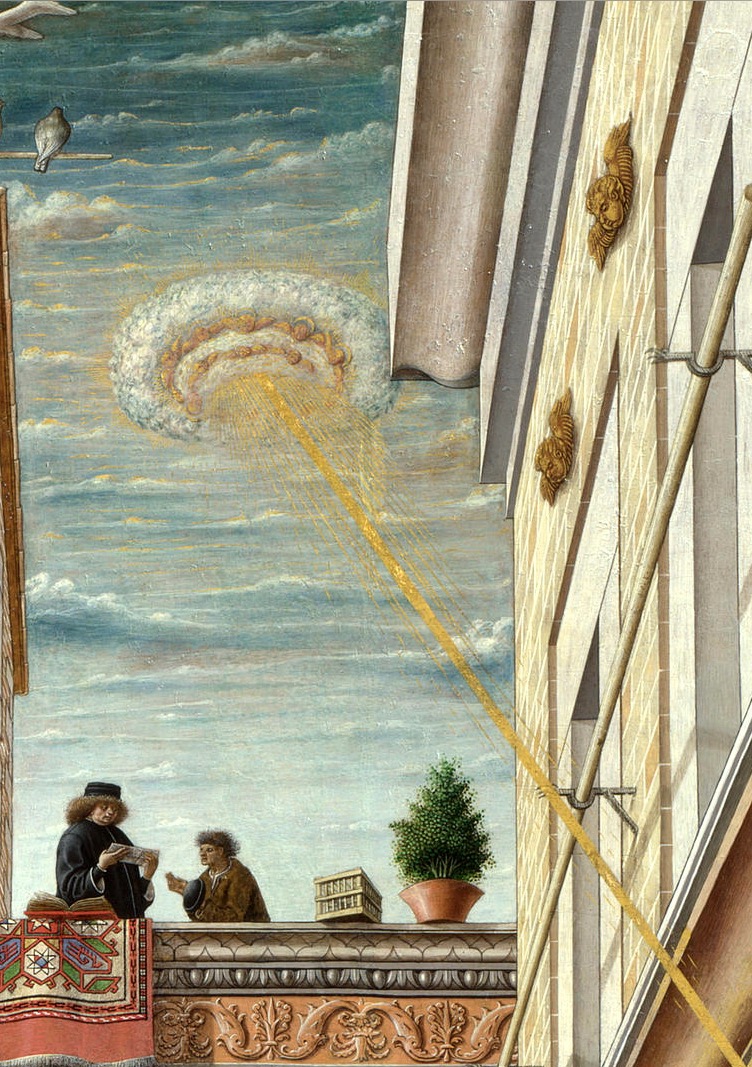
Assuming God has made another triumphant return to influence human kind in a far more direct and perhaps intimate manner (sounds like humans are still having trouble learning about the principle of love at this time — and will we ever learn for good?), it seems as if artificial insemination (with the women being kept unconscious during the event) may have been how this was achieved. Of course, no one really knows for sure. Without evidence of who God is, it is a matter of speculation. Still, at least from a scientific perspective, one can see how a woman might describe herself as a virgin and still carry a child. It doesn't take much thinking to figure this one out.
At any rate, nothing more would be heard from this "external influencer".
Then a moment came when she must have realised she was carrying a child. As a female living on her own with a child, this was a dangerous time. Such a situation for Mary would often get frowned upon by the Jewish community and potentially could face more serious consequences if evidence is found that she had her child out of wedlock. And who was the father? If the father was already married, there is a risk Mary could be stoned to death. even if Mary explained God had got her pregnant, Jewish men would not believe a woman, and using God as the excuse may be against Jewish religion as this might imply an impure entity willing to be tempted by the flesh of a woman and, therefore, could not be a true God. Again, she could face serious consequences by the men using the name of God to explain her situation with a high expectation of losing her life. Then there is the issue of how to support herself during this difficult time.
No one knows exactly how it happened, but Mary was lucky to have found a compassionate and open-minded male who seemed to be unusually understanding to her strange predicament. The man agreed to take her in as his wife. Either that or Mary may have tricked him into thinking he was the father. Not a surprising technique considering it has been used in modern times by some females who prefer the genes of one male, but end up living with another male having the resources to support her and her child and making him think it is his own child (because they were intimate even though she was already pregnant). Whatever the true situation, it turns out this gentleman, either oblivious or totally understanding of her miraculous pregnancy situation, was named Joseph.
Good to see one problem solved for Mary, and for God too.
Apart from a coincidental astronomical event in the sky by the unusually bright Jupiter and the appearance of some old men who seemed to have received word under mysterious circumstances of the arrival of the child, little more can be gleaned about this mysterious God or what was happening in the lives of Mary and her husband, Joseph.
As for the child, he too remained mysterious in his early years. Nothing to suggest that he had anything more than a relatively ordinary childhood and upbringing. However, we do start to see glimpses of his potential to think and be highly independent as a young boy when he decided to emerge, and on occasions walk away from his parents without seeking permission and enter the religious temple. This was noted briefly by his brother James. On trying to find his older "enlightened" sibling, he would discover his brother had entered the Jewish temple talking to older priests and listening in on some of the religious teachings.
Hardly anything more was known of the boy until one day, as a young man, he made the decision on his own to move away into another neighbouring town named Capernaum to begin his life's work as a religious Jewish leader. It was about this time that he decided to officially "emerge into the real world" outside the temple to start solving some social issues of the day.
The young man would show clear and insightful knowledge about the principle of love. He kept mentioning to the people who were willing to listen about the kind of world everyone could live in by following this principle. He would call this the Kingdom of God. A kind of ideal world where everyone can have what they need and be happy by following the principle of love, which would naturally include making the environment productive for everyone, staying relatively frugal and learning to live within our means while focusing on our needs, and in seeing other lifeforms (whether humans, enemy or not, or other creatures) as playing an equal part in supporting the system and ourselves in order to have what we all need.
If God did make a comeback at this time and could listen in on his early teachings, one can imagine it would have been proud of this man's efforts so far. The only thing is, did the man receive help from God in this area? Or did he work it out on his own? No one knows for sure.
There was something different about this young social and religious prodigy that wasn't in keeping with the other priests and their actions. He was particularly well "balanced" and knowledgeable about the principle of love and the concept of God. perhaps more so than any other religious leader of his times. Why the exceptional insights and knowledge? The best we can say is that he would think more independently compared to any of his contemporaries, and to a deeper level using his prodigious imagination and strong rational thinking skills acquired through his training in carpentry with the help of his fatherly figure named Joseph. Or did he receive some quiet training or help from someone else? We can never be sure. What we do know is that he was prepared to disagree on teachings from the older religious leaders of the day. And at other times, he would listen carefully to see what religious leaders knew about God, the principle of love, and what to do for the various social issues that prevailed in society at the time. Some of this he would internalise, as he slowly formulated his broader and more balanced ideas. And eventually, he would attempt to implement his ideas in reality.
For all this to happen, there had to be a certain level of independence from the young man.
One can imagine such fierce independence must have at times rubbed off the wrong way on his family too. We see evidence of this in the Bible. For example, the young man's fervent desire to live an independent life can be seen from his early decision to leave the family and find a separate roof over his head (he would only allow a few Jewish men to be with him because they wanted to due to his insightful views on various social issues and his understanding of the concept of God, and they were prepared to try something different too after listening to this young man's views, but still needed his help to give them the confidence and knowledge to go out there and do the same). At other times, this level of independence from his mother and other family members was unsurpassed and sometimes created conflict in the family. Indeed, there was a story in the Bible in which his brother had to see him and ask personally for his presence for a get together with his mother Mary, but the young man wasn't ready and said he had other matters to attend to at that precise moment. Could this level of independence have created conflict with his father Joseph? Could there have been a falling out with his estranged father because of the young man's ambitions to become a religious leader and be more independent? Little if anything is known about Joseph when the young lad started his own religious teachings. A bit unusual. Perhaps Joseph wanted the young man to continue his carpentry work and carry on the business only to find that the young man had other ambitions. Or was Joseph already separated from Mary due to some quarrels in the home or some agreement that once the child was born, Joseph was no longer needed to be around, or did he die unexpectedly? No one knows. Only Mary, the mother of the young man, would appear throughout the young man's life at various times, showing her love as would any mother for her son. Whatever really happened, it seems as though the young man would make his own decisions, going out to visit the temple without informing anyone in the family of his whereabouts was just one example. It was the kind of independence that must have been essential in the man's early upbringing, and gave him enough exposure as a young boy to the current religious knowledge so he can formulate his own ideas. But at the same time, one could see how it could cause some angst in the family.
Then the young man developed a new understanding of the concept of God (which he found the Jewish priests to be terribly confused and/or misinterpreting of what it meant ¡ not surprising considering it is still happening to this day). He also understood the difference between God and god. In fact, he thought we were all gods in the way we can change and influence things (and hence we could all solve social issues of the day together as one), but always made sure it was never the same as God. How did this young man know so much about God? Did he meditate deeply enough to see through the problem? Or was he helped along the way to make him realise who or what God really is? It is hard to tell.
From the way he spoke about God in his teachings, he seems to believe in something localised that would come down to affect the world. And in the initial phase of understanding God, he seem to have accepted the "our Father" or masculine form of God in his communications and early teachings. Yet, at the same time, he understood it was important to believe in only one God, and yet he wanted to see everyone as "gods" with the ability to influence and change events on the ground. He wasn't expecting the one and only true God to change the world and sort out the mess caused by the Roman occupiers and anyone else who was corrupted by greed and power. He felt ordinary people on the street had the power to make things right. All that was needed is for people to feel confident, to ensure the principle of love was understood, and to stop the fear people have of doing the right thing and start changing history for the better.
What made him believe God was localised and able to come down when it wanted? Did he really understand the concept of God? Or did he really see God to help him make that interpretation or support the Jewish religious teachings of a masculine God? Again we may never know the answer.
Whatever he saw, the young man did have a bit of a disagreement with the Jewish priests about this God concept. In an attempt to straighten out the misunderstanding, he stated, "Is it not written in the scriptures that you are gods?" showing that he understood the difference between god and God (and so did the writer) and what humans should be doing if they are gods themselves with the power to influence and change things. Not so for the other priests. Whether this was the way God and god sounded when spoken in the Aramaic language which was too similar and confused the priests, it would appear that there was a view that the young man had allegedly committed blasphemy by claiming he himself was "God" (instead of "god").
This is not a good outcome for Jesus.
As the priests quite rightly said, no one can be God. The young man understood this too, but the priests could not understand how he and other people can be called "gods". In fact, this very issue of god or God would haunt the young man right throughout his life as some spiteful Jewish priests would never let go of this serious "blasphemy" claim. And certainly they would not see him as the "son of God", which is another way of saying you are a "god" (it was likely Jesus attempted to resolve the conflict with the priests by elaborating on what he meant) even though today, technically speaking, we are all "sons and daughters of God", or the "children of God". No one is allowed to elevate themselves to a position that could be equal to that of God. Yet the priests could not see how "son of God" (or "daughter of God") is the same as being called "a god". Even though it is still part of "God's family" and hence the hierarchy with God is still maintained without breaking the fundamental rule of the Universe, the presence of the hierarchy means it is is there to help people to see they are like a child learn something. No child is perfect. To improve we must get a better insight into the principle of love. We must be like the "children of God" with its parent (i.e., God, in all its balanced masculine and feminine dualistic properties that appear to us). There is the old masculine-like "father" figure in God commonly found in the Old Testament scriptures, and the newer feminine-like compassionate and forgiving "mother" figure in God commonly found in the New Testament scriptures. However, under no circumstances do we attempt to equate the "god" tag on people (i.e., "the children") with God (i.e., "the parent"). The terms "god" and "God" are totally different things. The only thing that is similar is the ability to "influence" and "change" certain things, and hopefully it is done with love based on our knowledge and understanding of the principle of love. Otherwise, the difference is that people are likely to make mistakes and must learn to be more loving. And there must be opportunities to forgive in order for people to move on and do things better. So they must be "gods" when they choose to influence and change things (hopefully for the better), and certainly not a true God (which is what we are aiming to become). God is already the "expert" in love and balance. People must imagine what this must be like and relate it to their situation to see whether the love is actually there. If so, great. You have done the right thing. If not, then it is time to learn of a better way. Still, the priests could not understand what the young man was saying.
Not even the Romans were any better as they preferred to worship any kind of god, including animals. The multiplicity of god was everywhere to be seen. All one had to do was visit the homes of Romans and in the city of Rome and see the variety of different gods represented in statue form. Here we have a complete misunderstanding of the concept of God.
Yet despite a clearer understanding of the concept by the young man, what eventually got Jesus into considerable trouble with the Jewish religious elites was when he was asked whether he was God, and later "the Messiah" which is the closest thing to being called God. As the words "God" and "god" are virtually indistinguishable even in the Aramaic language when spoken and the young man claimed he was god (but not God) and tried to avoid the term "the Messiah" and instead choose "son of God" to provide clarification, this still got him into all sorts of trouble. The priests were interpreting his answers as if he was God or elevated himself enough to be at the same level as the God (which he can't to avoid the multiplicity of God), and certainly they did not believe Jesus to be God (and hence "the Messiah") or someone who is close to God. Eventually all this would come back to haunt him later when the unforgiving, unimaginative and spiteful priests found a way to have the man killed by the Romans.
If all this wasn't enough, the young man disagreed over yet another fundamental aspect regarding God: the unwavering view from Jewish priests of an authoritarian God that was willing to punish people as revealed in the Old Testament, even for those who make simple mistakes or have to find ways to survive. To test this theory, Jesus had to do the work on the ground by visiting a variety of different people. Here, he would talk and learn from certain people in society about why they had to do what they did. A classic example would be the prostitutes in the town who would be described by Jewish religious leaders and their supporters as sinners. From there, Jesus quickly formulated in his mind a better understanding of the various factors that were controlling the apparently "sinful" situation and causing people to do things that perhaps they shouldn't or somehow felt forced to do in order to survive. Eventually, Jesus understood the importance of forgiveness for those people who were stuck in situations they couldn't get out of. The idea of forgiving someone and helping them out of a difficult situation (e.g., to join his group) became an essential part of the young man's new teachings and dealings with certain sinners. He did this because he saw a more compassionate and "feminine" side to God, which is kind of in direct contradiction to the official view of God in the Old Testament according to many of the traditional Jewish priests. But here too we find further conflict taking place with other Jewish religious leaders of the day. In particular, the power to forgive can only be granted by God himself, not a human like Jesus. Otherwise, Jesus would effectively be saying to the world that he is God. Again another dangerous thing to face for the young man.
This may also explain why Muslims also feel Jesus was not God or the "son of God" in its own religious teachings. In the Qur’an (the equivalent of the Bible in Christianity based on the Arabic teachings of another Prophet named Muhammad who lived in the 7th century), Muslims believe the power to forgive someone belongs to God and only to God, for it asks:
"Who can forgive sins except Allah?" (3.135)
It is a view shared by Jewish religious leaders when we read in Mark 2:5–7 of the New Testament:
"And Jesus seeing their faith said to the paralytic, 'Son, your sins are forgiven.' But some of the [Jewish] scribes were sitting there and reasoning in their hearts, 'Why does this man speak that way? He is blaspheming; who can forgive sins but God alone?' "
Here is another example, this time from John 5:21–23:
"For just as the Father raises the dead and gives them life, even so the Son also gives life to whom He wishes. For not even the Father judges anyone, but He has given all judgement to the Son, so that all will honor the Son even as they honor the Father. He who does not honor the Son does not honor the Father who sent Him."
Now we can see why the term "son of God" was affecting other Jewish religious leaders. The problem these leaders were seeing is how this strange man named Jesus was essentially performing the same forgiving acts as God would and acting as though this power was given to Jesus as if he was "the Messiah".
What a complete mess the Jewish priests have got themselves in.
At any rate, Jesus would supplement his knowledge of a compassionate God and the power to forgive so-called "sinners" in the eyes of Jewish people with a thorough understanding of the principle of love considered by his contemporaries to be more all-encompassing of different people and their circumstances, irrespective of gender, race, or the unfortunate circumstances some people found themselves in. Thus, radical statements such as "love thy enemy" as well as looking after the sick and destitute who were often being ostracised and seen by Jewish people as a sign of God's unhappiness and willingness to punish people for whatever sins these people had apparently committed became a normal part of his life's work.
Furthermore, we also learn of the young man's deep insight of why people fought and accumulated wealth and power, not to mention how these people were more likely to become corrupt in their thinking and ways of doing things when they do acquire enough wealth and power. And, from this he could see why people would get harmed by the actions of these corrupted people, such as what we see in those slaves building the pyramids in Egypt, why the Romans were occupying the lands, and anything else he saw in these dysfunctional leaders in his part of the world. Not only that, but it seems he also understood the issue of death and why some people were keen to extend their lives at the cost of others, and the innumerable statues of different gods that people seem to be worshipping thinking the problems of the world would be solved if the gods could be made happy (through some form of sacrifice) and later hopefully give the humans something in return. He also understood why poverty existed and could see how relatively simple and curable diseases would develop in humans from the way people went about their lives and not given the knowledge of good hygiene and being clean. He could also see what the Jewish priests were doing, and this was not in keeping with the young man's idea of how to solve world problems. In some ways, the priests were waiting for the return of God or the Messiah to solve the problems and would spend more time praying in the hope of receiving the divine inspiration or intervention, whichever would come first. From all these observations he could see a solution. But in order to implement the solution, something had to change.
Firstly, the young man had to see himself as a "god" capable of doing good in the world and making changes.
Secondly, the young man had to change his own life. Kind of get his own backyard in order so to speak by simplifying things and choosing to live more frugally. Already his family did the right thing in this regard. The young man wanted to keep it simpler and learn to be happy with what he had, and get away from the distractions at home in the family so he can focus on his life's work and think through the problems. Even this first step of keeping things simple and focusing on one's needs was a significant solution to many problems because he believed all people should be able to experience this happiness and contentment in life by at least sticking to what we need and not what we want. There is no need to be wealthy to be happy, nor do we need to be constantly fighting and protecting oneself from others who also want to have the same things. Having what you need is more than enough to achieve true happiness and security. And there is enough for everyone to have what they need too. If we all do this in our lives, he realised there would be no need for wars, and people would be genuinely happy and live in harmony with one another. There would be no crime when people are happy having what they need. People could live in genuine peace (and have time to think and come up with original and great long-term solutions to any problems set before them or wish to pursue for the benefit of everyone else) so long as we all understood death was not meant to be the end, but just the beginning to a new adventure. The true God will take care of this aspect for all living things in its own mysterious way, as well as letting God (helped along a bit by us through our knowledge and efforts) provide everything people need (i.e. recycling and growing foods) as well as to resurrect those who have died. Everything will be in balance and in abundance in due course if we all play our part in doing the right thing in what is effectively a heaven on Earth if we so choose. This is the heaven by which the young man would call the Kingdom of God.
The only thing remaining to do after this was for the young man to convince the masses that it is okay to make the changes for themselves, either by working together, or individually at a local level, to solve all world problems. He wanted everyone to realise their full potential in achieving great things. In that way, even he could achieve the social change he wanted to see on a grand scale with the help of others. It cannot be a one man effort (or a one God effort). Just so long as he was careful not to be seen by the Romans as inciting social unrest that could affect those in a position of wealth and power and so put his own life at risk, it should be okay. Just quietly make it look like he was only teaching the principle of love to the people, and helping to heal those who were suffering. Nothing the Romans could do there if this is all they could see.
Okay. So once he was in a position of stability and able to think freely and independently of everyone else, especially the influence and distractions from his family, Jewish priests, and the Romans, and had the clarity of thought to know what to do next, it was time the young man began to tackle a number of problems in the outside world using his knowledge and insights.
Among the first things the man did to change people's lives was the decision to break the power held by the Jewish priests over the people (especially in the town where he moved to) because of what the old religious scriptures said and how the priests went about their work. He saw how incapable the priests were in solving problems and helping the people. These religious leaders were protecting their position of power by controlling the people as the Romans wanted and spent too much time praying and not enough action to fix the issues. It seems like they were waiting for the next true prophet from God, or for God himself to arrive, and all the problems will hopefully be solved. Certainly, they would not see the young man as potentially being the next prophet, or for themselves to be "gods" in changing the situation and influencing those to do things better in order to solve world problems. From the way things were at the time, it became clear the young man had to do the work himself.
The young man would not be ostentatious about what he had to do. In fact, it would be the opposite. And for good reason too as we shall learn, at least in the early stages of commencing his life's work. The surreptitious manner in which he began his work can be seen at the temple where the young man frequented and gathered his essential training.
Here, the young man knew the place provided an abundant fresh underground water supply. A natural spring was bubbling up from underground with its rich levels of minerals. Only problem is, the water was being protected by the priests as if it had special powers, or considered holy water. And they felt it was their privilege to hold this resource to themselves because of their work to understand God. Or maybe it was just the fact that it was clean and drinkable and made people feel good. More a placebo effect? Or maybe it contained trace minerals, such as calcium, potassium, magnesium, bicarbonate and sodium, to aid in the improved health of people who could drink from it. Whatever the truth, the only problem was, the resource was being locked up from the people either because the priests felt entitled by God to own it and was essential in the priests work to get closer to God (for divine inspiration and a solution to the social problems), or they did not want other people to contaminate the water. If people got diseases, it must have been God's way of punishing people for any wrongdoing. More praying and following the ten commandments from Moses was needed to be in the good books of God before people could get better. Whatever it was that made the priests so controlling of the fresh water, the young man saw it was wrong. Furthermore, he became acutely aware of the health benefits of being properly bathed in fresh water, for which many people did not have. So, it seems the number one decision in this young man's mind was to give people access to this clean water by helping to bath them secretly at night (and even on the Sabbath).
This was also a time when the young man probably had knowledge of some medicinal plants that could have aided in his treatment of common human diseases, and to use this opportunity when bathing the people to refine his techniques in administering the treatments.
As more and more people felt cured of certain diseases that they thought was incurable (and thus may have been seen as a miracle from God), they become more receptive to listening to his ideas about the kingdom of God and how it can be attained. He seemed unusually well-informed and confident in the knowledge he acquired and was willing to share it with others. Among the concepts being presented to the people was in a kingdom of God and who could enter it, and who would not. He began presenting certain stories to teach people about the principle of love. Interesting stories that would get the people to think through the problems and understand the consequences of doing the right thing or not do the right thing. However, there was one more concept that the young man realised later in his life was stopping others from making the necessary social change for the better: it concerns the issue of death. He didn't realise this at first, but later he saw what was holding back the people. They were afraid to be the agents of change due to the fact that the Romans could easily have them killed.
Somehow the young man had to convince ordinary folks not to be afraid of death. Resurrecting Lazarus was one way to try to convince people of the broader patterns of the Universe and the cyclic nature of life and death. Yet people could not be sure about this. Yet somehow people had to believe in something grander. Then it can be possible through sheer numbers to make the changes as needed to solve world problems. It would effectively make the Romans incredibly insecure and not have the manpower to deal with it. The possibility of having the Romans retreat and return to Italy was a real possibility if enough people could get together and rise up against the occupiers. Until that time came, somehow people have to be convinced that dying is not a bad thing and is not meant to be the end for all of us. The only thing is, how could Jesus show to the people the truth behind death as he understood it? It is hard to know for sure how the young man saw the issue of death other than claiming that God would forgive your sins and be reborn or something along those lines. Certainly there has been talk of an everlasting life. Whether that is to join with God in some kind of heaven, or an experiencing of the endless cycle of life and death, and back to life again with God being there during a kind of unexplained and mysterious resurrection stage, it is not entirely clear.
Then, at some point in his life, the young man, now aged in his early thirties, made a very odd decision to use himself as an example of how to survive after death with the help of God to bring him back to life.
Until that moment came and decide on the best way for the Jewish priests to have him punished by the hands of the Romans for the blasphemy charge and be seen as a trouble-maker to the Romans even though a Roman leader in charge in Jerusalem had trouble seeing where the trouble was in this young man, people had to contend with the view from the Jewish priests that there had to be a heaven and possibly a chance to see God, or else go to hell. There is no in between, and there is no expectation that people can change and become better in their application of the principle of love over time. If you sin, you are automatically seen as a bad person, and there is little chance of forgiveness from the type of God the priests had understood from the Old Testament. Unless you sudden got healthy again, or choose to do something different, it had to be assumed that God was punishing you. Not so for the young man. It is no wonder the young man was having increasing conflicts with the priests. He was willing to challenge traditions based on his own understanding of God and the principle of love.
However, the elite Jewish priests were not the only ones the young man found to be a problem (instead of being a solution). The Romans were another source of contention, and were creating a lot of the social problems. These uninvited foreigners arrived before he was born and would occupy his homeland with a stranglehold that was unparalleled in the known world at the time. Roman brutality was customarily dished out to the people as a way of maintaining power and quelling any unrest. Otherwise, any help from the Jewish priests to control the population would play an pivotal role for the Romans to maintain power in the region. Thus, any sign of dissent among the local Jewish and Palestinian people would be quickly dealt with in a harsh manner by the Romans unless the number of people involved in the unrest would overwhelm the Romans. That was the only thing the Romans feared the most. But while locals were not yet ready to rise up in numbers, the only other weapon the Romans could use was to introduce fear into the minds of people through various forms of punishment of which crucifixion was the worse — a brutal Roman idea of causing maximum pain and suffering to an individual while being pinned by large metal nails through the wrists and feet until sufficient blood loss and/or the shock of the experience kills the victim. Hardly anyone could survive this. There was one report of a survivor who lived his days after the crucifixion, but since then, the Romans added the terrible act of breaking the victims legs to make sure they died properly from the shock and intense pain. Otherwise, Romans were known to be efficient in crushing rebellions unless somehow the number of people involved were too great for the Romans to handle. This was the only thing that worried the Romans. Perhaps this was the quiet aim of the young man? To use sheer numbers of people to change the view of the Roman authority and stop the occupation as an important way to make the necessary social change.
The young man did have his own personal views about the Romans, and it wasn't one of great fondness to say the least. He preferred the Romans stopped interfering in the affairs of the people and show more kindness, while at the same time stop seeking wealth and power. It did not mean that he would not help the Romans, especially those who were kinder to the people. In one story, a Roman centurion with a young male slave asked Jesus to help heal his slave. At first the young man tried to ignore the request, but on hearing more about the plea for help and seeing the person who was asking, the young man stopped and listened. It wasn't long before he was moved sufficiently to help the slave and assist the Roman. Then he made his famous statement to the people (mostly the Gentiles) saying that he felt this Roman was showing more faith in him and his ideas that any of the Jewish priests and many of their Jewish followers. Since then, he did find some Romans in his local area to be sympathetic to his cause as they could not see a problem with his work (at least at a local level and no signs of any exterior motive for helping so many people), much to the dismay of other Jewish priests who did not want this young man to rock the boat and undermine the position of power held by the priests over the people.
Were some of the Jewish priests receiving benefits from the Romans to ensure the people were kept in control? Probably. To the young man, he probably wanted the opposite to happen, but to do it in a way that promoted the principle of love. Only one problem: not enough people were going ahead to make the changes. They were afraid of something else.
While the Romans were unaware of the young man's ultimate aim, the Jewish priests could do nothing to stop this man while the Romans were effectively "protecting him" in the local town where he lived and allowed him to go about his work. Until the young man left the town, there was little the Jewish priests could do to stop him as he went about his life's work.
Nevertheless, the fear people had of death kept returning to the young man's mind. He saw it as the number one reason why the people would not work together to make permanent change for themselves, and in a way that would be peaceful and stop giving the occupiers and the religious elite and rulers any chance to wield power on the people.
On seeing the brutal methods employed by the Romans to control the population, many people chose to keep quiet, be somewhat apathetic to the whole situation, and instead for some to look for an escape from reality by listening to this young man's interesting ideas as a way to imagine themselves out of a difficult problem. It seemed so alluring, almost like a drug they could enjoy, and within reach of this ultimate goal for the "Kingdom of God", but the reality for many people is that they could suffer immensely before they die if the Romans did not relinquish power. So the young man eventually had to not only teach people about the afterlife, but finally make the very brave point to all regarding the nature of death by putting himself through the process. Perhaps a foolish thing to do. Then again, the young man was unusually confident about something. Did he know what would happen and how we might survive it? There are indications that Jesus was confident he would be assisted by God to help bring him back to his people. But this would require the young man to have had a secret discussion with God at some point where he explained what he had to do and how God would play its part to help push through the idea about what happens at the moment of our passing? Did God agree, and was it ready to assist the young man at the right time to make this change possible?
Indeed, did God ever disagree or explained the risks to the young man? What happens if he dies and God could do nothing to return him to his old life? What would be the Plan B?
All we know at this stage is that this young man made the bold decision to visit Jerusalem. Perhaps foolishly, but he had already made a decision and he would go ahead with it given the enormous trust he held with God. Despite having many years ahead of him to teach the finer points of his knowledge to a larger audience and create further change on a grander scale, it seems as though he felt it was necessary to go to the city and be ready to sacrifice his life, or so it seems. He was a man on a mission, and nothing would phase him on this latest and dangerous quest. He was looking to achieve something, and wanted a bigger audience. At the same time, he must have known the risk this would involve, especially with the spiteful Jewish priests who wanted nothing more than an opportunity to put an end to this young man's life due to the blasphemous nature of his claim that he was a god, or at least the son of God and how this has been interpreted by the priests as effectively God himself. Very risky move considering he would now be away from the protection of the Romans in his home town. Or, maybe he already knew the outcome for his own life? Perhaps he had already planned and prepared himself for what would be the most difficult phase in his life just to get an important lesson across to the people who would listen to his view of the Kingdom of God and eventually about what happens when we die and why we should give ourselves entirely to this God who will presumably resurrect all of us into a new life. This idea of being resurrected or brought back to life was strong in him. He looked unusually confident in a quiet sense of what the outcome would be. It is almost like he had someone or something by his side to help him when the right time came to show everyone what God could do. Or was it a foolhardy decision in the sense that he hadn't considered all the factors that could permanently put an end to his current life and so make it too difficult for God to bring him back from the brink, thereby making it harder to teach this next important lesson to the people? It is not entirely clear what really happened, or why the young man made such a courageous, if not potentially silly, decision.
Whatever the truth, what happened next would end up being incredibly difficult for this young man (and to his disciples who watched on and saw the suffering even though they all wanted him to live on and continue his life's work). He was probably about 32 years of age when the young man endured what could be best described as horrific brutality and torture at the hands of the Romans through the crucifixion and other actions, no thanks to some spiteful Jewish priests who wanted the man killed (mainly on the blasphemy charge and certainly not to see this strange man as having any connection to God or to undermine the authority and position of power held by the priests).
Of course, the young man did have numerous opportunities prior to arriving in the city to perform some further miracles as well as teach a few more people of his knowledge, and made full use of parables to get everyone thinking about how to apply the principle of love and the benefits in doing so. But on the day he was condemned to die on the cross, he had to bear the pain of being tortured and whipped by a number of Roman soldiers. To appreciate the considerable suffering and pain (unless he prepared himself in such a way to minimise the pain), he young man could be seen bleeding profusely around his head from the numerous large thorns of a bush used as a crown for his head and pushed in hard until it made significant cuts. A decision from a naive young Roman soldier based on unfounded claims from the Jewish priests that he was acting as the King of the Jews and thus of his Kingdom of God as if he was God. Thus the soldiers thought that for a king he must always wear a crown. Since the soldiers knew the young man was condemned to die, it probably didn't matter what was used as a crown, so long as it provide lots of pain and suffering. He was going to die anyway. Might as well slap on a thorny branch on his head. Yet more torture was to come.
The next bloody stage was for the young man to be tied to a wooden pole. Part of his clothing was removed so that the whipping he would receive would be felt right across his back. This was no ordinary whipping. The impact from each whipping would take out tiny pieces of the young man's skin. He would bleed profusely until he almost passed out, but somehow he managed to stay conscious. Blood loss was already enough to see him struggle to find the energy to keep himself up let alone carry the heavy wooden cross as he was expected to do before meeting the final stage of his torture and death.
While lying on the cross at the final resting place on top of a hill just outside the city walls, the Romans used large metal nails to penetrate the wrist (although some argue it was the hands, in which case ropes were wrapped around the wrist to hold him up on the cross)and feet of the young man. The pain would have been unimaginable. Nerves in the wrists and certain blood vessels going to the hand would have been either severed or severely damaged. The two bones in the forearms were likely pushed apart by the foreign object, possibly dislocating from the joints in the wrist. Several smaller bones in the feet may have been crushed or broken and dislodged from their joints. Once he got through the initial almost unbearable pain, it may have been a little easier. The body would kick in to try to numb some of the pain. However, the slow blood loss and unrelenting pain would have slowly eaten away at his remaining energy reserves. He was feeling tired and unable to support his body. Letting the weight of his body fall would have added to the pain and damage to his wrists by the nail holding him up. Less blood would also see a reduction in oxygen intake to the brain. He was slowly going in and out of unconsciousness. After uttering his last words saying in Aramaic for God to forgive the people for they do not know what they are doing, he went into a more permanent state of unconsciousness.
For all intent, it kind of looked like the young man had died.
Whilst the Romans made the unusual decision not to break the young man's legs (a rare testament of their ability to show some compassion, although more likely it was because the leader of the Roman group was a supporter of the young man in his home town and granted the wish of mother Mary for this not to happen to her son) something had to be done to prove to other Romans that he was probably dead. A decision was made for the leader to prove to everyone the the young man had died by piercing the young man's ribs with a spear. Being unconscious if not dead would ensure no pain would be felt from this further injury. But the Roman soldiers were not smart enough to know the difference. It was assumed the young man had died. Death and unconscious can look like a person is asleep. And there is no pain either way. There is just no way to tell the difference. But another fortuitous moment arrived to help the young man's in his potential recovery if God could help. Apparently at the time, there was a sudden change in temperature and humidity. An unusually well-timed heavy rains and initial blistering wind to force most people back to the city came from a large and rather unexpected dark thundercloud that was sweeping over the spot. Apparently no one saw it coming, so no warning signs that this was not a good day to be crucifying people. Later the young man's wet and cool body was wrapped in clean cloth and placed in a cave for further protection, and carefully guarded by Romans at the request of Jewish priests. Then another oddity took place where it appears that he was taken away by some mysterious entity during the night. As the story goes, a couple of Romans who were ordered to guard the entrance way to the cave suddenly saw a bright light and it was approaching them quickly, and this was enough for the men to run away. The next morning, and with no one around to witness what went on during the night, the body was found missing from the cave by the mother Mary followed by another unusual sighting, this time of a mysterious angel at the doorway to the cave who was attempting to alleviate her concerns by explaining his son was alive and well.
Timing couldn't have been better for the young man. An opportunity to live again was definitely on the cards for this very lucky individual.
Then somehow, after a few days, the young man returned to his closest disciples, his mother, and a few friends at a secret location. Quite extraordinary it this was true, and would have convinced anyone to believe in God. Or was it a sophisticated god with the technical means to revive and repair this young man? One thing is certain, the young man was not perfectly healed. Signs of the severe damage to the wrists and feet could be seen. Even God could not do a perfect job of repairing the damage, which is a bit odd. Even the man's appearance was not exactly as he was before he got arrested and pinned to the cross, but after seeing the wounds and looking more closely into his eyes, his disciples eventually recognised him. As further evidence of the reality of his revived body, witnesses observed the man ate the food he was given. It was then that people realised the speed of his recovery was highly unlikely to be natural. They had no choice but to think God does exist and had intervened in the process just at the right time to revive the man and repair most of the damage done to him from the excruciating crucifixion process.
Whether this is true or not, the only other time that those closest to the man (i.e., the disciples) would actually acknowledge and observe God's presence in a highly localised form was in one spot in the desert. The event would occur not long after he was revived and had returned to his loved disciples (where he would further provide his final teachings to a woman named Mary Magdalene as a way to test the male disciples over some gender issue, and eventually anoint them, including Mary Magdalene, as apostles), he had to explain that it was time for his departure. Soon a spectacular aerial event was shown to everyone out in the middle of the desert with all the usual fanfare, such as the big cloud appearing in the sky (where God allegedly resides) and the usual flying lights representing angels of which one had descended to pick up the man and ascend back into the cloud. All the disciples (including Mary Magdalene) were present to witness this remarkable event according to the Book of Acts written by one of the apostles named Luke, and in the Gnostic texts written by Mary Magdalene.
An attempt to portray this interesting event, unfortunately without Mary Magdalene present, can be seen in the 2016 movie Risen directed by Kevin Reynolds.
In other words, this young man — known simply as Jesus Christ — appeared not to have physically died on the cross as we are led to believe by Christian leaders. Although in those days, being unconscious for long enough and death could be seen as the same. What we do know, if the events that transpired subsequent to the crucifixion is true, is that his body had probably not gone too far to force many modern Christian leaders to re-think the young man's spirit was risen by God to start a new life in what was potentially a brand new body. There was every indication that Jesus had probably survived one of the greatest and most painful ordeal in a physical sense. It is just that the speed of the recovery and repair done if it is true would have to bring in God into the picture. This mysterious God continues to haunt humanity. Then we have the finale of Jesus's departure from the Earth while still alive, even though Chritian leaders in the Church would like to interpret this as a resurrection of the spirit and a return to God. Or, more likely, he was always alive and was helped along the way to stay alive. All because this young man wanted to teach a lesson about the nature of death and what happens to all of us when we die. Or, more specifically, that a mysterious God would be there to balance the situation from life to death, and into life again in one quick step. In other words, resurrection and death is seen as a simultaneous event that everyone will experience when it is time to shed our old biological clothes and wear a new one in the next life.
Other than that, we now have the legacy of Jesus' teaching for us to ponder, understand and implement in real life. Well, at least those points that help to promote the principle of love and make us do the right things for one another. We see how the man knew more than a thing or two about God and the difference between "God" and "god" (or the "son of God", although some Christian leaders still want to capitalise the letter "S" to become the "Son of God" in order to have a higher hierarchy than any man or woman can ever achieve), as well as a thorough understanding of the principle of love, and his skills to heal the sick through his medicinal knowledge (the importance of service and helping others to achieve greater goals). So deep and powerful was his understanding that he was prepared to "love thy enemy" and to "forgive" in a way that many of his contemporaries found it hard to understand. Even today, you will hear governments claim that they will not talk to terrorists and instead continue to use violent means to stop certain people as presumably the only solution. But from the perspective of this man, he would choose a non-violent approach. Negotiate. Talk to your so-called "enemy". Understand why. Make sure everyone has what they need. And learn to live within our means and not interfere with others that might affect their survival. Or at least show some respect. Understand the circumstances and what others are going through. Learn why people do what they do. How can we solve the problems in a peaceful way? That is how we get to a permanent long-term solution that will benefit everyone (i.e., a win-win situation).
Because of his remarkable efforts to affect a large number of people through his teachings and healing abilities (and the work of the apostles ensured more people would hear about his teachings), a new religion was formed in his honour and to promote his teachings, known as Christianity.
YEARS AGO
Christianity would not spread across the world as quickly as one would think despite the efforts of the young religious prodigy named Jesus to change the views of enough people. Part of the problem relates to the Jewish religious leaders: Many of whom still refused, even after the death (from their perspective) or departure (from the apostles' perspective) to accept the possibility that Jesus could have survived and had some connection to God. Even despite the exceptional knowledge of the principle of love and the concept of God compared to the other priests, and the possibility that he was resurrected (or revived) except no one close to Jesus wanted to mention it for fear the Jewish leaders might want to kill Jesus again, Jewish priests were not going to have a bar of it from the Christian followers. In these supposedly open-minded religious leaders' eyes, Jesus was just an ordinary bloke who spoke in a blasphemous way. So, without irrefutable evidence of the man having returned and healed very quickly to make them re-think what they had done and would do in the future that perhaps this guy may have received miraculous medical help from a mysterious entity called God, it seems none of the Jewish leaders wanted to have any dealings with this strange young man and his ideas. They were still hung up about the alleged blasphemy all because of the priests' poor understanding of the concept of God.
Another factor to affect the spread of the new religion can also be seen in Rome. Certain Roman leaders thought the only good Christian was a dead one, especially in the arena where many Christians got killed in battles with well-trained brutal male warriors known as gladiators, as well as being eaten alive by deadly animals (lions, bears etc.).
Another thing to slow the spread of the new religion was the continued hung up of certain male apostles with their Jewish religious background (the ones who should have dropped the Jewish title and its traditions in favour of a new, more modern and clean religious start). And it has to do with this gender issue and whether the opposite gender could become religious leaders in their own right. This is evident from the Gnostic texts when we see Jesus had presented his final teachings to his closest disciples, and/or watched how the male disciples discussed religious matters and knowledge acquired with the only female wanting to be a part of this discussion and noticed something was not quite right with certain male disciples, especially the ones most outspoken about having a woman involved in religious discussions with the men. Just before Jesus left the Earth, he gave what was believed to be his final and additional private teachings with Mary Magdalene, conducted behind closed doors and away from the prying ears of all the male disciples. It would appear that none of the male disciples realised there had been an extra teaching made with the woman although they were aware that occasionally Jesus and Mary would get together in a room to have private discussions. Well, this is what we are told went on as far as we can tell. Anything could happen in a private room. Perhaps it was presumed by the male disciples that the private teachings was merely to reinforce existing knowledge they already knew about and the woman just needed extra help from the teacher. But if there were extra teachings, why wasn't it shared with all the male disciples?
That was the question to enter the minds of some of the male disciples, and would play a pivotal role that would shape Christianity for the next 2,000 years.
Today, we now understand this decision to pass on one more teaching to Mary Magdalene was meant to be a final test to see if the select few and outspoken male disciples with their views against allowing women to join their ranks as professional religious leaders capable of teaching the masses would be forgiving and accepting of the situation and understand why it happened. However, we start to learn of one of the reasons why departing too early for the religious leader of this movement can be a problem. Or, then again, how long can this leader stick around and waiting for the male apostles to modernise and get with it and just allow women to be part of the religion, and especially in the top echelons of becom,ing a religious leader and teacher.
What we do know according to the Gnostic texts is that the few male apostles, notably Peter, who could not let go of the Old Testament of their Jewish faith and religion and felt males were the only ones to be entrusted with this religious knowledge, were still not ready for women to be a part of the religious inner circle of leaders. Yet, at the same time, they dared not speak up again about this concern in front of Jesus after the last talk down from Jesus when Mary Magdalene asked to be a part of Jesus' group and to become a religious leader with skills to "think like a male". Jesus probably knew there was still some lingering concerns with some of the male disciples, but he just couldn't get it out of them in order to have another discussion. Jesus tried to antagonize the few male disciples and force them to speak up when he chose to kiss Mary Magdelene on her lips in front of all the male disciples. A controversial move only seen if the couple had consummated their relationship or were married. But there is absolutely no evidence at this stage that such a relationship had been formed between Jesus and Mary Magdalene as far as the available Gnostic texts can provide at this stage (it should be noted that we don't have the complete text as some of the crucial pages needed to explain what was going on had been inadvertently burned by an Egyptian farmer who found the papyrus in a jar and used some of the paper for cooking his food). We have to assume it was merely a test. It turned out no one said anything, so it seems everyone had past the test. However, Jesus was not entirely convinced. The tension was definitely in the air and Jesus could feel it. They pretended to accept whatever Jesus was doing. So perhaps this was the reason Jesus would provide a final private and extra religious teaching with Mary Magdalene just to see how the males would react by the time Jesus departed from this world and she had to discuss this extra teaching with them. At the same time, Jesus could not be expected to wait for the males to say something. Hopefully Mary and the other disciples, especially John who was open to the idea of women becoming religious leaders, could convince the more outspoken ones (the . more "alpha males") to accept the opposite gender as Jesus had wanted to see it become reality. It seems that his final legacy was to see balance in the genders before he left.
So how did this gender issue begin?
It was the day when Jesus had to save a woman from a multitude of “demon possessions” and probably the subsequent poor treatment (or risk of being stoned to death) of this woman in the hands of the Pharisees thanks to their strict observance to Jewish laws when handling these so-called demons. We learn the woman was named Mary Magdalene. According to Luke 8:1–2, Mary’s problem was best described by the biblical writer as possessing every conceivable "demon" known to humans at the time:
"And it came to pass afterward, that he went throughout every city and village, preaching and showing the glad tidings of the kingdom of God: and the twelve were with him. And certain women, who had been healed of evil spirits and infirmities; Mary called Magdalene, out of whom went seven devils."
Mark 16:9 gave support for this claim when it stated:
"Now after he rose early on the first day of the week, he appeared first to Mary Magdalene, from whom he had cast out seven demons."
Whatever these “demons” were, not to mention the obscure technique Jesus had employed at the time to remove the "demons", if one were to accept this at face value and assume the woman had been possessed by supernatural evil spirits, the action performed would be considered a truly astounding feat. A true miracle. It is either that, or the woman simply had gone through the various stages of becoming "corrupt" through the various sins she committed, but the solution was simply to give the woman a way out of her predicament, by having a religious leader of some standing in the community to know what she went through (perhaps he already knew her as a child or visited places to understand what women go through to survive) and to simply forgive her. Forgiveness was the way in those days to give a person who has sinned in the eyes of others a second chance at life (and so put an end to the men's argument that she should be punished under Jewish law, which is most likely to be stoned to death). All it required was for the religious leader to understand her predicament and how the people arrived to this position of seeing the woman having all the sins in order to be seen as possessed by all the bad demons. It needed the religious leader to choose the right words to help convince the men in the community to let the matter go. Perhaps it was a case of highlighting the sins of many of the men in the town was enough to focus the minds of these men on the core issue and for them to see the hypocrisy of what they were saying.
In terms of the "demons" referred to by the writers, some theologians have speculated that perhaps this worst-case scenario suggested for the woman could be evidence of a person suffering from a mental illness or epilepsy. For example, Meera Lester said:
"Mary Magdalene's seven demons, as the Bible describes them, might have been epilepsy or a form of mental illness."
Support for this view can be found in Who Framed Mary Magdalene? by Heidi Schlumpf:
"[T]he mention of seven demons is now believed to mean illness, most likely mental illness."
Or maybe she was genuinely possessed by demons and in need of an exorcism? As Bible scholar Ben Witherington III wrote:
"What, then, had happened to Miriam [Mary] of Magdala when Jesus came into her life? Sometimes modern people have assumed that exorcism texts are simply about people who have mental illnesses or epilepsy. While that is true in some cases, there is also credible testimony across many cultures about the reality of evil spirits, and the practice of exorcism over many centuries, including our own."
Either way, the ability of Jesus to cure Mary of demons, mental illness, or epilepsy would be considered a truly bona fide miracle even by 21st century standards. Or, could there be an alternative and more prosaic explanation to explain what happened to the woman? Because if this explanation could be found, it is possible that Mary could have been an ordinary young woman who was seriously misguided by her actions.
However, Peter Binsfield gave some clarification on this suggestion when he said that "demons" could represent nothing more than misbehaviors described by others as sinful. According to his understanding, demons are essentially deadly sins, or specific actions and behaviors that encourage the person to commit them repeatedly because of the short-term benefits they bring to oneself (but not necessarily to others), making it easier to commit the sins again and again. Each time the sins are committed, they become habits that clamp the person like a vice into a specific behavioral rut and so make it difficult to break the habit. If the sins persist in the person, it is likely such behaviour will persist and cause significant harm to others, as well as oneself, given enough time and people knowing about it.
In 1589, Binsfield personified each deadly sin (right) with the name of a demon (left), as follows:
Deadly Sins
| Lucifer | Pride (vanity) |
| Mammon | Greed (avarice) |
| Beezebub | Gluttony (over-indulgence) |
| Belphegor | Sloth (laziness) |
| Leviathan | Envy (jealously) |
| Aamon | Wrath (anger) |
| Admodeus | Lust (uncontrolled desire) |
To better appreciate how these deadly sins may have played out in the life of Mary Magdalene, let us imagine her early life was one of living a relatively rich and extravagant lifestyle because of family's wealth or possibly she had inherited the wealth from her dead parents, and/or perhaps she married a wealthy husband. Given that Mary allegedly possessed all the "demons", including one where she took excessive pride in her appearance, also known as vanity (Demon 1), her good looks and ability to maintain those looks with minimal effort may have seen her marry a reasonably wealthy husband at a relatively young age. Once she had this level of wealth, she could have become more greedy (Demon 2) and/or gluttonous (Demon 3). She wasn't described as fat or anything. Rather a fairly pretty woman and able to keep up with the long walks with Jesus and his entourage as we later learn. So this gluttonous behaviour must be in relation to something else. Nonetheless, she may still be envious (Demon 4) of those who still had certain things she could not possess or obtain, at least not immediately. Later, when she did acquire or possess certain things (thereby meeting the requirements to be described as being possessed by Demon 3), she could have become slothful (Demon 5). As for the husband, who may have been abusive and neglectful to the woman at times and probably committed his own sins behind Mary’s back, he may be tempted to cheat on his wife, which might make the woman feel jealous and wrathful (Demon 6). As English poet and playwright William Congreve said in The Mourning Bride, “Hell hath no fury as a woman scorned”. Otherwise, the risk of committing the sinful act of murder by the woman would have to be considered extremely high under the circumstances (surprisingly not one of the “deadly sins”, so it seems as though she didn't try to kill her husband). However, if not, the woman could choose to get back at the cheating husband as a form of revenge by doing the same with another man, and perhaps another, and then it would not be long before she would eventually experience the deadly sin of lust (Demon 7) herself. Or perhaps the husband was not rich and he gained access to her inheritance on marrying her and later ran off with everything she had for another woman or kept the wealth to himself? Either way, upon reaching this low point in her life, she would have pretty much acquired the full gamut of deadly sins to her name. And to support herself after losing the wealth, well it is possible she provided the personal services other men were looking for.
If what has been said so far is highly conjectural to some readers, we only need to look at examples of deadly sins played out regularly in a number of American television drama series, such as Desperate Housewives and Dallas, to get an idea how plausible this is. Need another example? Have a read of the article by Louis Sullivan titled The Seven Deadly Sins of The Great Gatsby published on May 14, 2013. This has plenty of situations where the seven deadly sins are played out in remarkable detail. And no, people do not have to be suffering from epilepsy or mental illness to acquire these “demons”.
Sure, one could argue the possibility that this woman had every right to divorce her husband and take her fortune elsewhere if the above scenario had been a reality. However, it is important to remember not to presume that 21st century Western norms can be applied to a situation in the Middle East around 2,000 years ago. It is quite possible that Mary could have lost everything if there was any divorce, with the woman seen as always responsible for the break up. Or else the husband could have stole everything and ran off with another woman and no one knows where he went. But if the married woman was on her own and the husband had not died, it could be interpreted as her being responsible for the separation or divorce. Either way, such action would be seen in a negative light with the potential for her to lose everything from the relationship, including financial support, and her family might have quickly disowned her to protect their own reputation — or perhaps her parents had already died and there was no other family member to give her support. It would explain why she was on her own and in trouble with the men in the town when Jesus arrived in a nick of time. No family members, not even her husband. All that was needed was a few good words about her. Otherwise, who would help her? Somehow she had to support herself, and there weren't that many jobs in town.
In that time, a woman on her own would face a particularly harsh existence unless there was someone to support her. A supportive family or husband would be helpful. In Mary Magdalene's case, something must have pushed her to this lonely existence. Yet her looks would not suggest she was always alone. Something was keeping her in a state of constant sinful behaviour. Perhaps she was trying to survive. If this was a case of her losing much of her inheritance or the wealth from her husband, it would be necessary for a woman on her own to find ways to survive, even if what remained in her life was a lingering bad reputation in the town given the number of sins she had committed, and probably continued to commit with other men.
For a woman with limited education and/or opportunities to work and earn a living in an area that would be considered more appropriate and acceptable to society, the options available to her would have been seriously diminished. The one thing that Mary did seem to have going for her was her good looks, and her apparently long hair. Combined with the fact that she allowed her hair to flow freely and come down to nearly her waist in the company of other men, it is quite feasible that she may have received some money and food from men who were prepared to take advantage of her situation and attractive appearance by benefiting from her “personal services”.
It should be noted that this is not definitive proof that Mary was a prostitute. There is no clear evidence anywhere in the Bible to support this view. The only tantalizing clues we have at the moment to suggest this possibility are her good looks, long dark hair, her decision to leave it uncovered and hanging long in front of other men, and the fact that she allegedly committed every form of sin under the sun according to Luke 8:1-3. Since lust is definitely among the list of known deadly sins, it strongly suggests that she must have at some point either committed adultery, or she was a prostitute (but both are seen as the same). And worse for her in the face of certain men who claim to follow the laws of Moses and Abraham in the Old Testament, she may have obtained some enjoyment from the experience. Well, life isn't meant to be continuous misery. Hence the lust status she may have attained could have been legendary in the town. The only complicating factor in all of this is the fact that in those days prostitution and adultery were seen as one and the same thing. Therefore, we can’t tell if she had been married or not. All we know is that to have any sense of lust for someone (i.e., to have sex), Mary probably did seek another man (or more likely a number of men), or allowed men to seek her services. The question is, was it a means of survival? Or was she trying to get back at her husband for being neglectful to her during marriage? This part is unclear. What we do know is that the sinful act of lust was seen by men at the time as a form of prostitution. And if one of the men was married and got caught out by the family, he could blame the situation on Mary as the one to have tempted the man to commit the sin. In which case, why not have the woman stoned to death? It could be as simple as that.
Again, we cannot say with absolute certainty that Mary was a prostitute even by the standards known two millennia ago. Her early life is still not fully known.
On the other hand, there is evidence that Jesus did have a soft spot for prostitutes. According to Matthew 21:31, Jesus was believed to have said:
"Truly I tell you, the tax collectors and the prostitutes are entering the kingdom of God ahead of you."
If Mary had been a prostitute (or adulterer in the eyes of Jewish men), Jesus certainly went out of his way to help her when she needed it. In fact, the Bible claims that Jesus did have a wander around to a woman's house on his own and the male apostle were looking frantically to see where his teacher went. They found him outside a house talking to a woman. Jesus was merely conversing with her, but any association with the woman was frowned upon by the male apostles fearing the teacher might become corrupt by the sins of the woman, or be tempted in some way.
For an example of just how serious adultery (or prostitution) can be, we see a similar situation with another woman accused of adultery in John 7:53 – 8:11:
Then they all went home, but Jesus went to the Mount of Olives.
At dawn he appeared again in the temple courts, where all the people gathered around him, and he sat down to teach them. The teachers of the law and the Pharisees brought in a woman caught in adultery. They made her stand before the group and said to Jesus, 'Teacher, this woman was caught in the act of adultery. In the Law Moses commanded us to stone such women. Now what do you say?' They were using this question as a trap, in order to have a basis for accusing him.
But Jesus bent down and started to write on the ground with his finger. When they kept on questioning him, he straightened up and said to them, 'Let any one of you who is without sin be the first to throw a stone at her.' Again he stooped down and wrote on the ground.
At this, those who heard began to go away one at a time, the older ones first, until only Jesus was left, with the woman still standing there. Jesus straightened up and asked her, 'Woman, where are they? Has no one condemned you?'
'No one, sir,' she said.
'Then neither do I condemn you,' Jesus declared. 'Go now and leave your life of sin.' "
Apart from this scantily brief episode, the Bible is remarkably lacking in detail of what occurred when saving the woman, as well as immediately after the event. All we know is that Mary did join the group of followers to help with what appeared to be the usual domestic chores as a means of supporting the work of Jesus and his male disciples, and later witnessed his crucifixion and resurrection.
This is the preferred narrative the Church would give to the people. However the Gnostic texts would reveal further details of what happened next.
Now, what we seem to know at this stage is that even after Jesus successfully saved Mary Magdelene from what we presume was a similar sinful life (or was it the same woman?), gave her a second chance to live a life free of sin, and listened to her request to join his group and learn his teachings, he later heard the attitude of one male disciple piping up in a manner that undermined the importance of women in the group. It was an attitude that effectively summed up the prevalent view of most men, if not all Jews, in this part of the world, and has continued to this day. More specifically, women were seen as second-class citizens, or people who could never be as good as any man when it came to understanding the religious knowledge of the day, let alone become a respected religious leader of any repute and one that was capable of making reasonable decisions on a logical basis.
The statement from the male disciple can be seen in the Gnostic gospels, the ones not published in the current book Christians call the Bible. We see this in the Gospel of Thomas where a reference is made to a woman named “Mary”. In another Gnostic gospel, we learn who this woman was at a stage when she was already the closest disciple to Jesus and with the knowledge to rationally discuss religious matters and lead a group. We know it is Mary Magdalene. At any rate, the view expressed by one male disciple about her can be seen in the following statement:
Simon Peter said to him [Jesus]: 'Let Mary leave us, for women are not worthy of life.'
Notice the particularly strong view of a male disciple against one woman. Clearly he should have known better, especially if he had been taught the principle of love from his teacher and understood the concept of God at its very essence. Remember, there should be no discrimination, right? And God is meant to have both masculine and feminine qualities as part of its paradoxical nature. Therefore, it is important to treat both men and women equally with respect and should be given the same opportunities to achieve whatever goal they wish to attain. If a woman thinks she can become an effective religious leader and have robust religious discussions with other men, then so be it. Let her be trained to become one. You must treat women equally and with love as you would for anyone else. Surely, such a statement would have certainly required Jesus to respond and counteract in some way. And, if the gospel can be relied upon, he did exactly that as revealed in the full quote:
Simon Peter said to him: 'Let Mary leave us, for women are not worthy of life.'
Jesus said: 'I myself shall lead her in order to make her male, so that she too may become a living spirit resembling you males. For every woman who will make herself male will enter the kingdom of heaven.'
However, he did not stop there. The next radical decision by Jesus to help reinforce his balanced view of God and the genders on the men in his group was to also allow a number of other women to not only follow him while providing general assistance in domestic duties and purchasing needy items for Jesus and his disciples, but also to let a number of them willing to listen to his teachings to become his disciples. Among these women privileged to receive religious teachings from him were Joanna, the wife of Herod’s steward Chuza, and Susanna. As Biblical scholar Renita Weems stated in her book Just a Sister Away:
"...Joanna, Susanna and other female traveling evangelists made up the band of female workers who surrendered and sacrificed everything to follow Jesus....Between teaching, they did the cooking; beyond recruiting, they did the mending; in excess of donating their funds, they donated their time.
To his ministry, they had given everything they had: their gifts, talents, time, money...their very substance. Anything to keep his dream going. In short, the women had ministered to Jesus out of the abundance of their hearts."
To teach women religious knowledge was an immensely brave move in those times. As one commentator mentioned in David E. Garland’s Luke-Acts:
"It was unusual for a woman in first-century Judaism to be accepted by a teacher as a disciple."
In fact, it was more than unusual; Jewish men would simply not allow women to learn from a religious teacher. Full stop. Even the mere association (whether for a casual chat or some other reason) with a woman on the street by a Jewish religious leader was considered a serious problem among Jewish men in Jesus’ time, as we can see from John 4:27:
"Now at that very moment his disciples came back. They were shocked because he was speaking with a woman. However, no one said, 'What do you want?' or 'Why are you speaking with her?' "
Notice the adverse reaction of the male disciples on seeing Jesus talking to a woman. More importantly, he was not even teaching her religious knowledge as far as we can tell from the quote itself. It was nothing more than a casual conversation. Unless the woman was a known prostitute in the town, it would seem strange for the male disciples to react this way over a casual chat. Or else, people who become Jewish religious leaders never meet women. Unlikely considering Jesus’ mother Mary would see him on occasions.
Why the negative reaction from the men? Some commentators have reasonably argued that the woman was a Samaritan and this group of people and the Jews had a certain level of animosity that had not been quelled for a long time. Even so, the quote makes no mention of the woman’s ethnic origins. The focus was on a woman (and, by implications, other women) per se. Specifically, either the talking was of concern, or the passing of religious knowledge to women is the major issue. If there was a passing of religious knowledge, we know this was forbidden under Jewish law. For example, Rabbi Eliezer ben Hurcanus (c. 45–117 CE), who lived around the time of Jesus, was famous for saying:
"Instructing a woman in the Law is like teaching her blasphemy. Let the Law be burned rather than entrusted to a woman."
As the quote in John 4:27 evidently shows, there is no evidence of Jesus teaching the woman any religious knowledge during the chat. In fact, the Bible is unable to tell us the difference between a casual chat and the passing of religious knowledge to a woman on the street. Therefore, either the mere association of a woman with a religious leader, the act of a woman talking to the leader in public in those days, or something about the nature of this woman, was what caused considerable angst among the male disciples. Whatever the concern was, Jesus was already prepared to overturn yet another long-held tradition in Jewish law when it came to religious leaders freely intermingling and conversing with female strangers.
And that was just the start. Now Jesus went further to permit women in his group to listen to his religious teachings. A truly radical move for any Jewish religious leader.
Even more radical, as the Gnostic gospels have indicated, Jesus had chosen one woman as his closest disciple, providing numerous private teachings, including further religious ideas not mentioned to the male disciples. Sure to rock the boat of any Jewish religious male leader. Furthermore, when the time came for Jesus to relinquish his position as leader of the group, it would appear that he wanted this woman to be his successor together with John as his second-in-command to lead the entire group of men and the woman of newly appointed apostles in spreading the Good News to the world. That woman was Mary Magdalene.
Eventually Jesus ceremoniously turned the disciples into apostles and thought that they were ready to pass on the knowledge to others. Later his opportunity to depart from the Earth came in a spectacular fashion where he permitted his apostles to watch on, including Mary Magdalene herself.
With Jesus gone for good, the apostles went to a building to grieve the loss of their teacher. Unfortunately, through all the grief in losing their leader, some of the male apostles remained uncomfortable about having a woman as part of the religious discussions.
Not all males were like this. For example, John, a gentle and quiet man (seen as a simpleton but with a strong physique through his fishing days with his brother, a kind of gentle giant) was like an empty vessel wanting to be constantly filled and ready to listen to everything Jesus had to say. Jesus was particularly fond of John for his open-mindedness and kind nature. Never one to constantly doubt Jesus and what he said. When Jesus spoke of his willingness to help women join his ministry and become religious leaders, John was open to the idea of having women as part of the group and religious discussions. John was not the most eloquent speaker compared to the more "outspoken and distrusting of women" alpha males who had better communication skills. Yet somehow Jesus made Mary Magdalene and John the two principle leaders of the new religion for other apostles to rely on for advice if need be. How can this be possible? Well, it happened. The two least likely individuals to become religious leaders became the "top dogs" in the new religion, quite possibly because they were completely open and willing to learn, whereas the other outspoken males remained deliberately quiet when Jesus was around. And Jesus knew it at the time. He must have known these males still wanted to maintain their Jewish religious upbringing, including rules to ban women from joining the ranks of the male religious leaders' group.
Well, it came to be that one was concerned about the extra attention Jesus gave to Mary Magdalene. As the Gnostic text revealed, a moment came when one of the males decided to speak up and perform a test of his own. He asked Mary to explain whether she received any extra teachings from Jesus, in case this could be the reason for her being nominated the head of the group of apostles. Mary, in being honest and thinking her "brothers" would be understanding, had to acknowledge that she did. When asked what this was about, Mary agreed to pass on the extra knowledge. Despite her honesty and willingness to share her extra knowledge, some males were not prepared to forgive her (and, thus the Teacher). Actually, it had infuriated at least a couple of the male apostles. It is unclear at this point whether other secrets were revealed by Mary to make some of the males feel even more angry. What we know from the remaining Gnostic texts is that a number of the male apostles decided to go their own separate ways, but made it clear that they did not want the help of Mary for any aspect of the work the males were doing.
Not all males agreed. John was still supportive of Mary. But he was seen as a simpleton with limited writing skills and could not formulate an argument to convince his fellow male apostles to accept the woman and any other female disciples in the "Christian male club".
Whatever happened next, it would appear that Mary, together with the second Mary who was the mother of Jesus walked away together into obscurity, perhaps taking final residence somewhere in Europe to live a frugal life until their deaths.
As for the remaining male apostles, some spread far and wide, while a couple went to Rome and another to Jerusalem. Attempts were made by an apostle (Peter) in Jerusalem to convince Jewish priests to at least allow the Christians to join the Jewish temple to present their teachings from the young man, with mixed success. Jewish priests were doing all they could to stop this as they continued to maintain the old testament traditions and the type of God presented in the old scriptures. But there was one important success made on this front by Peter with other authorities in Jerusalem to permit the Christian religion to flourish side-by-side with the Jewish religion known as Judaism, much to the dismay of the Jewish priests.
Another apostle went to Rome to carry the message and teach open-minded Romans to consider the ideas from Jesus. A small following grew, but it wasn't growing fast enough. Also the Roman authorities were still not keen to have Christians in the city. At some point, the apostle was discovered and sent to prison for some time in an attempt to minimise his influence among the Romans, probably at the request of some Jewish religious leaders having a temple of their own in the city. Eventually it required another apostle, this time one of the men who was outspoken against women in the Christian religious leadership positions and a more effective communicator to arrive in Rome and quietly recruit more men to join the religion.
It would be a couple of centuries before the time was ripe for Christianity to grow and flourish properly and openly without persecution in Rome. It would require the old leaders in Rome to be ousted in favour of a new Christian-friendly leader to control the city.
Before this happened, at least one other open-minded male apostle did allow women to partake in the new religion and the rigours of religious discussions, as well as let them try out some leadership roles. What stopped the religion from properly expanding was the male-dominated nature of much of the known world in Europe, the Middle East and in Africa. Even in Asia, the males were seen as at the top of the gender hierarchy. Until this hierarchy is broken and men can learn to see the gender equality and understand woman can play an important role in religion, it would be a very long time before anyone can even consider looking at the gender debate in Christianity and whether woman can be ordained as priests. And even then, the debate rages on to this day because of certain "traditions" acquired from the old Jewish religion known as Judaism. While the Old Testament forms a part of the Bible, men holding positions of power in the Church would retain this Jewish tradition of keeping women out of the religious order.
As a result of the male-dominated nature of human society, a strong male with the right leadership qualities and strong communication skills was required to push through the religion to other males. This was the forte and priority for Peter (and one of the earliest and most outspoken apostles against Mary Magdaleine becoming a disciple and student of the religious teaching). It was Peter who took over the reigns of converting enough Christians in Rome. The ideas slowly rubbed off on enough males. But the real moment came when a new Christian-friendly Roman leader took the reigns of power in the city. From then on, the Christian males in their lofty positions high up in the hierarchy were able to establish the Church in Rome while maintaining the old traditions that only males should be in a position of power within the Vatican and not women.
With all decision-making processes centralised in Rome, the Christian teachings spread throughout most parts of Europe. Despite Jewish priests refusing to accept Jesus as someone with a connection to God, Christianity continued to spread, reaching almost all corners of the world.
This was also a time when a new calendar system was established to mark the arrival of Jesus as year 0 and enough nations have come to accept this change.
Finally, the male leaders of the Church with their newfound powers in Europe made deliberate efforts to select their preferred gospels and removed anything that could be considered by them to be a little too controversial in their eyes (or potentially undermine certain "traditions" that the males had always wanted to uphold, such as the idea that only males could learn, teach, and discuss religious matters within the Church in Rome). Thus the close relationship between Mary Magdalene and Jesus had to be removed. As we are told in the Gnostic texts (the gospels and additional writings rejected by the Church), the reason for this close relationship was presumably because Jesus had wanted to show to his male disciples how any woman can "think like a male" and partake in any intellectual rigour of religious discussions once he trained her in the right way. Also, anything to suggest that Jesus was just another man (since Jesus was kissing Mary Magdalene on her lips in front of the male disciples, either as a test or to reveal a more intimate bonding between the two), despite his exceptional knowledge of the principle of love, would be almost blotted out of history. Somehow it was felt Jesus' association with a woman was not in keeping with what they thought was a holy man having a connection to God. Jesus had to be pure and not seen as if he may have been tempted under the Jewish law by a woman or his religious ideas tainted by a woman. Even though Jesus said that he felt anyone could learn and apply his knowledge in order to do greater things than he did (after teaching his listeners to think for themselves with the help of his parables and stories), the male Church leaders preferred to make Jesus a holier man than any human could ever achieve, thereby elevating him to close to God status, if not God himself in the flesh and so perpetuating the misinterpretations of the concept of God. No written gospels from Mary Magdelaine would ever enter the minds of the religious male leaders. With the preferred gospels firmly at hand and a new vision set for Jesus, a new unified religious text was created. It combined the Jewish Old Testament views (thereby acknowledging those male apostles who could not let go of the Jewish traditions and religious knowledge) of the previous authoritarian God with the New Testament teachings of Jesus showing the more loving and compassionate side of God. The name given to this book is the Bible.
As a result of this deliberate and careful selection, it helped the Church in Rome to justify and cement its position and claims to maintain its (Jewish) tradition as a male-dominated religion, extending right throughout all leadership positions, including the Pope.
Yet, irrespective of how these males think, the reality is, women have always had an equal footing in the new religion as Jesus had wanted it and expected to be seen, and the males running it should have transformed themselves to become more balanced and inclusive of women. It is just that a few Jewish men still could not handle the fact that women can do the work of a religious leader just as well as any of them. But to make it worse, at a time when people were experiencing hardships and poverty in Europe, Christian males in positions of power within the Church did not want to lose their position and all the luxuries and other comforts men could receive by dominating the Church and forcing others to support it.
Hence the riches acquired by the Church over time.
Would Jesus have been pleased by such a move within the Church?
Can we rely on the gospels in the Bible to provide some useful historical information? Here is the view of Father Dwight Longenecker, a Pastor from Greenville, South Carolina, on this aspect:
"The gospels are not factual news reports....They are not typical biography or the work of a professional historian. Neither are the gospels academic historical documents which are cross referenced with multiple documentary, archaeological and anecdotal evidence. The gospels are...recorded accounts of personal experiences of multiple individuals from within a faith community. They are the written record of the stories told and sermons preached by the immediate followers of Jesus Christ about his life, teaching and death.
Most scholars conclude that the synoptic gospels (Matthew, Mark and Luke) were composed before the death of St Peter and St Paul in the year 65AD, and that the gospel of John was composed around the year 90AD. Some scholars say the Gospel of John is the first gospel written — in the 50s — just twenty years after the death of Christ (JAT Robinson).
Who wrote the gospels Matthew is the only one of the three synoptic gospels authored by one of the Apostles himself. John is also written by an apostle. Mark was a disciple of Paul and Peter, and the early traditions say that he recorded Peter's sermons and accounts of the life of Christ. Luke was also a companion of Paul and the early traditions are that he is the doctor who traveled with Paul, and that Luke also knew the Virgin Mary....
We can therefore conclude with the majority of scholars that Mark's gospel was indeed written by John Mark the companion of Peter, and Luke's gospel was written by Luke, the companion of Paul. Their sources, therefore, were Peter and Paul — both eyewitnesses to the events portrayed in the gospel. Furthermore, these gospels were written just thirty years after the events described.
The fact that the gospels were records of sermons to the early church community strengthens the case for historical reliability because the community itself would exercise a form of check and balance with the historical record....They are not the creation of any one individual, but the record of the stories and accounts and memories from many individuals. This multiplicity of sources adds an astounding level of veracity to the gospels since those many different sources check and balance and correct one another....
In addition to this we must consider the Jewish context of the early church. A strict memorization of the Scriptures is part of the Jewish tradition. Jewish boys even today for their Bar Mitzvah have to memorize parts of the Scripture and are checked for it word by word. In the first century, with the scarcity of manuscripts, boys were taught to memorize the entire Old Testament, and to recite the accounts of the history of their people word for word....The stories of Jesus Christ were told and re-told within this Jewish context by Jews who were the first Christians.
Critics of the historicity of the gospels like to talk in vague terms of "the mythological elements" which crept into the gospel account. However, no one actually quotes chapter and verse. That is because there are no "mythological elements." Those who talk about mythological elements are clearly ignorant not only of the gospels themselves, but of what mythology actually consists of. What they usually mean by 'mythological elements' is the supernatural. The gospels do indeed contain supernatural elements, but these supernatural experiences — angels appearing to people or miracles happening — are recounted as real events that were recorded because they were real events and therefore all the more astonishing. The supernatural elements presuppose belief in a supernatural dimension....
When confronted with the accounts of the miraculous we have to ask ourselves why anyone would fabricate a tale which is so obviously incredible. Why would twelve other men corroborate the tale if it had not happened? The only possible motivation for fabricating a story would be that more people would join their religion. But that religion didn't do anything for them. It did not bring them fame or fortune or power or glory. On the contrary, it only brought them ridicule, persecution, torture, hardship and eventually death.
Surely a person who was fabricating tales — or even allowing them to be exaggerated — would not have the moral fortitude to then die an agonizing death for those lies. The record of supernatural events does not negate, therefore, the historical claims of a document....
Critics point to the discrepancies of detail between the gospel accounts. Here a character is missing, there an incident happened a bit differently - here there is confusion about who a character is related to. Here the chronology di ers between one account and another. This is put forward as a criticism of the historicity of the accounts, but when this is examined more thoughtfully it actually proves the authenticity of the gospels. Wouldn't it be much more suspicious if there were four di erent accounts of the same events and they matched perfectly? Then we would surely conclude that there was a work of fabrication and serious editing going on. Instead we find four different accounts which essentially agree, but which differ in detail. This is exactly what you would expect from four different perspectives from four different witnesses of the same event....
It is true that the gospels do not measure up to the standards of modern critical historical practice. But they do not purport to be modern, scientifically verifiable documents. They are the records of real events experienced by real people."
YEARS AGO
At around A.D. 66, Jewish historian Titus Flavius Josephus and many other witnesses throughout Judea claimed to have seen UFOs on the eve of the Jewish War started after centuries of ethnic differences and subsequent financial greed, before finally escalating into the religious intolerance that led to the destruction and pillaging of the Temple of Jerusalem by the Roman army in A.D. 70. Even though Josephus was himself born in Jerusalem and was initially one of many who fought against the Romans, he claimed to have received a divine revelation from God during the UFO sighting about the future Emperor Vespasian rising to power. Following the success of Vespasian’s military campaign against the Jews, he later called Josephus a "prophet" for anticipating the events preceding the ethnic conflict-driven Jewish War. Josephus was released and quickly rose the ranks among Roman nobles.
As for the UFO sighting, it was considered spectacular enough to warrant a recording in his book, "The Wars of the Jews or History of the Destruction of Jerusalem", which dates to A.D. 75. As the sighting occurred over Judea and, therefore, over a wide enough area, enough people were able to verbally testify to its veracity at the time. As Josephus wrote, based on the best available modern translation into English:
"On the 21st of the month Artemisium, there appeared a certain prodigious and miraculous phenomenon, passing belief. Indeed, what I am about to relate would, I imagine, have been deemed a fable, were it not for the narratives of eyewitnesses and the subsequent calamities which deserved to be so signalized. For, before sunset throughout all parts of the country, chariots and army of soldiers in their armour were seen running about among the clouds, and surrounding the cities. Moreover, at that feast which we call Pentecost, as the priests were going by night into the inner temple...they said that, in the first place, they felt a quaking, and heard a great noise..."
An interesting choice of words to represent an "army of soldiers" in their metal armour riding what looks like chariots in the clouds. Could this be a fanciful way of saying large circular metal wheels (or discs) were flying in the sky and creating the clouds as they moved across the sky? Given the bad omen the sighting represented, such visual imagery could have helped remind people of what happens when the wheels of the soldiers’ chariots as they are being moved by horses across the desert can whip up clouds of dust in their wake.
As for the choice of a word to describe who is riding in the sky (and hiding behind the metal armours and circular wheels), this can vary with different witnesses accounts, different times, and who is likely to be leading the group of riders. For example, the word "soldiers" might get replaced by "angels" according to the Book of Revelations where it is claimed that Jesus, on his second-coming and judgement day, will come to earth via an "army of angels". Of course, such a passage does assume Jesus had survived the crucifixion and was taken away by God (or a god or gods to be more precise) and is planning a return to Earth with an apparent concerns that some humans may not be doing the right thing.
YEARS AGO
The last known major eruption of New Zealand's Taupo caldera on the northern island, and the most violent in the last 5,000 years. Taupo began erupting 300,000 years ago and ever since there would be a major eruption arriving in a cyclic manner roughly every 1,000 to 3,000 years. Today, the caldera is partly filled with a large body of freshwater called Lake Taupo.
to YEARS AGO
Around the year 426 A.D., a young teenager living in a rich English family was taken away by pirates to be sold as a slave among a group of poorer Pagan people of Ireland. Many years of hardship through hunger, cold, rain and loneliness in a foreign country taught him to rely more strongly on his Christian faith for a sense of stability in a new world that seemed to be lacking the necessary understanding of love.
One day, as he tended to the sheep of his captors, he realised how the one true God in the things he observed in nature was essentially sustaining him and keeping him alive (i.e., find foods that were keeping him alive, the sunshine for warmth, the fresh water satisfying his thirst, etc.) despite all the suffering. Then he heard a voice in his head suggesting that he can return home in a ship if he followed his faith.
Possibly he ate a magic mushroom by accident?
After 6 long years being held against his will in a foreign land, his creative and defiant spirit finally took over. He chose to follow the voice he heard in his head to see where it would lead him. The young man decided to make his daring escape on foot across Ireland despite the considerable risk to his life if he was captured, relying simply on the water and food of the land for nourishment and his intelligence and creativity to avoid detection.
Miraculously he managed to reach the Eastern coast of Ireland where he found someone who was prepared to take him back to England after observing how this strange man was able to pray like a Christian. Clearly this was no ordinary Irishman.
On his return to England, he was welcomed with open arms by his family and the people of his own township. Soon everyone learned of the man's incredible story of capture, living in Ireland, and how he escaped the land. It was considered at the time the first person to ever do so as a slave.
It wasn't long before his remarkable story and strong Christian faith would see English priests sufficiently impressed to allow the young man to become a priest himself and later a bishop. Yet his life's work had only just began.
The voice of God seemed to call him again saying the people of Ireland needed him. He may have felt a little reluctant to follow this voice again. Understandable considering the hardship he went through. Yet somehow he must have realised the people of Ireland were missing something in their lives. The multiple gods in this ancient and brutal Pagan society and not seeing the power of love was not helping the people to see a better way of living.
It took a while and some thinking, but eventually the lack of love and./or direction in a nation yearning to be loved and/or led in the right direction eventually brought the man back to Ireland.
Over the next few years he convinced an incredible number of Irish people to follow the one true loving God by using a simple language spoken in the native tongue of Ireland, which he had learned during his time as a slave. The ideas of God and love and in solving many social problems in an alternative way helped the people to understand life more clearly and to reach for yet another higher level of existence through the Christian faith.
In return for this knowledge, the people of Ireland gave him the love and the things he needed to survive and live peacefully.
Back in England the Christian king and some of the bishops were getting jealous of the man's increasing fame and success. They wanted to pick on his weaknesses in a vain attempt to see him as a sinner. The man had to return to England to answer charges that he had sinned unto God.
The man tried to convince his fellow Christians in England that what he did for the people of Ireland was right. For example, he did not speak Latin to the people of Ireland and his methods were somewhat unorthodox. Yet this should not have made a difference when speaking the language of love. Unfortunately the behaviour of his colleague priests and bishopsweren't in keeping with the Christian faith and the true principle of love as he understood it. The man felt disillusioned by the Christian leaders in England. In the end, he realised that he could no longer stay in a country that forgot so easily the true principle of love and instead wanted to maintain traditions so rigorously. The Christian faith in England was preoccupied with following too many specific rules from the head of the Church in Rome as if this is the only way to do things. The place he once called home was forever abandoned. He returned to Ireland where he felt the people could benefit more from his teachings than he could ever achieve from his so-called Christians in England. He wrote letters explaining his strong convictions, how God spoke to him, and gave a clear account of his entire life story in vivid detail.
His courage and persistence in writing eventually saw him left alone by the religious authorities in England. Perhaps the man felt abandoned in Ireland by the English religious authorities. Yet the Irish people made him feel at home as he continued to help them until his death.
The man's incredible strength, sacrifice, determination to survive, conviction and support for his own understanding of the principle of love as taught by the original religious leader in the Bible, appreciating the simple life, realising how nature was supporting him as God would, to allow his mind and body to acutely be sensitive to his natural environment, to think about problems and be an excellent problem solver, and his tremendous love for the Irish people, even those who the English Christians thought could never be helped, had turned him into a Saint.
Today the Irish people remember the man as St Patrick, which is celebrated on 17 March every year.
YEARS AGO
On a night when an unusually bright star was seen by Jewish religious leaders in the Middle East and thought this was the sign of God having brought forth a prophet and looked everywhere in the Jewish community for this likely child and failed, a male infant was born in the Arab world who would bring forth a new religion. He would be named Muhammad (570 CE - 632 CE). His appearance in the world came under somewhat unusual circumstances in the sense that the mother apparently felt no pain during childbirth. How this was possible is unclear. Perhaps this observation in itself might have warned others of something special about the child.
As is common practice among Arabs, the child's full name encapsulates his lineage, family traditions, and significance in Islamic tradition. Hence the newborn was named Abū al-Qāsim Muḥammad ibn ʿAbd Allāh ibn ʿAbd al-Muṭṭalib ibn Hāshim. The name's meaning is explained below:
- Abū al-Qāsim: This means "Father of Qasim". It refers to his son, Qasim ibn Muhammad, who died at a young age.
- Muḥammad: His personal name, which means "the praised one".
- ibn ʿAbd Allāh: "Son of Abdullah". His father’s name was Abdullah.
- ibn ʿAbd al-Muṭṭalib: "Son of Abd al-Muttalib". His grandfather’s name was Abd al-Muttalib.
- ibn Hāshim: "Son of Hashim". His great-grandfather’s name was Hashim.
As a matter of brevity, we will refer to this individual as Muhammad.
Born in Mecca (now in Saudi Arabia), Muhammad became orphaned following the death of his father Abd Allāh, who died just before Muhammad was born, and his mother, Āminah, who passed away when he was six years old. Muhammad belonged to the ruling tribe in Mecca at the time led by his grandfather Abd al-Muttalib who also played a significant role in Muhammad's upbringing during his early formative years. His grandfather also held the key to a sacred rectangular-shaped stone building considered the most important mosque known as the The Kaaba (or al-Ka’ba al-Musharrafa), also referred to as the House of God. This is a sacred building for Muslims originally built in the days of the prophet Abraham, and rebuilt in 683 AD when it was damaged by fire during the siege of Mecca by the Umayyads. Today, Muslims pay their respect to God about three times a day and use the opportunity to memorise the teachings of Muhammad by facing in the direction of this stone building anywhere in the world during prayers.
As the years passed, Muhammad married a wealthy widow named Khadījah and successfully raised six children, including a daughter named Fatimah.
Then, something strange began to affect Muhammad's life at the age of 40. From what can be gathered from his followers, it would appear that Muhammad received revelations from what he believed to be God, but in Islamic tradition is named Allah. These revelations were passed down through an angel named Gabriel. Eventually, these revelations would form the basis of a new religion called Islam and a written holy scripture or book known as the Qurʾān. Among the teachings is the observance of a single God, which, at the time Muhammad was alive, was at odds with numerous rich traders who wanted people to turn to idolatry as a way to pay for the privilege of worshipping many gods.
To Muhammad, this was not to his liking. Instead, he would grow his own group of followers and teach them the importance of worshipping only one God.
Realising this valuable source of income was in jeopardy through the teachings of Muhammad, the traders came up with ways to stop Muhammad from teaching his ideas and to disband his followers. Methods to persuade, prove to his followers that the God promoted by Muhammad does not exist, and eventually tried to end Muhammad's life and those of his followers were attempted, without success.
As an example, the traders wanted to test this "one God" theory by asking Muhammad if his God would perform a miracle. One of those miracles was to show the Moon being split in half for a short period of time. Somehow this was achieved, but the traders were not convinced. That was when the traders turned their attention to killing Muhammad and his followers.
Speaking of the Moon splitting apart (or at least the appearance of something like the Moon splitting in half), this is not an unusual occurrence in history. Occasionally such a feat may be repeated to select individuals. For example, a man on the York Road east of Leeds, England, allegedly saw a Moon-like object split into two halves. This unusual event happened at around 11:00pm, on August 20, 1829. Not only that, but the upper half also gave off a shaft of light. In the darkened middle region, he could observe two human figures visible from the head down to the waist of which one had a red cloth wrapped around its head. The object remained in the air for more than an hour, allowing other witnesses to corroborate on the sighting before the object was eventually hidden by a cloud passing in front of it and disappeared afterwards once the cloud moved away. ("Celestial Phenomena," York Herald, August 22, 1829, p. 2; Chris Aubeck and Martin Shough, Return to Magonia: Investigating UFOs in History, Anomalist, 2015, pp. 111–125)
In another example, on September 10, 1798, just before midnight, schoolmaster Alexander Campbell and one other person observed what was thought to be a "remarkable comet, or meteor" at Alnwick, Northumberland, England. It increased its brightness until the star-like object looked like “"two half-moons, back to back, having a short luminous stream between the two backs". The whole sighting lasted 5 minutes. (Annual Register 1798, p. 83)
In Muhammed's time, it is unclear whether the prophet observed a single or two hemispherical-shaped glowing UFO(s) during this particular "Moon splitting" event.
When the traders decided to wage war on Muhammad and his followers, Muhammad had another revelation in which he received word from God through the angel that it was okay for humans to fight. This led to the second half of the Qurʾān to speak of the need to fight if it meant one could preserve the teachings and protect the followers and leader. A unique inclusion into any sacred religious scripture making this the only religion to promote violence by its followers and leader if no other way to solve the conflict peacefully was available. Otherwise, its primary goal is to promote a single God and to solve problems peacefully and with compassion.
Hence Muhammad played a significant role in several successful battles, including the Battle of Badr and the Battle of the Ditch. He also negotiated the Pact of Al-Ḥudaybiyah with Meccan leaders.
After another unusual moment in which it would appear Muhammad was permitted to travel above the clouds with the help of the angel Gabriel and so permit him to see a representation of God inside an object before returning to Earth, Muhammad lived the remainder of his life until the ripe old age of 62 years. He passed away on June 8, 632 AD. To this day, Muslims would see him as the final prophet and the central figure of Islam.
YEARS AGO
A group of Polynesians known as the Rapanui sailed east to reach a large uninhabited island in the South Pacific. A place of remarkable beauty, the island had a seemingly unlimited supply of trees and fresh water, and to a certain extent this was the kind of thinking a number of the first settlers had on arriving at this untouched tropical wilderness. Not knowing how the fresh water was maintained and the importance of the trees in sustaining the water cycle and other natural resources, the new inhabitants were poised to create an imbalance in the natural ecology with a decision to cut down trees to build homes and boats. The eventual disaster would not happen straightaway. It would take time. Time for humans to go about using up the natural resources over the next couple of centuries.
The place where this happened is called Easter Island.
As the people settled on the island, they did not realise the amount of fresh water was highly dependent on the availability of trees to condense the moist air on the surface of the leaves. To further enhance the condensation effect, the island's natural landscape helped the moist air to rise and form water droplets called clouds or fog over mountain tops. The droplets on leaves enlarged and would fall to the ground at night. Trees provide a secondary benefit of preventing the ground water from evaporating. Enough water on the ground ensures not all the moisture is absorbed in the soil or lost through evaporation. Excess water flows downhill and later combine to create small streams. They then collect in ponds and small lakes. Eventually they overflow, and the water continues to flow downhill until it reaches the oceans. Having extra moisture on the island to create adequate clouds and enough rainfall or foggy conditions to help maintain the whole natural cyclic system was the key to why the island remained so lushes and self-sustaining.
In terms of the number of trees, scientists have estimated that there were a healthy 20 million in total, comprising mostly of palm trees. In the summer time, rain clouds could be seen forming regularly over the island thanks to the shape of the land to raise its moist air to a suitable height, and its abundance of trees to condense the moisture into droplets of water and prevent evaporation. While the trees remained, everything looked to be in plentiful supply to the new settlers. Together with the abundant supply of fish in the oceans acquired by the fishermen in boats made from the trees on the island, it seemed the place was just like back home in Polynesia.
Then, some time around 1,100AD, the number of trees diminished significantly, and the ability to gather enough food from the oceans or grow food on land was getting harder. Freshwater supplies were also diminishing rapidly for some inexplicable reason to the inhabitants. Perhaps the population was getting too large. Or was there greed and power in the minds of a handful of men? Or did some men blame it on the gods for being unhappy about something? Whatever the reason for this situation, the population split into several different tribes, each with a different approach to solving the problems on the island. Unfortunately the one causing all the problems still remained and had a way to stay in power on the island longer than the other tribes. It is the people of this successful tribe, mostly men and lead by a man, who maintained the view that "she will be right, mate!" and to continue using up the resources while doing things to appease the gods. Just give it enough time and the rains will return if we can keep the gods happy.
This kind of thinking of the males is the real problem. One of the tribes thought the remaining resources could still be plundered and the gods will grow back the trees and provide everything the people needed to survive. As a result, that tribe probably used more of its fair share of the resources to stay strong and win the equivalent of the annual Birdman competition to see which tribe would lead all the other tribes and tell them what should be done on the island. The benefits of a comfortable life after acquiring the resources were too much. The unsustainable tribe wanted to win the competition more often to maintain the status quo of unlimited resources. No doubt the other tribes on the island were not happy even if more and more people could see the island's natural forest was being decimated from human activity and the winning tribe would not instigate some from of adequate recycling of the resources.
As the food supplies went down and the number of trees diminished, a religion was formed. The leaders of this stronger tribe directed other tribes to build statues to keep the gods happy on the assumption that they would provide an abundance of food for the following year. This approach was repeated for many years.
Not everyone in the other tribes agreed with this approach. Some people believed it was better to plant new palm trees and other plants. Unfortunately, it takes time to grow the trees.
One further complication to the life of the people on Easter Island was the presence of seasons. In the summer time, the island felt very much like one of the Polynesian islands — moist and hot. In the winter time, temperatures would drop far more than expected. The island's geographical location being further south of the equator would create this seasonal change in climate and temperature. Combined with the need for wood to build boats for fishing, burning palm trees for warmth would have placed a further strain on the island's natural forest.
There were attempts by people in the other tribes to reverse the trend in the tree populations. New trees were being planted, but to reach a reasonable size would take time.
Time was not on the side of the people living on the island. Before the last big tree was cut down, some of the people from the opposing tribes thought the idea of carving out statues from the volcanic rock was a waste of time. Several large boats were constructed and some of the people went onto the high seas to escape the insanity. Some travelled further east until they reached South America. Others made the decision to go west following the winds to return to the other Polynesian islands.
A time came when the last tree was cut down. This was a dangerous time. No more trees meant no more replacement canoes or even to keep warm in the winter. And no canoes quickly saw a growing number of people experiencing regular malnutrition. Only enough crops growing on the land was just sustaining a smaller population. Something had to change.
Soon a decision was made to stop building the great Easter Island statues. The religious aims of certain fixated leaders from this unsustainable tribe would collapse. It was likely that the leaders who supported the religious views were rounded up and burned in a ditch.
Afterwards, food became carefully rationed.
The population grew slightly as the people adapted to a different way of life and method of growing food.
Then in the 18th century, visits from Dutch and South American sailors added further pressure to the Rapanui people. A fight broke out with the Dutch in 1722 in which 12 Rapanui men died, mainly because it was thought the foreign visitors would impact on the resources of the island (and understandable thought considering what the inhabitants had went through). Eventually a truce was made once the people of the island understood the purpose of the visit.
Then the Spanish sailors arrived 48 years later. They brought with them new diseases such as chicken pox. Up to 1,500 of the islanders were also brought to South America. When a number of them returned, many had sexually transmitted diseases that soon wiped out many of the remaining inhabitants on the island.
Despite all these factors affecting the survival of the people in various ways, approximately 100 of the original inhabitants have survived. Today the island has a stable and thriving population, only because tourism and the availability of ships to bring supplies to the island has made sure the original inhabitants can survive. Without this help, it is likely the last of the inhabitants would have died out in the early 20th century, leaving behind only a handful of birds and insects finding a tiny niche in this barren part of the world.
Will the people of Western society in the 21st century go in the same way as the people of Easter Island? Or will we be forced to adapt to a world without trees and rely on tourism to somehow keep the economic system ticking over? Or will there have to be a new world order, and one that is more closely aligned to the re-building and protection of our natural environment?
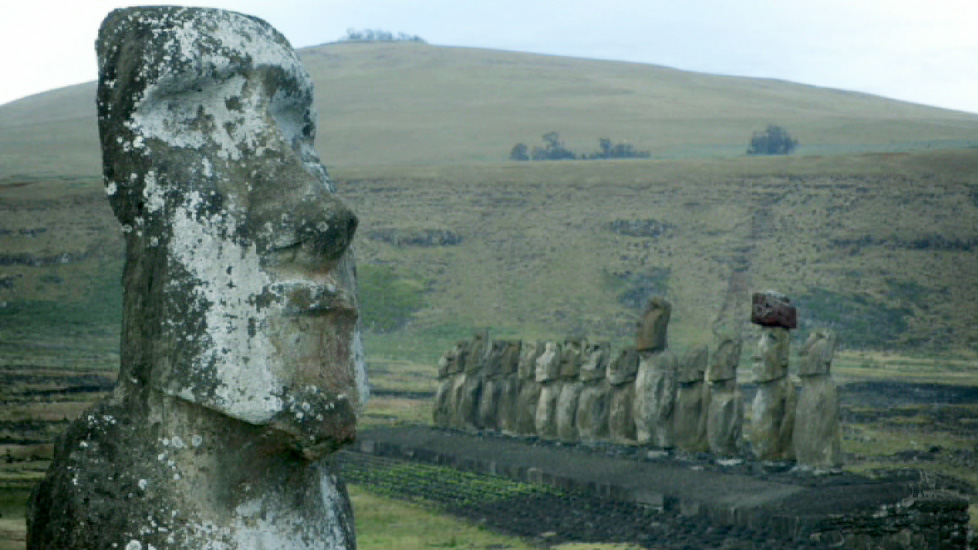
YEARS AGO
Not all UFOs in Earth's skies have to be unnatural or inexplicable. Some can have a logical and natural explanation. A good example of this is the bright light in the sky over China on 22 July 1054. Today, astronomers can confidently explain that this was due to a massive supernova explosion, the remnants of which can be seen in photographs taken of the Crab Nebula.
to YEARS AGO
The time of the Aztecs would reign supreme in central Mexico.
It began around 1150 AD when as many as 175,000 people came into the Valley of Mexico — a fertile area containing a plentiful supply of water and rich fertile lands. Any wars that may have existed between feuding tribal groups prior to this time — probably over food and territory — had suddenly vanished as if by agreement, or the realisation that in a land filled with abundance there was no need to fight each other. The kind of thing old prophets in the Middle East keep telling us is the key to ending wars and guaranteeing human survival while living in the kingdom of God (or place of plentiful and recycling everything). Do we need more examples?
A number of years went by. People from the surrounding countryside saw how well the settlers in the valley were doing, so they thought to do the same. Slowly the population levels increased in the area.
As more people came to the area, some of the original people who owned the fertile land decided it would be better to lease it to others to do the work of growing food and so free up the land owners time to do other things, which is mainly to enjoy the luxuries to come from people working in this society, as well as exercise powers in making decisions and telling others what to do (does this remind you of any modern civilisation in the 21st centuiry?).
As the population swelled to around 1 million in the late Aztec period of 1350 to 1519 AD, people were placing considerable stress on the environment. By early 1500 AD, all available fertile land and surface water in the valley were virtually exhausted. Why? Because the land was being frivolously and carelessly cleared of the trees, rain washed the valuable nutrients away from the soil making it harder to grow food, the swamp was drained of its waters to create raised fields and places for some of the inhabitants to live, and where the trees were cleared, it exposed the soil to increased evaporation of the water under the hot Sun. Things were not looking good for the people.
As resources dwindled and populations expanded even further, a hierarchical system of powerful Aztec rulers, religious leaders and elite overlords began monopolising power in the city. The early abundance of food and other goods hoarded by the rich and powerful and later leased the land to other people to help make more riches created a separate class of people called the commoners. As a matter of survival, the commoners created their own markets free of state control. People could produce their own goods consisting of growing water-thirsty cotton crops and making cotton textiles, as well as pottery, statuettes and offering other kinds of services.
Yet no matter how much richer the rulers got, or how many people worked the land, the environment wasn't getting any better. The rains became increasingly infrequent and the crops were not as plentiful as they once were. Before long, some diseases started to set in among the crops resulting in a number of commoners struggling to feed themselves and give enough to the rich leaders as payment for the lease of the land.
The rich and powerful with their lack of environmental knowledge and a preference for selfishness in their own needs and wants probably passed laws into Aztec society making it a requirement for commoners to work harder and for longer or pay the upper class more money as well as food as if the leaders thought too many commoners were dole bludgers and were not providing adequate contribution to society to help explain the low resource situation. The truth, however, was that some of the rich and powerful were probably asking too much from the commoners. Those in a position of power could not see why things have changed and the commoners were struggling. They were locked away in their own world of luxury and strange rituals that made them oblivious to the environmental destruction that was taking place all around them, or thought things would return to normal some day. An occasional bit of rain might make the leaders think everything is fine and life must go on. While others, namely the religious leaders of later generations immune to life on the land and thus no understanding of what it means to perform hard work in growing food, had no practical knowledge to give to the commoners and were increasingly resorting to religion for a solution as people sought answers.
So where is this knowledge to protect the environment? Weren't the commoners given practical (or more scientific) knowledge) of how to look after the environment and recycle everything they produced? Unfortunately not. Part of the reason was because the rich and powerful had no knowledge to give to the commoners. They were too self-absorbed in their own lives. But it is also because the rich and powerful were afraid of giving too much knowledge to the commoners. Knowledge is a dangerous thing to have in the wrong hands. It could undermine the power of those who are rich and supposedly leading society along the right path. The other reason could be to do with the way some rich and powerful Aztec rulers and overloads became obsessed with death and their own gods.
Some of the questions that may have filled the minds of the rich and powerful at the time included, What's the purpose of life? Is there a greater meaning to our existence? Is it really to fill one's belly with food that the whole meaning of our existence and the purpose of life and the Universe can be understood? If this is true, why do people still die? Why is death so much a part of this Universe and life cannot escape from it? And why do people continue to suffer?
This fatally flawed obsession consumed the life of the rich and powerful, and also the religious leaders whose job it was to support the elite in finding a solution to this great problem of death and in understanding the environmental disaster taking place. No practical knowledge of how to grow food and look after the environment was provided, only religious knowledge. Religion became the dominant feature of the Aztec's lives. Once the rich and powerful accepted religion as the only solution, the scene was set for the destruction of a great civilisation.
Towards the end of the Aztec empire between 1500 and 1519 AD, the commoners became very poor as they tried desperately to resort to non-food products such as cotton and increasing the production of textiles to sell to whoever could afford to buy it and so help them to pay the elite overlords for the land as well as import any food from towns and villages far away. Soon religious activities increased as a way for the people and the leaders to solve the food shortages. Indeed, the leaders felt that the gods were somehow unhappy about something. To make the gods happy again, something must be given to appease these supernatural beings. A kind of nourishment like we see maintained for those elites in order for the people to be nourished and maintained with an abundance of food.
How did this belief come about? It seems the religious leaders found a way to appease the gods by observing how the dead buried in a plot of land after a period of time and receiving some water can suddenly grow a abundance of vegetation than in an area not containing the dead as if somehow the bodies were helping to restore the land and bring back fertility. Then a decision was made for someone to sacrifice a bit of blood on the ground to see what happens. Surprisingly for the religious leaders, something grew out of the ground. Was this the way to keep the gods happy?
Now a new and dangerous religious idea and precedent was born: why not sacrifice more blood to the Earth as this may somehow nourish the gods, the soil, and ultimately grow more food? As crude as the idea may seem to us today, it does provide a primitive way of understanding why death exists in the Universe and how life suddenly appears in the spot where the blood-letting takes place.
We know without death, life in the Universe would not exist. No one could survive in an infinite population of the living. Death is an inherent part of this Universe in order for life in the Universe to exist and with reasonable comfort (depending on the population levels and how sustainable it is). However, for those who are alive today, it does require the natural recycling systems of the Universe and the diversity of life itself to work in order for balance to be restored. Thus one could create a story to help explain this inherent nature of the Universe by saying death is a way to make God happy and restore balance to the Universe for the rest of life to continue indefinitely.
Unfortunately some religious leaders in Aztec society took the idea too literally and to the extreme. This was desperate times calling for desperate measures to solve the food shortages.
At first some blood letting performed in rituals under these leaders may have coincided with some periods of rain to help reinforce the idea. When the rains stopped again and would not return for a longer period of time, the leaders thought more blood-letting was needed to make the gods (i.e. the environment) happy. Soon many people had to die in brutal sacrifices to help bring a sense of balance in the environment (i.e., appease God, or the gods — well, whoever or whatever is responsible for controlling the production of food and water in the valley).
To further add to the woes of the Aztecs, the constant war between the Aztecs and Tarascan people eventually saw enough weapons smuggled cross the border from Tarascan and into the hands of the commoners through the Aztec market system. The time was ripe for a major revolt.
The tipping point finally came when certain religious leaders were asking too much from the commoners. And too many people from outside the Aztec community were being sacrificed (including babies because of how some religious leaders were developing a psychopathic view of blood and tears of the babies representing the rain in the eyes of the gods). Too much was being destroyed to appease the gods. On top of all this was the fact that the elite in the Aztec civilisation could no longer be paid properly and too many people were beginning to starve for food as society began to descend into chaos.
The rich and powerful must have sensed something terrible was about to happen. They probably tried to protect themselves through its own crude military force. Yet the stupidity continued. Rather than meeting with the people and searching for alternative solutions, the leaders hid themselves in their fortified and luxurious homes. Finally, the massive population of commoners eventually saw through all the religious crap. The decision to bring back balance in their own way started and there was nothing to stop it. What happened next turned out to be brutal and violent to return the favour to the elite people. The loyal soldiers for the elite could not stop it, or more likely they joined with the commoners knowing they had no chance to protect the rich and powerful and they too had to survive. Now the people had the power to change the future. No longer would they continue working for the dysfunctional leaders and support the outrageous religious rituals. The final act was really a bloody end, followed by looting and a great fire consuming all the resources and representations of deities and gods held by the rich and powerful. What could have been a prosperous and peaceful society if it took a balanced and more frugal approach to living and had understood the power of recycling everything including the biggest natural recycler of all — our environment — instead caused the civilisation to take the road to self-destruction.
We can only hope modern human society will take heed of these warning signs before it is too late.
YEARS AGO
By no later than 1445AD, the last of the big flightless wingless birds were hunted to extinction on the islands of New Zealand by the Maori within a century of human arrival. Known as the Moa, these docile birds stood up to an impressive 3.5 metres in height. Now scientists believe they know why they disappeared. After analysing the growth rings in the stored bones of extinct Moas, scientists discovered the two Moa species may have taken several years to reach reproductive maturity and up to a decade to have a strong enough skeletal frame to defend itself and run away from the humans as well as support their offsprings. Without adequate time to reproduce, humans became the idiots (yet again) in the demise of this bird. Instead of looking at the situation like a giant Kentucky Fried Chicken experience, they could not learn to be sustainable and protect the resources available to them. Blame it on the males of the human species whose egos and demand for food are suddenly inflated every time they kill an animal much bigger than themselves. Such a macho thing to do, isn't it?
Or do as most males do — blame it on the gods! You cannot tell males they are wrong. They will resent you for it.
For an animal having the largest brain in comparison to its body, we are acting more like we have the smallest brain in comparison to our body.
YEARS AGO
As human language reached a level of sophistication in describing things, some people began to report UFOs as "coloured globes", "fiery lights", "flying shields" and "chariots of fire" to name a few. Where a mysterious column of light appeared below these UFOs or from strange clouds moving around in the sky, it may have been described as a "pillar of fire". In other observations, flying crosses and cylinders were not unheard of.
If an unusual aerial event was seen as significant, humans were likely to draw pictures of what they saw to make a permanent record of it. For example, a woodcut made in celebration of a momentous hour-long event that occurred in the sunny sky over Nuremberg, Germany, on the morning of 14 April 1561, suggested that a number of flying spheres, hollow cylinders with spheres inside, other cylinders without the spheres, as well as flying crosses made their presence known to observers on the ground. Not unheard of observations for UFOs today, as we shall see.
The spheres made their triumphant return at sunrise and sunset on two days in July and again at sunrise on 7 August 1566, in Switzerland, where the following picture was produced.
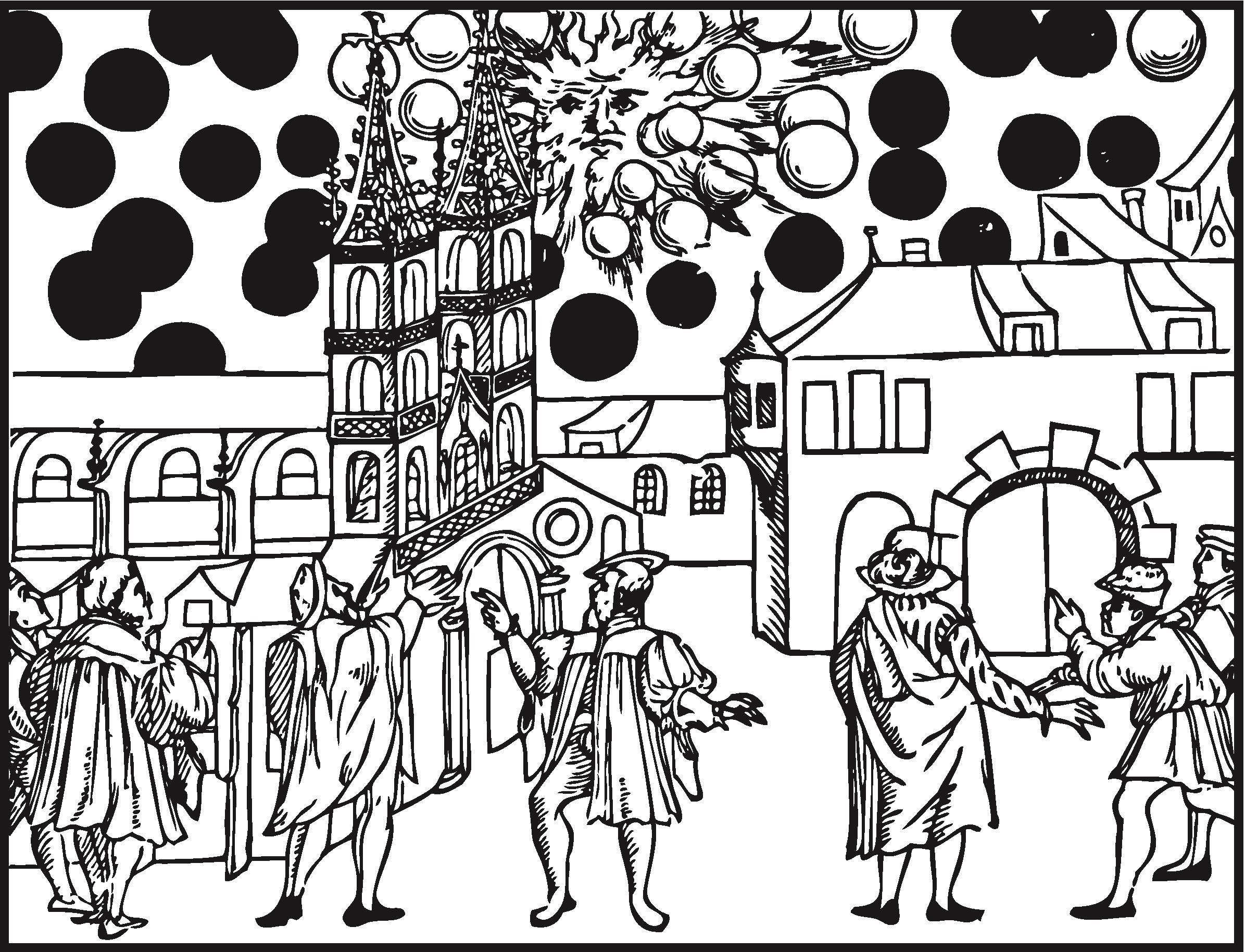
A student from the Swiss town of Basel reported the sighting in the following way:
"…[M]any large, black globes were seen in the air, moving before the sun at great speed and turning against each other as if fighting. Some of them became red and fiery and afterwards faded and went out."
In both sightings, it would appear the UFOs were engaging in a type of aerial battle as some of the objects collided and faded off as they fell from the sky. Could this be evidence of the early introduction of fireworks into Europe from the Arab world, where such technology had been known since the 12th century? Or were these UFOs something more mysterious?
YEARS AGO
The first deliberate effort by humans to separate electric charges for the purpose of doing work with it was successfully achieved by humans thanks to the invention of the electrostatic generator. The earliest type was friction-based using a sulphur globe that was rubbed by hand — first discovered in 1663 by Otto von Guericke. The design was improved, with Sir Isaac Newton recommending a glass globe, while his assistant Francis Hauksbee (1660–1713), whom Newton later appointed curator, instrument maker and experimentalist of the Royal Society, used an electrical machine, enabling the rapid rotation of the glass globe against a woollen cloth.
As for realising that negative charges flow toward the positive end forming an electric current, this was first observed in 1781 when Luigi Galvani, professor of anatomy at Bologna University, Italy, saw the effect of electricity on the nerves and muscles inside the legs of a dead frog. It was an accidental discovery. Galvani's assistant just so happened to be playing with an electrostatic machine in the same room as he was dissecting a frog with his steel scalpel. A spark was generated by the machine, which managed to complete a circuit, whereupon Galvani observed the muscles in the frog's legs twitch significantly. As Galvani said:
"…[S]uddenly all the muscles of the frog's limbs were seen to be violently contracted just as though they had been seized with a violent cramp."
In 1800, Alexandro Volta became credited with inventing the battery. It may not have been the world's first battery in the strictest definition, if the Baghdad jars are anything to go by, but it would be the moment when people actually recognised the usefulness of batteries as a means of storing electrical energy.
Electricity would be exploited further following the development of magnets and coils for generating power. The prolific inventor Thomas Edison made the most of this power by redesigning the light bulb in 1879 to ensure a reliable source of light using lower electric currents thanks to an improved vacuum inside the globe.
Of course, the reverse situation of using electrical power to turn magnets and coils also had its benefits too. In particular, it became the basis for creating many modern electric motors for performing work. However, when it came to transport, humans in the 20th and early 21st century took the easier route of using fossil fuels (mainly for the sake of profit) principally to turn wheels and push aerodynamic objects for lift in the air. While this wasted a lot of fuel and has resulted in global warming, in the 21st century, humans would return to the electric motor for vehicles on the ground for essentially the same purpose. In terms of flying machines, the principle of radiation propulsion would be applied. The only additional requirement for human society to become sustainable was to find renewable solutions to generating electrical energy.
It would take a long time before humans finally make the transition to a purely electromagnetic and sustainable society.
YEARS AGO
We see battles continue throughout history between people of different religions as if some people were trying to prove one's faith (or God) is better than another and thus allegedly closer to the Truth. The classic example is the battle of Vienna on 11 and 12 September 1683.
In this battle, Vienna was besieged by the Ottoman Empire led by a well-respected Turkish warrior and leader named Grand Vizier Merzifonlu Kara Mustafa Pasha. No less than 90,000 and as many as 300,000 men under the rule of Mustafa had amassed on the grounds outside the walls of Vienna. The aim of the Turkish leader was to take back the territory the Ottoman Empire had once occupied for a brief period over what was effectively a long and bloody battle lasting over 300 years between the Christian believers of the Holy Roman Empire living in Europe and those who believed in the Islamic faith, as can be found among the people of Turkey and some parts of Eastern Europe.
The battle ended almost as quickly as the Turkish leader arrived when Mustafa made the fatal decision just before the battle began of not securing a mountain ridge nearby despite one of the leaders of an alliance group recommending this should be done. As a result, an ageing Polish General on the opposing side saw an opportunity to inflict considerable damage and casualties to the large numbers of men that Mustafa had concentrated on the ground. With agreement of all other leaders from various supporting Christian-based European countries, the Polish leader ordered his men to lift a number of heavy cannons into position at the top of the ridge during the night and in the rain. It was a gruelling job. Mud hampered the work considerably.
By the following day and with the canons in position and pointed at the enemy, the battle for Vienna quickly swung around in favour of the Christians thanks to the terrible damage caused by the canons on Mustafa's army. The remaining soldiers on the ground forced into disarray were taken care of by Polish forces and the various other groups forming the European alliances.
It was a humiliating defeat for the Turkish leader. And since Islam does not believe in forgiveness as Christians do, Mustafa had to pay with his life by being strangled by two men with a piece of rope in front of Turkish soldiers as a witness to the rest of the remaining army of what happens when leaders fail to deliver.
Over the next 16 years, European armies largely removed any remaining pockets of the Ottoman forces, thereby ending any dreams of Turkish leaders occupying much of Europe.
But why should a battle of different faiths have to take place at all?
What people don't seem to realise is that the way certain individuals express their faith in a God does not make their God any more important or different from anyone's else's faith in a God. There is only one God. What are we trying to prove by going to war with regards to our faith? All the names we may give to God and the places we may worship (whether it is a Moslem temple or a Christian Church) are what men have created for themselves in order to help them better understand this one God and to get closer to understanding this entity. No single faith that people have created will ever represent the ultimate true faith or religion of God. This is something we must work together and approach. And the only way this can be done is by combining all the faiths into one, showing what is in common in all the knowledge, and so make it easier for everyone to see the same God. It is not about proving whose God is better than whom.
Any battle over people's faith is a waste of time because all you are doing is fighting over the one and same God. Having enemies in such a war is like fighting your own brothers under the principle of love. There is no such thing as an enemy when you have the true God promoting true love. The only reason for having these pointless battles over so-called faiths in a God are based on non-religious reasons. Many leaders often hide their secret agenda behind the veil of religion. Usually this agenda is merely for materialistic gains in terms of acquiring wealth or territory, or love for another person, or a lack of understanding of God by allowing hatred to fester on another person without truly understanding the principle of love. What leaders often forget is that bringing religion into wars is not the true religion of God. The one and true God never teaches us to fight battles against other living creatures. Wars have no place in a true religion. Only love, even right down to our greatest enemies.
to YEARS AGO
The grand 300-year solar cycle lasting up 50 years (as opposed to the standard 11-year cycle) reached the Sun's lowest output of heat and light between 1650 and 1700, leading to particularly long-lasting and severe winters in England and Europe. The coldest was in 1683 when the river Thames froze.
NOTE: Europe and England can experience colder winters than usual during periods of global warming. As the planet heads into this phase in the 21st century, a moment will come when enough ice melts in the Arctic ocean thereby reducing the winds from the north. As a result, the winds from the Arctic do not come down to stop the flow of cold winds from Siberia moving in from the East. As the difference in cold and warm waters becomes non-existent (because there is very little ice in the Arctic and elsewhere), the warm ocean currents from the Caribbean reaching Europe stops flowing as well because of this extra colder water and ice moving down from the Arctic, the cold weather in Europe will be much more severe. On the other hand, during the summer times, temperatures under a global warming environment can rise quickly. Snow and ice across Europe and England will melt and create massive floods in low-lying areas and along major European rivers. The summer will also bring initially more rain than usual followed by intense and very hot days. Soon, the conditions will dry up. For other parts of the world, global warming will see continents experience severe droughts. If the droughts don't occur, it is only because the warm ocean currents are able to add extra humidity in the air and this can reach the coasts to provide extra rainfall. But once the ice in Antarctica and Arctic regions fully melt, these ocean currents are expected to stop flowing. Then the weather will be more constant of an extreme and mostly drier nature over land.
YEARS AGO
The Industrial Revolution commences in Europe (led by England in 1780) around the late 18th century.
According to the United Nations InterGovernmental Report on Climate Change, global warming increased from the moment human's began burning wood and coal for energy, but quickly accelerated as the demand for wood, oil and coal by businesses in the industrial age increased. As population grew, the demands for businesses to expand and produce more items and services for the people expanded as well. Irrespective of any efficiencies, a growing population increases the energy demands.
High energy demands to run factories and the product themselves in the early stages revealed the highly energy-inefficient nature of the products, the size of the products needed to be produced, and the number of people demanding those products, not to mention how people went about producing those products. The early forms of the products were expensive and this initially reduced the demand and restricted its use to the rich members of society. Later, as the scale of economies reduced the price, more and more people were able to afford the products. Then the energy demands to use certain products naturally increased even further. Even when new energy-efficient products are produced, the sheer size of the growing population will see to it that the energy savings are lost. Until population levels are controlled, there will always be a need to use up energy from wood or coal unless something else can supply the energy.
This is the problem with businesses. It sees no limits (just like the Rapanui people of Easter Island saw no limit on the number of trees). More customers are better, and continuous growth is essential. There is no such thing as a perfectly recyclable product. Well, at least not on the minds of most business people. Unless the packaging can also be eaten, it just doesn't happen. Businesses do not pay the true cost from cradle to grave of what is needed to produce something, recycle it properly, and give time to grow or re-create a new product.
Another thing that also went out the window at this time was the idea of working only so much as needed to survive. Rather than "work to live", the new motto for business people and the expectations of their employees became closer to "live to work" as individuals realised materialism was the key to building untold wealth and business people could become incredibly rich simply by selling as many products as possible to the consumers (and keeping a larger share of the profits while convincing the workers the pay they are getting is better than receiving no wages). Of course, to sell products, someone has to make them. And the more time people spend to make them, the more products there were. This explains why workers in the early days had to work longer hours in poor conditions and age was no limit to who could work for these business people. Today, conditions have improved. Despite the existence of weekends to allow workers to rest, employers today still think in a similar way with demands for overtime work from workers increasing, or else find ways to reduce costs, such as sacking permanent full time staff in favour of younger and more naive workers who think the lower pay is good while working under contract in order to give more power to employers to sack them without giving a reason.
In essence, the principle of love was not high on the agenda for a number of business people (except for their own families, friends and like-minded business people).
From this industrialised society came a predominantly two-party political system in Western democratic nations. Different names might be used to describe these parties. One party (e.g., Liberals in Australia, Republicans in the United States, etc.) focused on the employers and their needs and deregulating the markets while ensuring people work for the employers to help keep the taxes coming in regularly and substantially. The other party (e.g,, Labor in Australia, Democrats in the United States) is focused on protecting the workers and providing essential services for everyone. In the late 20th century and into the 21st century, things got a little more complicated as the environment showed enough degradation that a third-party had to appear to influence the political landscape, known as the Greens Party. Beyond that, other parties will have diverse opinions and agendas about why they exist and these tend to come and go with each election. The only countries that do not experience this type of political system are those described as socialist nations. Here, the aim is for one leader and supporting members receiving benefits to maintain power and wealth at all costs and eliminate any opposition from the people. The workers' pay is always very low and the treatment is often quite bad. Only those running a business are permitted to do better and have enough wealth so long as they pay their dues to the dictator running the nation. Also, looking after the environment is an even lower priority compared to Western democratic nations.
Not surprisingly, we see many of these early businesses run by males. Their strong L-brain skills helped to improve the efficiency and complexity of various products in an attempt to meet demands as well as provide unique selling points to the products for the more discerning buyers.
As Western Europeans applied more L-brain skills and views of unlimited resources and energy inefficient practices to the rest of the world, the arrival of the first Europeans to Australia saw the introduction of many traditional "non-recycling" ways of farming the land, hunting for animals, and gathering other resources as needed not only to survive but also to become famous, powerful and rich. For example, the new settlers effectively stopped "patchy" burning by Aborigines. Eventually the fuel loads on the ground built-up and the appearance of massive broad-scale and intense fires have become the norm in modern Australian life.
As for the hunting techniques employed by white settlers in Australia, this has effectively wiped out 20 mammal species weighing between 35 and 5,500 grams in size. All we have remaining are a few small animals and only a very few large "high breeding" mammals like kangaroos and emus to survive on the remaining tough, more fire-resistant vegetation of the Australian continent. As a result, the Australian continent combined with increasing carbon dioxide emissions from the growing industrialised world would see the land dry up significantly and lay the foundations for bigger and more devastating droughts and bushfires to sweep across the states.
By the time the 21st century would come around, the pressing issues on many Australians would be where to find enough fresh water, how to allocate the remaining resource in an efficient way to maintain their way of economic and social life, how to combat the bigger and more intense bushfires, and what to do during the longer and more intense droughts that arrive (as well as the occasional bigger floods when the few rains do come). These are the latest issues to preoccupy people trying to maintain the current economic system with its limited recycling solutions and over-emphasis on the economy and supporting businesses with poor environmental practices, and at the same time demand more consumers to magically appear from new families to help maintain and expand the economy.
Sure humans may enjoy the occasional and rare climatic conditions known as the "El Nina" to bring back some of the rains and give a false sense of security to the Australian people as they say "She'll be right, mate!". But unfortunately it is all too short lived. Australia is just one of those countries where it will experience longer spells of more intense and extreme droughts conditions under global warming.
Perhaps the Australian people should concentrate more on rebuilding the environment, re-establishing the great inland sea, and developing fully recyclable products and services as the key to solving all the water issues. Or will profit drive the ambitions of many Australians in the 21st century towards self-destruction?
YEARS AGO
In the last 75,000 years, there have been only three massive volcanic eruptions that stood out in the minds of humans today, and probably even for those who lived at the time they occurred depending on where humans were located.
One of them was not officially recorded by humans as it occurred 75,000 years ago — too early for writing to have been invented. This was the Toba volcanic eruption in Indonesia considered the biggest as far as scientists are aware of. The size of this eruption was so massive that it caused a global volcanic winter lasting anywhere between 6 to 10 years, and kept the planet cooler than expected for another 1,000 years. This was an event that could have put an end to the human species and perhaps allowed another hominid species to evolve and take our place.
The second volcanic eruption, and considered the biggest in the last 10,000 years, occurred on the island of Santorini. The hapless Minoan civilisation took a massive gamble to live on the island nearly 3,500 years ago thanks to its relatively fertile soils and close range to major trading partners. Unfortunately the gamble did not pay off. Things took a turn for the worse when the volcano erupted abruptly and almost without warning. It would appear from the archaeological evidence that few, if any, people had an opportunity to escape this cataclysmic event. The only mention of such an event was more indirect and can be seen in the Bible after the story-teller gave some vivid accounts of certain disasters that took place in Egypt within a matter of a couple of days of the eruption.
If we think the Bible is a dubious source of historical information, then the only other volcanic eruption that was recorded with certainty and in a direct sense is the one that occurred on 15 April 1815. The aftermath of this explosion can be seen today as a 2,850 metre high (it was originally 4,300 metres) mountain topped with a large 6km wide caldera, known today as Mount Tambora (or Mount Tamboro). This one is also located in the same volcanic hotspot country of Indonesia.
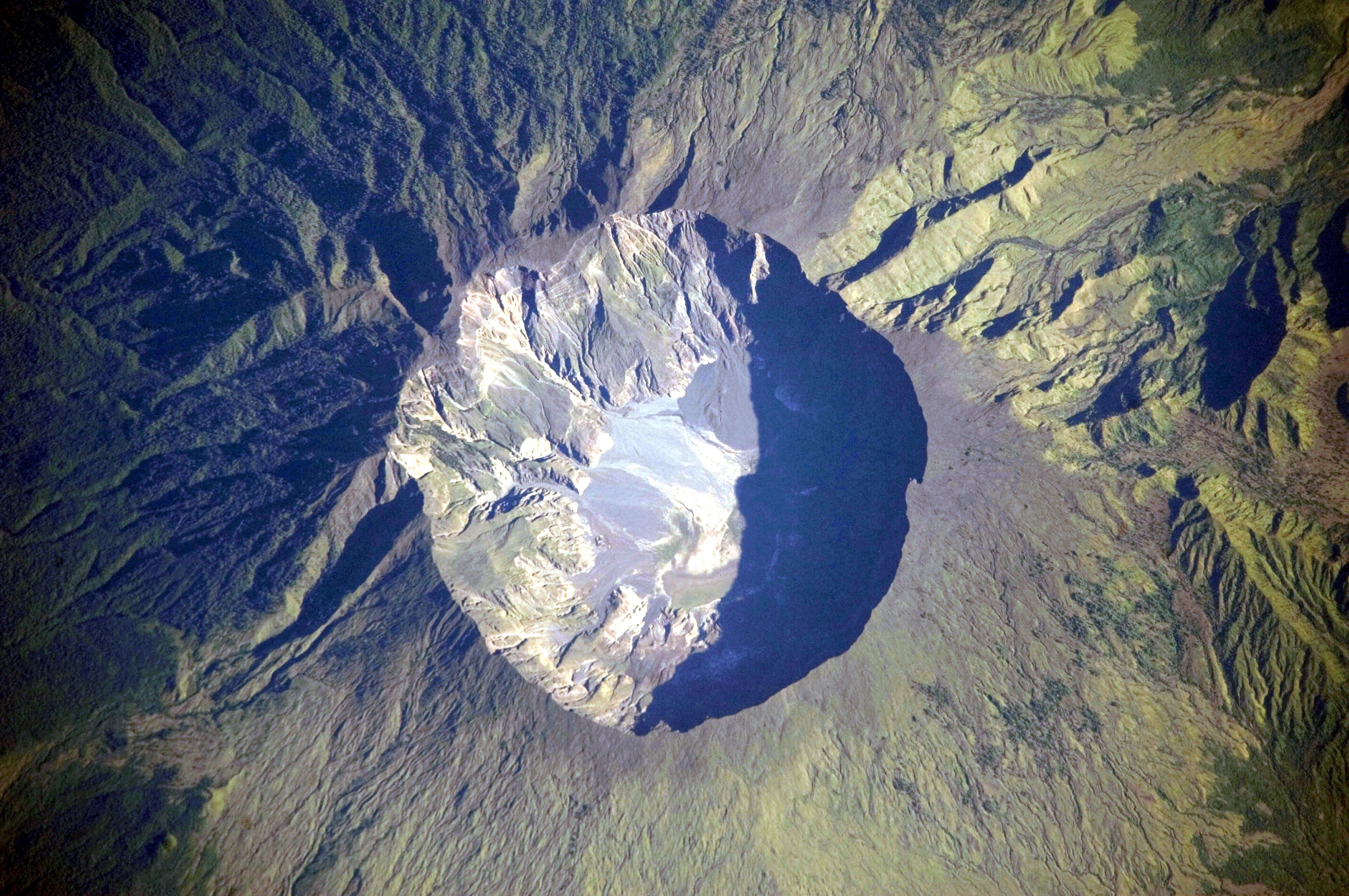
There was one other relatively massive volcanic eruption that took place in recent times. Getting its more than fair share of volcanoes, Indonesia also gave the world another almighty bang from a place called Krakatoa in 1883, located in the Sunda Strait between the islands of Java and Sumatra in the Indonesian province of Lampung. The resultant explosion blew apart the small island, leaving behind its own large caldera to almost rival that of Mount Tambora.
YEARS AGO
In the mid-1800s, we had another "enlightened" male individual named Mikao Usui in Japan who decided to not only practice martial arts but later entered a Zen monastery to study the ancient texts of Buddhism known as the Sutras. It is here that he noticed the healing practices of an ancient religion called Reiki or Usui Shikiu Reiki Ryoho. Still unsure of the effectiveness of the practices, at some point in his life, Usui made the climb to the sacred Mount Kurama to fast and meditate for 21 days. As a way of counting the number of days, Usui collected 21 stones.
Then, something unusual happened after he threw the last stone. It is claimed a "brilliant light" approached Usui as he was meditating. He felt an energy came over him and had intense feelings of well being. He then saw certain symbols and methods of Reiki which gave him confidence he was on the right track with Reiki before he lost consciousness.
He eventually awakened and realised he had received what he described as the power to heal.
As healing is a form of love, today the religion of Reiki continues as a handful of Reiki leaders attempt to re-kindle the positive side of the ever-flowing light energy of the universe as a healing method (most probably electromagnetic radiation concentrated by our bodies and emitted usually through the hands to produce a sense of warmth, and so opening up blood vessels and helping to enhance the healing process within living tissue). It also teaches the importance of the principle of love during the healing process (perhaps by getting the body to emit the right hormones and other biochemicals for raising the immune system response to fighting infections).
Or exercising and massaging the tissues regularly can probably generate the same level of warmth, extra blood flow, and hormones to help with the healing process?
It is interesting to see these stories of men who once lived a rich and/or comfortable lifestyle and later changed to a more frugal and simpler life, learning some skills to heal, and after seeing the injustices and/or inequalities of modern society, try to do something to bring back balance. These are not unusual events in history. The question is, are we learning from these "enlightened" men and applying them in modern society to ensure all problems are solved? Or do we need an "enlightened" woman this time to sort things out? We hope humans won't need to go that far.
Or else you can be sure God will find a solution. Why not throw down an asteroid or two on Earth and then maybe people will quickly get their priorities right?
Then again, with the way the planet is warming up and too many people are living and becoming excessively profit-motivated, perhaps God will not have to do anything. We will solve our own problems in a way that ensures we are no longer around on this planet.
Let us hope there is time for humans to do the right thing.
YEARS AGO
The possibility that something alien could be travelling around in the skies of Earth inside glowing symmetrical flying objects surrounded by a cloud on occasions especially during the time of Moses may have returned. Although such objects have been observed throughout history, a greater number of sightings began to get reported at a time when humans developed primitive balloons and airship technologies in the late 19th century to help lift people off the ground. It is possible people might be misinterpreting UFOs as man-made balloons, but sightings of fast-moving (often against the wind) glowing disks started to emerge and get reported in some newspapers (around 1890s).
The flying objects would reappear towards the end of World War II. Very little details could be discerned other than as bright glowing objects chasing or tailing the aircrafts of American and other allied forces in the daytime. During the time they appeared, pilots called them foo-fighters, only to move away and reappear again in northern Europe where they would act like mysterious rockets coming down from the sky. In Sweden, you will find a handful of interesting UFO reports showing a more close up view of these unusual-shaped objects. They would disappear and concentrate their presence in the lower south-western corner of the United States where a lot of the testing of new aircraft, the first atomic bomb, and other military and scientific activities were taking place.
About two years after World War II, sightings of unusual symmetrical flying objects proliferated in the United States and other developed nations. What makes this period more interesting is the level of detail in the UFOs. Indeed, people were reporting quite specific features and characteristics relating to these objects and not seen in man-made aircraft. And they were looking decidedly artificial and real. The most logical and rational explanations for these uninvited visitors by scientists were based on what was familiar and known at the time, which was mainly either secret U.S. military experiments or natural phenomena. And if the observations are a little too unusual, why not categorize them as hallucinations or hoaxes?. Much easier to solve the problem using these rational explanations while the more unusual and close-range UFOs have no logical solution in the eyes of most scientists as yet.
However, the USAF was finding unusual UFO reports of "electromagnetic disturbances" involving "radiation" and "induction fields". Something that the first Project Blue Book director, Captain Edward James Ruppelt (1923 - 1960) remembered and wrote about in his 1955 book, Report on Unidentified Flying Objects. So for some people investigating these objects, it wasn't a straightforward "find a natural or man-made explanation and be done with it" kind of scenario. Rather, something else was going on.
Whatever some of the more unusual close-range UFOs were meant to be, the rapid technological developments in the U.S. would become a prime focus for a series of intense UFO waves between 1947 and 1964, including a remarkable event in New Mexico of something symmetrical in shape flying in the air and dropping pieces of a super-tough shape-memory titanium-based alloy (of a purity that could not be manufactured to any reasonable quantity in 1947 and 1948 by anyone on Earth) from its outer hull, and eventually crashing in New Mexico together with unusually small and very thin bodies and large heads on the night of 2-3 July 1947. Since the event occurred, the USAF and Army have done everything possible to cover it up to this day, but not perfectly as we will discover. The efforts to maintain secrecy would include a complete denial of the existence of UFOs (there can be only a natural or man-made explanation even if more scientists in the 21st century are coming around to the view that there must be life, and intelligent and technological as well, in the universe). Never would the military like to see the possibility of aliens, let alone anything to suggest the UFO reports could advance science , such as the potential to reveal a new electromagnetic technology. Yet despite such efforts, more and more cracks in the cover up would emerge as people continue to report them, and the UFO observations get more closely analysed with some scientists discovering important discrepancies in the official explanation given by the USAF (the people responsible for allegedly recovering and analysing the original crashed disk materials and bodies, as well as looking at the UFO reports in Project Blue Book and other taxpayer-funded investigations).
YEARS AGO
On 30 June 1908, an object was seen hurtling from space at approximately 7.15am. The object entered the Earth's atmosphere and turned into a bluish-white ball of fire as it raced across the summer sky, leaving behind it a trail of multicoloured smoke. Soon afterwards, at 7.17am (Siberian time), it exploded at an altitude of 16 kilometres above the ground with a blinding flash of light and releasing the energy of a thousand Hiroshima atomic bombs in a desolate region near the Podkamennaya Tunguska River, in remote central Siberia.
As a result of the massive explosion, over 3000 square kilometres of pine forests ignited and continued burning for days, ferocious winds rattled doors and windows of people's homes and 600 kilometres from the epicentre, and tremors were recorded at Irkutsk's seismographic centre nearly 900 kilometres to the south. The explosion was of such tremendous proportions that almost all trees within a radius of 64 kilometres around the blast site (approximately 80 million trees) were flattened outwards like match sticks.
The accompanying thunderclaps could be heard up to a distance of 80 kilometres. Dirt and burnt debris was sucked-up and thrown 20 kilometres above the Tunguska region to fall as a shower of 'black rain' within 24 hours. Massive glowing silvery clouds suddenly appeared over northern Europe and Siberia, which became so bright during the next few nights that in some places it was possible to read a book at midnight without the aid of artificial lights. When Russian scientists finally investigated this remote and mostly uninhabited area notably Leonard Kulik, a mineralogist nearly 20 years later, no crater or meteor rock was found.
Further discussions with witnesses near the scene of the explosion reported a blinding flash, expanding shock waves, black rain of debris, and an apparently mushroom-shaped cloud formed immediately after the blast. This made some scientists think that perhaps it was a nuclear explosion of some sort. However measurements of radioactivity in the Tunguska soil using sensitive equipment were performed some fifty years after the incident. Scientists found little signs of radiation. The only that could be found was radioactive caesium-137 traced in much higher quantities than normal in the inner rings of living trees that would coincide with the 1908 explosion. Consequently, some people have proposed that a nuclear-powered spaceship went out of control and crashed in this sparsely-populated area of swamps and forests.
Today scientists have opted for a natural explanation: that an icy comet fragment (or possibly a small asteroid covered with ice) previously lost in the glare of the Sun weighing between 100,000 to more than a million tons, and measuring up to 70 metres across, collided with the Earth at a speed of perhaps 100,000 kilometres per hour, leaving no trace of itself after impact. Or if it was a rocky asteroid, the size would be about 10 metres across.
Whatever it was, scientists are confident it was of natural causes.
to YEARS AGO
Conflict between certain nations in Europe culminated with the advent of World War I from 1914 to 1918. Over a million soldiers from up to a dozen countries were sent to their deaths by their unimaginative, narrow-minded, and highly profit-motivated and power-driven male leaders to fight a war that could have been avoided in the first place if the knowledge from certain wise men in the past were heeded. If only people learned to share their resources and allowed economic development and trade among all nations while being more accepting of differences in our beliefs, ideologies etc., things could have been very different today.
People would naively describe World War I as "the war to end all wars". We now know this to be untrue.
As if we have not learned anything about setting a brighter future for generations to come in all nations, World War II began in the 1930s among essentially the same nations (e.g. Germany, France, the UK, Australia and Russia) with assistance from the United States at a late stage (the attack on Pearl Harbour in Hawaii by the Japanese got the Americans involved) over what was believed to be economic hardship placed on Germany by European nations after the previous world war and how a German leader emerged with delusional ideas of turning his nation into the greatest on Earth at the expense of other nations and a willingness to invade other nations to achieve this goal.
Again this is a continuing saga of certain male leaders who simply cannot think right and in a balanced way and follow the principle of love. Males are too obsessed with their own wants and desire for power. And at what cost to achieve this stupid aim? If people are going to get hurt by such actions, expect other people to fight back.
YEARS AGO
Albert Einstein completes his most ambitious theory yet. Expanding on his Special and General Theory of Relativity linking mass (and the gravitational field), time and length with speed and acceleration, he finished off his work with a look at how the electromagnetic field affects the gravitational field (which in turn affects mass and all the other factors covered in the special theory of relativity). Without giving away too much, it would appear Einstein had realised that the oscillating electromagnetic field (or radiation) not only creates the gravitational field, but may, in fact, be the gravitational field. If the latter is true, we live in a purely electromagnetic universe ruled by radiation. It is radiation that makes every single atomic and subatomic particles and their interactions. The fundamental force of nature is looking like the (oscillating) electromagnetic field, and any other exotic force of nature created by humans is expected to have an electromagnetic explanation behind it when analysed deeply enough.
Even though Einstein kept his unified field idea quiet, by 1943, the U.S. Navy may have stumbled on the idea by accident. Rumours have it that a ship was rendered invisible using several large degaussing devices to generate a powerful pulsing magnetic field in resonance (i.e., radiation). The aim was to create a powerful gravitational field to bend the light from the ship back on itself and allow other light to bend around it in order to allow an observer to see what is behind the ship. Unfortunately, without adequate protection to the sailors involved (whoever they are, as no names were ever revealed) in the experiment through the use of skintight metal suits to dissipate the extra current, heat generated by the current (on belt buckles, watches, and other metal instruments and tools), and interruptions to electrical brain activity in the frontal lobes of the sailors, many were burned or suffered mental disorders. On seeing the adverse biological effects, the secret project was allegedly abandoned.
The concept of an oscillating electromagnetic field having a link with the gravitational field would make a come back in the 1950s when the USAF started to understand the electromagnetic propulsion system of at least one recovered crashed disk from the late 1940s.
YEARS AGO
Another man emerges into the world with, yet again, the same realisation as some other broader-thinking male leaders in the past of how important the principle of love is in solving world problems and why we should focus more on the spiritual adventure aspect of our lives rather than our constant obsession with the materialistic universe and using it to be rich and powerful. He was born in India. Many years of personal experience and in watching the oppressed people in his nation get controlled under British rule in India, not to mention the considerable time he had to think about the issues of the day, allowed him to develop the necessary personal moral behaviours and discipline based on the principle of love which he believed would help his people to solve their problems at the time.
His name would be Mahatma Ghandi. A quietly-spokened eccentric character with a unique way of dealing with the repressive and profit-focused British authorities in his time. Of interest in this regard is his propensity to make things very expensive, socially embarrassing, and difficult for the British elites to handle the sheer numbers of Ghandi supporters as well as the man himself even when he was sent to prison. He was also media savvy to the point of showing the worse side of the British authorities during a time when it seemed the British empire was fixated on protecting its acquired wealth and maintaining control of India, and trying to create the perception that everything is fine and under control. Yet the reality has no where near what the authorities had hoped, at least not in the country of India.
For British citizens occupying foreign lands, there was this view of unlimited resources to acquire and sell and so benefit from the power of economics as a means of getting rich. Such a financial goal and the chance to live an easy life had allured many British males at the time. For a while this view looked as though it would continue to march on unimpeded as if there is no tomorrow no matter what could be happening to the environment and to other people. The power of love was not going to stop this kind of thinking. It would take World War II to nearly bankrupt the British Government to eventually force the authorities to let go of India and allow this nation to become independent and so fulfilling a lifelong dream Ghandi had for his homeland.
However, the religious tensions between Muslim and Hindu people in India escalated. There was a separation of old India into a new India and Pakistan (the new and secure home for Muslim people). The dividing of old India was not to Ghandi's liking. He continued to fight for equality, this time among the Muslims living in India. Unfortunately, this ended up being too much for one Indian man who felt strongly against the Muslims, and it was enough to see Ghandi get assassinated by this misguided individual.
People still have not learned the principle of love.
When will we finally learn?
YEARS AGO
Something interesting occurred in the deserts of New Mexico, on the night of 2 July 1947. The event would somehow forever change the attitude of the U.S. military (primarily the U.S. Air Force and Army) toward UFOs. Because of the potential to disrupt human society and cause social chaos should the reality of what occurred become known to the world, all manner of denial in the existence of UFOs and what they may represent in terms of something to advance science let alone indicate something alien would be attempted to keep people away from the subject and focused on more pragmatic things.
According to witnesses at the time of the incident, a strange symmetrical glowing object allegedly flew over the city of Roswell in the late evening of 2 July 1947. It was said to be heading in the direction of a large thunderstorm that was sweeping over New Mexico.
A couple of hours later, an odd explosion was heard by a rancher and his family in the midst of numerous lightning strikes over one particular area of the desert. It looked as though something was attracting those lightning strikes before it all suddenly died down immediately after the explosion.
As can be gleaned from the testimonial evidence, unusual wreckage was discovered the next morning in the direction of the odd explosion by the rancher (and observed by a young boy from a neighbouring rancher's family while sitting on his horse and watching the rancher inspect the materials). As the rancher could see and touched, he noticed a shape-memory dark-greyish metal foil (the most abundant material), an unbreakable and thin plastic parchment sheet that he could not burn with his cigarette lighter, and a number of semi-flexible and unburnable plastic beams with strange symbols on them. Again these beams showed the same unbreakable quality that would astound even his own experiences of man-made materials, and yet it was clear to him that something had stressed these unusually tough and unimaginably lightweight beams to beyond normal tolerances. Did the lightning strikes somehow played a pivotal role in all this damage? The rancher was not entirely sure, However, the thing that did get him excited the most was the plastic sheet pieces. Not being able to burn and break them for something so lightweight and extremely thin was nothing he had ever seen.
Based on a general inspection of the site and what we know from eyewitness testimony of the UFO heading in the direction of the thundercloud, it would appear that, just prior to the explosion, the object had changed course to a west to north-westerly direction and was accelerating away to avoid the thunderstorm. Unfortunately, whoever or whatever flew the object had made the wrong decision to increase power causing one of the lightning bolts to hit the outer surface of the object (probably closer to the back end where the extra energy to propel the object would be found). Whatever it was on the surface of the object to attract the lightning bolt, the object incredibly remained in the air despite sustaining significant damage as it flew at high speeds to get away from the thunderstorm, according to an expert military airman sent to investigate the debris field and noticing the distinctive pattern left behind by the materials on the ground when it was dropped from a height (it probably flew not too high above the ground, but was travelling at high speeds). Numerous highly tough, high-temperature resistant, and extremely lightweight materials were stressed beyond normal limits, resulting in a shattering and tearing apart of the materials into a great quantity of smaller pieces. The most abundant of the pieces came from the outer hull (where the most damage occurred) made of a dark grey metal foil, followed by a breach of the interior symmetrical metal compartment for protecting instruments and possibly some people inside. A thin plastic sheet acting as an insulator between the compartment and outer hull as well as some structural plastic I-beams to give this artificial object extra strength and rigidity were broken and torn apart. The shattered materials were blown out by the internal pressure of the cabin. When combined with the lightning bolt that initially tore through the flying object, the materials fell to the ground in a fan-shaped pattern, with most of the materials concentrated at the narrowest end and spreading out to over 600 metres from ground zero of the explosion, showing the object remained in the air and flew very fast as it tried to get away from the thunderstorm. If the object attempted to accelerate away from the area, it was a bad decision.
Whatever it was that flew and dropped a significant amount of materials on the ground, the rancher eventually went to Roswell to notify the authorities. He carried two boxes containing the materials to support his observations and showed them to the local sheriff, George Wilcox. Even when armed with the materials to show the city sheriff, and later an experienced military airman named Major Jesse Marcel sent from the Roswell Army Air Field to inspect the materials, everyone remained baffled by what kind of object had lost these pieces. Marcel was particularly disturbed by the materials. Despite his complete knowledge of every conceivable and known man-made flying object and the type of materials used to construct them, he could not find an explanation for what flew over the rancher's property. Not even the materials themselves looked familiar. Of particular interest, and which intrigued the military official the most, was the shape-memory metal foil pieces.
Marcel returned to base with one of two boxes of the materials to show to his commanding officer. He even showed the shape-memory effect of the foil. Not much help from his boss. He too was stumped to find an explanation, and surprised by the properties of these materials. So the boss decided he would send this military airmen with his experience in flying objects and a colleague to check on the crash location and carry as much of the material back to the base. Another USAF representative later visited the Sheriff's office to collect the second box brought in by the rancher.
A whole day was spent by Marcel and his colleague, Sheridan Cavitt, looking at the materials scattered on the local rancher's property and collecting as much as possible and as far as they could walk, They were left scratching their heads about the nature of the mysterious object. Apart from working out the direction the object flew but could not notice any complete machine or object on the ground as far as the eye coul;d see in the distance, the only thing they could do was carry as much as they could to the base in two vehicles and later told the commanding officer more of the materials still remained.
A group of military personnel in several trucks was assembled and sent to the wreckage site. The soldiers carefully combed the area. Some of the men travelled further along the route allegedly taken by the flying object to a point approximately 30 kilometres from the initial explosion site. It is here where some men made a startling discovery: bodies had been found, and they were small and unusual looking individuals. Investigators later learned that potentially up to three small bodies were recovered, all of which appeared deceased (one was badly burned, another was partially burned, and a third showed no obvious signs of injury but seem to have fell out of the "craft" in an unconscious or deceased state).
It was at this point that things began to get very secretive at the Roswell air base, as one reporter had noticed when he tried to arrive at the site of the recovery operation but was promptly taken away by the military. This reporter was held at the base against his will but overhead some of the people talking about what was happening. Given the reaction and quiet discussions taking place among some of the military personnel, the reporter realised some bodies were found on the rancher's property. Excited by the possibility of "little green men" being picked up, he secretly used a phone on a table nearby to make a call to his radio station to let them know about the discovery. But suddenly the person on the radio statiopn's teletype machine getting ready to prepare the scoop for a news story was cut short by a call from an unknown person in Washingtopn, D.C., requesting a complete cessation of the news item. As for the reporter at the base, news arrived to inform military personnel of what was happening. The call ended abruptly and the reporter was taken aside for a firm rebuke and threatened with his life and those of his family if he spoke out about what he had heard. Since then, he remained quiet on the matter.
As for the rest of the object, it is claimed a civil engineer and some archaeologists and students came upon the object and additional bodies some 200 kilometres to the west. All this happened presumably on the same morning that the rancher first discovered his unusual debris. Why this belief? The things that were linking the two, apart from the unusual bodies, is the dark-greyish metal skin found on the disk, and the civil engineer's mention of having seen the disk sometime in the summer of 1947. H didn't want to be too precise in case he might get into trouble with the U.S. government. In terms of the metal foil making up the hull of the disc-shaped object, it was described as a "dirty stainless steel" material by the civil engineer. Dirty in the sense that it was like the metal had a thin film of black grease spread evenly over the surface to make the metal look darker, yet there was no grease to account for this darker colour. It looked clean and smooth on the outside. The colour would not be too dissimilar to the metal lead (or perhaps tinfoil) if not a bit more darker, but certainly not bright silvery in colour. It was definitely not aluminium. This darker appearance of the metal on the disc-shaped object is highly reminiscent of the dark-grey foil found at the rancher's property with its distinctive shape-memory effect and extreme toughness. Is this the disk that dropped dark-grey metal foil and other debris over the rancher's property?
On closer examination of the object, it would appear that it had been ripped open, either by impact with the ground or from an explosion, but it was hard to tell just by looking at the object. A number of bodies could be observed lying around outside of it as if the object had made a solid impact with the ground with the intent of killing all the crew members, or perhaps that was the way it turned out while the object flew at high speed into the ground. The interesting thing about the impact was how there was hardly any pieces of the object separated from the main body as if the materials were indeed very tough. Clearly something had opened up the object even if it had not lost pieces on hitting the ground. Everything about the object remained reasonably intact except for the obvious rip. At any rate, a few other people arrived claiming to be part of a university archaeological team. They too had noticed reflections off the metal object in the early morning sun at a distance thinking a plane had crashed. The main focus for everyone present at the crash site were on the bodies themselves. Just as the civil engineer did, they all looked intently at the bodies. What caught the eyes of everyone present was the unusual looking nature of the bodies in the sense that their heads were quite large compared to their short and unusually thin bodies. A one-piece dark-grey skin-tight suit was worn by all the dead crew members with no signs of different genders. Not seeing any breasts or any other feminine features in the crew member's faces, the civil engineer naturally assumed they were all "male". No buttons, zippers or other sharp-edged objects can be seen attached to the suits. There was something about the bodies that made them look too real to be dummies given the length of time spent by all the witnesses to observe the bodies (no one made an effort to look inside the object and test the materials). Were they hoping to find a survivor? Not likely after a short while of observing. They were too transfixed by the sight of these unusual bodies. It seemed the unusual appearance of the dead crew members and looking too realistic had made them wonder who or what these people were that had died.
Not long after, a group of U.S. Army military vehicles, including a truck, came up and started to cordon off the area. The civilian witnesses were told in no uncertain terms to forget what they saw and, as part of their patriotic duty, to never mention it to another soul. There was mention of the possibility of a secret military experiment, or so the civilians were told. However, to the witnesses who heard this claim, it was unlikely to be man-made and owned by the military after looking at the bodies in great detail. Without a thorough explanation of who or what the crew members were, they had no choice but to comply with the request from the military. They all had to leave the area with haste.
The archaeological team appeared to have kept quiet, and to a certain extent so did the civil engineer. However, the engineer was already an old man and knew he would not be around for much longer. To protect himself, he mentioned what he saw to his closest friends and his employer and asked them not to repeat it while he was alive. And he also did not give a precise date when it happened other than it occurred in the summer of 1947. Beyond that, the friends and employer could not give an explanation as to why he would mention his unusual experience other than it had to be real event given how serious he spoke of his discovery.
All the materials at the rancher's property and presumably the disc itself and bodies were sent to Wright-Patterson AFB for scientific analysis. Later, the materials and bodies would be sent to a more secret location for further analysis. During the initial analysis of the Roswell foil, we learn the first attempt by the USAF to seek outside scientific assistance to understand one titanium-based shape-memory alloy of dark-grey appearance known as NiTi. Together with examples of other more bright silvery-coloured titanium-based shape-memory alloys, such as ZrTi, it looks as though the USAF had discovered a new shape-memory alloy and didn't want to advertise this fact with scientists at the Battelle Memorial Institute (BMI). Instead, the USAF needed help to purify titanium to a much higher level in order to reveal certain physical properties (a fact needed to reveal the shape-memory effect in NiTi and other titanium-based alloys), and for the BMI to supply highly pure samples of NiTi in the titanium-rich end of the alloy's composition and at different temperatures due to the limited information on the crystalline structure in this range.
NiTi, or any NiTiX (where X is one or more chemical elements added to NiTi and not more than 3 per cent in total to help enhance certain engineering properties), is distinctly dark-greyish just like the original Roswell foil. Could the Roswell foil be NiTi or NiTiX?
Did any president learn about the event and seen the original materials and bodies?
There are indications that President Dwight D. Eisenhower had a personal glimpse of the evidence during a secret trip he made one night with assistance from the CIA and the military. But that was believed to be the last time any president would get the privilege to see what was recovered. Rumours have it that his reaction to the materials and bodies was enough for him to visit the church the next day (not something the president was noted of doing on a regular basis) and never spoke again of what he saw. Since then, the CIA has chosen to go at it alone by not telling other U.S. presidents of the discovery.
Only one president posed the biggest security risk for the CIA and the U.S. military (i.e., the USAF) when he wrote a UFO memo on 12 November 1963 to the CIA director. There is rumour that he had a private viewing of the Roswell object and bodies. Because of this knowledge and his willingness to get to the truth and potentially expose the UFO evidence using his position of power thanks to his revealing memo, ten days later the president was assassinated. The memo was never enacted and pursued. The UFO problem was solved and the public would remain in the dark of what the USAF and CIA knows about UFOs.
We will learn more later about what happened to this president.
7 JULY 1947
On 7 July 1947, Lieutenant General Nathan Twining suddenly changed his travel plans to attend a matter of utmost importance in New Mexico. This is confirmed by a 17 July 1947 letter from Twining to Mr Eric Schaefer of the Boeing Airplane Company, as well as directly by the Air Force which has since downplayed the event as a “routine visit”.
Following the visit, a document from Twining dated July 15th, 1947, has provided details of a preliminary examination of a flying disc recovered in New Mexico. The report explained some of the internal aspects of the disc and the electromagnetic effects the disc could perform, such as:
- "…the craft itself comprises the propulsion system…"
- "…the reactor to function as a heat exchanger and permitting the storage of energy into a substance for later use…"
- "…storage battery…"
- "…no moving parts discernible within the power room…"
- "…The activation of an electrical potential is believed to be the primary power to the reactor…"
- "…the air outside would be…ionized…"
- "…Crew compartments were hermetically sealed via a solidification process…"
- "…No weld marks, rivets or soldered joints…"
- "…craft components appear to be molded and pressed into perfect fit…"
The choice of words in the document are interesting in the sense that they strongly indicate some kind of electromagnetic technology associated with the recovered disc. In particular, we are dealing with a "craft" that generates a high electrical potential (or voltage/charge), can store the energy in a battery or some kind of storage unit and used elsewhere, resulting in some ionisation of the air when in operation, no moving parts are involved in generating the charge and moving the object, and everything has to be designed to avoid electrical sparks from taking place around sharp points and edges, as if a high amount of charge was being used on its external surface for some unspecified purpose. No further information could be gleaned at this early stage of the investigation into the mystery flying object.
MARCH 1948
Not long after witnesses had observed a new shape-memory metal and other odd materials near Roswell, the USAF showed considerable and unexpected interest in the manufacture of a new titanium-based (the principal element of sudden interest to the USAF after the event and the ones to request new technology to increase the purity of titanium alloys) dark-grey alloy known as nitinol immediately after 1947 (i.e., in 1948) with assistance from scientists at the Battelle Memorial Institute in Ohio. However, the shape-memory effect of this alloy was not detected by the scientific community until after 1958, and since then the world of shape-memory alloys officially began in various nations.
Together with the unusual bodies, it would appear that the U.S. military had quickly realised the importance of the find and have decided (initially for fear of creating a mass panic) to keep it a secret.
The reason for doing so can be understood by looking at our history and the way the public would react toward anything weird reaching the Earth. At first the U.S. military generals, intelligence chiefs and U.S. President Harry S. Truman were deciding behind closed doors whether or not to reveal the truth to the public according to several documents released under U.S. FoI and interviews by UFO investigators with several retired top military brass willing to state on the record what had happened. However, as soon as evidence of panic and social chaos emerged from events such as the CBS radio broadcast of Orson Welles War of the Worlds, Truman decided it was in the best interest of his people and the rest of the world to maintain secrecy at all costs.
The original Roswell materials, including the shape-memory foil, were sent for analysis at Wright-Patterson AFB. This is the place where nitinol was first studied in pure form immediately after 1947 with assistance from Battelle scientists as revealed in recently declassified USAF/Battelle reports written at this time at the request of the USAF at Wright-Patterson AFB, and by Dr John P. Nielsen of Phillip Laboratories (part of the USAF) who later became full professor in metallurgy at New York University so he could do his research on NiTi using the newly acquired vacuum furnace invented by BMI and used to create highly pure alloy samples starting in late 1947 (when the university re-opened after the summer holidays to start a new teaching year).
Not long after this, much of the original materials were moved to another more secret location. Some scientific reports from the period may exist in secret vaults held at Wright-Patterson Air Force Base, but it would take a major Congressional hearing and a courageous U.S. President to order the vaults open for public scrutiny and force the USAF to reveal the evidence they have kept of this momentous event.
NOVEMBER 1950
The first the public learns of an electromagnetic technology in UFOs comes from an anonymous “magnetic science expert” mentioned in Frank Scully’s Behind the Flying Saucers in 1950. Apart from operating on electromagnetic principles (the exact process remained unknown but suggestions of working with magnetic fields to derive some of its energy was mentioned), it was claimed by the scientist that the flying disc was constructed to follow these principles, such as:
- The very smooth outer metal surface.
- Any separate metal components on the exterior must touch and provide a perfect fit to other external metal components.
In other words, there were no sharp edges or points on the outside of the disc. Portholes and the door were set flush and smooth. When the door closed, you could no longer see where the door was as it simply became part of the exterior hull as needed to hide any sharp edges. This latter observation has been noted of other UFO reports, in particular, the world famous Antonio Villas Boas UFO abduction case in which he observed looking back from inside the UFO how the door seemed to merge perfectly with the wall to reveal no gaps or edges to show where the door was. And in the Alfred Burtoo UFO abduction case, the corners of the door was rounded, and a rubber-like black material was used as a flooring inside the object.
Then there are the electromagnetic effects when the flying disc was in operation. The scientist mentioned a few of them. Such effects are not an unheard of situation for numerous genuine UFO reports from people worldwide.
DECEMBER 1950
Canadian radio engineer Dr Wilbert Smith of the Department of Transport in Ottawa, noticed the electromagnetic nature of UFOs in a number of UFO reports. After reading Scully’s book, Behind the Flying Saucers and noticing the link of alleged crashed disks in the United States to electromagnetism, he recommended a study into UFOs to his government. The Canadian government agreed. The project commenced in December 1950, and went under the auspicious name of “Project Magnet”.
The aim of the study was to find the electromagnetic principles that might be employed by UFOs and why. Part of the work also involved setting up instruments in a wooden hut to measure electromagnetic and gravitational fields of UFOs as they flew within range.
Even though one significant reading on all instruments was measured on the afternoon of 8 August 1954 during a foggy day showing that something had flown overhead, behind the scenes the U.S. government heard about the project and felt it was necessary to "encourage" the Canadian authorities not to pursue the project for some unspecified reason. Officially, the Canadian government claimed it was nothing unusual, but Smith believes his work was probably embarrassing his government as certain people were made to believe UFOs were nonsense.
Since then, Smith continued working privately. Before he died in 1960, the results of the measurements made on the instruments when the mystery object flew overhead convinced him of a connection between the gravitational field (i.e. gravimeter measuring the strength of this field) and the electromagnetic field (using a compass and other instruments). All the instruments went off simultaneously when the mystery object flew overhead, and no ordinary aircraft could have been responsible. He wrote a 3-page paper trying to establish what this link is as a final legacy of his work, and his best understanding of UFOs at the time.
1951-1959
Happy to talk the walk to the Canadians in not pursuing projects into UFOs and the electromagnetic connection, the U.S. government would do the opposite by instigating major secret projects into advanced and controversial electromagnetic concepts in the 1950s.
Picked up by one newspaper and published in a page 1 spread for the public to learn about in January 1955, the projects of interest to the USAF at the time included Albert Einstein’s Unified Field Theory linking gravity with the electromagnetic field. By 1959, two researchers from the USAF investigated the highly controversial concept of classical electrodynamics known as the “radiation reaction force”. This is the concept that looks at charged objects emitting radiation and how the mathematical solution reveals an astonishing exponential acceleration effect. Soon after this work, the interest in electromagnetism suddenly went quiet. The 1960s was the time for the USAF to issue some secret contracts to selected American aircraft companies to develop anti-gravity devices based on whatever the USAF had understood gravity to be following their work to understand Einstein's Unified Field Theory. By 1974, the contracts ended and the USAF was confident to go ahead with the work on its own. By December 1980, the USAF (with assistance from the U.S. Army's Chinook 47 black helicopters to help with transport should any malfunction take place) tested a new EM aircraft and allowed three American witnesses to observe the object at close range just before single-rotor and double-rotor Chinook 47 black helicopters arrived to escort the diamond-shaped UFO away from the area. It was not without leaving some evidence behind of its existence with Betty Cash, Vickie Landrum and her son Colby receiving various degrees of radiation poisoning caused by the electrons on the outer charged surface of the UFO streaming off at high speeds and striking the stainless steel car body, causing ionizing x-rays to be emitted as the witnesses stood outside their car. After successfully avoiding responsibility in the incident by claiming to a U.S. court of no knowledge of the UFO and military test (and hence no compensation given by the U.S. government for the injuries suffered by the civilians), the USAF ran off to a secret location in the Nevada desert known famously as Area 51. Here, the USAF hoped to secretly test more examples of EM aircraft technology away from the prying eyes of the American public. But for how much longer can the USAF cover its backside on this secret "EM aircraft" project? What exactly has the USAF managed to achieve after all this work?
Outside of the USAF, we see the civilian world is a little slow off the mark to understand certain concepts and realise the true situation with UFOs (with many people choosing to take the easy route of denying UFOs exist or certainly not anything new we can learn from, let alone something alien visiting our planet). Indeed, while physicists continue to debate the reality of this type of acceleration of a charged particle emitting radiation to this day (as well as the link between the gravitational and electromagnetic field), we see that Thomas Townsend Brown, an American physicist and inventor, was one of the few people on the planet to get close to working out how UFOs move in the air through his patented asymmetric capacitor. He called his capacitor an electrokinetic device (in the latter stages to help get approval for some U.S. patents), or an electrogravitic device (a term used in the earliest patents, including one from the United Kingdom showing Brown's belief in a link between the electromagnetic and gravitational fields in his device, and technically he is probably right, except he did not know an oscillating electromagnetic field generates a gravitational field, and hence he never realise his devices were emitting large-scale radiation to accelerate his devices). He was also the world's first person to observe an unusual acceleration of his device when given a sufficient high oscillating voltage and frequency, forcing him to reduce the voltage to prevent his device from flying away. It is here where the practical proof for the existence of exponential acceleration is expected to be found.
However, the inventor had not studied the Abraham-Lorentz formula to make him realise the importance of measuring the rate of acceleration to determine whether this is a non-linear or linear pattern. Instead, he focused on trying to gain interest from investors in the United States, and wanted to learn more about how to prove this link between the gravitational and electromagnetic fields. Over the many years, he faced many setbacks when it came to trying to convince others of a new technology through his devices due to appreciable way his devices moved. Occasional break-ins of his laboratory and damaging his equipment did not help his situation. The continual denial and property damage was almost like someone in the United States knew the importance of his work, but did not want him to succeed or discover something else about his devices. With no support from the U.S. government, and no satisfactory explanation for why his device moved (other than some people claiming it could have something to do with the flow of ionised air over the capacitor's electrodes), he was never able to complete his work and solve the UFO mystery before his death on 27 October 1985.
The bad luck also reached Professor Morris Ketchum Jessup (1900-1959), who was found dead in his car under suspicious circumstances in 1959. He too was another person close to working out the secret of how UFOs worked. At the time, and with a Master of Science Degree in astronomy obtained in 1926 and lecturing at the University of Michigan and Drake University, Jessup was on the verge of discovering the secret behind Einstein’s Unified Field Theory, and with it an insight into how UFOs move. Indeed, the secret could help to explain the exponential acceleration of charged objects emitting radiation.
As Dr J. Manson Valentine remembered from his discussions with his colleague Jessup in 1959:
"An electric field created in a coil induces a magnetic field at right angles to the first; each of these fields represent one plane of space. But since there are three planes of space, there must be a third field, perhaps a gravitational one. By hooking up electromagnetic generators so as to produce a magnetic pulse, it might be possible to produce this third field."
In other words, a pulsing magnetic field is just another way of saying we have an oscillating electromagnetic field, or radiation. Therefore, the concept behind Einstein’s Unified Field Theory is that radiation generates a gravitational field of its own. So when people talk about a link between the electromagnetic field and the gravitational field whenever Einstein's Unified Field Theory is mentioned, we are talking about an oscillating electromagnetic field. You need a time-varying electromagnetic field to generate its own gravitational field.
If we go back in history, we learn that it was the paradoxes arising out of light that got Albert Einstein pondering the true nature of radiation. At first it was the way radiation could eject electrons from a metal plate known as the photoelectric effect that started Einstein's quest to better understand the true nature of light. Back then, he proposed the photon concept in which light came in bundles of compressed energy called photons. But after he published his Generla Theory of Relativity in 1916 and saw the results of an experiment carried out by Sir Arthur Eddington in 1919, Einstein returned to the question of light.
To be more specific, Einstein wanted to know why radiation is able to move uncharged matter. Einstein saw this in Sir William Crookes' invention called a radiometer. Then he really got into radiation in a more serious way once he realised an experiment in 1919 by Sir Arthur Eddington had proved Einstein's light bending effect does occur in the gravitational field of other objects of mass (e.g., the Sun). This is just like throwing a tennis ball and watching it fall to the ground. Light, or radiation, is not only acting as though it is ordinary matter, but it behaves in the presence of other matter of bending towards other objects as if it has a gravitational field of its own. So why leave out the gravitational field from the electromagnetic field? There is no way Einstein could see light as any different from ordinary matter. And what does ordinary matter possess? Obviously a gravitational field. It was enough for Einstein to make the bold decision in the 1920s to write his Unified Field Theory to help mathematically cement his idea that radiation does carry a gravitational field of its own.
Of course, all this is good and fine. But there was one more thing to keep Einstein pre-occupied for the rest of his life. It is to do with the true nature of the gravitational field. In fact, the only question remaining to be explained after publishing his Unified Field Theory in 1929 is, what is the gravitational field? Is the gravitational field controlled entirely by radiation? Or could there be other ways for solid matter to create a gravitational field with radiation merely contributing to this mysterious field?
Until a solution could be found to explain the true nature of the gravitational field and how it is created, here we have a practical application of Einstein's Unified Field Theory. The idea that people could render objects invisible using a pulsing magnetic field started to take shape.
But there is more. It wasn’t simply the fact that radiation could render objects invisible when immersed in this radiation using its own gravitational field as Jessup discovered about a so-called U.S. Navy’s secret experiment on invisibility. There were other implications, some of which relate to UFOs. For example, some of the ideas to start making the rounds in secret studies carried out by the USAF were as follows:
- Gravity is likely to have an electromagnetic explanation according to the Unified Field Theory. Since the oscillating electromagnetic field generates its own gravitational field, the gravitational field itself that causes matter to clump together is likely to involve radiation pressure and the application of the radiation shielding effect of matter to lower the pressure over the inner surfaces of objects compared to the outer surfaces that receives the universal background radiation. Here we have a kind of "electronic rain from outer space" could be taking place to push solid matter together.
- Radiation is the key to explaining how UFOs move, not just as a side-effect of the glowing regions revealed by these objects and how some witnesses receive burns and radiation poisoning, but an actual direct application of radiation for moving charged objects that somehow achieves significant acceleration.
- There is a controversial area of electromagnetism involving charged objects emitting radiation predominantly in one direction. It reveals a disturbing mathematical solution supporting exponential acceleration. This is the kind of dramatic acceleration one needs to travel the stars very quickly and would allow biological entities to participate in the flights if they are clever enough to implement techniques to minimise inertial forces on the body at high acceleration. In fact, the way scientists must interpret the solution is the idea of recycling electromagnetic energy at sufficiently high energy density of the radiation. How high should the energy be to achieve this type of recycling of energy to help create exponential acceleration? Nobody knows as no scientist has ever carried out the experiment outside of any particle accelerator. However, the key to understanding how this can be achieved in reality and applied in a real-life flying technology seems to come down to what is contained in the radiation to make it recycle its energy. As some UFOs have been observed to render themselves invisible to the naked eye of witnesses, and we have seen at least one scientist learning about a pulsing magnetic field capable of rendering objects invisible when immersed in this high energy density of the radiation, scientists could be facing a situation where the gravitational field of the radiation could be helping UFOs to recycle its own emitted radiation for propulsion, which in turn leads to the dramatic acceleration rate shown by this famous radiation reaction force on a charged object. Indeed, the scientific interpretation of the "runaway" exponential solution of the Abraham-Lorentz formula is a recycling of the energy as the radiation bends back on itself and re-exerts its pressure again and again, with the charge recoiling each time. And as the charge accelerates "exponentially", it increases the energy density of the emitted radiation even further by this moving charge, making the next application of the force on the charge by radiation even stronger than before.
It is here, in the UFO scene, where someone had tried to leak information to Jessup to help him gain a proper understanding of the unified field concept and perhaps use it to explain how UFOs work (but was being extremely subtle about it by mentioning a so-called U.S. Navy project on invisibility).
Unfortunately for Jessup, he was not aware of the Abraham-Lorentz formula. He did not know about an unusual form of acceleration could be present for a charged object emitting radiation. All he knew was that a pulsing magnetic field was likely creating a gravitational field and somehow this was related to UFOs.
Could this be the reason for Jessup’s untimely death so soon after he had figured out the concept behind Einstein's Unified Field Theory and the U.S. Navy project on invisibility? And, was this concept the key to understanding how UFOs move so appreciably and showing unusual accelerations rates? If so, Jessup was getting too close to the truth about UFOs. The official explanation for his death was suicide, but some people disagreed saying certain people did want him to keep quiet and not pursue this line of questioning for whatever reason.
Maybe at last we can understand why.
4 AUGUST 1962

Hollywood actor and socialite Marilyn Monroe(6) (1926-1962) may have had her life abruptly cut short by certain individuals in the U.S. government after learning a bit too much about UFOs (and specifically about the Roswell incident). Whether this is true or not depends on the veracity of a leaked CIA document discussing the results of a wire tap on Monroe’s phone as well as the testimony of several key witnesses versus the official explanation given by the authorities at the time for her death on either August 4 or 5, 1962.
If we accept the official position, it would appear that Monroe was found dead on her bed at around 3:40am on Sunday, August 5, 1962. She had either accidentally overdosed on prescription sleeping pills, or she committed suicide (7). As the official and final coroner's report written by Thomas Noguchi, M.D. concluded (but not the original report before it was modified to support the suicide theory):
"Miss Monroe has suffered from psychiatric disturbance for a long time. On more than one occasion...when disappointed or depressed, she has made a suicide attempt."
The alternative version of events as they are emerging today is that Monroe died between 10:30 and 11:00pm on Saturday, August 4, 1962, because certain people (probably those from the CIA) wanted her dead to prevent her from revealing a certain secret to the public.
So, what really happened to the famous Hollywood star? Was it murder, or suicide?
What we do know is that written letters have surfaced(8) confirming a number of secret affairs between Monroe and U.S. President John F. “Jack” Kennedy. Historians are in agreement that at least one sexual encounter has taken place on March 24, 1962, at a hotel in Palm Springs. However, the letters also suggest repeated encounters starting in February 1962, only to raise public suspicion of what might be going on between the two by May 19, thanks to her sexually provocative rendition of the “Happy Birthday” song to the president, which was televised live to the public. Afterwards, the president, who was still married to his wife Jackie, decided to end the relationship with Marilyn on July 16, 1962, fearing it could affect his career and marriage. Luckily this didn’t prove difficult, as Monroe had become infatuated(9) and eventually had secret affairs with Kennedy’s younger brother, Robert Kennedy, who was the country’s attorney general at the time. But even after the affairs ended with John Kennedy, Monroe continued to attend social functions with the president right up to July 26, 1962 as confirmed by a confidential FBI memo.
The only tricky part in all of these affairs with Robert Kennedy is that Monroe was falling in love with him. This meant that any end to this relationship with him could turn out to be a much harder proposition for Monroe to handle. She could easily get upset and angry, as she may have felt like she was being used by Robert (and his brother) for his sexual gratification and that he never really loved her to begin with.
Perhaps a good enough reason to commit suicide?
However, the CIA document alludes to another possibility. One that is more disturbing.
The alleged CIA document first came to light in the spring of 1992 when security officer and private detective Tim Cooper allegedly received a poor-quality photocopy of the CIA memo from Thomas Cantwell, who Copper believed to be a former CIA employee. In 1994, Cooper sent a copy to another private detective Milo Speriglio, writing anonymously as "an unknown well-wisher". Speriglio passed away in 2000 at the age of 62 without commenting on the document. Mr Steven Greer reviewed Speriglio’s work and his vast collection of documents. He came across the anonymous "well-wisher" note attached to what was purportedly a genuine top-secret CIA document. Further investigation eventually led to an identification of the man who sent the document. However, in an attempt to avoid creating undue attention, Cooper sent an email on April 23, 2009, to UFO researcher Robert Hastings claiming the document is a fraud.
The only other indication that the document could be a fake is the appearance of the word "MJ-12".
In other leaked government documents mentioning MJ-12, many of them have been found to be fakes due to the type of typewriter used to create the documents (it was only available well after the alleged dates shown) as well as the obvious effort by someone to forge a presidential signature (it was photocopied from another document)(10). However not all MJ-12 documents are fake, such as the memo written by General Nathan Twining discussing an alleged examination of a flying disc recovered in New Mexico dated July 15, 1947. According to this memo, it claims that a preliminary examination of the main wreckage had revealed a disc-shaped object with various unusual internal components that appeared to serve some sort of unknown electromagnetic function to help move the disc during flight using high electrical potential. The memo also refers to the presence of large metal balls below the floor arranged in a symmetrical way and capable of moving into an asymmetrical configuration, as well as an unknown fluid moving around a torus-like component together with a coil at the center. On reading this memo, neither Twining’s son, Nathan Alexander Twining, Jr. (1933–2016) of Baltimore, nor his daughter, Olivia B. Twining (1935–2017) of San Antonio, Texas, have categorically denounced the document as fake. They believe the document supported their father’s claims of something artificial and foreign crashing in the New Mexico desert. Twining further vouched that all materials found at the crash site (together with bodies allegedly present at the scene) were closely examined at Wright-Patterson AFB before being moved to another undisclosed location. He made this confession only 6 weeks before his death, and had no reason not to be truthful with any of his revelations. Furthermore, an examination of the document’s construction showed no obvious signs of forgery using modern means of reproduction. The general consensus is that the typewriter used to create this document is consistent with state-of-the-art technology used by the military in 1947. Hence, this is one of the very few documents in the Majestic-12 bundle to be considered genuine.
The same is true of MJ-12. In other words, it need not be the case that an MJ-12 group had never existed in history. Apart from Cooper choosing to change his mind when the MJ-12 group appeared in his document, there is virtually no other evidence to put this CIA document on Marilyn Monroe into the "fake" category at this stage. Not even the choice of typewriter used to create the document, which appears correct for the date shown.
Furthermore, the unusual chain of events surrounding Monroe's untimely death cannot be explained properly unless we consider the contents of this intriguing CIA document and the latest testimony from key and new witnesses who were present on the day of Monroe's death. For all intents and purposes, the document could potentially be genuine, especially considering the way Monroe kept mentioning a certain "earth-shattering" secret being kept in Washington, D.C., which we know cannot be referring to the secret love affairs of the Kennedys given what is known of their preferred secret location for these encounters and away from the prying eyes of various people at Washington, D.C.
Analysis of the CIA document dated Friday, August 3, 1962, suggests that not only was Monroe's phone wiretapped(11) for several months prior to her death following her earlier relationship with John Kennedy(12), but also Monroe told Howard Perry Rothberg, an antique dealer who also acted as a designer for the rich and famous in New York and a close associate of journalist Dorothy Kilgallen with insightful and reputable articles on UFOs to her name, that her diary contained sensitive secrets obtained from the president. Unbeknownst to both women at the time, the CIA also had allegedly wiretapped Kilgallen’s phone as if her efforts to get to the truth with UFOs was ruffling a few feathers for the CIA. If the CIA document is meant to be a fake, it must be a particularly good one considering one would expect the CIA to monitor Kilgallen. Her work on UFOs was already enlightening and showed an effort to reveal the truth, fasr more than most other researchers at the time. It just wouldn’t be proper for the CIA not to have a tab on her whereabouts, what she was doing, and who she was talking to. It makes the CIA document seem probable and realistic as if it could be a genuine document. What makes this document even more interesting is how, in the conversation between Kilgallen and Rothberg, the R word was mentioned in relation to the most famous crashed UFO in history. Given what we know of the continuing secrecy behind the Roswell case and the USAF’s lack of transparency in explaining the work it was doing in shape-memory alloys and the bodies that were found, we can be sure the Roswell case remains of utmost importance to the U.S. government. It would make sense for any mention of Roswell to affect certain people in this government, including the CIA. More a reason to wiretap Kilgallen's phone. But the CIA was not expecting Monroe to know more about UFOs than Kilgallen. The wiretap on Monroe's phone was probably just a precaution knowing her close connection to John Kennedy. But to learn that Monroe had a secret about UFOs and was willing to tell the media about it? Well, that sort of thing would be enough for the manure to hit the fan for certain people who knew the truth about Roswell. The only question is, could there be a way to stop Monroe from telling what she knew?
But why did Monroe approach Rothberg? Rothberg may not have necessarily known who Monroe was. But it seems like Monroe probably knew who he was and his connection to Kilgallen. She may have read further into the UFO situation, and Kilgallen's name may have cropped up in relation to the Roswell case. She probably thought she was being clever by making herself anonymous and talking to Rothberg. Unfortunately for her, the CIA could easily make the link considering Rothberg told Kilgallen over the phone of the mystery woman's secret.
If anyone would be interested in the Roswell case and could cause the most damage to the U.S. government, it would be Kilgallen. More of a reason for the CIA to find ways to put a lid on this secret. Knowing it was Monroe who had the secret and was willing to divulge what she knew, it made sense to target her.
But how could Monroe have learned about this secret? For this scenario to have any traction, there must be a moment in history when the U.S. president could pass on such a secret to Monroe. This can be observed during the period when the two were cavorting with each other between February and March 1962.
So apart from sharing his naked ambitions with the famous Hollywood actor, the president could have been a little too relaxed and willing to share certain government secrets with her. Not an inconceivable situation. Looking back in history, it was well-known during the Cold War with Russia how the KGB in the Kremlin made full use of female spies to have sex with targeted men in order to obtain certain secrets. The tactic did prove to be highly effective on more than one occasion. In the case of the president and Monroe, it is not difficult to imagine a similar situation. All it would take is for Monroe to be sitting back on the bed rest in a hotel with John Kennedy and watching the evening news after having a torrid love affair moment with the president. She could have asked John what he thought about these stories of flying saucers, and John may have spoken a little more than what the CIA and the USAF would have wanted to see from him. The topic of UFOs could have cropped up easily enough, which was a popular topic at the time. The only thing we do not know was the precise words the president said. Clearly the president knew more than she realised, and later she wrote down in her diary what she heard. Certain details could have been in her diary to validate what she heard and confirm the likely truth of Kennedy's frank admission about UFOs. At the very least, based on discussions with a UFO researcher Kilgallen, Monroe had spoken about the Roswell incident as if this was the focus of John's admission. Therefore, it is quite possible that the president may have told Monroe of a secret visit he made to an air base to view the remains of the original Roswell debris and recovered bodies. The exact details of what he saw is unclear or where the viewing had taken place, and whether anyone else of repute or standing in the community was present with him. Any names of military officials to vouch for Kennedy's whereabouts? Whatever was said by the president, it gave Monroe considerable confidence in the reality of UFOs because the president was the one to have seen the evidence in person, or so it was believed by the Hollywood socialite. It was enough for her to write down what she heard in her diary, including all the specifics. No one else was aware of this entry in her diary until she decided to speak to Rothberg and mention her diary as containing certain secrets, and this is where the Roswell case gets elevated and essential to this whole story.
So, what was Monroe going to do with this secret she had recorded in her diary? It would appear that Monroe was preparing to make a public announcement to the media on Monday morning to explain what she learned (perhaps together with details of her intimate relationships with the Kennedy brothers and where they took place, although such sex scandals wouldn't be a total surprise to the public considering there were already rumours circulating of secret love affairs with the president and possibly with his brother and how the wives of the two men were already convinced their husbands were cheating on them, so a bigger secret had to be revealed to get the media to really listen to her). Unfortunately for her, the CIA was listening in on the conversation with Rothberg, and she left it too late to carry out her action. Before the weekend ended, she was dead.
Indeed, her death was on either the night of Saturday, August 4, or early hours of Sunday, August 5, 1962, depending on which version of events one wanted to believe, which is either the official position taking by the authorities or those witnesses present at and near Monroe's home.
It is probably worth mentioning at this stage that rumours did circulate of another U.S. president who allegedly viewed the original Roswell materials and bodies. It occurred on one mysterious day in which the whereabouts of President Eisenhower were said to be the least documented in history. As the story goes, a certain time frame for the president on a particular day was allegedly spent meeting a dentist. However, the dentist in question had no recollection or written evidence to support this visit. No one else has seen the president on that day to vouch for his whereabouts, either. Then, within days of the time frame in question, people noticed Eisenhower had visited a church with his wife to pray for which he was not known to do previously. Before Eisenhower was alleged to have seen the evidence, Truman was the only other president to be aware of what happened near Roswell (and probably seen the evidence). Therefore, it is not inconceivable for John Kennedy to have been the next president to get a private viewing of the evidence, However, if John Kennedy was the third president to have had a secret private viewing of the remains of a flying disc and bodies, this may have occurred just before Kennedy suddenly made his ambitious announcement before a special joint session of Congress that he would put the first human on the Moon in his speech on May 25, 1961, and not long after his inauguration to become President of the United States. From this moment on, John Kennedy felt confident in the reality of UFOs and became personally interested in the subject ever since. In fact, for UFOs to be seen by skeptics as natural or man-made phenomenon, Kennedy would not act as though these UFOs had a simple explanation. He was convinced UFOs were real.
Robert "Bobby" Kennedy, on the other hand, may or may not have been aware of his brother's secret. This part we will never know for sure. What we do know is that he was not so open and willing to divulge government secrets, even when lying in bed with a famous Hollywood celebrity(13). He probably did not have the top clearance from the CIA to view the original Roswell materials, but the way people who knew the situation very well were keeping quiet and able to affect anyone who knew the truth and could rock the boat, Robert felt he too had to maintain the status quo at all costs. If anything, the affairs Monroe allegedly had with Robert Kennedy were kept more secret to a level where he could later deny this claim. Of course, if anyone could set the record straight in this regard, it would be Monroe and her diary, as there is no reason to believe she would not have written a record of these intimate moments with Robert Kennedy. More of a reason for Robert to find this diary and get rid of it. But someone had to inform Robert of this situation and to give him a reason to visit Monroe and try to get her diary. Could this person have originated in the corridors of the CIA headquarters? Was there a secret phone call to convince Robert that he had to do something?
It is unlikely Robert was told of other secrets. Robert's primary concern was to protect his reputation and retain his marriage at all costs. hence the reason for being secretive of the affairs with Monroe. There would be no goodf reason for Robert to silence Monroe permanently. All he had to do is find the diary and take it away. Then his problem would be solved, and the rest would come down to hearsay between one woman and the statement of two powerful men in the U.S. government. It is unlikely the public would believe Monroe no matter what she said.
However, we still have this other secret to contend with. The one not related to the secret love affairs, and Robert could have been oblivious to. Here we have a different situation. If there was anything else in her diary to affect the U.S. government, the CIA would have more of a reason not only to see the diary disappear, but also to have the woman killed in some way to prevent her from giving any details verbally to the media. But that would require a powerful "earth-shattering" secret to go to this level of harm to an American civilian. Now what could that be?
At any rate, a time came when it was alleged that Robert Kennedy had to end the relationship with Monroe. Perhaps the decision was made soon after he had the telephone call with someone who knew about the diary and what was contained in it (i.e., the CIA knew for sure).
A de-classified FBI document(14) seems to explain what happened. It claims Robert Kennedy was "deeply involved emotionally" with Monroe and was contemplating on whether to divorce his wife Ethel and marry Monroe. After much thought, he decided against this. Monroe then learned of his decision, which was enough to affect her work at the studio; eventually, her contract was cancelled due to a "reliability" issue—that is, not arriving at the film set on time. Monroe made several phone calls from her home to Robert Kennedy at the Department of Justice in Washington for help. At first, he said he would take care of it. When nothing was done, Monroe made a final call to Robert Kennedy in which some unpleasant words were exchanged. The document claimed "She was reported to have threatened to make public their affair".
This suggests that her other secret was not going to be needed as Monroe thought the love affairs would influence Robert to do the right thing by her. As it turned out, it wasn't enough.
Monroe hatched a plan. There was another secret even more devastating that would almost certainly affect the careers of not only Robert,m but his brother John as well.
If that wasn't enough to make Robert re-think his position, there would be one more secret she could reveal. The CIA document gives an indication of what this is. And an interview with one of Monroe's closest friends also support this secret and the claims made in the CIA document. This was a dangerous time for Monroe. With Monroe in love with Robert Kennedy, one can imagine how quickly she became upset over his decision to stop the relationship. She wanted to be with Robert—when she couldn't, she decided to do something to get back at him (and his brother). She wanted to hurt the Kennedy's by doing the one thing that was most damaging to them: revealing to the press all the secrets she kept in her diary.
It would not rest with the secret affairs. There was something else, and one that would hurt the CIA and not just the Kennedy's if the public learned of this other secret. As the CIA document claims, Monroe contacted Rothberg to let him know she would make an announcement to the press and potentially pass on sensitive information to Kilgallen with his help in relation to this other secret regarding the Roswell case.
As people would say, "Never throw the baby out with the bath water". There could be some truth to this CIA document in relation to the secret wiretaps on Monroe's phone and others with insightful knowledge of the UFO situation. It is either that or the CIA document is not genuine, and Monroe was simply having mental health issues as the simplest solution. Her death was presumably inevitable due to her depression, and there was nothing going on in her life to cause all of this. It was entirely an accidental overdose and that was it.
Perhaps.
However, certain eyewitness accounts of what happened next have given support for the CIA document and its connection to Roswell, not to mention the sinister chain of events that suggest someone was definitely not happy with Monroe and what she was going to do after the weekend. It is strongly suggesting that Monroe had to be "taken out"—but surely not on the grounds of revealing the secret affairs with the Kennedys, of which the two men could easily deny if the diary can be found and taken away from Monroe. Getting rid of the diary means she would face a situation of her word against the Kennedy’s. Not a good legal position to be in for a woman with no other evidence to back her up. Women in those days were not likely to be believed in the face of two powerful men. However, to kill someone suggests that Monroe was aware of something else far bigger and with details that could blow the secret wide open—something that required more drastic action.
In essence, it was murder.
But why go to such drastic action on one woman? What made her so dangerous that whatever she could had said to the media would be so damaging even without her diary? Only the CIA document can shed light on this matter, and it has something to do with the Roswell case. Because if there is any truth to what happened in New Mexico and something new and significant was found and is being kept secret from the public, it could hurt a lot of people, especially those R-wing individuals in a position of power within the CIA, the USAF, and anyone else in the know.
Indeed, there are enough discrepancies that have emerged even prior to the witnesses speaking to the police and private investigators for a reasonable person to seriously consider the "murder" theory for Monroe. Suicide does not make sense at the present time no matter how the American authorities would like to see it at the time of her death.
For example, when the first policeman arrived at the scene, he became immediately suspicious as if time had been spent preparing Monroe's body to make her death look like a suicide, even right down to the fact that someone later inserted a tall drinking glass on the floor next to the small table beside Monroe's bed to suggest that she had ingested 30 to 40 pills. However, John Miner, the assistant Los Angeles District Attorney, who was present at the autopsy has re-evaluated the autopsy report and has concluded that Monroe did not die by ingesting sleeping tablets. In fact, the number of pills needed to be consumed should have shown signs of crystallization of the chemicals in the lining of Monroe's stomach walls, the upper intestinal tract, kidneys, and urine. There was none. Only her blood showed the chemicals. Therefore, the only way to administer the chemicals into the blood was through an injection of a barbiturate (pentobarbital, also called Nembutal).
Unfortunately, the report did not reveal signs of needle puncture wounds, even though there are ways to hide the mark. For example, by not killing Monroe straightaway and allowing blood flow to heal the tiny wound, the body can assist to hide the site of injection, making it difficult to detect, even by a coroner. However, even despite this knowledge, the level of concentration of the chemicals in the blood would not have killed a human as medical experts have stated—which means Monroe died by another means.
We also have certain witnesses' testimony that casts doubt over the suicide claim.
For example, friends (e.g., Henry Rosenfield, Sydney Guilaroff, Joe DiMaggio Jr. Mickey Rudin, and others) and Monroe's ex-husband and American baseball star Joe DiMaggio recall speaking to Monroe over the phone on that final day. All agree that she seemed happy enough and was looking forward to certain things she would do in her life. Not the type to contemplate suicide. If she was in any way unhappy earlier on Saturday because of what was said between herself and Robert Kennedy, she would suddenly be cheerful and happy that afternoon and well into the night as if she was knowingly aware of something else she would divulge to the media and was ready to act on her decision.
For example, Joe DiMaggio Jr. the son of the American baseball player, called Monroe at around 7.15pm on 4 August. He found her voice cheerful and upbeat with a sense of purpose in life.
If there was ever a moment on the day Monroe was allegedly not quite herself was observed early in the afternoon in the presence of the house keeper Mrs Eunice Murray, and her son-in-law and handyman Mr Norman Jefferies who was working on re-tiling the kitchen in Monroe's home. Jefferies thought Monroe looked a little unwell and sounded grumpy about something, but he couldn't quite put a finger on what it was. She was wrapped in a bath towel and told Mrs Murray and Jefferies that she wasn't feeling well and would go to bed to get some rest. However, by 9:00pm, Mrs Murray and Jefferies were watching a movie on NBC called The Day the Earth Stood Still. Monroe came in to watch some of the movie. There was no evidence she had taken drugs or alcohol. Indeed, she was observed to be in high spirits, even laughing and enjoying the movie. Then she returned to her bedroom.
Jefferies is a key witness of the events that took place at Monroe’s home. He had much to say about the people he saw come and go in Monroe's home. Surprisingly, the police never took his statement—nor did the press. In the testimony he gave many years later to investigator Anthony Summers, he claimed to have suspected foul play on that night but could not pinpoint exactly who carried out the fatal drug overdose on Monroe, assuming this was the cause of her death.
Confined to a wheelchair and terminally ill, Jefferies was not worried about getting into trouble with the U.S. government in giving his version of events. He wanted to tell the story as he recalled it and without embellishment. He said he arrived at the Los Angeles bungalow at 12305 Fifth Helena Drive owned by Monroe with his mother-in-law and Monroe's longtime house keeper Mrs Murray at 8:00am on Saturday 4 August 1962. It was around 2:00pm on Saturday when Robert Kennedy arrived. He was not alone. Actor Mr Peter Lawson drove and accompanied Robert. Lawford entered the house and told Jefferies and Mrs Murray to leave and gave them money to buy a drink. The two left and later returned to the house. The only other location Jefferies was present was in the neighbour's house when he and Mrs Murray were again asked at around 9:45pm, this time by Kennedy, in the presence of two unidentified men wearing dark suits and sunglasses with one carrying a small black bag to leave the house. By no later than 11:00pm, Jefferies saw Robert and the two men run away in a haste. This prompted Jefferies and Mrs Murray to return to the house. Since then, Jefferies only left the house the following morning at 7:30am Sunday, August 5. As he stated:
"I was there in the living room with Eunice when Marilyn died, and after that all hell broke loose."(15)
Robert Kennedy disputes any claims of him having been at Monroe’s house, saying he was in northern California during the weekend. But as the retired Los Angeles Police Chief Daryl Gates has admitted, Kennedy was in Los Angeles on the day Monroe died(16). Mrs Murray (hired by Monroe’s psychiatrist, Dr Ralph Greenson, as a reliable and trustworthy person) stated on the BBC documentary Say Goodbye to the President that she saw Kennedy that Saturday afternoon. And nearing the end of his life, Jefferies reaffirmed the claim, adding that Lawford(17) was with Kennedy. But they were not the only witnesses. A number of neighbors and their friends saw Kennedy arrive at Monroe’s home on two occasions—the Saturday afternoon, and later that night. For example, Monroe’s next-door neighbor Mary W. Goodykoontz, her guest Elizabeth Pollard, and two other ladies having an afternoon of bridge party recall seeing Kennedy leave Monroe’s home at around 2:20pm. Everyone could see that he ran back to a white Lincoln convertible and raced off.
As further supporting testimony, a distraught Monroe telephoned her hairstylist and makeup artist Sydney Guilaroff telling him that Kennedy was at her house and had responded, "If you threaten me, Monroe, there’s more than one way to keep you quiet." In the light of the CIA document and possibly her secret affairs with Jack and Robert Kennedy, it looks like Monroe was prepared to use something against her former lover, and Robert was not happy. It seems he was aware of something damaging she might use against him and/or his brother (and perhaps would go further to affect the entire U.S. government depending on the secrets she was willing to divulge) which prompted him to visit her home and convince her to keep quiet or give him what she had to prevent certain secrets from being "confirmed". She learned that Robert would not leave his wife for her, so she maintained her position. Apparently a dangerous decision to take. No doubt Robert matched her threat with his own.
After Kennedy left her home and had time to talk to her psychiatrist, sleep it off a bit, and had time to think things through, she called Sydney again between 8:00 and 9:00 p.m., telling him that she had just met with her psychiatrist. Sydney thought Monroe sounded fine and certainly better than during the call she made earlier. This time, however, Monroe offered an intriguing hint that she knew of a number of secrets in Washington and that she intended to do something about them after the weekend (apparently first thing on Monday). Not indicating any kind of secret love affairs with the Kennedy's, it seems the secrets centered around what was happening or found in Washington in terms of certain government departments located in the city as well as knowledge of what the president knew while he was in the White House. Again we can only speculate on what she meant by this unless we refer back to the CIA document, but surely it wasn't about the love affairs she had, even though she could reveal these moments with great detail to help reporters confirm the reality of what took place. The only problem is, these intimate moments with the Kennedys took place away from Washington, D.C. For example, according to Marilyn’s close friend and masseur Ralph Roberts, Monroe and JFK had a sexual encounter on March 24, 1962, at Bing Crosby’s house in Palm Springs. There is no evidence left behind to prove this claim, so it remains hearsay. With Robert Kennedy, it was alleged the secret love affairs where held away from Washington,. D.C. But again it cannot be confirmed. Even if the secrets did involve these love affairs and could be confirmed from the details she had in her diary, these secrets are not exactly earth-shattering revelations considering Ethel Kennedy, wife of Robert Kennedy, and Jackie Kennedy, the wife of Jack Kennedy, were kind of already aware of the men's propensity to cheat on them. The most that could happen to the Kennedy's if the secret affairs got out would be a slap on the wrist, but life would go on.
This leaves us with other secrets.
As another indication of Monroe's willingness to divulge certain secrets (but wanted to choose her moment to reveal them), Jefferies and Mrs Murray were unaware that Monroe was on the phone in her bedroom talking to her friend and occasional lover Jose Bolanos at around 9:45 p.m. Bolanos, the last person to speak to her, recalls her happily chatting away with him. There was nothing to indicate she was upset about anything. Indeed, there was a sense of confidence in her voice as if she knew what she wanted to do or had a purpose in life. Then, she mentioned having a secret that “will one day shock the whole world”. Before she could say more, she said she heard noises coming from the guest cottage. Bolanos could hear her put down the phone without hanging up and went to investigate. She never returned.
Speaking of "shocking" news, what could be so Earth shattering that Monroe needed to get off her chest? It would highly unlikely be the affairs she had with the Kennedy brothers. As scandalous as this may seem, you only have to mention the words "Monica" and "Clinton" to remind the public of other similar affairs. Talk to the Italian politicians and they would have no trouble rattling off all the sex scandals in politics they have heard about. No one would be shocked by this revelation. About the only truly shocking news that would have everyone reeling and wondering the implications for humanity if it is true would have to do with her other secret that she briefly spoke about (but didn't give all the details because she wanted to choose her moment when to reveal the secret). She mentioned "Roswell" to a UFO researcher just as the CIA were tapping the phones and listening in on the conversations. The "Roswell incident" is big enough to "shock the whole world". It would be the only thing that would make sense based on everything we know she had spoken about towards the end of her life.
But is it true? Why mention "Roswell" and link it to a well-known UFO researcher doing quality research work on the subject? And what prompted Robert Kennedy to go to Monroe's home with a high probability she wanted her diary as if a number of secrets in it could be so damaging to certain individuals. Hard to imagine the Roswell case hurting the president if he knew nothing about it. Even if he did, he could argue that he was told to keep it a secret by someone else working for another government department as a matter of national security. He was just doing as he was told and didn't really believed in it. Perhaps it was all staged to look real and someone was playing games with him or tricking him into believing it was real as part of some April Fool's joke. Well, who knows? But to be so concerned by this aspect and any other secrets in Washington, D.C. for Robert Kennedy to suddenly visit her home would suggest many more people would be hurt by her secrets.
Despite these important eyewitness accounts and existence of this other secret she was willing to divulge to the public, the authorities still had no evidence to implicate Kennedy (or the CIA) in Monroe’s death, so the matter was never pursued.
<As for the reason why Kennedy was at Monroe's house as seen by numerous witnesses has also never been satisfactorily explained. Unless, of course, we refer back to the CIA document and the secrets that Monroe allegedly had written in her diary. One of those secrets we already now about. It had been rumours at the time and, indeed, even John Kennedy's wife Jackie knew about it too in relation to her own husband; she was the one to request her husband to end it or face divorce; John, fortunately, made the right decision, and later Robert would follow suit on his own for the sake of keeping his own marriage. There is only one other secret still remaining to be brought out into the open, and big enough to affect the world in a big way. This is the thing. We cannot ignore this CIA document mentioning the Roswell incident simply because it seems too incredible, unless there is something else to put it into context. Thus far, the document makes the events surrounding Monroe’s death appear rational if the event in New Mexico is actually far more significant that we had imagined. The alleged event does not work if it was entirely a relationship breakup or a series of torrid love affairs. The Kennedys could deny any affairs (assuming the diary could be found and destroyed, and if not, the wives of the two men weren't exactly surprised about the affairs). Furthermore, if the missing diary was taken by Robert Kennedy late that Saturday night, any other secret would not make sense for why Monroe later had to die unless it is a secret so sensitive and damaging to the U.S. government (especially to the CIA) that having Monroe survive and mention it even verbally to anyone (including the press) despite not having the diary was considered too much of a security risk.
Perhaps Monroe had enough details kept in her memory that would allow reporters to investigate and confirm certain facts. Having the diary may not be necessary.
For something so sensitive that even a mention of it would cause chaos and affect so many people in the U,.S. government, it is starting to look like the CIA document has to be the key to everything.
In 1975, Mr Lawford was tracked down. In a recorded interview, he told detectives that he was not at Monroe's house and never saw Robert on the day. He claimed to have spoken to Monroe by telephone (telephone records confirm this). He said the woman sounded about the same as before, which was her usual depressed self. He had a "gut feeling" on that day that something was wrong and regretted not visiting her home to talk to her. As the detectives mentioned in their report:
"She stated she was tired and would not be coming. Her voice became less and less audible and Lawford began to yell at her in an attempt to revive her."
The detectives said Lawford described it "as a verbal slap in the face."
"Then she stated, ‘Say goodbye to Pat, say goodbye to Jack [John F. Kennedy] and say goodbye to yourself, because you're a nice guy'," the report said. The phone then went dead.
So what is going on? Why are there plenty of people willing to testify that Robert was at the house twice and doing something to suggest that these were not social calls to the Hollywood actor. There was even a police officer who stopped a car with Lawford and Robert Kennedy sitting inside, and the same vehicle was seen by neighbours earlier that Saturday. Lawford was definitely there. So was Robert Kennedy. More interestingly, why was Robert seen running away from the house twice and claiming to police he was not near Monroe's home on the day of her death? As for Lawford, he is choosing to play the "depression" story as the likely cause for Monroe's death as if alluding to the possibility that it was "suicide" even though other witnesses who spoke to Monroe later than Saturday night showed she was cheerful and happy. Something isn't quite right, unless, of course, it has something to do with the CIA document. Again, nothing else makes sense unless we refer back to this document.
Only the CIA document can make sense of all these events.
But does this mean Monroe was murdered? Could the contents of the CIA document reveal the true motive for having Monroe gone for good?
Mrs Murray is certainly another key witness. Her version of events would reveal more details of a possible homicide or murder. However, she has been frightened by the events that transpired on the night and the things she was told to do and later had to say to the police by Dr Greenson. As a result she has felt compelled in her initial statement to police to stick to one story.
Jefferies is in general agreement with much of what Mrs Murray has said except for one important detail: Mrs Murray never actually saw a light under the bedroom door and later called out to the woman to see if she was okay. Rather, the two of them returned to the house at around 10:30pm on Saturday night and found Monroe in the guest cottage next to the main house. Beyond that, Jefferies saw a group of men in plain clothes claiming to be the police arrive to move the body to the bedroom and doing other things to prepare for what appeared to be an attempt to show the woman had committed suicide. Later he followed the recommendation of Greenson for him and other witnesses to hide elsewhere in the house claiming Greenson and Murray would handle the situation when the first police officer arrived at the scene. When the police officer was dismissed and taken over by a new group of policemen handling the case, Greenson received an agreement from Monroe’s personal secretary and press agent, Pat Newcombe, to support his story of what happened. Later, as a reward for Murray and Newcombe cooperating with Greenson, Murray was able to pay for a trip to Europe two weeks later, and Newcombe was put on the federal payroll "as top assistant" to George Stevens, Jr., head of the motion picture service for the United States Information Agency.
If Jefferies' testimony can be relied on, then what actually happened was that at around 9.40pm on the evening of 4 August 1962, Robert Kennedy and two unidentified men (one of whom was carrying a small black bag) entered Monroe's home unannounced. Murray and Jefferies were in the house watching a movie when Robert told them in no uncertain terms to leave. The two got out of the house and walked to a neighbour's house. They waited there. Jefferies was watching through the window. They heard noises from the guest cottage as if someone was looking for something. Monroe's large filing cabinet was broken. As if they still couldn't find what they were looking for, more noises could be heard. No one saw Monroe come outside. It was unclear to Jefferies what she was doing.
Jefferies and Mrs Murray were unaware that Monroe was on the phone in her bedroom talking to her friend and occasional lover Jose Bolanos at around 9.45pm. Bolanos recalls her happily chatting away with him. There was nothing to indicate she was upset about anything. Indeed, there was a sense of confidence in her voice as if she knew what she wanted to do. Then, she mentioned having a secret that “will one day shock the whole world”. Before she could say more, she said she heard noises coming from the guest cottage. Bolanos could hear her put down the phone without hanging up and went to investigate. She never returned.
The men eventually left the house in a haste, running back to their car. There was screeching of the tires on the road, as Jefferies remembers it — as if the men had done something in the house, or they had found whatever they were looking for.
By the time the housekeeper and Jefferies returned to the home, the two either found Monroe in a comatose state in the guest cottage according to Jefferies, or the housekeeper claimed she saw a light in Monroe’s bedroom through the gap between the door and floor. The door was locked. She had a key herself to get in, but didn’t think too much about it. She took a nap. By the time she came back later to see the light and called out to Monroe at around 3:00am, something was amiss.
Whichever story is true, the two eventually realised Monroe was not responding. Mrs Murray called the ambulance and then the psychiatrist, Dr Greenson. This decision from Mrs Murray is confirmed by Jefferies. Soon Peter Lawford and close friends of the Hollywood star began arriving.
The ambulance attendant James Edwin Hall (and his driver Murray Liebowitz) arrived just before 11.30pm based on the correct chain of events mentioned by Jefferies. With Liebowitz's help, they moved Monroe into the main house. One of the men accidentally dropped Monroe onto the floor leaving a bruise on the "left side of [her] lower back". The autopsy report later showed the site of the bruising as evidence that Monroe was very much alive at the time she was carried as the heart was still pumping blood around the body. Hall decided to rest Monroe on the hard floor and tells Liebowitz to get the resuscitator from the van. He quickly inserts an oxygen tube into the woman to assist with her breathing. Something suggested to him that Monroe was still alive at this point. Hall claims Monroe's colour was returning to normal and believed it might be a good time to take her to hospital.
Suddenly, Dr Greenson arrived and what happened next was unusual to say the least.
Dr Greenson tried to look like he was assisting Monroe. He ordered the ambulance officer to remove the breathing tube. Even though the officer disagreed with this, he had to do as he was told, as Greenson was an MD (the ambulance officer was trained to never challenge an MD). Then, the ambulance officer noticed another odd thing. Greenson then took out a syringe with a long heart needle out of his bag. He filled it with a fluid from a "pharmaceutical bottle of adrenaline". Hall was surprised to see Greenson had made no attempt to dilute the solution. Another strange observation noted by the ambulance officer was how the psychiatrist had to count how many ribs to go down (which an experienced doctor would not need to know). Hall remarked later that it looked like "he [Greenson] was still in premed school and had really never done this before". Then, it occurred to him that Greenson was just a psychiatrist and perhaps he may not have much experience with a needle. He had to let him continue. Greenson became aware his methods were alarming the ambulance officer. He said that his clumsiness and working things out were more of an attempt to make "a show of this" in front of others. With that said, he immediately plunged the needle only to hit a rib because of the incorrect angle he chosen. Yet remarkably, instead of pulling it out, he continued to push in the needle. He eventually entered Monroe’s chest by cracking the rib and quickly injected the fluid in or near the heart. If Monroe was not yet dead at this point, the psychiatrist would pronounce her dead within minutes of giving her the injection.
Greenson told Hall his services were no longer required. The ambulance officers had to leave the scene.
It was about this time when some mysterious plainclothes officers in a police car arrived claiming to be from the LAPD intelligence division. They never mentioned their names.
Jefferies watched the events unfold as he observed the men move Monroe’s body to the bedroom of the main house. The story of “suicide in the locked bedroom” started to take shape as the men placed pill bottles on a small table next to the bed, broke the bedroom window from the inside (later Greenson would claim to police that he was the one to break into Monroe’s bedroom and discover her body even though the glass was lying on the ground outside), and the door was locked from the inside and closed.
After the men left the house, Greenson remained at the scene until just after midnight. He went into Mr Lawford's Lincoln Continental sedan. The inebriated Lawford forgot to turn on the headlights as he drove at 70 to 80 mph with Greenson in the front seat. Beverley Hills Detective Lynn Franklin observed this and pulled the car over. Astonishingly, he chose not to give a ticket because Robert Kennedy was in the back seat. Instead, he gave Lawford proper directions and let the men go. Still no mention on the police radio of the death of Monroe. It would be several more hours before news of her death reached police.
Los Angeles International Airport had records to show that Robert Kennedy boarded a plane for San Francisco sometime between 12:30 and 2:00am in the morning.
By 4:25am, Norman Jefferies, Pat Newcomb, Mickey Rudin, and Monroe's personal physician Dr Hyman Engelberg were at the house when Greenson, also at Monroe's home, decided to call the police (or perhaps Murray was requested to make the call). Finally, to make sure there was no evidence of someone else having rectally-administered a barbiturate enema into Monroe at the time when Robert and his men arrived at the house and had to sedate her properly as if the initial injections through the skin did not have a sufficient effect of keeping her still and quiet, Greenson told Murray to clean the soiled bedsheets in the cottage.
The first police officer to arrive was watch commander Sergeant Jack Clemmons. He was told by Greenson that Monroe committed suicide. Greenson pointed to the empty Nembutal bottle as alleged proof. Clemmons was not entirely convinced. He noticed the way the body was face-down in the soldier’s position with her arms at her side and legs straight. And the bed sheets were too clean. From his experience, the way the body was laid down on the bed suggested that someone was trying to disguise needle marks. Furthermore, he noticed the lack of a drinking cup with water to explain the presumed number of pills ingested(18) by the woman based on the empty pill bottles. Later someone else placed a glass of water into the bedroom without Clemmons awareness. And just to add yet another level of strange behaviour, he also noted Murray was using the washing machine to clean the bedsheets.
Clemmons wasn't aware of anyone else at the house other than Murray and Greenson. He acknowledged not checking all the rooms, including the guest cottage. If he did, he would have noticed that Jefferies, Newcomb and Mickey Rudin were hiding in those rooms at the request of Greenson. He spoke to Mrs Murray for her version of events, followed by Greenson. Mrs Murray was told by Greenson to choose the story of noticing the light beneath the door of the bedroom and calling out. Mrs Murray had to say that Greenson entered the bedroom by breaking the window on the outside where he noticed for the first time Monroe slumped on her bed. Greenson added that he found Monroe dead around 3.40am. There was no need to call the ambulance. With nothing else to go on, Clemmons had to accept the statements.
The Village Mortuary employees Mr Guy Hockett and his son Don arrived at 5:40am. Hockett noted the state of rigor mortis taking place due to a darkening of the skin on Monroe's face. He estimated the time of death was between 9:30 and 11:30pm.
Yet the police did not appear concerned by all of this or by the lengthy delay in being contacted. It was assumed Monroe was in her bedroom the whole time and had simply overdosed on the pills.
By the time reporters arrived, Sergeant Marvin Iannone dismissed Clemmons from the scene, and Dr Greenson made his quick exit from the house.
Still more discrepancies would emerge, this time with the autopsy report. When the first official autopsy report was written, it accepted Greenson's time of 3:40am for Monroe's death. However, this contradicts the advanced signs of rigor mortis on Monroe's face (i.e., it was darkening the skin) as seen in photographs taken at the morgue. The report had to be adjusted to show the time of death closer to around 11:00pm.
Also, a confidential source relayed to Jay Margolis claims that in the first revision of the report (which, like the diary, the very first set of police records and many other key forms of evidence, had also gone missing), Thomas Noguchi noted the needle marks behind Monroe's knees, the jugular vein in her neck, and under her left armpit. There was also the needle mark to the heart. When the final revised version of the report was released, however, Noguchi decided to handwrite "no needle mark"—not even the one to the heart.
About the only thing that had not changed in the report was the lack of crystallisation of the chemicals in Monroe's stomach and small intestines given the number of pills allegedly ingested. But because Noguchi wrote "no needle marks", he had to assume the pills were swallowed.
The cause of death was marked as accidental suicide. Case closed.
But now, with the advent of the CIA document and latest testimony from a larger number of witnesses and those not afraid to speak out, it is looking more like foul play had occurred. Either that, or Dr Greenson killed Monroe through gross medical negligence and incompetency. This is unlikely based on the testimony and the fact that the ambulance officer was present at the scene and assisting the patient with signs that she was looking better and the correct decision was being made to take her to the hospital. What more do you need to do to convince a doctor that Monroe was getting the care she needed and had a chance she could survive. Take her to hospital and let the professionals handle the situation. To go against all of this tells us there had to be a reason why Marilyn Monroe was killed. Or, to be more precise, what kind of secret warranted this kind of action?
One can safely assume the diary was found as Robert was running from Monroe's home late that Saturday night and eager to get on an airplane to leave California. He had no reason to hang around, and the desperation to leave Monroe's home would suggest that very situation. Monroe was not dead at this point. She was still very much alive and would survive the drugs she received from several needle injections on her body. The decision to kill Monroe required a much more deeper and sinister reason. The need to have Greenson in the car with Kennedy and Lawford meant that a call was made to Kennedy by an unknown source (quite possible someone from the CIA) to finish off the job and Greenson was asked to do what it would take to silence the woman permanently while he was in the car with the two men. Reason? It was to prevent her from verbally discussing something more damning than a secret love affair given the fact that Robert Kennedy could deny the claim especially while he probably had Monroe's diary. But to proceed to a complete "taking out" of the woman to prevent her from saying anything is indicating something far more devastating. A secret that would hurt many more people to a much more deeper level.
The other possibility is that there could have been a secret regarding a possible sexual relationship with the psychiatrist. Unprofessional conduct on the part of Greenson with at least one high-profile Hollywood client may have sent his reputation into tatters, thereby ending his career. This is something that could have seen Greenson take matters into his own hands. However, the problem with this theory is that it makes no sense why Monroe had to be silenced. We can be confident the diary was found. Any secret about Greenson could easily be destroyed, along with secrets about the Kennedys. All that would be left is mere hearsay from an essentially unreliable and emotionally unstable woman. However, there is one more thing that makes this scenario even more unlikely. You see, the gripe Monroe had was not with Greenson. It was with the Kennedys, in particular Robert Kennedy. There was nothing Greenson had to worry about even if he did something unprofessional. Monroe was not going after him—only Robert Kennedy. The ones who had more to worry about were the Kennedys, and potentially the CIA, depending on the nature of the secrets and how sensitive those secrets were. Robert almost certainly had the diary, so the love affairs could be hidden even if the public and the wives of the two men were aware of rumours going around about these love affairs.
Not even a secret decision presumably by the president to kill the Cuban leader Fidel Castro as a possible explanation would have warranted Monroe’s death. If one could somehow show such a secret was true, the most the president would face is a slap on the wrist and a downturn in his polls making his chances of being re-elected later a little harder, but things would continue as usual. Again, not enough to silence Monroe.
It had to be something far more disturbing and secretive within the U.S. government.
Therefore, the only reason to go as far as Greenson did must be because he was told by someone (everything is now pointing to Robert Kennedy with Robert Lawford in on the plan without knowing all the details of what was contained in the diary, although we cannot completely rule out the CIA as not having some involvement in the Hollywood star's death) to silence her permanently because of a more devastating and significant secret contained in Monroe’s diary—one that would hurt the U.S. government right to the very core, a secret so big and sensitive that it could not be told by Monroe to anyone, even without the diary present as confirmation. We learn that Robert did receive a call in his car and something was said to him to do something with Monroe to keep her quiet. He brings in Greenson in the car and after some discussions, Greenson emerges with a mission to end Monroe's life. What was said exactly and why in that car with Robert Kennedy will remain a mystery.
Well, what other secret could be bigger and more sensitive than what really happened in the Roswell case? If it is a genuine event of great significance to humanity, it would be hard to imagine another secret more devastating and "earth-shattering" than this and one that required Monroe to lose her life. More of a reason why the CIA document should not be ignored completely out of hand.
Thanks to the CIA document, we may have one possible scenario to consider. And a particularly good one at that given what we now know about UFOs. The strong possibility that UFOs could be a real phenomenon and remain a highly sensitive matter to the U.S. government cannot be overlooked, and all stemming from that one key moment in early July 1947.
NOVEMBER 1963
Another man to face a similar unexpected ending to his life because of his insights into UFOs (and with knowledge of the Roswell incident) or willingness to divulge certain UFO secrets is former U.S. President John F. Kennedy.(19)
Kennedy wrote a memo ordering the CIA director to share all UFO secret intelligence files with the American space agency NASA, and ultimately with Russia as part of his effort to bring world peace and end the Cold War. At the time, Kennedy was not only interested in seeing the first man on the Moon, but he also wanted to make realistic and achievable efforts for greater co-operation and peace with Russia when he asked in a formerly Top Secret memo dated 12 November 1963:
"SUBJECT: Classification review of all UFO intelligence files affecting National Security.
As I had discussed with you previously, I have initiated [unintelliigible] and have instructed James Webb to develop a program with the Soviet Union in joint space and lunar exploration. It would be very helpful if you would have the high threat cases reviewed with the purpose of identification of bona fide as opposed to classified CIA and USAF sources. It is important that we make a clear distinction between the knowns and unknowns in the event the Soviets try to mistake our extended cooperation as a cover for intelligence gathering of their defence and space programs.
When this date has been sorted out, I would like you to arrange a program of data sharing with NASA where Unknowns are a factor. This will help NASA mission directors in their defensive responsibilities.
I would like an interim report on the data review no later than February 1, 1964.
/S/ John F. Kennedy." (Original copy is with Robert and Ryan Wood, investigators of UFO-related U.S. government documents and was originally available from http://www.presidentialufo.com/john-f-kennedy/73-president-kennedy-ufo-articles as of 1 July 2012. If the web page is moved, another copy can be found at http://www.abovetopsecret.com/forum/thread691191/pg1 as of August 2011. If it disappears again, get a copy from here.)
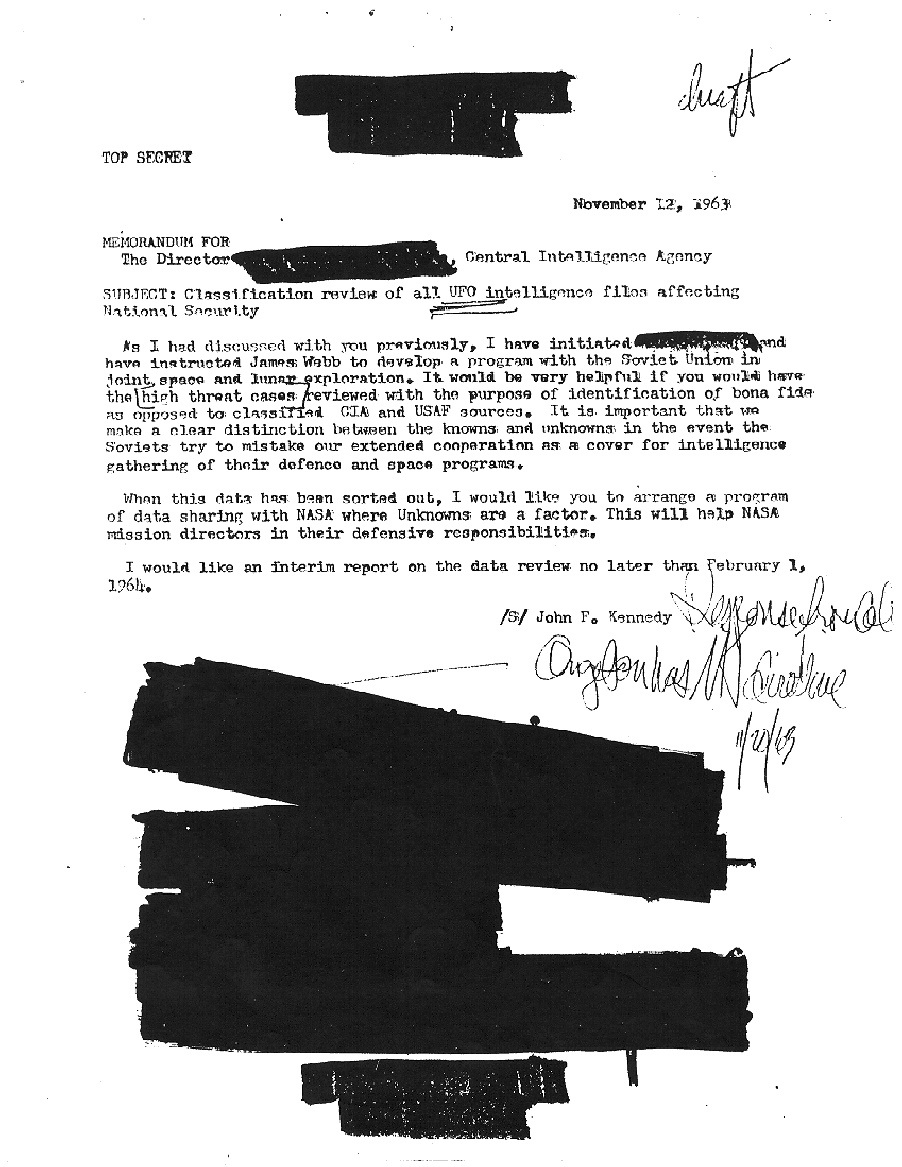
The memo came at a time when Kennedy succeeded in getting broad agreement in top level dialogue with the former Soviet Premier Nikita Khrushchev to work together on all future space and lunar projects and to release classified UFO files held by the CIA to NASA to help show to his Russian counterparts that UFOs were not examples of Cold War psychological warfare plans from his nation. Unfortunately, he never succeeded in his aim to release UFO information, let alone receive a response to his request. The highly sensitive nature of UFOs to certain people in top echelons of the U.S. government and military was made evident when at 12.31 p.m. on the hot, sunny afternoon of 22 November 1963, President Kennedy was assassinated in Dallas, Texas. Who assassinated the president has remained one of the most contentious in history as the man allegedly responsible for the shooting, Lee-Harvey Oswald, was within two days of being arrested killed by Jack Ruby (born as Jacob Rubenstein), a night club owner with Mafia connections, before Oswald could ever reveal his knowledge to the public.
As history tells us, Oswald was led vulnerably by two policemen to the county jail on Houston Street in Dealey Plaza through a crowd of 75 reporters and numerous policemen and civilians. During which time, he was asked by reporters whether he was the person who assassinated the president. What little time Oswald had to respond, he was able to state to the reporters that he wasn't responsible and that his time in court will vindicate him when he gets the opportunity to explain his situation. He never got the chance to have his say in court. A short time later, just when somebody shouted "Do you have anything to say in your defence?" and another good time for Oswald to admit if he did it (and perhaps who else might be involved if he did shoot at the president), Jack Ruby suddenly pushed himself through the crowd, pointed a handgun at Oswald and shot him at close range. Oswald later died in hospital.
Ruby was arrested and sent to prison for his part in the killing, but he too wanted to set the record straight of why he did it and who else was involved to chief justice Earl Warren of the CIA- and FBI-backed Warren Commission set up to investigate Kennedy's assassination. He claimed "my life is in danger", and "I want to tell the truth, but I can't tell it here". Before Warren could allow for it, Ruby quickly fell ill. Doctors diagnosed him with cancer in the lungs, brain and liver. He died three weeks later from pulmonary embolism in the lungs. No written confession or other evidence was found following Ruby's death. Presumably his sudden death at a time he could have revealed much about what really happened had to be considered a coincidence.
Before Oswald was led along his final walk through the crowd by the policemen, he did attempt to state briefly to reporters previously that he denied killing the president (together with another man killed on the same day, a Dallas police officer named J. D. Tippit, on a local street nearly 45 minutes after the president was shot). He said:
"I don't know what dispatches you people have been given, but I emphatically deny these charges. I have NOT committed any acts of violence."
And the final thing Oswald said (and recorded on film by NBC News) prior to his assassination was as follows:
"Oswald: I'd like some legal representation but these police officers have not allowed me to, to have any. I, uh, I don't know what this is all about.
Reporter (off camera): Did you kill the president?
Oswald: No, sir, I didn't. People keep asking me that. Sir?
Reporter (off camera): Did you shoot the president?
Oswald: I work in that building [Texas School Book Depository].
Reporter (off camera): Were you in that building at the time?
Oswald: Naturally, if I work in that building, yes, sir.
Reporter (off camera): Back up man.
Reporter (off camera): Did you shoot the president?
Oswald: No, they've taken me in because of the fact that I lived in the Soviet Union. I'm just a patsy."
Strangely these statements from Oswald never made it to the Warren Commission, the committee tasked with investigating the case and determining who was responsible for killing the president. Apparently the statements were not seen as relevant or important.
The only damning evidence the authorities had against Oswald was what appears to be his fingerprint on a similar-looking rifle to one owned by Oswald (or it could be the same one, which he had kept in his garage on the day of the assassination, except Oswald's wife and police noticed the rifle went missing). Whoever rifle this was, the Warren Commission wanted to believe this was the weapon fired at the president, including the third and final fatal shot. Interestingly, the weapon was not found after an initial thorough search of the library, until it was suddenly found wedged between two boxes (as the presumed reason why it wasn't found earlier) in the library on the sixth floor some 30 minutes later. No one can explain why the rifle (or the cartridge casings) wasn't found on the initial search. But now that the weapon was found and three cartridge casings were located on the same floor near the window (confirmed to be the place where bullets were fired on the President, although the Warren Commission did go to extraordinary lengths to accept a total of three bullets as having come from this single weapon and with no one else being involved) together with Oswald's fingerprint on the weapon, it seems to be an open and shut case. It didn't matter if it looked strange for the rifle and cartridge casings were suddenly found by Texas police despite a failed search to locate this evidence (and no library staff noticed the gun or cartridge casings just sitting in the room prior to the shooting, which was essentially how it was found). Basically, if we leave aside how the gun and cartridge casings got there, we have the mystery of how his fingerprint got its way onto the rifle. Apparently someone had left what appears to be Oswald's rifle for all intent for the police to find (rather conveniently) and it just so happens to have Oswald's fingerprint on it. Everything would seem like an open and shut case. Not one else could have placed that fingerprint on the rifle except for Oswald. Oswald must be lying. It was probably Oswald who brought in the rifle to the library without anyone noticing. Up to three bullets (20) must have been fired from what appears to be his rifle (which he did own a very similar if not the same weapon, or certainly the same make and model although there were some differences in the way the strap is attached compared to the rifle held by Oswald in personal photographs). It looks as if Oswald had been the one who pulled the trigger in an attempt to kill the president. So why not point the finger of blame at Oswald as being responsible for the whole event? It is the easiest and simplest solution.
Or so we are led to believe.
However, nothing in life is ever that simple. Looking at the events that unfolded on this day reveals this notorious fact. Indeed, the situation had somehow got dramatically and unusually complicated following Oswald's death, raising the spectre of an extraordinary conspiracy with strong links to other people being involved in the death of the president (with latest evidence now pointing to the CIA as well as the secret service agents who were meant to protect the president), and the considerable effort by these people to influence the public to think Oswald had to be the gunman and no one else. These people tried to use Oswald's background as a socialist sympathiser who formerly lived in Russia for two years as the likely motive for him to kill the president, but subsequent checks with people who knew Oswald would paint a different picture of the man, and one who apparently liked the president for his leftist views and willingness to get to the truth. Anything else unusual seen, heard, or detected by other senses of the human body by various witnesses (such as the smell of gunpowder in the air surrounding the secret service agents' car behind the president's own vehicle suggesting someone in that vehicle had also fired a weapon, as well as a couple of witnesses claiming to have seen someone holding what appears to be a rifle on the picket fence on the grassy knoll ahead of the presidential car although others claim it was merely someone smoking a cigarette to look like smoke fired from a weapon) must have an innocent and logical explanation. Yet the big picture is not supporting this simple explanation of Oswald being the culprit. And there is a lot of effort going on to confuse people about what really happened. Whatever the truth to this matter, there is no doubt that a bigger secret exists and it had to be maintained at all costs by those in the know. Or someone didn't like the president. Unfortunately, the latest evidence is not pointing in this direction. The president was definitely the target and he was seen as doing something to upset the status quo. Just to add to the odd nature of this case, even a presumably humorous note passed around on the day of Kennedy's arrival at Dallas airport in the FBI office claiming "Kennedy is wanted for treason" may actually have some truth (see the 2013 movie Parkland in an attempt to poorly re-enact the events of the day). Someone felt that Kennedy was getting too dangerous for whoever wanted him dead. It would appear, after looking at all the evidence gathered so far, that the president had to be taken out because of a certain secret, whatever that might be, that he was willing to reveal to the American public and the world. And to make sure Oswald would take the blame for this whole matter (and so avoid implicating other people in the killing), things were done to hide crucial evidence, confuse what went on during the event, and getting anything to point in the direction of Oswald at all costs as being the sole man responsible.
The whole conspiratorial nature of this event began when the autopsy report on the president was not performed in Texas in accordance with state law by Dr Carl Rose. Here, the forensic examination would have been performed to get the most detail as possible as to how the president was killed (21). But this was not what the secret service agents and others wanted to see. After a brief and dangerous standoff and likelty decision to draw guns on the doctor and police officer in front of other witnesses present, former secret service agent Clint Hill (the man who ran forward and jumped on the back of the presidential car to assist and protect Jackie Kennedy and her husband) said:
"In the end they [the secret service agents] accepted the fact that that was going to happen, and it did happen." (Source: NOVA's Cold Case - JFK)
. It is unclear if a preliminary forensic report was written by Dr Rose, but we discover the president's body was sent to Bethseda Naval Hospital in Washington, D.C., where it became apparent that some kind of an autopsy report had to be written, or else it would smack of a major conspiracy. The public had to be convinced everything was done by the books. However, it wasn't in the sense of gathering all the evidence from the president's body. The aim here has to be as brief as possible about what to include in the autopsy report.
However, when it came to the time to release the autopsy report to the civilian world, a lot of the crucial photographs of the president's head would go missing, and what few photographs were released showed considerably effort to hide the hole and stitch up the area with skin behind the president's head, and certainly no photographs of the front of the skull.
All this shows how important it was for whoever was responsible to control the autopsy procedure and have it done at a specific location controlled by the US military (where it can be more easily directed by the CIA to selected top military officials who would order two military pathologists with no experience in forensic examinations to carry out the autopsy and have limited access to x-ray images and practically no photographs to make their conclusions). Fascinating to see how the secret service agents were expecting the president's body to be taken to Washington, D.C., but didn't realise under Texas law, an autopsy had to be performed in that state where the death occurred. What difference would an autopsy make in Texas or Washington, D.C.? What benefit would this service have provided if it wasn't done in Texas? The concern seems to be on the level of service. We know there are two forms of autopsy one can perform: the standard one, and the forensic one. The latter is the most comprehensive of the two, and would provide considerable detail about how the whole event transpired and the people involved. It looks like the secret service agents were worried that the latter type of autopsy would be performed and that would cause some problems for them and potentially anyone else who may have been involved in the events of the day.
Now we see the decision was made to go for the standard autopsy in a military-controlled hospital. How interesting?
Today, we have very brief notes from this standard autopsy. What few poor quality photocopies of photographs exist of Kennedy's head show only from behind (and well covered up). This essentially hides the all-important crucial evidence around the side and front end of the head needed to determine whether the bullet that killed the president was an exit or entrance wound (ballistic experts say there is a distinctive pattern created by an entrance wound compared to an exit wound) and how likely it was that Oswald could have been in the right position to fire the fatal shot from the sixth floor room. Indeed a lot of the controversy and debate (and subsequent range of conspiracy theories brought up by the public, and later added to by the CIA, which only succeeded in raising more questions than it answers) could have been cleared up right at the beginning with detailed access to the complete autopsy report and all photographs, and preferable of the forensic examination type. Because a detailed analysis of ballistics on Oswald's gun and a closer study of how the president's skull got so shattered by the impact of one bullet would allow a complete and definite answer on how feasible Oswald was the shooter, and presumably the only one as we are led to believe And if we didn't have another man with Mafia connections choosing to interfere in the legal and scientific process of getting to the truth, a full and complete story of what really happened and who was responsible could have been revealed if Oswald was allowed to go on trial and gave his testimony, if not Mr Ruby himself if the people involved in the Warren Commission could have got their sorry excuse of an ass off the seat and get to the truth to the matter while everyone was fresh and had something potentially important to contribute. What a shemozzle. This is an unusual event with so many crucial forms of evidence having mysteriously disappeared, modified, or latter added to suit a particular and preferred outcome and all done at a short period of time after the killing. it was enough to give most people the view that there has to be a different story from the one officially being told by the Warren Commission. Namely more than one gunman had to be present on the day of the assassination, and with links going back to the CIA, for whatever reason. In fact, as of 2020, there is a strong possibility that Oswald may not have been one of the shooters. Unfortunately, with Oswald taken out by another gunman, it is impossible to listen to Oswald's side of the story to determine his whereabouts on a minute-by-minute basis, possible motives, and whether he was alone and had been present in the sixth floor room when the bullets began firing on the president. This is what happens when people don't do the proper investigations to find out before affecting those who are claimed to be responsible for the shooting. The old "shoot first and ask questions later" is a common mentality of American men (and still prevalent to this day with police shootings of black people with no reason given, as well as in the movie Fugitive starring Harrison Ford which shows it does not matter who the person being shot at is — anyone who is seen in a bad light is treated the same "we think you are guilty" way). And if there are secret agendas for why the shooting had to take place (and so far this is looking like the reality), this just adds another layer of complication. No wonder this event is so messed up.
Let us see if we can sort out this mess.
Firstly, we know that Oswald did own a gun of the same type found in the sixth floor room. In recent times, this is now being questioned with experts examining photographs of Oswald hold his own rifle and noticing differences in the way the strap connects to the rifle compared to the one found in the Texas library. But let us leave this aspect aside for the moment. In March 1963, Oswald used the alias "A. Hidell" to purchase by mail order a 6.5×52mm Carcano Model 91/38 infantry rifle with a telescopic sight. Already investigators found something odd. After examining the advert, it was determined that other choices for a rifle could have been made by Oswald, and this had gun experts scratching their heads as to why Oswald chose what is considered to be a slow, clumsy, and increasingly inaccurate (as the rifling chamber gets easily worn) to use weapon compared to other much better rifles that were available from the same advert — so why did Oswald choose this rifle if the aim for him was to kill people? It is almost as if he wanted to purchase this weapon because he felt unsafe living in the United States (he lived in Dallas, Texas, where much of the American population there have strong right-wing views and are fiercely patriotic of the American way of life) and would only use it as a weapon of defence if he was attacked or to scare off people rather than any form of offence on others. A bit like the excuse that Russia, United States, China, North Korea, and other countries have with stockpiling nuclear weapons. It is more of a deterrent. Having a gun is there to make other people think, "I better not mess around with him. He has a gun!" and hopefully that would be enough for American people to treat this guy with a little more respect. At any rate, the rifle that was purchased fits remarkably well to what was found on the sixth floor of the library building. Or was it a coincidence? Not likely because the rifle found on the sixth floor just so happened to have Oswald's fingerprint. With this first vital piece of evidence, we can say with reasonable confidence that this was probably Oswald's gun, unless he touched another similar gun from someone else and this other weapon was placed in the library. We can never be absolutely sure. However, what is not clear, and with no official testimony from any witnesses, is whether Oswald had brought in the rifle to the library and was actually in the room on the sixth floor when it all happened, let alone firing at the president as the authorities were quick to state as the probable scenario. If there is the slightest possibility that he was in there doing the dirty deed (the gun Oswald owned and the presence of his fingerprints would strongly suggest this), then we might as well see him as the culprit.
However, more oddities would arrive to question the likelihood of Oswald being the shooter and the only one to have allegedly caused the demise of the president. Firstly, three women were on the fourth floor, two of whom were watching the presidential parade through the window. Within 15 to 30 seconds of seeing the president slump over the backseat and made her think an assassination attempt had been made, 22-year-old Victoria Adams, an employee working in the book depository building, immediately ran down the stairs to go outside and get confirmation on what she saw. At no time did she see Oswald run down the stairs by the time she was in the stairwell. She also recalls Sandra Styles, a co-worker was following her down the stairwell, thereby having further corroborative evidence for her claim. And Sandra could confirm Victoria's story of what happened right down to a tee. Yet again the Warren Commission ignored the testimony of both women and, indeed, went as far as to initially rely on just Victoria's testimony, which was put on tape, and quickly (like the full autopsy report from the military pathologists) the tape goes missing. Later we learn the Warren Commission had the tape destroyed. Once the testimony disappeared, the Warren Commission could fudge the time it took for her to decide to go down the stairs by as much as several minutes. Several mkinutes and up to 40 seconds is a massive difference. To take on the "several minutes" theory, the Warren Commission could claim that it was possible for Oswald to run down the stairs to the first floor. But if the Warren Commission had accepted the testimony of both women, and a third named Dorothy Garner who was also on the fourth floor and saw the two women go down the stairs, it would have been learned that a United States Attorney had spoken to Garner and she said that immediately after Adams went downstairs, she saw Mr Truly and a policeman named Officer Baker running upstairs to the sixth floor. Under no circumstances did she see Oswald come down the stairs. So where was Oswald when this happen? We will have more to say about his whereabouts later.
As another anomaly, Oswald was trained to a level of marksmanship in his time as a marines soldier. Yet incredibly, all his knowledge of weapons made him choose a remarkably poor quality rifle. The kind of rifle that would lose accuracy with each shot taken with it, unless Oswald was given a proper military rifle and bullets. No such better quality rifle was available on 22 November 1963 and yet the advertisement for other guns showed much better options if his aim was to shoot the president at some point in his life. Interestingly, no such quality weapon was left behind on the sixth floor of the library, and Oswald never had any other weapon he could use. The only way to get around this inaccuracy and poor quality nature of the rifle Oswald had bought was to get a true sniper and expert marksman to adjust to the inadequacies of the Italian Carcano rifle design. Then the first shot would have been accurate. That kind of expertise was not available to Oswald. And, incredibly, whoever fired the rifle found in the library had completely missed the president and his car by a significant margin (that bullet has never been found to this day, so the assumption is that this first bullet must have missed the president), as if the person shooting had no idea had bad the rifle was. Even if the rifle was new or refurbished to a near original condition and working optimally, subsequent testing by the best Italian marksmen to re-enact the scene revealed a major problem with Oswald's rifle. No expert marksman had the time to fire three shots using that type of rifle owned by Oswald.
Indeed , this revealed yet another discrepancy. The Warren Commission remained convinced that three bullets were fired, all from the rifle owned by Oswald. Yet no expert gunman could fire 3 bullets in less than 19 seconds at the President and expect to have any reasonable precision required from the sixth floor location using this type of Italian-made gun (noted for getting inaccurate over time even with minor wear-and-tear of the rifling chamber) as an Italian investigation using professional marksmen has discovered. There was a reason the Italians put that weapon out-of-commission. It was a hopeless weapon to be using after a few dozen shots with it. It seems to be designed more to shoot a couple of rounds at the enemy and later the Italian soldier had to run back as quickly as possible to get a new rifle if he hasn't got shot and killed by the enemy. The manufacturer of the rifle were not expecting Italian soldiers to survive and return home. So you might as well give the soldiers a crappy rifle and the manufacturer can make its quick profit. Not only that, but there seems to be a strong possibility that Oswald was not alone in the room. Or, as the evidence is slowly emerging and falling into place today, it would appear that Oswald was not on the sixth floor when it happened but someone else. And that mystery person had access to Oswald's gun (it was found to have gone missing from Oswald's garage in his home on the day of the assassination, so it could have been anyone who had taken the rifle, not just Oswald) and this other person was more of a marksman to attempt this dreadful act on the president (but turned out he was not the guy who actually killed the president) and left Oswald's gun in that room for the police to find in an attempt to frame Oswald for the crime. Otherwise, the alternative theory is that the rifle found in the library was not Oswald's, but another of the same make and model. Pictures of the rifle found in the library is different in the way the carrying strap is attached compared to the same make and model of rifle carried by Oswald in three personal photographs. In which case, whoever fired from the sixth floor had to be another similar rifle, was better prepared for the event, and could have achieved a slightly more accurate hit of the president.
Well, only slightly better accuracy.
According to Governor John Connally who was hit by a bullet as he sat in front of the president in the car, he believed two bullets were fired. The first hit Connally, and the second hit the president. If this is true, the marksman was not quite accurate in the first shot, but was expert enough to adjust and fire within an astounding 1.6 seconds the second bullet. Amazingly this second bullet hit the president, but it did not kill him. Either that, or there had to be another gunman firing on the president.
But if we are talking about a rifle owned by Oswald, the lack of evidence on the whereabouts of the first bullet suggests that the sequence of firing of the bullets revealed the first shot was a complete miss and had hit the road beside the president's car and ricochet to hit the left side of the road kerb and after that no one knows where the bullet went. An expert marksman with experience of using the rifle and even spent time preparing for the event would have been aware of this and had adjusted the aiming on the first go, or at least fixed the rifle and tested it before going to the library on the day. Yet somehow, it appears the person who used what we are led to believe is Oswald's rifle for the first time had no idea had worn and bad the rifle was already. No preparation was ever done prior to arriving in the library to perform this dreadful act on the president. Amazing. An unbelievable situation for any expert sniper and marksman to find himself in should he be in the business of killing someone. No one of such skill would be so stupid as to not prepare for the event. Yet here we have a situation where someone had not prepared well enough to figure out that this Italian rifle was the nearest thing to crap as anyone could ever get at the time. Whether Oswald was asked to fire his own rifle under duress by someone else, or he was at another location in the library building (16) and someone else did the firing, already there are extraordinarily strange things emerging about this case. And much of it is not pointing to Oswald as the person responsible.
Again, not preparing for this horrific act of violence by testing the rifle and making the necessary improvements to get the accuracy would suggest that another gunman was present, and not Oswald. And this other person had no idea how bad Oswald's gun was.
So, who else was in the library to support another gunman other than Oswald?
The case gets even more complicated and murkier in terms of the people who were seen in the library at the time of the shooting and the likelihood of Oswald being the man responsible for the shooting.
For example, according to the authorities, an additional fingerprint was found on a cardboard box in the room in a position next to the window where the rifle was fired out of it. At first the fingerprint seemed to match a man named Malcolm "Mac" Wallace (he had killed a man some years earlier for having an affair with his wife and his fingerprints were recorded and kept by the police). An experienced ex-Marines sniper and marksman, if anyone could have fired at the president at that distance from the sixth floor room, Mr Wallace would have had a much better chance than Oswald. Yet investigators could find no good reason why Mr Wallace needed to be in the room despite some witnesses placing him in the building at the right time. Or was it someone else who looked very much like him? According to Joan Mellens, a closer examination of the fingerprint on the box has now suggested that it may not match Mr Wallace's police record. Or has it been damaged or modified by the time a second round of examination was made? We cannot be sure. At any rate, an alibi was found claiming Mr Wallace had been at his home sitting in his living room. Or did someone else look like him and had stayed at his home while Mr Wallace did the shooting? Again, we cannot be absolutely sure about this. No one has actually gone to the home at the right time to find out who was sitting in the living room with the back of his head facing out the window.
The American authorities have not pursued this angle further. The presence of an alibi was considered sufficient to see Mr Wallace as not a suspect.
Then we have the question of how the third bullet managed to get fired from the library and kill the President.
One thing seems certain, it would have required incredible luck for Oswald to fire and hit the president at the distance required. Even more luck to fire three bullets. Indeed, the Warren Commission accepted the view that the first bullet completely missed the President's car. The second bullet was more accurate, but could not achieve the objective of killing the President if this had been the aim. This second bullet entered the shoulder and exited from the president's neck. Yet he was able to calmly communicate to his driver that he was shot. It took a while, but a third and final bullet came out-of-the-blue from an unusual direction. And the nature of this final bullet was not normal. It did not behave like the ones fired from Oswald's gun Furthermore, the angle for this third bullet to arrive to hit the president seem different. At first it looked like it came from the front but this was probably because of the way the bullet and sudden expansion of the metal fragments on impact had exited the president's head. The ability of this bullet to partially disintegrate and push apart one side of the skull towards the front and right side regions with such incredible force may have caused his head to recoil backwards. This can make it seem like someone was firing from the front, but the likely direction could easily come from behind. Either way, the angle of entry looks way too difficult to achieve using Oswald's gun from the sixth floor of the library. But more astonishing was the level of damage done to the President's head by the third bullet. The two previous bullets fired from what appeared to be Oswald's rifle could not cause this amount of damage. The one that entered the president's shoulder, hit the vertebra and emerge from the neck did not explode. It kept going through the body, out the other side, kept moving and, if we accept the Warren Commission's view on what happened, had entered another body (this time Governor Connally) in front of the president and eventually moved around and got lodged in his leg. The one that entered the president's head appear to act like it wanted to explode to cause such tremendous damage. For all intent, this is strongly looking like we have a different type of bullet.
If this is a different bullet, we definitely have another gunman.
Unfortunately, with Oswald taken out by presumably another lone and crazy gunman with Mafia connections, it makes it incredibly hard to find out what really happened. Even more convenient, the loss of much of the autopsy report (especially the photographs of the original damaged areas on the president's body) is just too crucial and convenient. It would have confirmed what type of bullet hit the president's head and from which angle it entered and exited. Yet someone did not want this evidence to be made available to anyone. It is hard to see it any other way. Otherwise, the president's body would have been exhumed (apparently his body has not been cremated) from his grave at Arlington National Cemetery in Virginia, and his head properly examined again. Interestingly, no one was gone that far to resolve this mystery once and for all. Instead, his death and subsequent blaming by the authorities on one man named Oswald seems too convenient. It is certainly not helped by the fact that Oswald had an association with Russia (i.e., a Russian citizen for two years with an interest in a particular social brand of communism in Cuba and not the hardline version used in Russia), and he wasn't exactly fitting into American life given his diverse views, especially among the more ring-wing patriotic democracy-loving hardliners living in Dallas, Texas. Yet his background and beliefs should not be held against him. In fact, he had strong support for Marxism views but denounced later after leaving Russia the type of communist regime it represented. He simply did not support it. Yet at the same time, he did not agree with all aspects of the American way of life and how democracy worked either, mainly because of his concerns of how the rich were using the poor in a manner that wasn't to his liking. If there was any support for the American views, it was the fact that he preferred Kennedy's left-wing views.
George de Mohrenschildt, who befriended the Oswalds, claimed that Oswald:
"...was an admirer of President Kennedy.…I mentioned to him that…I thought that Kennedy was doing a very good job. … And he also agreed with me: ‘Yes, yes, yes; I think [he] is an excellent President, young, full of energy, full of good ideas."
Very interesting. Must make a reasonable person wonder what possible motive could there be for Oswald to kill the President? His views were too closely aligned to the President to warrant an assassination by this man. It does not make sense for Oswald to do this kind of horrific act. This is looking more like someone else had wanted this event to happen, and Oswald just happened to be in the wrong place at the wrong time and was used as the scapegoat to cover for the actions and motives of other people. Or, it could be closer to the truth to say that certain American patriots already knew about Oswald and his support for Cuba and the Cuban leader Fidel Castro's socialist aims, not to mention the Marxist views he held (but interpreted by some Americans as a communist of the hardest form as seen in Russia), and so have chosen to have him in the right place and time for others to achieve the dirty deed and later blame the man for the whole episode. Certainly Oswald was known to the CIA for quite some time and kept on file prior to the assassination taking place.
Whatever was going on between Oswald and the CIA, there is one thing that has got a lot of people wondering: Did the bullet that killed the president come from Oswald's rife?
This has to be the greatest question on everyone's mind in this whole matter: the mystery third bullet. The nature of this bullet is most intriguing. It is certainly not of the type fired from the rifle in the Book Depository room on the sixth floor of the library building. The way the third bullet behaved on impact with the President's skull is not in keeping with the other bullets, especially the type used in the rifle on the sixth floor of the library. Those bullets do not cause such extensive damage to the head as seen in the video of Kennedy getting killed. In fact, the bullets do not explode or split apart and suddenly expand outwards in all directions to cause maximum damage, which in the case of the president was a blowing apart of the front and parts of the side of the skull. Rather, the bullets of Oswald's rifle stay intact and just crumple on impact and would only show small entry and exit holes. Furthermore, a professional Italian marksman could not achieve the accuracy at the distance the president was killed, and he could not make the bullets shatter and expand to cause this kind of damage to the head. Just to make it worse, Oswald was a mediocre gunman (22), not the expert marksman variety.
If the Italians are right, then the gunman had no further opportunity to prepare, aim, and fire the third bullet. The target was too far away and any expert marksman had a high chance of missing the target. If someone wanted the President dead, someone else had to do the job.
Here is a video to show from the vantage point of the first gunman on the sixth floor what he saw and where the president's car was when the bullets were fired.
However, we now learn from investigations by an experienced and retired Australian detective examining the case from a fresh new perspective of the existence of another gunman. And the nature of the weapon and type of bullets used by this second gunman does fit the observations of how much damage the third bullet had left behind on the president. Everything does come down to the unusual nature of the third bullet.
So what do we know about this third bullet, and who fired it?
The most recent analysis conducted by a retired Australian police detective with experience in homicides has shown quite convincingly that Oswald could not have been the guy who achieved the ultimate destructive outcome with the president. This is further reinforced by the latest ballistic information, from accurate 3D re-creation of the Dallas street and motorcade, and the scanty information from poor quality x-ray images of the president's skull. Further details can be watched in NOVA's documentary Cold Case: JFK. Oswald, or whoever was shooting in the position on the sixth floor of the library building, was not at the correct angle to kill the president based on the type of damage caused to the skull. Just to make it harder, the person who started the shooting had already struggled to get the precision and accuracy needed with the Italian rifle to aim for Kennedy's head in such a short window of opportunity and distance away from the moving target. Even with a top notch expert marksmen at the helm, the inaccurate nature of the weapon and distance involved made it clear any attempt to fire a third bullet from the library was a no goer. It was too far and inaccurate even for the most expert marksman on the planet. Somehow this man got a conscious and decided he didn't want to kill an innocent bystander. If Oswald could somehow have fired the fatal shot (it is looking improbable so far), it would be more of a "magic bullet" to reach the president. Because in this circumstance, the bullet had to turn in mid-air just behind the skull, maintain speed, enter the skull, and then, by some inexplicable reason, the bullet had to explode quite dramatically to cause the level of damage seen in the official Zaprada video. Basically, we are talking about an impossibility. The bullet that ultimately killed Kennedy came from someone else, located in a different place, and was of a special type designed to explode and destroy whole organs in the body as a means of ensuring instant death. In the case of Kennedy, much of his brain on his right side had been totally destroyed (it would have been an instant death other than the primitive brain stem still ticking away and trying to maintain a heart beat), and the explosion caused a significant amount of the skull over one side (that is, to his right and front side) to be blown out. Also, the angle of this final fatal bullet came from a sufficiently different direction, too difficult to achieve from Oswald's position. Fortunately, the retired Australian ex-police detective was more rational about it, and looked for a sensible and reasonable solution. The work he did of carefully analysing the scene and available evidence is now pointing quite clearly to one of the bodyguards in the vehicle behind Kennedy's car. Furthermore, whether by sheer coincidence or not, it has been revealed that only one bodyguard had the high-powered weapon with the right bullets to do it, and was in the right direction as well. What a coincidence? Does this mean we have finally got the answer?
After identifying the bodyguard, the producer's of the documentary suddenly realised how quickly the man (who was still alive) was ready to sue anyone who claimed he fired the fatal shot in order to keep his side of the story quiet. That is a good sign that we are getting very close to the truth.
Let's assume it was this bodyguard.
If it is true, why was it necessary for this bodyguard to carry this type of weapon? Everyone else in the secret service who were there and meant to protect Kennedy were issued with standard weapons with bullets that would not cause the level of damage seen of the president (more designed to wound or create a clean kill and hence a simpler entry and exit wounds). However, without video evidence to show the bodyguard actually firing on the president (apart from the smell of gunpowder noted by some witnesses in the crowd nearest the vehicle where the bodyguard had been riding in) and with no one actually being able to see exactly who it was in the vehicle (as the other two bodyguards in the car on either side of the gunman carrying the high-powered rifle and deadly exploding bullets had stood up at the right time and covered for the guy, the bullet was fired, and he sat down, only to be further covered from behind by two more bodyguards in the second back seat), the confusion among the public of what happened and being more concerned about the president's well-being had effectively avoided the bodyguard responsible for killing the president from ever being singled out by anyone in the public. And to make sure of it, one bodyguard in the car behind Kennedy's vehicle ran forward to assist the president and so ensured anyone who remained standing to watch the events unfold were watching this bodyguard and the president. This effectively directed the gaze of the public elsewhere (if they had not hit the ground, ran from the scene, or looked away in fear).
We see all the secret agents in the car behind the president in this photo, with the actual person who fired the fatal shot being flanked on all sides by agents now seated in the middle position:

As the retired secret service agent Clint Hill said to NOVA:
"I was on the left running board of the follow up car immediately behind the presidential vehicle. All of a sudden I heard an explosive noise over my right shoulder, and I saw the president grab at his throat and I knew something was wrong. I jumped off the running board of the follow up car and ran towards the presidential vehicle. As I was running, they tell me there was another shot — I didn't hear it. Just as I was approaching the president's car, there was a third shot. It hit the president in the head, and then it exploded out to the right side of his head. Blood and brain matter and bone fragments sprayed out across the people in the car, across the trunk and myself, and Mrs Kennedy. Pulled myself up to the rear of the car and Mrs Kennedy came out on the trunk. She didn't even know I was there. She wasn't reaching for me. She was reaching for something that came off the president's head I grabbed her and put her in the back seat and I screamed to the driver to get us to the hospital."
And all the while, the secret service agents kept quiet about the shooting. Even after realising what had happened and would have been aware of the gun shot (well if the public can smell the gunpowder, the secret service agents could have easily heard the gun go off without any trouble), no one wanted to say a thing. Clearly they all must have heard the gunshot at close range. They must surely be able to smell the gunpowder. The two men on either side of the shooter must have noticed the rifle going off and saw the aftermath. And even after it all happened, the shooter was still carrying out his duties as usual, this time to protect the new president who would take over the leadership position. Amazingly, he was allowed to continue carrying the same high-powered rifle with exploding bullets despite the likelihood that he was responsible for killing President Kennedy. Huh? It was almost like a job well done given the way all the secret service agents were behaving subsequently. Not even a sign from the shooter that he had remorse or guilt for "accidentally" firing and hitting the president. Surely he must have known he had pulled the trigger, accidentally or otherwise. Yet there is no testimony from the secret service agents to claim that the shooter was prepared to step down from his position and hand over the gun to someone else, let alone whether any one of them had accidentally fired their weapon on the president (assuming it was accidental).
It made for a remarkably well-conceived and planned effort by someone or a group of individuals to kill President Kennedy.
Suffice to say, all this is leading us to suspect that a second weapon was definitely used in the shooting, and thus a second shooter.
Yet the American authorities remained unconvinced. Still, to this day, the authorities prefer to see Oswald as the sole shooter and person who killed the President.
Now really?
Just to add to the strange nature of this event, not even the couple of witnesses who allegedly saw two men come up to policemen Tippet and shot him dead could confirm that it was definitely Oswald. Yet a person of similar body build was linked to Oswald and the authorities have took this to mean that it must have been Oswald. Who else could it be? Father Christmas? The Easter Bunny? Nah, it must be Oswald. Well, if this view from the police is meant to be true and represents top notch investigative abilities of the police, heaven help us. It would have to be one of the most amazing deductive skills ever applied to a murder case by the American police based entirely on body type. Unfortunately, today, the law courts wouldn't allow for such a conclusion to be made based on this kind of testimony from the witnesses unless other evidence existed.
At the time this second shooting took place, Oswald claimed he had heard about the Tippet shooting on the radio. Prior to this, his boss at the library where he began his first day at work told staff to leave early because of the shooting incident with the president. Oswald decided to keep away from the commotion on the streets and watch a movie. But he was picked up by police after a tip-off from a member of the public. Since then, every attempt by the authorities was made to pin all the shootings on this one man.
Even the Warren Commission went to extraordinary lengths to establish that all the bullets came from this one rifle, and Oswald had to be the man responsible for the policeman's death given how similar he looked to witnesses testimony (but no one could confirm it was definitely him). Noting Oswald's fingerprint was on the gun used to fire on the president, for some reason, this made the case rather damning against Oswald unless he could find an alibi to support where he was when the policeman was shot, and a very good explanation of how his fingerprint got onto the rifle and whether he had brought the gun into the library. Not unless we believe in the supernatural and he could speak from the grave in his own words, it would appear that this is one aspect we will never quite know the truth. Yet it is amazing that the Commission went to considerable efforts to avoid implicating anyone else. It had to be this one man and no one else. Together with knowledge that Oswald did own a similar (if not the same) rifle, and may have been used in the past in a failed attempt to kill Major-General Walker, a man with strong right-wing views, at close range outside his home (but missed, and that was for a non-moving target since Walker was sitting in his chair at his desk at the time when he heard the shot and saw the bullet get lodged in a wall as if Oswald or someone else using his rifle had wanted to frighten Walker but not kill him), the simplest solution was to point the finger at Oswald as the only person capable of this crime. End of story.
Again it just seems too convenient.
Or would it be closer to the truth to say that President Kennedy was killed by someone else and everything was made to look like it was Oswald as the sole shooter (even right down to stealing his rifle from the shed in his home and placing it in the library, unless it was another rifle of the same make and model), only to be later taken out by the CIA rather conveniently with the help of Jack Ruby with Mafia connections to avoid something sensitive from getting out to the public?
Or should we accept the view that it was the crazy antics of a lone gunman and considered a Cuban/socialist sympathesizer as the CIA and FBI-backed Warren Commission on the assassination in September 1964 wanted to conclude?
For more than 70 years, serious questions remained unanswered while the majority of the American people expressed considerable skepticism of the "one gunman" theory. For example, witnesses reported seeing an unidentified man in the crowd opening up the only black umbrella on a sunny, hot day and holding it high above his head as the president was going past him. He then decided to move the umbrella in a clockwise motion (even though the president would not have seen it) and immediately the bullets started firing. Once it stopped and the president was slumped in his car, the man closed the umbrella, sat done on the kerb for a few minutes, got up and walked to the library. A strange act to be seeing of anyone. Furthermore, how the bullets hitting the president seem to come from two different directions. Indeed, there was even talk of a third gunman on the grassy knoll, with a couple of witnesses claiming they could observe someone holding what they thought was a rifle. Or was this more a misidentification of something else, and anyone else who saw smoke on the grassy knoll was nothing more than someone smoking a cigarette? Or was there a third-gun who realised his services were not needed and he hid his rifle, sat down and had a cigarette before walking off into obscurity? No one knows for sure. But if this is true, having backups is not an absurd idea for the U.S. government, especially the CIA if it was determined to achieve a certain outcome. Indeed, as many as three backups is common in the US military (we see this in the three US Army-owned Chinooks 47 black helicopters following the testing of an electromagnetic vehicle in Texas as developed by the USAF to ensure multiple backups are ready at hand should the vehicle have a mishap during its maiden flight across the countryside on 29 December 1980 and need to be transported back to its military base, as can be seen in the Cash-Landrum UFO case) and something the CIA would fully endorse if it had the plans to carry out this violent act on the president. The only difficulty in having so many gunman is how to co-ordinate them all and let them know when their services are needed. Back then, no one had mobile phones and earpieces to communicate the key information. So the best thing was for someone to have a good vantage point. Then he can, say, carry a black umbrella, open it up to tell everyone the president has arrived and is alive, and watch the events unfold. Each gunman (or anyone next to the gunman) observes the umbrella, and when it is clear the president is still alive at a certain point along the route, the next gunman with the opportunity to take the shot prepares and aims for the president and tries to take him out. The only time the umbrella gets closed and the man eventually disappears is when he can see the president slumped at the back of the seat looking fatally wounded. Any other gunman next in line can quickly hide behind a picket fence, put the rifle in a bag, take a smoke, and then casually walk away as if nothing unusual happened. That is how it would work. But leaving that aspect aside, how can we forget the incomplete and second-rate "non-forensic" autopsy report, not to mention what happened to the photographs and actual original brain samples from the president's head where the metal fragments were embedded. There are also serious questions about why a forensic examination was not permitted at the Parkland Hospital by an expert forensic pathologist. And why were the authorities so quick to blame the whole event on one ordinary man working in the Texas library on his first day without establishing the facts in a court of law just in case they have got it wrong? Whatever is going on and how the events unfolded on that fateful day, all these interesting and somewhat confusing observations helped to add fuel to the fire of a grand conspiracy and based on a bigger and more sinister reason. Whether or not Oswald was the gunman, or one of the gunman, there was definitely someone else involved in the killing of the president, and potentially as many as three more gunman other than Oswald himself could have been present on the day. Even if just one other gunman had killed the president, we can see this individual is not willing to come forth to claim responsibility even if in the slightest possibility it could have been an accident. The hush hush nature of this event, even despite most of the American public being convinced it had to be someone else, is extraordinary. It is looking like the president really did have to be taken out by someone with a grudge against the leader given how many people involved want to stay silent on the matter. (23)
So, how likely is it that Oswald was one of the gunmen, if not the sole gunman?
There is a photograph showing what appears to be Oswald standing outside the library watching the president go by in his car (with a couple of secret service agents looking back as if noticing him or someone in his general direction).
This is the picture that also shows Kennedy holding his throat as his wife Jackie turns to him and reaches around with her left arm to support Kennedy's left arm, as can be seen in these two pictures:
Here are the best close up picture in raw and original form of the people congregating around the library entrance, including the mystery man:
To get a better sense of the people's positions and stance they took when the above photograph was taken, volunteers have helped to re-create this photograph outside the library:
Looking at the original photograph (23), we see the clothing worn of the mystery man appears to be a jacket or shirt with a distinctive V-front design. Nolan Billy Lovelady was outside the library at the time the picture was taken. He claimed he had a shirt unbuttoned in a manner that looks somewhat V-shaped on the front. When asked in 1971 to wear the clothes he wore on the day, this is what he claimed he looked like:

There are some notable differences in his shirt, especially in the design of the neck collar region when compared to the mystery man's jacket/shirt and the actual clothing worn by Oswald when he was arrested.
Here is the best comparison images of the mystery man's clothing for comparison with Oswald's official clothing with jacket on when he was arrested:
Here, the collar design is wide around much of the back and side of neck, but suddenly comes in deeply, then V-shapes out slightly and slowly merges in line with the jacket across the chest. You do not see this in Lovelady's shirt. There is a noticeable difference even despite the pictures not being perfectly sharp. Another thing odd is how some witnesses claimed Lovelady's shirt was done up differently while working in the library, whereas in the photo in 1971, Lovelady was happy to give the impression of how he believed he looked with the buttons on the shirt undone towards the top to create the V-shaped appearance. Not exactly dressed for work. While Oswald and many others took pride in their appearance, Lovelady was looking rather scruffy for the V-shaped look. Perhaps his work entailed more labour-intensive activities that required casual clothing and a more laid back look?
Also notice how the white T-shirt underneath for each of the men shows a slightly more prominent V-shaped neck design for Oswald compared to Lovelady's white T-shirt. We see this more clearly with these photographs of Oswald and the mystery man. Compare these pictures with Lovelady's T-shirt design:
There is also something else a bit odd about the mystery man. His face looks not quite like Oswald. It appears to be in the hair region when seen close up. To see this more clearly, here is the best digitally-enhanced image of the mystery man:
Notice the way the hairline is shaped and combed. It looks way too similar given a difference of 6 years for a man that was known to be balding quickly as was the case for Lovelady. It is unlikely Lovelady had his hair looking the same after 6 years.
Here we see signs of a conscientious effort by some unnamed person(s) to modify the picture in a professional manner to make the mystery man look more like Lovelady (at a younger age) rather than Oswald and had it re-photographed. In that way, Oswald cannot be seen as being among the people watching on as Kennedy was being shot. There is even a possibility that the whole face of the mystery man could have been modified to look like Lovelady as this example shows:

Makes one wonder just how much tampering has occurred to the photograph to ensure Oswald would be blamed for the whole mess. In conclusion regarding the photographic evidence available at hand in its current form, Professor James Fetzer's stated in his book titled Murder in Dealey Plaza:
"A man many people think strongly resembles Lee Harvey Oswald is pictured standing in the front entrance of the Book Depository Building. If it is, in fact, Oswald, he could not have been on the sixth floor of the building when the shots were fired. The Warren Commission will discount any possibility that the figure is Oswald, and instead identifies the man as Billy Nolan Lovelady, another building employee. The man in the photo is wearing a dark, heavy-textured shirt open halfway to the waist over a white undershirt. Lovelady later tells reporters that he was wearing a red-and-white-striped sport shirt that day. The identity of the man in the photo has never been clearly established. (pp. 34-35)
So what is left for Oswald to support his case? Surely it must be the eyewitness accounts of those who were outside the library, right? In which case, could anyone vouch for Oswald being outside the library? And how reliable are these statements?
There was a witness, an employee of the library, who did report to the authorities that he had encouraged Oswald to come outside to watch, which it seems he did based on Oswald's testimony. Oswald remembered the name of the person who asked him thereby corroborating on the witness seeing Oswald.
As Mr Oswald stated to police, he saw, and allegedly was with, Bill (William H.) Shelley outside the door. Shelley was observed, as Mr Oswald had claimed, by another man named Billy Nolan Lovelady. Strangely, neither Mr Oswald nor Mr Lovelady could confirm whether either of them were present outside the library. Either Oswald was outside for a very brief moment or something was obstructing Lovelady's view of Oswald. Or was Lovelady too fixated on watching the spectacle not to notice? Or could there have been some animosity between the two men because of their different views, or a willingness by Lovelady to take revenge on Oswald for what he thought had happened to the president and did not want to confirm Oswald was outside? Or there is the possibility that someone asked Lovelady after the fact to overlook any memory he had of having seen Oswald. One can never be sure about this. One thing is certain. There was plenty of time for the witnesses to think about what they wanted to say in their testimony to the Warren Commission. A pity considering it should have been the job of the Texas police to gather the testimony immediately after the shooting from all the witnesses, despite how many there were. A big job, but it had to be done. Or given the fact that everyone wants to blame Oswald, why not focus the investigation on the witnesses who worked in the library. Start there at the very least and work outwards. A much easier task surely.
In the case of Oswald who was interviewed very early in the piece (a rarity it seems for the Texas police), he noted Shelley was outside but did not mention any other employee. Is this because working on the first day in the library was not conducive to remembering or being aware of all the people working in the same building? Maybe it took a while for Oswald to become familiar and recognise the faces of all his co-workers. Only Bill Shelley, who was happy to speak to him and encouraged Oswald to come out to have a look, was the one that had the strongest imprint on Oswald's mind.
Mr Will Fritz of the Dallas Police Department wrote in his notes during his interview with Mr Oswald that he was "out with Bill Shelley in front" (see this link) of the library building watching the president going by. The Fritz notes does exist and were not mentioned by the Warren Commission. In fact, the notes were hidden from the public until 1997.
Yet again another crucial piece of evidence gets conveniently removed or hidden. No one really wanted to hear what Oswald had to say about his whereabouts outside the library. Useless investigations from the Warren Commission and hopeless police work to confirm what was said.
This is an important piece of evidence. Oswald obviously knew the name of one man who was outside. This must support his claim of being outside, no matter how brief it was. Enough time as we see in the photograph for Oswald not to be anywhere near the sixth floor when the first two shots were being fired on the president. How else could he possibly have known that? No indications anyone had told him about this. As for why Oswald and Lovelady had not seen each other, it is quite possible Oswald was not familiar with Lovelady as an employee of the library because he had not been working in the building for very long to be introduced to him and all the other employees. Likewise Lovelady could have been completely unaware of Oswald and who he was (perhaps he arrived slightly late to work), never mind if he was an employee in the library. Yet somehow Oswald knew Shelley was present outside because he spoke to him, and now he said to the police he was outside. So where is he in the photograph? Must be the mystery man looking around the wall, even if his face looks a bit odd.
Most intriguing.
This may be crucial evidence.
On closer examination of the photos, we see four people near the entrance to the library. Apart from the mystery man looking around the edge of the wall with his interesting clothing and body build highly reminiscent of Oswald, we see another person to the left of the mystery man and somewhat behind with two arms held up to cover the person's face from the sun in an attempt to get a better look. He was Buell Lesley Frazier. Then there is a third man just in front of this person, lower down. Part of his head starts to show, but is covered (and without a clear picture showing the details of an arm covering part of the head, it might be interpreted as his face had been cut out), He appears to be standing a couple of rungs down the stairs. It has been determined that this was Lovelady. According to his testimony, he intended to sit down and have lunch with Sarah Stanton until the word came through that the president had been shot and then the lunch part was cancelled. Immediately after, Lovelady and Shelley were busy trying to get a vantage point across the road to see what had happened to the president.
There is another man behind the mystery man. This has been determined to be Shelley. In which case, he should have been able to identify Oswald if he was outside. Interestingly, Shelley's testimony provided to the Office of the U.S. Attorney at 4:10 p.m., on April 7, 1964 (which gave a lot of time for Shelley to think about things, talk with others, and decide how he would respond) indicates that he found Oswald was not very talkative, but had spoken to him on various work-related matters (mainly to direct Oswald on what to do). Other than that, there is no obvious indications he was aware Oswald was outside.
As for the testimony of the others who were outside, here is a summary of what was said:
- William Shelley, Oswald’s manager: “as the Presidential Motorcade passed I was standing just outside the glass doors of the entrance … Billy N. Lovelady … was seated on the entrance steps just in front of me” (Warren Commission Hearings, vol.22, p.673 [Commission Exhibit 1381, p.84]); “several people were out there waiting to watch the motorcade and I went to join them … Billy Lovelady joined us shortly afterwards … just outside the glass doors there” (Warren Commission Hearings, vol.6, p.328).
- Sarah Stanton: “I was standing on the front steps of the Texas School Book Depository with Mr. William Shelley … and Billy Lovelady” (Warren Commission Hearings, vol.22, p.675 [Commission Exhibit 1381, p.89]).
- Billy Lovelady himself: “I happened to look on the outside and Mr. Shelley was standing outside with Miss Sarah Stanton, I believe her name is, and I said, ‘Well, I’ll go out there and talk with them, sit down and eat my lunch out there, set on the steps,’ so I went out there” (Warren Commission Hearings, vol.6, p.338).
- Buell Wesley Frazier: “I was standing on the steps there … I stayed around there pretty close to Mr. Shelley and this boy Billy Lovelady” (Warren Commission Hearings, vol.2, p.233).
- Harold Norman: “Billy Lovelady … was sitting on the steps there” (Warren Commission Hearings, vol.3, p.189).
- James Jarman: Lovelady was “standing on the stairway as you go out the front door” (ibid., p.202).
- Danny Garcia Arce stated that he went outside with Lovelady and Shelley: “I was standing in front of the Texas School Book Depository. I was on that grassy area part in front. … The other guys … were all in front of the building” (Warren Commission Hearings, vol.6, pp.365f). He identified Lovelady as the man in the photograph (ibid., p.367).
- Virginia Rackley, who had become Mrs Donald Baker by the time of her Warren Commission deposition, pointed out Billy Lovelady on Commission Exhibit 203, a copy of Altgens’s photograph (Warren Commission Hearings, vol.7, p.515).
With things looking a bit shaky to support Oswald's claim of being outside (unless a number of the witnesses were choosing to be forgetful and blame Mr Oswald for everything), we can only go by what Oswald did next. Hopefully there would be another witness to support any further claims.
Not being of the talkative type as Shelley has admitted in his testimony, and being Oswald's first day at work (understandable), Oswald made the decision to walk back inside to have his lunch. He was oblivious to the fact that the president had been injured and that a third bullet was about to be fired on the president (and that was the time when people would mention to each other of the president being shot).
If the photograph showing what appears to be a man wearing remarkably similar clothing to Oswald is in fact Oswald, then how long did Oswald stay outside? Long enough until Oswald saw the president moving away (and apparently already shot in the shoulder and neck region) and decided he would walk back inside the building on his own, still oblivious to the next bullet about to be fired on the president. People were not expecting the president to be shot and still couldn't tell even why the wife of the president was moving over to support the president in his hour of need and help. Just as he was going upstairs to the first floor, the third and fatal shot was made. No other staff member outside saw Oswald walk back in, let alone whether they all recognised him as a new employee standing outside (or more likely, given the attitude of American citizens at the time of a man accused of any wrongdoing, if the authorities find Oswald's fingerprint on the gun, it must have been Oswald who did it, so maybe the testimony from some witnesses would show some deliberate forgetfulness and even needing to pin it on the man given such seemingly strong evidence against him).
To make it doubly worse for Oswald, there was no one on the first floor to support his claim to the police that he was working on that level and having lunch when it all happened. He got his lunch and walked to another location on that floor to sit down and eat his food. And all the while we have various other people who were prepared to call Oswald a liar simply because his fingerprint was found on the rifle on the sixth floor. No other evidence could be found to help Oswald in his case.
But there is another problem for the American authorities in framing Oswald. It concerns the time needed to climb up an additional five floors to get to the sixth floor and get prepared to fire the third bullet. As Oswald claimed, he began to walk up to the first floor. Not run as we are told. Looking at how far the President was going down the road (and the photograph shows quite clearly that he was already hit by the second bullet when his wife came over to assist him), the third bullet was fired. For this to be true and for Oswald to be responsible, he had to run extraordinarily hard to get to the sixth floor. Kind of like superhuman strength. By the time he got there, he would have been puffing and breathing very hard. Not an ideal situation to be in if the aim is to fire on a president at some distance with great accuracy. He somehow had to find the aim and begin aiming at the president, calm his breathing (more time wasted here), take another deep breath, and hope to hell he can hit the President. There is something about all of this to suggest that this is highly unlikely for Oswald.
Then Oswald had to run down the stairs at superhuman strength and not be noticed by three women on the fourth floor. Oswald must have been an astonishing magician in his spare time to make himself invisible to other people in the stairwell, or else he was quieter than a mouse and disappeared faster than a fart in the wind given how well he managed to evade every witness in the building.
Yet the question still remains: Did Oswald stand outside the front door of the library looking at the motorcade for a brief moment? Only he can say with any reasonable certainty. He believes he was outside based on his testimony and acknowledgement of seeing Mr Shelley. Unfortunately Oswald is dead. How convenient the poor man was taken out so early in the piece.
Apart from all of that, we see that Oswald was meant to be working in the library. Roy Truly, told the Warren Commission that Oswald was an employee. Truly had the option to assign Oswald to one of two buildings on his first day at work. "I might have sent Oswald to work [there]....Oswald and another fellow reported for work on the same day [October 15] and I needed one of them for the depository building. I picked Oswald."
Interesting to see it was Oswald's first day at work. This would explain so much. A lot of the staff members at the time were probably unfamiliar with a new employee. Combined with the intense focus on the president's motorcade, it must have made for a difficult time to prove a lot of Mr Oswald's claims, let alone who was present and where. Only Shelley could have shed some light and confirm what happened. Unfortunately his testimony starts to get wonky and unreliable as if he too has decided to be judge and jury in this case and believing that Oswald had to be the guilty man. In the case of Mr Lovelady, he claimed not to have noticed Oswald. Or maybe he hadn't met the guy to know who he was; and he, like the other staff members, was too preoccupied with watching the president to really know all the people who were standing around.
If all this is true, a number of people have gone to a remarkable effort to blame Oswald for the president's death all because of a fingerprint found on a rifle resembling very much like the one Oswald owned (and probably was his rifle). Yet no one ever considered the possibility that Oswald could have been innocent and another person was likely involved and was trying to frame the poor young man for the murder. This other person could have easily stolen his rifle to commit the atrocious act.
It is amazing.
So who really killed the president? And could the gunman who delivered the fatal blow be linked back to the CIA?
Indeed, could it be the CIA that started this mess in the first place?
All we know is that the CIA has used the Mafia in the past to do its dirty work. For example, the CIA has hired the Mafia (two men) and several Cuban exiles in America in a failed attempt on 17 April 1961 to kill Cuban leader Fidel Castro during the "Bay of Pigs" fiascoe. So any involvement by the Mafia in stopping Oswald from revealing evidence of his whereabouts and so potentially jeopardize the "lone gunman" theory and his prime suspect status in the murder to the media or the independent commission if paid enough money or other rewards could be eventually linked back to the CIA.
And certainly the CIA would have the motive to take out Kennedy after his revealing memo on UFOs.
Perhaps we may never know.
Whatever really happened, we do know there is still a considerable effort to this day by the top echelons of the U.S. spy agencies and the military community (in particular the U.S. Air Force) to maintain UFO secrecy at all costs. Initially the excuse was to avoid public panic as has been seen in the radio broadcast of H. G. Wells, War of the Worlds, and how a number of people reacted to hearing this story. Today, it is more to do with maintaining power and staying rich under the current economic system so long as other people are made to believe all UFOs are IFOs or to at least get people to be preoccupied in areas that would force them to maintain the current economic system and not be aware of the true UFO situation. As for American Christians wondering about all of this, the CIA is willing to paint a demonic picture on the UFO phenomenon to help convince these simple-minded religious folks to believe UFOs are not worthy of discussion.
For example, Charles Upton, a retired high ranking military attaché with CIA connections, wrote an article in the New York Times in April 2011 talking about the similarities of UFOs and the demons described in religious folklore. As Upton said:
"The UFO phenomenon has three separate yet related aspects:
- ) It produces real material-world events, detectable by radar and sometimes leaving behind physical traces;
- ) It is a psychic phenomenon that profoundly alters the consciousness of those exposed to it;
- ) It is apparently surrounded by deception activities which mimic it, produced by human groups. We tend to consider these elements as mutually exclusive, but they’re not; all three are explainable by demonic activity and invocation.
Demons are subtle beings who can temporarily materialize themselves and various objects in this world, but who cannot remain on our material plane for very long.
And the deception activities of human groups, besides being attempts to piggyback on a phenomenon that the deceivers didn’t originate and can’t control, may be designed not simply to imitate the "aliens" to influence mass belief, but to actually invoke them.
This suggests the possibility that elements of the intelligence community and various arcane technologists are involved in Satanism." (Upton, Charles. "The UFO Phenomenon and Demonic Activity": New York Times. April 2011, p.1. What is shown here is an abridgement of this article that Upton published on 29 December 2011 titled "UFOs, Mass Mind-Control, and the Awliya al-Shaytan". Full details of his "UFO-Satanic connection" theory can be found in his book Cracks in the Great Wall: UFOs and Traditional Metaphysics published in 2005.)
To give further support to his theory, Upton obtains support from Father Seraphim Rose. As he wrote:
"Father Seraphim Rose, in Orthodoxy and the Religion of the Future, citing many of the Eastern Orthodox saints and the Greek Fathers, draws many exact parallels between the UFO phenomenon and the experiences of the early Christian saints with the demonic powers.
I believe that the powers that be are playing a game of both debunking the reality of UFOs and covertly planting evidence of their reality as a method of mass mind-control, using a technique I call "subliminal contradiction."
Yet little do ordinary religious folks know, the CIA are experts in psychological warfare techniques if it means getting people to support a preferred position in order to maintain the status quo of continued UFO secrecy. Furthermore, the common observation that UFOs can appear and disappear (often in a cyclic manner) can be explained scientifically as the result of an intense oscillating electromagnetic field, which under Einstein's Unified Field Theory, generates a strong gravitational field of its own. This in turn is what helps light to bend, thereby allowing an observer to see what is behind the object. The fading out of view and re-appearing would simply be the result of the way that the field oscillates. As soon as the field drops to zero, the gravitational field is not strong enough (it must also drop to zero), so the object appears to the naked eye. Increase the field to its maximum amplitude and the gravitational field will also be at its maximum, and that is when the object can be rendered invisible. Definitely no need to link the invisibility observation to demonic creatures from another dimension. Basic scientific principles have the power to explain the same observation with no trouble at all.
Still, the CIA is willing to take the chance that the public is stupid and will never know the truth. The electromagnetic concepts behind UFOs are presumably too hard to figure out for ordinary folks (well, alien technology must be too difficult to reverse-engineer or even figure out from UFO reports, so why bother studying UFOs?), and scientists are made to believe there is nothing to study from UFOs given how incredible the observations of UFOs appear to be and all the fake UFO documents and dead alien photographs that have come and gone (apparently linked to the U.S. government by anonymous individuals).
Combine this with the Condon UFO Report of 1969, done in a manner that was not properly balanced and certainly not aimed at focusing on the electromagnetic side-effects displayed by genuine symmetrical-shaped UFOs (the person who headed the study, Dr Edward Condon, was a nuclear physicist and not an electromagnetic expert with knowledge of advanced electromagnetic concepts, such as the Abraham-Lorentz formula for describing the radiation reaction force, and Einstein's Unified Field Theory linking the gravitational field with the electromagnetic field), and the CIA must feel overly confident it has the scientific community all stitched up "in the bag" so to speak. The scientists cannot see any advancement to science from the study of UFOs according to the Condon Report. UFOs must be hogwash, so let's keep it that way. While many scientists remain ignorant of the reality and not willing to challenge the status quo on this matter, it seems like just about everyone is in the palm of the CIA's hands, completely ignorant of the true situation regarding UFOs.
Yet despite the tough exterior and efforts to hide the UFO evidence by the CIA, as well as methods of deceiving the public on the UFO phenomenon through carefully crafted newspaper articles, false UFO documents released by individuals currently still working for, or have retired from, the government and military, or individuals who claimed to have been contracted to work in Area 51 and seen UFOs being reversed engineered, there are enough cracks in the U.S. policy of extreme UFO secrecy to get people asking some serious questions. We have seen it with nitinol and its association with the Roswell UFO crash of July 1947 and how the military did not have the technology in 1947 to make sufficiently pure titanium to reveal the shape-memory effect of the Roswell metal foil, or the necessary quantities to build the mysterious high-speed flying object that required such tough, high-temperature-resistant and expensive materials. We have seen the sudden interest by 1955 of Einstein's Unified Field Theory and all things electromagnetic by the U.S. government (with the interest initiated by the USAF) as if the USAF has understood the importance of electromagnetism to explaining certain things it has discovered in secret. We have seen how keen the U.S. government, including the CIA, is in hiding copious amounts of documents discussing UFOs and are willing to deny their existence until a US FoI request is made in 1975 and thousands of documents (considered a drop in the ocean) was released. And if that is not enough, in 2017 the CIA has gone one step further by claiming that some UFOs are probably top-secret military IFOs in an attempt to convince people why UFOs have to be kept secret to this day. The same excuse the USAF uses to convince the public of why the Roswell incident still remains a secret to this day (i.e., secret weather balloons), even though it is hard to imagine the importance of Einstein's Unified Field Theory in explaining how weather balloons achieve their miraculous ability to fly in the air.
Then the USAF provided secret contracts to selected American aerospace and aircraft companies in the 1960s to develop "anti-gravity" flying machines. All part of the US military gaining more confidence in its understanding of the true nature of gravity and universal gravitation, while secretly stealing Thomas Townsend Brown's invention for its own secret work and new aircraft technologies. All this contract wok ended in 1974 and we discover the USAF went alone to develop its own electromagnetic flying object to mimic the observations we see in UFOs. Because in December 1980, the USAF (with assistance from the US Army to provide transportation of the new aircraft technology should it fail during its maiden flight across the Texas countryside) tested its own a diamond-shaped glowing UFO in Texas (and later escorted by various black military helicopters, including the US Army owned Chinook 47 used to lift objects off the ground if required), but not without leaving behind on three witnesses various levels of radiation poisoning. This is the famous Cash-Landrum UFO incident, and the strongest evidence yet on the reality of UFOs given the the nature of these symmetrical and glowing kind for which other witnesses have reported the same observations for many decades before this incident occurred.
Given the latest scientific knowledge of radiation propulsion from a charged surface, the new theory of how radiation interacts with solid matter, and how feasible it is to build this electromagnetic technology to show the mathematics behind the type of dramatic acceleration is likely to be real, we think the CIA should have another re-think of its position on UFOs, and its secrecy stance on the matter. Things are about to get tricky for the organisation, and soon someone is going to put a blow torch up the ass of the CIA to heat things up and put pressure on the organisation to come clean on what it knows. It is not going to be quite as simple as pretending not to know, or to hide behind the veil of secrecy. It won't work anymore.
Not even sanctioning the records of Project Blue Book (which closed down in 1969) for public scrutiny in response to the FoI release of UFO documents in the mid-1970s was enough to convince the public that UFOs are IFOs. Forget it. The public knows too much. It is understood that this military study was seriously skewed to support a natural or man-made explanation after the retirement of Captain Edward J. Ruppelt (the man who started the project and was the right person for the job because he was more curious and willing to do a more balanced investigation of which he did find more and more unusual electromagnetic cases emerging from the UFO reports). It was done to avoid anyone noticing the genuine electromagnetic UFO cases emerging from the reports, and instead get the public to focus on finding quick natural or man-made explanations for all UFOs. The aim was clear right from the outset given the sensitivity of the UFO situation for certain people. The public had to see UFOs as nothing unusual, and certainly not alien. That is the only way to maintain secrecy.
If that was not enough, someone in the government and military would secretly release anonymous and dubious U.S. UFO government documents, such as the Majestic 12 document, photographs and films of dead aliens, and fake employees from Area 51, to help keep UFO investigators and researchers busy and away from critical areas of research while ensuring the scientific community would never be open-minded enough to study the subject when they see what is going on. But then again, the people supplying this disinformation could easily over do it if they are not too careful. The more talk there is of crashed disks and alien bodies, the more likely people will start to think that perhaps all the continuing rumours in this area might actually be true. Probably best not to mention them at all if one is in the business of maintaining secrets.
Well, all this will certainly have to change later in the 21st century. It is not a question of if, but when the evidence is going to be released and the truth is finally told.
Update
25 October 2017
During a time when the U.S. President Donald Trump was under investigations for alleged contacts with Russian leader Vladimir Putin and links to Russian interference in the U.S. elections, the president decided in the interest of openness and presumably showing he had nothing to hide to order the CIA to release files it has kept in relation to the assassination of former president John F. Kennedy. Either that or whatever the CIA already has on Trump would be kept secret if Trump does the right thing of "not rocking the boat". Initially Trump wanted to release all the files. A very interesting decision. However, someone with close connections to the CIA has convinced Trump to be somewhat circumspect about what can be released. It looks like certain CIA files on the event remain too sensitive for the public to know about even to this day.
So, on Friday 27 October 2017, the CIA gathered approximately 3,000 files and sent them for "release", of which only 2,800 were actually handed over. As a further measure of the sensitivity of the matter to the CIA despite more than 60 years since Kennedy was assassinated, heavy redaction of the information can be seen. The decision to be heavy handed with the black texter will only fuel the public controversy surrounding Kennedy's death.
Examination of the files for those that remain readable generally try to paint Lee-Harvey Oswald as the prime suspect, together with various reasons why it may have happened. For example, we see in some documents a link between the Soviets and Oswald. In one CIA memo, we learn a KGB defector was aware of this link. It was clear Oswald had lived in Russia a decade earlier, and just 6 days before Kennedy's assassination he visited the Cuban and Soviet embassies in Mexico City (mainly to live in Cuba as he preferred that softer style of socialism). The KGB defector further added that the Soviet spies were unaware of Oswald and what he was up to. Yet Oswald's association with Russia at one time was enough to make the defector think he may have been "an agent of the KGB" or at the very least cause significant problems for the Kremlin if the U.S. decided the assassination came from Russia and retaliated by hitting targets in Russia (and potentially start a new world war).
In another document we learn that the Russians thought Oswald was a "neurotic maniac" to the point where they did not want to get involved with him.
However, following the event that took place with the death of John F. Kennedy, the Russians learned about Oswald and became more concerned about the U.S. starting a third world war against the communist country should the link between Oswald and Russia be made. Just like the Cuban missile crisis where the Russians stepped back from the brink of nuclear war, Russian officials were afraid of the likely repercussions should this information get out into the open. Interestingly, certain information did come out and was kept by the CIA but never released even when the Warren Commission into Kennedy's death was taking place. Apparently the documents were being gathered secretly and stored for a long time to probably help protect the CIA at some point in the future should enough evidence be found to implicate the agency in the assassination. Better for the CIA to keep people preoccupied with a host of other explanations and conspiracy theories that doesn't link back to the CIA in any way, but never the one that could be closest to the truth and could implicate the CIA.
At any rate, thanks to this Russian connection, a whole new conspiracy theory has emerged to implicate Russia and so keep the American public busy for many more years as they continue to wonder who really killed Kennedy, and the motive behind it.
As far as the reasons for the assassination are concerned, the documents indicate that there are many and varied. Strangely not one document ever tries to question the CIA in the matter, let alone anything to do with UFOs. Perhaps not surprising, Seriously, why would any document be kept by the CIA that could implicate itself in Kennedy's death? It would not be in the interest of the CIA to do so. It is far better to give the perception that the CIA is the good guy trying to protect American citizens and presumably has no idea about what happened on that fateful summer day in Dallas, Texas.
Interesting to see how UFOs are not recorded in the CIA files (well, certainly not in the documents currently released to the public). Quite a remarkable discovery in itself. Clearly UFOs would have to be part of the range of conspiracy theories and possible explanations for the killing if the CIA was doing its job properly. One would think that such a possibility would have been kept in the agency's files at the very least in relation to the event of 1963 given its efforts to retain every conceivable conspiracy theory of what might have happened and why. The Kennedy memo on UFOs would have to be a classic in this regard. Well, one would think so assuming, of course, the CIA is in the business of being balanced in gathering all the conspiracy theories and explanations it has uncovered in relation to this extraordinary event. So why isn't UFOs among the files?
Perhaps there is a reason why the CIA does not want to retain this kind of information and have it released to the public. It may well be the fact that any talk of UFOs could be considered too close to the truth, especially if one is working for the CIA.
Okay. So, was it really Lee-Harvey Oswald who killed Kennedy? Not likely. The CIA, and now President Trump, would like to think so. Rather convenient for Trump given his own difficulties with claims of knowing about the Russian influence in the 2017 presidential elections, and it would get the CIA off the hook too (and avoid Trump being the next target for the CIA if he exercises his powers beyond what is expected of him in order to maintain the status quo). Unfortunately, too many flaws exist in the Lee-Harvey Oswald "one man" theory. Sure, he was present at the time of Kennedy's death. And a couple of bullets were fired from a rifle that appears to be his own (all because of his fingerprint).
But was it Oswald who did the firing? And was it him who fired the fatal shot?
There is enough information and evidence to indicate that Oswald was not responsible. Someone else did do the shooting, and killing, and a number of people involved in what happened went to extraordinary lengths to cover up their own tracks and those of their colleagues and paid other individuals to help out while trying to get everyone to focus on Oswald as the prime and only suspect, and therefore, had to be the gunman. It is the only way to get the heat off those responsible.
Even without the remaining 300 files not yet released by President Trump (and perhaps never will) and many more still kept secret by the CIA, there is already enough indirect evidence to show with a reasonable degree of certainty who it was that fired the fatal shot, and what really happened. We can see how the secret service agent with the high-powered rifle had the means to kill the president. Despite how the CIA files try to paint Oswald as the only man to have done it together with a myriad of possible reasons as to why he might have done it, it is amazing how the secret service agents are never mentioned in any of the released CIA documents thus far. Why not? There was one secret service agent with the rifle that could have fired the fatal shot using specially-designed exploding bullets. It makes sense. Indeed, the CIA could have ended the conspiracies and stated that it could have been an accident and the service service agent responsible had accidentally discharged his weapon. No one is going to blame the guy because someone else had started the shooting. Then the whole matter would have properly ended right there and then. Apparently not. With all the trouble gone to keep a list of possible reasons, why hasn't the CIA kept a document about another gunman (i.e., a bodyguard shooting at the president)? Or what about the UFO memo written by Kennedy? Wouldn't this be good enough reason to take out the President if UFOs are actually real? Again the CIA's files on the matter remains woefully incomplete even with the decades that have passed by to do this job properly. It is almost as if the CIA had wanted it to be this way and instead try to convince the American public to see Oswald as the bad guy. Yet, on the whole, the public still remains unconvinced that it could have been Oswald. Now, the public is no longer interested in who killed the president since it is becoming clear ssomeone else uis responsible, and those individuals could easily link back to the CIA in what is likely to be a state-sponsored killing displayed in such gruesome and horrific manner in front of the public. There was something Kennedy was doing that ruffled too many features in some clandestine organisation keen to hide sensitive information at every turn and confuscate the truth. Rather, the public want to know why it was necessary for this event to take place. Why was Kennedy killed? What was so incredibly important and sensitive enough that he had to be taken out? The bodyguard responsible for the fatal shooting has kept quiet after all this time even though he has been identified as the second shooter. Not a good look for him, or for the CIA. Keep it quiet for any longer and it will look like a professional premeditated government-sponsored state murder of the first degree. In which case, what could be so incredibly sensitive to whoever in the government that the president was doing at the time to warrant such extreme measures on the man? And did he really deserve it?
Today, we have tantalising clues as to why it happened. It is all stemming from that fateful memo recommending a release of UFO information. Knowing the sensitivity this kind of information still remains to the CIA and the U.S. military to this day, one can reasonably surmise how it was possible to plan this whole assassination event under some haste in an attempt to maintain UFO secrecy at all costs. But then that would imply UFOs are real and not, as we are told by the USAF and the CIA, of familiar IFOs (if not some natural phenomenon, then a new secret military experiment), which would definitely be astonishing if it is true.
Is the assassination meant to be an admission from the CIA that UFOs are real and alien, and evidence has arrived in recent times to put the whole debate beyond a shadow of a doubt?
In the meantime, without definitive proof (such as a confession from the bodyguard who fired the fatal shot — the man is still alive but chooses to keep quiet, which can only make it worse for him and the CIA in the long run), it remains yet another interesting conspiracy theory to keep the public wondering. Until the true reason is given (and so far the CIA is doing all it can to avoid any responsibility), this final part of the question will remain an ongoing mystery for many years to come.
Or maybe the thing that is closest to the truth is the one that the CIA chooses not to say anything or mention in any of its documents released so far. As UFOs are not among the documents it has released to the public, it may not be too far fetched to imagine a scenario involving UFOs as the cause for this tragic death.
One thing is certain. Any attempts by future American presidents to ask about the UFO situation will probably not quite face the same fate as President Kennedy. It would be too obvious. Instead, the aim would be to deny the existence of UFOs and any possible links to alien life at all costs, even if scientific observations of the universe are telling us life can and should exist on other planets beyond our solar system.
As an example of the latest preferred approach by the CIA to stop the inquisitive minds of an American president asking about the UFO question, Mr Gerald Ford expressed an interest in UFOs while he was the Republican House Minority Leader of Congress. He said in 1966:
"I strongly recommend that there be a committee investigation of the UFO phenomena. I think we owe it to the people to establish credibility regarding UFOs and to produce the greatest possible enlightenment on this subject."
His statement fell on deaf ears. When he did get into the White House and asked again, it suddenly became necessary for someone behind the scenes and working in the US government to show a flat out denial on any UFOs as possibly having any opportunity to advance science, let alone one that could represent something alien. Luckily for President Ford, he did not pursue it further. This preferred approach to denying UFOs at every step by those in the know is supported by UFO director of MUFON in New Jersey, Major George A. Filer III, when he wrote to Ford asking about his interest. Ford wrote back saying:
"During my public career while in Congress, as Vice President and as President he made various requests about UFOs. The official authorities always denied the UFO allegations. As a result I have no information that may be helpful to you."
It just goes to show how sensitive the whole UFO situation really has got in the United States, far more than any other country in the world. Something has clearly got up the proverbial nose of certain people in the know in that country and in a bad way too to the point where they are not willing to divulge their knowledge even to this day, and anyone who gets close to the truth could find themselves in dangerous territory and could potentially find themselves dead under unusual circumstances. Indeed, they prefer not to see any form of questioning of the UFO evidence (not even a word like "little green men") through a proper scientific inquiry (and something more balanced and open-minded than the Condon UFO study in 1969 ever was).
This is the thing. President Ford, may have chosen wisely not to pursue the matter. Nor did he attempt any plans to force the CIA and the U.S. military to reveal UFO information and the Roswell case to the public in the way that President Kennedy was willing to do in his day, and so put his own life in danger. Kennedy was special in his own right. Too special, in fact. It turned out those in the know could not handle someone so curious and driven to get to the truth like Kennedy, while seeking permanent peace in the world by revealing certain secrets that he was privileged to learn. Someone who was willing to rock the boat and shake up the military and government establishment for the sake of ending the Cold War with Russia and get to the bottom of the UFO mystery once and for all (or perhaps he already knew and felt the public deserved to know the truth), especially if the military and the CIA knew something. For example, just ten days before Kennedy was assassinated and soon after he wrote his UFO memo, he spoke to an eager audience at Columbia University about his concerns of secrecy and the need for people to be more open-minded, free and independent to get to the truth. As Kennedy said (full speech available from here):
"The very word 'secrecy' is repugnant in a free and open society; and we are as a people inherently and historically opposed to secret societies, to secret oaths and secret proceedings.
We decided long ago that the dangers of excessive and unwarranted concealment of pertinent facts far outweighed the dangers which are cited to justify it. Even today, there is little value in opposing the threat of a closed society by imitating its arbitrary restrictions.
Even today, there is little value in insuring the survival of our nation if our traditions do not survive with it. And there is very grave danger that an announced need for increased security will be seized upon those anxious to expand its meaning to the very limits of official censorship and concealment.
That I do not intend to permit to the extent that it is in my control.
And no official of my Administration, whether his rank is high or low, civilian or military, should interpret my words here tonight as an excuse to censor the news, to stifle dissent, to cover up our mistakes or to withhold from the press and the public the facts they deserve to know.
For we are opposed around the world by a monolithic and ruthless conspiracy that relies on covert means for expanding its sphere of influence — on infiltration instead of invasion, on subversion instead of elections, on intimidation instead of free choice, on guerrillas by night instead of armies by day.
It is a system which has conscripted vast human and material resources into the building of a tightly knit, highly efficient machine that combines military, diplomatic, intelligence, economic, scientific and political operations.
Its preparations are concealed, not published. Its mistakes are buried not headlined. Its dissenters are silenced, not praised. No expenditure is questioned, no rumor is printed, no secret is revealed.
No President should fear public scrutiny of his program. For from that scrutiny comes understanding; and from that understanding comes support or opposition. And both are necessary.
I am not asking your newspapers to support the Administration, but I am asking your help in the tremendous task of informing and alerting the American people. For I have complete confidence in the response and dedication of our citizens whenever they are fully informed.
I not only could not stifle controversy among your readers — I welcome it.
This Administration intends to be candid about its errors; for as a wise man once said: 'An error does not become a mistake until you refuse to correct it'. We intend to accept full responsibility for our errors; and we expect you to point them out when we miss them.
Without debate, without criticism, no Administration and no country can succeed-- and no republic can survive.
That is why the Athenian lawmaker Solon decreed it a crime for any citizen to shrink from controversy.
And that is why our press was protected by the First (emphasized) Amendment — the only business in America specifically protected by the Constitution-- not primarily to amuse and entertain, not to emphasize the trivial and sentimental, not to simply "give the public what it wants" — but to inform, to arouse, to reflect, to state our dangers and our opportunities, to indicate our crises and our choices, to lead, mold educate and sometimes even anger public opinion.
This means greater coverage and analysis of international news — for it is no longer far away and foreign but close at hand and local. It means greater attention to improved understanding of the news as well as improved transmission. And it means, finally, that government at all levels, must meet its obligation to provide you with the fullest possible information outside the narrowest limits of national security...
And so it is to the printing press — to the recorder of man's deeds, the keeper of his conscience, the courier of his news — that we look for strength and assistance, confident that with your help man will be what he was born to be: free and independent."
Talk about adding more fuel to the fire he was building up thanks to his UFO memo. He was prepared to rock the boat and speak the truth. Now, at last, we can see how his revealing memo on UFOs was just one part of the big picture that Kennedy had planned for the public. It was his personal crusade — a kind of realisation that he could end the the Cold War with Russia if he wanted to, and how important it was to share knowledge of even the most controversial areas with fellow human beings. He felt certain secrecy in the U.S. government was stifling openness in the world. All it did was make the situation with Russia worse than it needed to be. Kennedy realised how it was looking and how quickly the world could change for the better. He was looking to change this perception Russia had of America by showing to the world that his Administration and those who were suppose to support him and his aims were not hiding anything important from Russia and the rest of the world. Being open was key in Kennedy's mind to establishing permanent world peace. Maybe even to help start a new world order, and a better society for all? It was looking like Kennedy was on the cusp of greatness by hopefully revealing explosive insights into the UFO phenomenon. Only one teething problem with this noble aim. It seems that certain people in the know were afraid of what Kennedy was about to do. If that memo had been acted upon in any shape or form and achieved as Kennedy had wanted it done, all hell would have broken lose for the USAF and CIA. The sh*t would really have hit the fan in those places, but at the same time it could have meant a new world order was on the cards for everyone, and genuine peace for all nations. However, in the end, the desperation of these people to stop a powerful man like Kennedy from forcibly revealing the deepest secrets was laid evident for the world to see.
Also, there could be another reason why Kennedy was keen to release UFO information to Russia, NASA, and eventually the rest of the world. He must have surely heard how his former lover and mistress Marilyn Monroe was "taken out" permanently. He may have been told later what was in her diary to warrant such action and why his private viewing of the Roswell materials and bodies had to be kept secret. Yet deep down, being somewhat partly responsible for Monroe's death, he couldn't quite see the benefit of maintaining such secrecy to the point of seeing American citizens getting killed by his government. What is the point of all this? What are we trying to hide from the American public? And, why continue the Cold War with Russia? One can imagine that during his moment of viewing the materials and bodies that he must have asked whether these visitors carried any weapons. The answer would have been an emphatic "No." Just individuals exploring like our scientists would, but nothing to suggest that they are here to take over the Earth. But as the former president Harry S. Truman recommended, keeping the evidence under wraps until enough information is gathered from UFO reports was the best way to determine the reason for the visitors arrival. By the time Kennedy had written his UFO memo, the U.S. government would have had 15 years to figure this one out. Of course, now it is 2023 and the CIA and USAF has had 76 years to work it all out. Still nothing. Either the people in those organisation who do know the true situation regarding UFOs are not the brightest crayon in the pack, or they are a hopeless bunch of buffoons to humanity in not helping people to progress and learn from the situation. Fear not. Citizens are still observing UFOs, especially at close range. No matter how hard people in the U.S. government try to keep the subject under wraps, someone flying these UFOs are doing an amazing job of counteracting all the secrecy. This is the thing. Kennedy can see the public is refusing to quieten down on what they see. All he wanted to do was to release just the UFO reports from witnesses gathered by the CIA in the United States and show to the Russians there was nothing to worry about. The CIA had nothing to indicate the UFOs are a threat to any nation. Plenty of time to work this out. Just hand these reports over to NASA as well and the scientists can confirm whether there is anything to worry about, and quite likely they will say no. It would be certain there is no evidence of an invasion or anything like that if they are real. And with the way things are going at the moment, it is starting to look like we do have something we can learn from the reports. Should the public handle this information well, why not release the core evidence recovered by the USAF? He must have felt this secrecy was going on for too long even by his standards and times and was starting to get out of hand from the way ordinary civilians in his country were getting killed over what is presumably natural or man-made explanations for UFOs. It does not make sense. For Kennedy, he must have known the real answer, but he couldn't see why the public could not know the truth. He felt the best way to create a safer world was to be more transparent and end the secrecy.
Unfortunately for those in the know and who are fully aware of the true situation regarding UFOs, they would not have a bar of it from this president. There was too much at stake, and more benefits to be had in maintaining the secrecy at all costs.
Sounds too incredible to be true? There is a solution. How about, as a final legacy for the former president who died trying to do the right thing (because he felt it was in the interest of the world to know the truth and bring peace with Russia), to carry out his last request of revealing everything the CIA and the military knows about UFOs and what was found in New Mexico in early July 1947 (the one we know that contained a significant amount of a highly pure shape-memory titanium-based alloy, together with the unnamed pilots and crew members that were found onboard the unusually smooth and rounded symmetrically charged metal object that was hit by lightning) as a matter of expediency? As the official authorities keep saying to the public, UFOs are nothing out-of-the-ordinary. Okay, prove it! If there is no evidence of any alien UFOs, then all UFO documents and the original materials of the Roswell object and bodies should be released to the public and let the scientific community conduct its own study of the evidence. No holding back or hesitation. Just release all UFO information and whatever was found near Roswell. A very simple solution. And to avoid the heavy redaction that may take place, there should be an independent body to oversee the process of redaction. If the redaction refers to names of existing agents in the field, fair enough. Have them blacked out. But everything else should be left intact and readable by the public. That's the reality one should expect to see. Surely this final effort is the least we could give the former president for all he tried to do for the world.
We should expect no complaints to come from the CIA or the USAF through this release of information. Or else the public will have good reason to believe that UFOs do represent something of significance to humankind. And that must surely be in the interest of the world to know the truth.
Since the assassination, future presidents would not be so lucky to have a private viewing of the Roswell debris and bodies for fear of becoming a security risk. Instead, some presidents might be advised that the evidence exists, but it is their duty to the American people to stay quiet. Perhaps this may explain why Barrrack Obama stated on James Corden’s Late Late Show:
"When it comes to aliens, there are some things I just can’t tell you on air."
YEARS AGO
The earliest times when civilian scientists started talking about recycling energy and all of our waste products in the industrial age and avoid climate change had its origins around the mid-1950s. Of all places, incredibly enough, it happened in the U.S.. Unfortunately, and for whatever reason, the government and business professionals have pooh-poohed the idea in the face of profits.
This is a particularly important decision to make. The U.S. military and intelligence communities may have become aware of the importance of recycling energy following their analysis of a recovered flying disc but were afraid to allow the idea to come out and affect the economy. Any emphasis on recycling concepts could reveal the secret to recycling electromagnetic energy via Albert Einstein's Unified Field Theory and the potential for a new electromagnetic technology (i.e. the UFO). It is better to emphasise jobs, the current economy and profits, fossil fuels and traditional technologies, and just consume to our hearts contents and don't worry about recycling. Just throw the waste in the ground and in the oceans in the old proverbial "sweeping under the environmental carpet" so to speak and hope no one would see the problems, or the big secret, and things will return to normal. In the meantime, use up as much oil as possible while maintaining the status quo seems to be the order of the day. And to pay for all of it, everyone must get a paying job, any job that pays something, in the economic system and everything should be fine. An easy solution for those in the know.
But there are consequences for humankind in not taking this recycling approach seriously and early enough, only to be exacerbated by an expanding human population. We are living on this planet quite literally in the billions. Give it enough time and the lack or limited recycling will affect the planet. More and more people will have to look for new recycling ideas to solve world problems.
This means that at point the big secret will come out.
7 JUNE 1967
Project Blue Book’s first director Captain Edward J. Ruppelt (1923-1960) could not help notice the electromagnetic effects that were showing up in a growing number of genuine UFO reports. He said:
"During my tenure with Project Blue Book we had reports of radiation and induction fields in connection with UFOs. However, the information was sketchy and we were never able to pin it down. [The reports] of electromagnetic disturbances characterised a whole new dimension to the UFO investigation."
On discovering this fact, the U.S. government quickly changed the aim of Project Blue Book following the Robertson Panel report's recommendations (overseen by the CIA) in an attempt to convince the public that UFOs were merely misidentifications of man-made and natural objects. Under no circumstances would the government concede the possibility of something “alien” in the UFO reports. It was enough to force Ruppelt to retire from the Air Force under protest in 1954.
7 JUNE 1967
The existence of electromagnetic effects in UFO reports were affecting a small but growing contingent of scientists. Professor James McDonald, an atmospheric physicist, was well aware of the electromagnetic nature of UFOs. He said in a speech on June 7th, 1967:
"A wide range of electromagnetic disturbances accompanying close passage or hovering of the UFOs is now on record throughout the world…
…Disturbance of internal-combustion engines coincident with close passage of disk-like or cylindrical unconventional objects is on record in at least several hundred instances. Often the disturbances are accompanied by broad-spectrum electromagnetic noise picked up on radio devices…
…In many instances, compasses, both on ships and in aircraft, have been disturbed…Magnetometers and even wrist watches have been affected. All these reports, far too numerous to cite in detail, point to some kind of electromagnetic noise or electromagnetic side-effects.
However, with too many so-called rational and close-minded scientific colleagues willing to ridicule these more open-minded scientists, and compounded by the fact that the U.S. government still wants to keep the UFO secret going for longer, and a U.S. military willing to put the more curious scientists into more pragmatic jobs, a proper study of UFO reports would remain elusive for quite some time yet.
Perhaps young student(s) in university will make the breakthrough?
YEARS AGO
There is good evidence to suggest that the USAF have already understood the technology behind the UFO by the late 1970s. We can say this because by late December 1980, the USAF had tested a prototype for a new electromagnetic flying machine designed to mimic the common observations of UFOs. Testing was performed in the state of Texas, and observed by three unsuspecting civilian witnesses.
On the late evening of 29 December 1980, fifty-one-year-old business woman, Betty Cash, was driving home in her car with two other occupants: fifty-seven-year-old Vickie Landrum, an employee of a restaurant owned by Betty Cash, and her seven-year-old grandson, Colby Landrum. They drove along Highway FM1485 — only used by people who live in this sparsely-populated area because of its isolation — to get to their home in Dayton, Texas, U.S.A.
At around 9.00 p.m., Colby Landrum was the first to notice a brightly-lit UFO moving over treetops that bounded the highway on both sides. Betty and Vickie, who could not ignore Colby's state of jubilation and excitement, looked in the direction Colby's finger was pointing. The distance between them and the UFO at that time was about five kilometres. Then the object approached the witnesses, until it straddled the road ahead of them, forcing Betty to slam on the brakes.
The object was described as diamond-shaped with blue lights centered around its outermost rim, and it glowed intensely. A large, intermittent flame could also be seen underneath the object, keeping it aloft. Despite the bright glow, it looked as if it were made of dull aluminium; and the object itself seemed to be devoid of sharp points and edges.
All three witnesses got out of the car in full view of the object hovering only fifty metres away: Vickie standing just behind the open door on the right-hand side with her left hand resting on the car roof; Colby next to Vickie for protection; and Betty walking around to the front of the car. For the next three minutes or so, Vickie and Betty stared intently at the brightly-lit object ahead of them while Colby pleaded with Vickie to get back inside the car. Unaware that the car body was now acting as a giant ionizing x-ray machine from the streaming electrons coming off the surface of the UFO and hitting the stainless steel car body, the witnesses remained still as they watched what the object would do next. Then the object began to rise slowly in the air. On seeing this, Vickie called out to Betty. She responded, but noticed when she got back to the door of her car just how painfully hot the handle was. Betty successfully opened the door with her leather jacket. As they entered the car, all three witnesses felt the intense heat of the interior; they were forced to turn on the air conditioner (likely to be caused by the intense oscillating magnetic field of the object inducing electrical currents in the car's stainless steel body, thereby heating up the metal).
As they watched the UFO depart, a group of black helicopters suddenly arrived on the scene. 'They seemed to rush in from all directions,' Betty recalls, '...it seemed like they were trying to encircle the thing.'
The last they saw of the UFO was when they drove off and joined a larger highway, where they could just make out what looked like a small cylindrical object lighting up the surrounding area and the helicopters following it closely. From this new vantage point, they counted 23 helicopters — some of the double-rotor (CH-47 Chinooks) and others of the single-rotor types.
By the time the witnesses arrived home, they all noticed their skin turning red as if badly sunburnt (especially Vickie's left hand), and a collection of blisters had appeared (especially on Betty's face). Other medical symptoms included headaches, diarrhoea, swellings on the neck and eyes, feelings of tiredness, and all had experienced hair loss of varying degrees of severity, with Colby being the least affected. After examination by doctors, it was concluded that the witnesses had probably been exposed to radiation of some type.
"This is a very important case providing physical evidence of the existence of UFOs," said John Schussler, a NASA aerospace engineer who investigated the case. "A radiologist who examined the women's records said they were apparently suffering from the symptoms of radiation poisoning."
As for proving whether or not the United States government was directly involved in the incident is extremely difficult, if not impossible. For as the New York Times reported on 20 January 1981: "Finding out what goes on in the CIA [and other clandestine organisations] is like performing acupuncture on a rock."
On top of that, it would be difficult to prove the USAF had owned the UFO unless the object landed in a public place or a document could be found to show the USAF was testing an electromagnetic flying vehicle. But it doesn't take a genius to realise it would have to be owned by the USAF. Anything that flies must be in the jurisdiction of the USAF, unless the military's left hand doesn't know what its right hand is doing. There is a renegade and supersecret military group doing this work and the US Department of Defence is unaware of this.
Of course, one could try the traditional blow torch of scientific knowledge about how UFOs work right up the proverbial backsides of those in the know at the CIA and the USAF. Then the scientific wedge will only widen the cracks in the secrecy and eventually force the truth out once civilians build a prototype.
Until then, which isn't too far away, it would appear that a small band of isolated American scientists forced under oath to maintain complete secrecy have quietly reverse-engineered the crashed disk and the concept gathered behind it and this has resulted in the manufacture of what appears to be a crude and dirty electromagnetic man-made example of a UFO as described above. The use of a chemical propulsion directly below the glowing diamond-shaped object suggests a backup system was necessary should the primary electromagnetic propulsion concept using the oscillating electrical glow fail in any way.
After the close call the incident in Texas created with the public, a secret contingent of the USAF decided to move over to a more secret and isolated location known as Area 51 to test more prototypes employing this type of electromagnetic technology. Unfortunately for the military, some American citizens have been able to come close enough and used binoculars to observe what is going on. And here we learn of glowing objects performing some remarkable feats in the air near the USAF base.
Or maybe it is time for the rest of the world to try this technology out for ourselves. Then we will know exactly what the USAF is hiding.
YEARS AGO
While UFOs might be considered too controversial for some people — mainly those who prefer to see things with their own eyes, or maintain a secret from the public — until evidence of a more direct nature is found (either to build the electromagnetic technology to take us to the stars, or to have just one alien civilisation make the decision to present the evidence to the scientific community), there is one area no one can ignore mainly because of the mounting direct scientific evidence to support the observations. It is the evidence supporting the view that humans are affecting the planet in ways that are not entirely helpful to the long-term survival and future of all living things. Of great concern is the greenhouse effect (the trapping of heat from the Sun) caused by the release of carbon dioxide and other similar warming pollutants from the burning of natural forests from land clearing and coal-fired power stations, the sudden release of stored methane under the oceans and in permafrosts to further raise world temperatures, greater levels of pollution in fresh water supplies and in the air from chemical factories, natural fish in the oceans becoming increasingly decimated from overfishing and being slowly poisoned by chemicals, massive glaciers melting and the beginning of what will almost certainly become massive sea level rises beyond the current predictions made by computer modelling, and so on.
Among the scientific evidence in support of the "greenhouse gas" problem (or global warming, researchers at the University of Alaska have discovered an alarming increase in the rate of melting of ice after surveying 67 major glaciers. It has already been known since the mid-1950s that glaciers were melting. However, a study has found in the five years to 2002, the rate of melting has almost doubled to nearly 52 cubic kilometres a year compared to the rate of melting from the mid-1950s to the mid-1960s (26). And the process is accelerating. The consequences are clear: pure ice from the glaciers are turning into water which eventually flows to the sea and this in turn raises the world's sea levels, putting coastal cities at higher risk of being flooded. The researchers came to this conclusion after measuring on an annual basis the changes occurring to the surface of glaciers using a laser system transported in an aircraft.
And now some scientists are claiming the greenhouse gases in the air is in greater concentrations than for the last 400,000 years and increasing at a rate more rapid than at any time in the history of life on Earth. The warning bells are ringing.
Even the economic costs to deal with this problem are escalating and eventually even the richest nations on Earth will struggle to raise enough taxes to cover the costs. At some point the economic system will collapse under the weight of the environmental problems and costs to fix them, and there will not be enough resources to manage the problem. A major and new social world order will have to begin if we are going to solve this problem.
Are the brains of humans big enough to solve the biggest environmental problems of our times, and do it quick enough? Or has greed and power taken over the most powerful leaders of the world and their supporters (i.e., the people who support the system), And can we afford the USAF to continue hiding all it can about its knowledge of UFO technology from the rest of the world?
Or are there too many Christians in the world who believe the Bible story in Genesis still applies in the 21st century and we can still continue to multiply and use up the resources without recycling? As we find in the Old Testament:
"Be fruitful and multiply and fill the earth and subdue it and have dominion over every living thing that moves upon the earth." (Genesis 1:28)
Continue with this kind of "continuous growth" thinking and soon the environment will have dominion over humans in a negative way once the resources are depleted and we have thrown our waste into the atmosphere. It sounds like certain people in the world will be reliving the Aztec experience very soon. And there will definitely be no religion (or economics) for people to practice too with this kind of bizarre unsustainable thinking.