560-540 MILLION YEARS AGO
Around 555 million years ago, 2 to 7mm long and 2.5mm wide worm-like creatures called Ikaria wariootia came out out of the shallow sea beds to feast on organic matter. What makes this species rather interesting to the scientists is the discovery that it is the first and earliest known bilaterian, meaning it has two symmetrical sides to its body with openings at either end connected by a gut. Furthermore, the creature appeared to have distinctive tail and head ends and so giving scientists considerable confidence this creature probably had a proper mouth that looked different from the exit region of the gut known as the anus. Researchers from the University of California Riverside are firmly of the view that this creature is likely to be the ancestor to most animals that exist today, including humans.
Then something unexpected happened. There was another explosion of mostly invertebrate multi-celled animal lifeforms of enormous variety in the oceans, inland seas, and of the various lakes peppered over the desert-like expanses took place close to around 542 million years ago.
Why the sudden explosion in diversity of animal life? Scientists are not entirely sure, but one thing is certain: the development of specialised appendages that permitted reasonably rapid mobility in the ocean to help gather food more efficiently and, more importantly, escape other predators probably played an important role in the sudden burst of animal life at this time. (1)
It was probably also the time when the first "animals with backbones" known as vertebrates appeared on the scene. Thanks to the presence of bone material to support an internal skeleton structure, not only could this material help to protect vital internal organs, but also provide a means of supporting much larger muscles to help push the body through the water at reasonable speeds.
Not lagging behind the evolutionary stakes, so too did those animals with an external skeletal system and no backbone classified as crustaceans evolve into more complex and diverse species. It would appear better armour protection was needed to survive in the waters at this time.
It is clear that something was making the animals evolve quicker and get to a larger size.
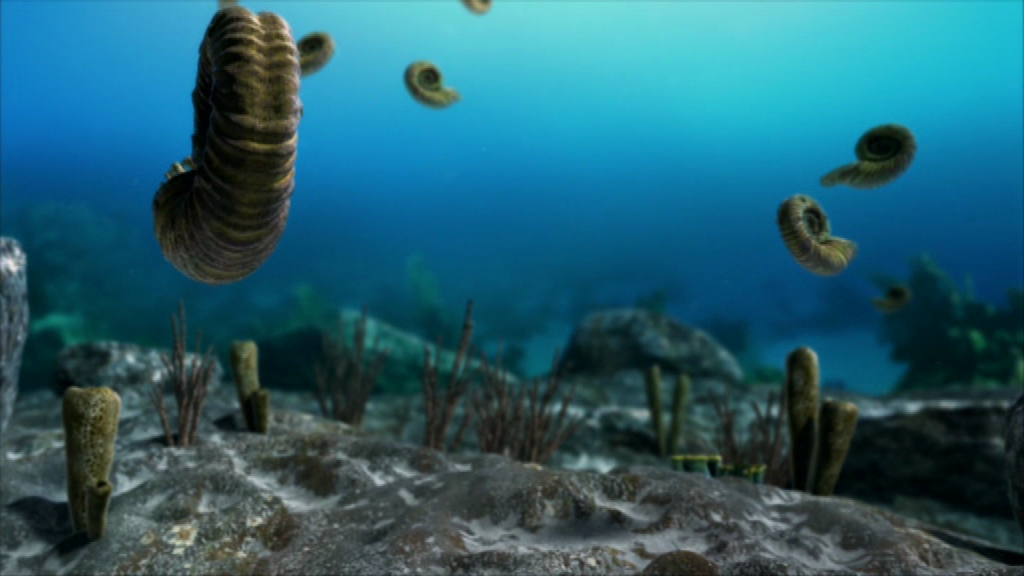
One theory is that as the animals moved closer to the surface of shallow seas (as a way to evade predators moving closer to the ocean floor where most food can be found), the UV radiation may have assisted in creating many more mutations, of which the worse kinds were weeded out by natural selection and the better ones survived. It is believed this led to a bewildering array of animal species with different and unusual defence mechanisms, more sensitive eyes to pick out greater details in the shallow seas and sometimes a multitude of these eyes to help give a sense of depth and distance of other animals, and better appendages and body shapes for swimming through the oceans.
Another theory to make the rounds in scientific circles is that the evolution to more rapidly moving and better protected creatures was probably in response to the increasing numbers of predators proliferating the seas at this time.
Dr Jean-Bernard Caron, a palaeontologist from the Royal Ontario Museum, is of the view that predators were probably the single biggest factor in pushing animals at this time to diversify into many varied forms. He said:
"It is during the Cambrian, starts with animals with legs and eyes, swimming. This didn't exist before. And this evolved very quickly at the beginning of the Cambrian.
We think that this evolution occurred relatively quickly because you find organisms that may have had some kind of different defence mechanism which has got to be response to higher predatory levels."
Possibly the oldest fossil of an invertebrate dated to around 560 million years ago has been found in South Australia.
530 MILLION YEARS AGO
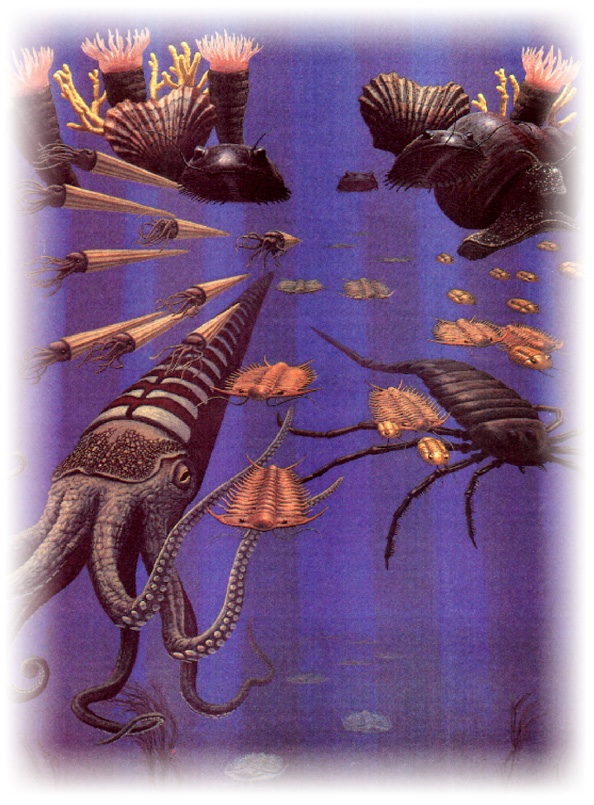
Ancient fish with backbones (for greater mobility and as an effective internal protection for the nervous system and other vital organs, known as vertebrates) and hard-shelled organisms (for greater external protection from the ravages of physical attack from predators) definitely populated the seas (2). Could this be another survival mechanism? Just create as many offsprings as possible so that it won't matter if some get taken by predators. Could this have been the time when sex was invented to allow for these regular sexfests and successful breeding to take place?
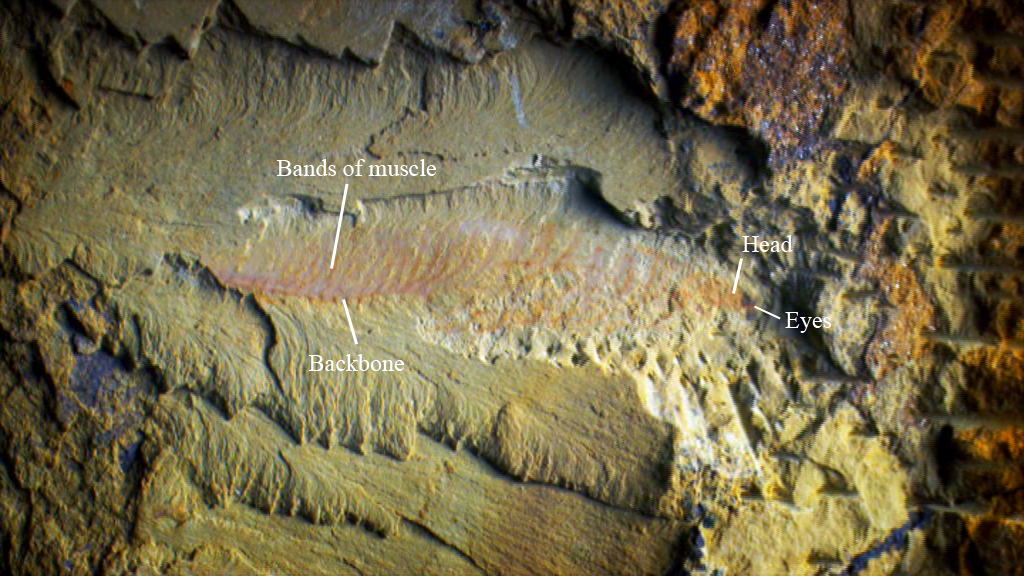
Among the earliest evidence of fossilized vertebrates dated to this period is an animal called myllokunmingia fengjiaoa, measuring 28 mm long and 6 mm high. Found in southern China by D.G. Shu from the Early Life Institute and Department of Geology at Northwest University in the Province of Xian, this tiny creature revealed bands of muscles down its body which had to be attached to something. The most logical explanation is a single hardened inner rod-like structure running along what is believed to be the animal's back. Of course, this may not be the first animal to have a backbone (and perhaps was just one species that evolved from an earlier type), but it is certainly the oldest known fossil containing this very structure of what is almost certainly a backbone of some rudimentary type. More details about this animal can be found in Shu's original scholarly article titled "Lower Cambrian Vertebrates from south China" published in Nature, Volume 402, 4 November 1999.
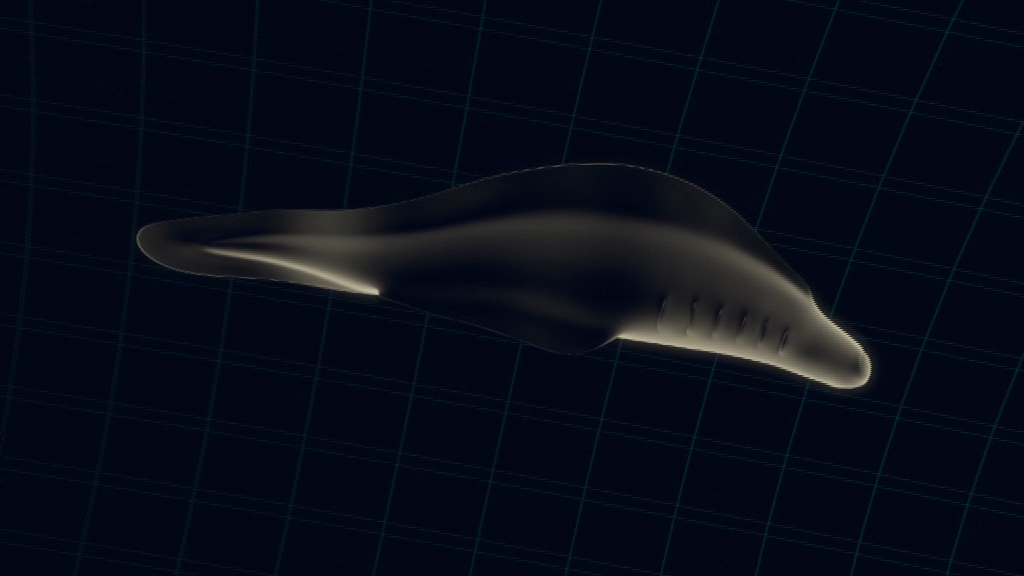
The success of the vertebrates in outrunning and/or evading most predators allowed these animals to diversify and grow into many different species after 500 million years. Among them included animals that developed jaws and teeth to grab and rip apart food around 475 million years ago. By 410 million years ago a subset of these animals evolved two pair of fins (e.g., parayunnanolepis with its additional armour-plated skin covering most of its body and head except the tail). And, as the fins and body became larger and more muscular, the skeleton-like structure evolved to accept calcium phosphate as a means of reinforcing the strength and density of the long stringy skeleton material called collagen while still maintaining some level of flexibility (i.e., to allow sufficient bending when certain forces are applied to the material). Today, the descendants of those early vertebrates with jaws, four primitive limbs, and tougher skeleton structure can be seen in all the fish species, the amphibians, reptiles and ultimately mammals of which humans are a part. We truly owe our existence and fundamental body design including our backbone, jaws and limbs to these incredibly ancient vertebrates of the great Cambrian period.
As for those other organisms relying on an external skeleton armour for internal support and protection, this was also the time for the emergence of the highly successful ocean floor scavenger and hard-shelled organism known as the Trilobites. Hard shells are naturally formed by absorbing calcium carbonate and other minerals from the ocean to help give them their legendary strength. Because of their hardness, trilobites became one of the most successful creatures to roam the ocean floors. So successful that scientists have found many fine examples of fossilised forms of this creature, together with the genetic variations in this species in different watery environments. As of 2012, scientists have identified over 50,000 different trilobite species. Many more species are expected to be found locked away in the rocks of northern Africa and other parts of the world. But it isn't just the hard-shelled exo-skeleton that gave these trilobite species their evolutionary advantage. Most trilobite species also had the power of sight to observe the environment in incredible stereoscopic detail. While some trilobites made full use of the ocean floor in deeper waters without the need for sensitive eyes, many other species adapted to shallow seas and coastal regions where their eyes could develop and make full use of the sunlight penetrating the water to paint a realistic view of the watery environment they lived in.
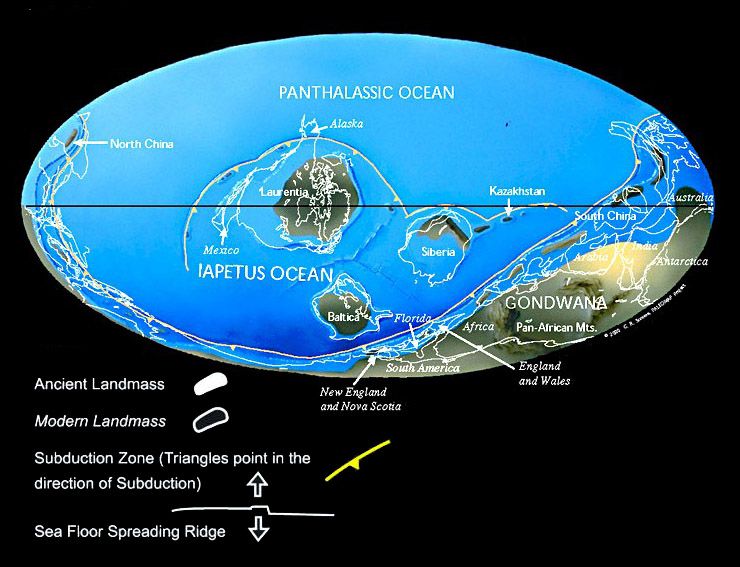
Trilobites were not afraid of colder waters. In fact, the biggest trilobites measuring up to a metre long have been found in places along the African coastline. At around this time, the African continent was positioned over the South Pole, thus explaining the colder conditions.
520 MILLION YEARS AGO
The fossilized remains of animals of this era were well-preserved due to the fact that the animals tended to stay in shallow wasters and as storms swept over the seas, the sand and water get whipped up and buried a number of the animals alive. When buried deep enough in the sand, the bodies were better preserved.